
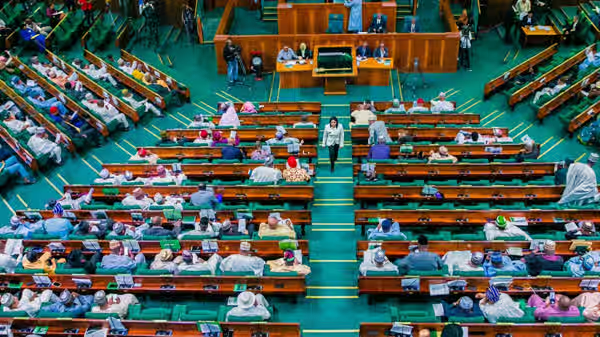
The House of Representatives on Wednesday approved the Federal Government’s proposed crude oil benchmark of $64.85 per barrel for 2026, departing from the Senate’s earlier endorsement of a lower $60 benchmark under the 2026–2028 Medium Term Expenditure Framework and Fiscal Strategy Paper (MTEF/FSP).
The decision followed the review and adoption of a report by the House Committees on Finance, and National Planning and Economic Development, which supported the executive’s oil price projections of $64.85, $64.30 and $65.50 per barrel for 2026, 2027 and 2028, respectively.
The approval comes ahead of the presentation of the 2026 budget by President Bola Tinubu later today.
By contrast, the Senate, while considering and passing the MTEF/FSP on Tuesday, reduced the oil benchmark for 2026 to $60 per barrel, citing uncertainties in the global economy, before revising it upward to $65 for 2027 and $70 for 2028.
The Chairman of the Senate Committee on Finance, Sani Musa (APC, Niger East), had explained to his colleagues that the downward adjustment was influenced by geopolitical tensions in Europe and the Middle East, as well as instability in the global oil market, underscoring the need for fiscal prudence.
Notwithstanding the differing oil price assumptions, both chambers maintained identical crude oil production forecasts of 1.84 million barrels per day (mbpd) for 2026, 1.88 mbpd for 2027, and 1.92 mbpd for 2028.
Lawmakers also approved exchange rate projections of N1,512, N1,432.15 and N1,383.18 for 2026, 2027, and 2028, respectively, aligning with the Central Bank of Nigeria’s efforts to stabilise the naira and improve coordination between fiscal and monetary policies.
The House further endorsed inflation targets of 16.5 per cent for 2026, 13 per cent for 2027 and nine per cent for 2028, referencing the commitment of monetary authorities to rein in inflationary pressures.
In terms of economic performance, legislators upheld real GDP growth estimates of 4.68 per cent, 5.96 per cent and 7.9 per cent for 2026, 2027 and 2028, respectively, expressing confidence that ongoing reforms and expected benefits from new tax laws would start to take effect from 2026.
The House also recommended the full implementation of the recently enacted Tax Acts, describing them as critical tools for advancing economic reforms, growth and development.
Consistent with ongoing reforms and the activation of the Tax Act, the House urged the Federal Government to introduce a National Scanning Policy under the National Single Window of the Nigeria Revenue Service (NRS), in collaboration with relevant agencies, to strengthen revenue assurance, facilitate trade, reduce leakages, and enhance transparency and national security.
On the fiscal framework, the House retained the 2026 Federal Government budget estimates, including proposed expenditure of N54.46 trillion, with N31.83 trillion projected as retained revenue. Planned new borrowings were set at N20.38 trillion, covering both domestic and external loans, while debt servicing was estimated at N15.52 trillion.
Lawmakers also approved N1.376 trillion for pensions, gratuities and retirees’ benefits, while maintaining a fiscal deficit of N22.63 trillion within the framework.
Capital expenditure, excluding transfers, was sustained at N20.131 trillion, alongside statutory transfers of N3.152 trillion and a Sinking Fund allocation of N388.54 billion.
Additionally, total recurrent (non-debt) expenditure was projected at N15.265 trillion, with special intervention funds for recurrent and capital spending fixed at N200 billion and N14 billion, respectively.
The House equally upheld other key macroeconomic assumptions, including exchange rate projections, inflation targets and GDP growth estimates, arguing that expected gains from tax reforms and broader economic restructuring would underpin fiscal stability over the medium term.
Discover more from LN247
Subscribe to get the latest posts sent to your email.

