
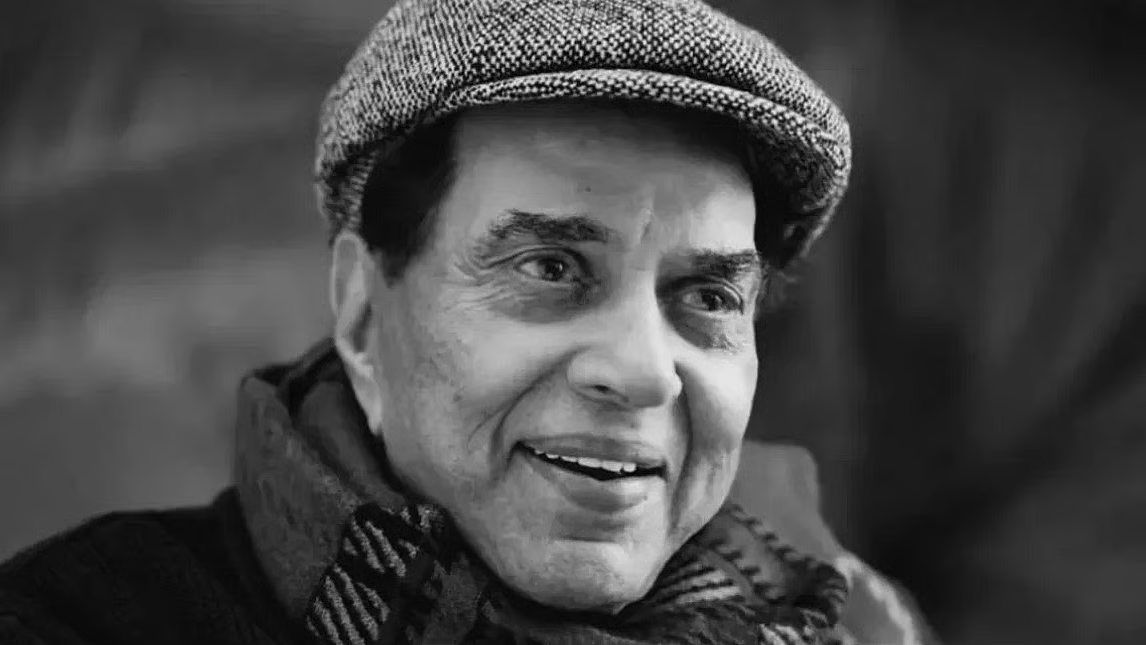
Veteran Bollywood actor Dharmendra, one of India’s most beloved and enduring film stars, has died in Mumbai at the age of 89. His death marks the passing of a performer whose charm, versatility, and longevity left an unmistakable imprint on Indian cinema.
India’s Prime Minister, Narendra Modi, described his death as the “end of an era,” paying tribute to a figure who inspired generations of moviegoers.
Dharmendra, often referred to as the “original He-Man of Bollywood,” enjoyed a career spanning more than six decades, appearing in over 300 films. Though widely admired for his rugged looks, he often insisted that he was “a simple man,” and credited any praise about his appearance to his parents and good fortune.
He achieved iconic status with his role as Veeru in the 1975 blockbuster Sholay, a film that became a cultural landmark. His portrayal of the mischievous yet courageous outlaw remains one of the most celebrated performances in Hindi cinema. Despite acting in numerous box-office hits across romance, action, comedy, and suspense, he frequently said that no role surpassed Veeru.
Born Dharam Singh Deol on 8 December 1935 in Punjab’s Ludhiana district, Dharmendra grew up in a middle-class Jatt-Sikh family. He was drawn to films as a teenager and dreamt of becoming an actor, even as his family urged him to focus on academics. His life changed after he won a national talent competition, which brought him to Mumbai and launched his film career.
He made his debut in 1960 and quickly rose to prominence with acclaimed performances, including a standout role in the 1963 classic Bandini. In the years that followed, he established himself as a romantic lead opposite some of the biggest actresses of the time, before transitioning into a celebrated action star with films like Phool Aur Patthar and Mera Gaon Mera Desh. Known for performing many of his own stunts, he earned a reputation for athleticism and screen presence.
Dharmendra’s on-screen partnership with actress Hema Malini became one of the most successful in Bollywood history. Their romance off-screen drew intense media attention, particularly because he was already married with children. The pair married in 1980, despite significant public scrutiny, and went on to become one of the industry’s most recognisable couples.
He briefly ventured into politics, serving one term as a member of parliament, though he later admitted that public office was not suited to his temperament. He continued working in films well into his later years and maintained a strong connection with fans through public appearances and social media.
Throughout his career, Dharmendra received several honours, including a Lifetime Achievement Award for his contribution to cinema and one of India’s highest civilian awards, the Padma Bhushan. Yet he often said that awards mattered less to him than the affection of his audience.
“I came here for the love,” he once said. “All I ever wanted was people’s love, and I’m grateful that I received it.”
Tributes poured in after news of his passing. Actors, directors, and fans described him as an irreplaceable force in Indian cinema. Many credited him with shaping modern Bollywood and inspiring generations of performers.
Dharmendra leaves behind a legacy defined not only by his films, but by the warmth, humility, and charisma that endeared him to millions across India and beyond.
Discover more from LN247
Subscribe to get the latest posts sent to your email.

