

Nigeria’s national electricity grid suffered its latest collapse on Monday, December 29, 2025, plunging large parts of the country into darkness during the festive season.
The outage occurred around 2:01 p.m., when power generation crashed sharply from over 3,600 megawatts to as low as 50 megawatts in some readings, disrupting homes, businesses, and critical services nationwide.
Distribution companies immediately confirmed the blackout and appealed for patience as recovery efforts began. By late Monday evening, gradual restoration was underway, and by Tuesday morning the Nigerian Independent System Operator confirmed that the grid had been fully stabilized.
This most recent failure has again drawn attention to the fragility of Nigeria’s power infrastructure and capped a year marked by repeated system disturbances.
Number of times it has collapsed
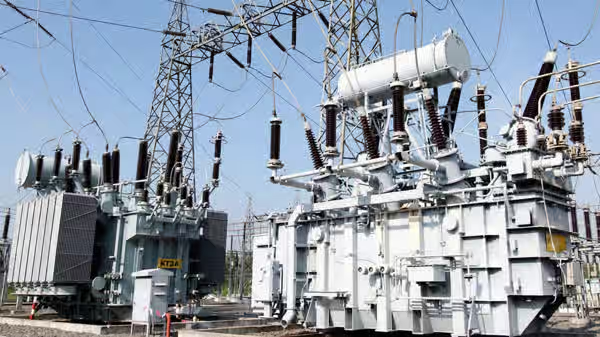
The December 29 incident was the fourth major national grid collapse recorded in 2025. Earlier in the year, the grid failed on February 12, triggering widespread blackouts across multiple regions.
A second collapse followed on March 7, while a third incident in September saw generation drop to near zero nationwide.
Although this represents a reduction from the more than twelve collapses recorded in 2024, four nationwide failures in a single year still underscore persistent structural weaknesses in transmission, gas supply, and system management.
Power sector officials and analysts continue to attribute these collapses to a combination of aging infrastructure, gas shortages, vandalism, frequency management challenges, and delayed upgrades.
FG response to it

The Federal Government has responded to the recurring collapses with a mix of emergency interventions and longer-term reforms.
Following the December incident, authorities pointed to the earlier vandalism of the Escravos–Lagos Pipeline System on December 10, which constrained gas supply to thermal power plants and left the grid in a fragile state.
The Nigerian National Petroleum Corporation Limited announced that repairs to the pipeline were completed in record time, helping to restore generation capacity.
More broadly, the government has continued to promote reforms under the Electricity Act 2023, aimed at liberalizing the power market and encouraging private investment.
The Ministry of Power has emphasized faster restoration times after grid failures, while the Nigerian Independent System Operator has opened investigations into each collapse.
The administration has also highlighted initiatives such as the Presidential Power Initiative to upgrade transmission infrastructure, plans to validate and settle long-standing debts owed to generation companies, and proposals to decentralize power supply by encouraging states and large consumers to develop independent electricity solutions.
Critics, however, argue that slow funding, stalled execution, and ongoing gas constraints have limited the real impact of these measures.
State of power supply in Nigeria today

As of December 30, 2025, electricity supply has been fully restored across the national grid, with generation gradually ramping up to nearly 3,000 megawatts by Monday night and stabilizing further by Tuesday morning.
Distribution companies in major cities such as Abuja, Lagos, Ibadan, Enugu, Kaduna, and Benin resumed supply, although restoration was uneven in some areas, including parts of Port Harcourt.
Despite the recovery, Nigeria’s power situation remains fragile. Peak generation still hovers around 4,800 megawatts, far below the estimated demand of over 30,000 megawatts for a population exceeding 200 million.
Intermittent supply remains common, forcing households and businesses to rely heavily on petrol and diesel generators amid high fuel costs.
Social reactions
The latest collapse sparked widespread reactions on social media, especially due to its timing during the holiday season. Many Nigerians expressed frustration, exhaustion, and anger at what they described as a recurring national embarrassment.
Others responded with sarcasm and dark humor, that grid collapses have become an expected part of the calendar.
On X, @jokotagbaposi (Ayomiposi) lamented the timing of the outage, writing, “Small holiday wey person dey enjoy. National grid don decide to collapse again. Nigeria which way self?”
Another user, @adedapo_adigun (Oba Cruise) reacted with biting sarcasm, saying, “There is only one thing that is guaranteed in Nigeria and it’s power outage. Nigerian power grid has collapsed again… it can never disappoint me.”
Calling for accountability, @saintIsaiah7 (Son of Grace) wrote, “The system is not working and nobody cares. Nigeria is deteriorating every day.”
Adding humor to the outrage, @charlexzy11 (Charles) wrote, “Dear Guinness World Records, I am writing to formally request that Nigeria be awarded a world record for the most national grid collapses.”
At the same time, many Nigerians reflected a sense of resignation, noting how dependence on generators has become a survival strategy rather than an emergency response.
What 2026 will look like
Looking ahead to 2026, energy analysts express cautious optimism mixed with skepticism. On the positive side, the full implementation of the Electricity Act is expected to attract more private investment into sub-national and decentralized power projects.
Increased domestic fuel supply, including contributions from facilities like the Dangote Refinery and the expected progress on major gas infrastructure such as the Ajaokuta–Kaduna–Kano pipeline, could improve gas availability for power generation.
There is also growing interest in renewables and independent power solutions for industries, data centers, and large commercial users, which could reduce pressure on the national grid.
However, experts warn that without urgent action to address vandalism, insecurity around transmission lines, funding delays, and aging infrastructure, grid instability may persist.
While the reduction in collapses compared to 2024 offers a small measure of hope, many Nigerians remain wary.
For 2026 to mark a true turning point, reforms will need to move beyond promises and translate into visible, sustained improvements in power reliability.
Discover more from LN247
Subscribe to get the latest posts sent to your email.

