

Godswill Udoh, an aluminum window-frame maker, was arrested in 2010 while returning home with ₦96,000 in savings. Police allegedly beat him, seized his money, and forced him to sign a false confession to armed robbery.
He spent 11 years in detention as prosecutors failed to present any witnesses, evidence, or an investigating officer. When a judge finally struck out the case in 2021, Udoh regained his freedom but found his business ruined and his family life shattered beyond repair.
Sunday Jackson, another victim, a university student arrested in 2015 for allegedly killing a herdsman, spent a decade on death row awaiting judgment. During that time, his wife left, his second daughter was born without him ever meeting her, and his home was destroyed. In 2025, the Supreme Court upheld his death sentence. a grim reminder of how delayed justice can become its own form of execution.
Mansur Ismail spent five years in detention simply for being near a group of men smoking cigarettes. Though eventually acquitted, the ordeal left deep scars, his reputation destroyed, and former customers too afraid to associate with him.
Jamiu Adedokun, a 17-year-old apprentice tailor, was arrested by a police task force while walking home late at night because he couldn’t afford transport fare. Accused of “breach of public peace,” he spent months in Kirikiri Prison until volunteer lawyers secured his release
These are just a few of the over 66% of inmates, about 53,000 to 70,000 people, awaiting trial in Nigeria’s correctional system.
The system is in crisis, with many languishing for years without legal representation.
Alleged widespread corruption, police abuse, and a slow judiciary have turned prisons into holding cells for the poor, prompting urgent calls for a state of emergency over this human rights disaster.
What Obtains in Nigeria Without Trials
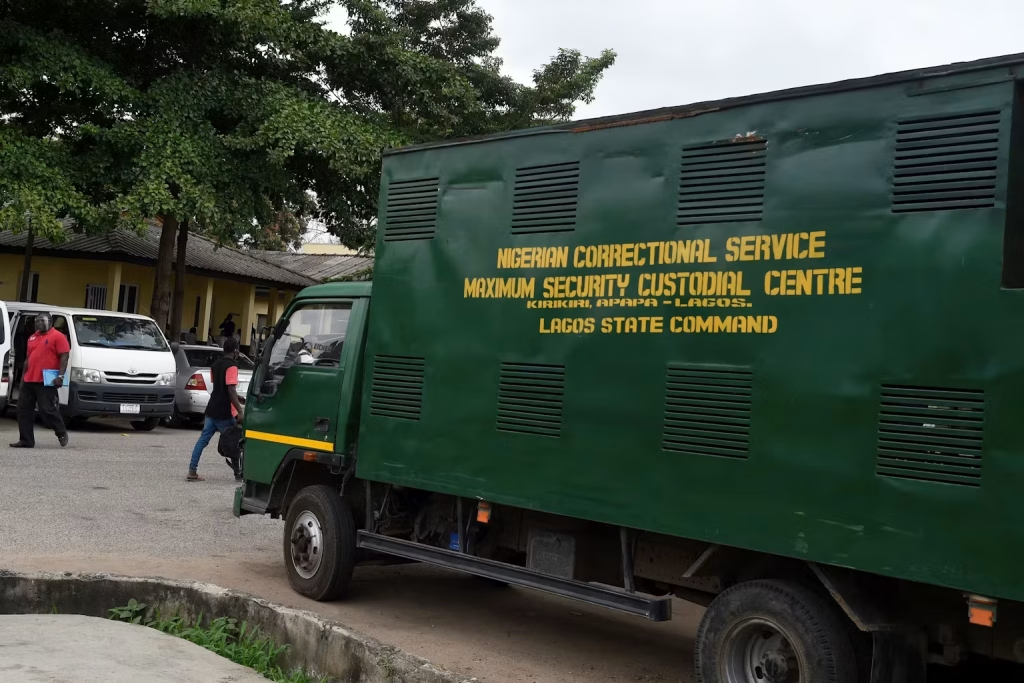
Nigeria’s justice system today operates as justice without trial, fueled by corruption, inefficiency, and the neglect of due process.
Over 66 percent of the inmate population are awaiting trial, far exceeding the number of convicted persons. This has resulted in deplorable conditions within correctional facilities, the spread of chronic diseases, and, in some cases, death among detainees.
Police officers are alleged to frequently abuse their powers through indiscriminate raids, framing poor suspects for fabricated crimes such as armed robbery, and seizing their belongings. Many victims are beaten and forced to sign false confessions without access to legal counsel.
And the inability to afford legal representation, which can cost between ₦50,000 and ₦100,000, remains the greatest barrier to freedom. While wealthy suspects can secure their release, the poor are left to languish indefinitely in detention.
In an interview with LN247 Digital, Barrister Don Akaegbu explained that the persistent delays in Nigeria’s justice system are the result of deep-seated inefficiencies and poor implementation of existing laws.
“Trials drag for years mainly because of systemic inefficiencies. You have constant adjournments, witnesses not showing up, poor investigations, and overloaded court dockets. Sometimes judges are transferred or promoted, and the new judge has to start the case all over again—that alone can waste years.
Another problem is the lack of technology. Most of our courts still operate manually.. So the real issue is not the absence of laws, but the poor implementation of the ones we already have.
What the Law Says

The grim reality across Nigeria’s correctional system stands in stark violation of the country’s own laws and constitutional safeguards.
Constitutional Right to Counsel
Section 36(6)(c) of the 1999 Constitution guarantees every accused person the right to legal representation and a fair hearing within a reasonable time. This right, meant to protect the vulnerable, is routinely denied to thousands who remain behind bars without counsel.
Presumption of Innocence
By law, every Awaiting Trial Inmate is presumed innocent until proven guilty. Yet, they are often subjected to the same harsh and degrading conditions as convicted criminals, stripped of dignity and due process.
The Legal Aid Mandate
The Legal Aid Act of 2011 requires the Legal Aid Council of Nigeria (LACON) to offer free legal services to indigent citizens. In practice, the agency is severely underfunded and overstretched, leaving countless detainees without access to justice.
Speedy Trial Legislation
The Administration of Criminal Justice Act (ACJA) 2015 was designed to ensure faster trials and reduce the number of awaiting trial inmates. However, enforcement has remained weak, and the law’s promise of timely justice continues to be undermined by poor implementation and systemic neglect.
What The Government Has Been Up To
Government actions have largely centered on welfare measures rather than fixing the systemic legal failures that sustain Nigeria’s justice crisis. As a result, civil society groups continue to bear the burden of securing justice for detainees.
Focus on Welfare
Authorities have increased the daily feeding allowance for inmates from ₦750 to ₦1,150, with lawmakers pushing for a further rise to ₦4,000. Budgetary allocations for upgrading correctional facilities have also been expanded, though conditions remain dire in most prisons.
Judicial Commitment
The Attorney General of the Federation and other senior officials have made public pledges to fast-track judicial processes and reduce the population of awaiting trial inmates. However, progress remains slow and uneven across the states.
Reliance on NGOs
In reality, the bulk of efforts to secure the release of detainees comes from non-governmental organizations.
Godswill Udoh regained freedom through the intervention of the Headfort Foundation, while Jamiu Adedokun was released by the Take It Back Movement Legal Aid.
The Public and Private Development Centre (PPDC) has also provided free legal services to more than 20,900 detainees, describing the situation as “intolerable.”
Insufficient Interventions
Barrister Don Akaegbu observed that while the government has made attempts to decongest prisons, the measures remain inadequate due to weak resource allocation and poor implementation.
“To be fair, the government has made some efforts. We’ve seen prison decongestion exercises where minor offenders and people detained beyond lawful limits are released. The Legal Aid Council and some NGOs also try to help indigent defendants get legal representation.
But the truth is, these efforts are not enough. Legal aid is underfunded, there are too few lawyers and judges, and the prison system is overstretched… Until the government invests more in judicial infrastructure, legal aid, and technology, we’ll keep having people languishing in jail for years without trial.”
The Road Ahead
Stakeholders insist that Nigeria must go beyond welfare measures and confront the structural roots of its justice crisis. They are calling on the President to declare a state of emergency to fast-track the release of detainees held for minor or unproven offenses and to ensure that justice is no longer delayed or denied.
A key priority is proper funding for the Legal Aid Council of Nigeria (LACON) to enable it to recruit and train enough lawyers to represent the more than 53,000 awaiting trial inmates. The judiciary must also embrace digital case management and virtual hearing systems to curb the endless delays caused by manual processes and administrative bottlenecks.
Equally critical is the need to hold law enforcement accountable through independent oversight that investigates and punishes officers involved in torture, extortion, and wrongful arrests. Without dismantling these deep-rooted injustices and enforcing due process, Nigeria’s justice system will continue to betray the very citizens it was meant to protect.
Discover more from LN247
Subscribe to get the latest posts sent to your email.

