
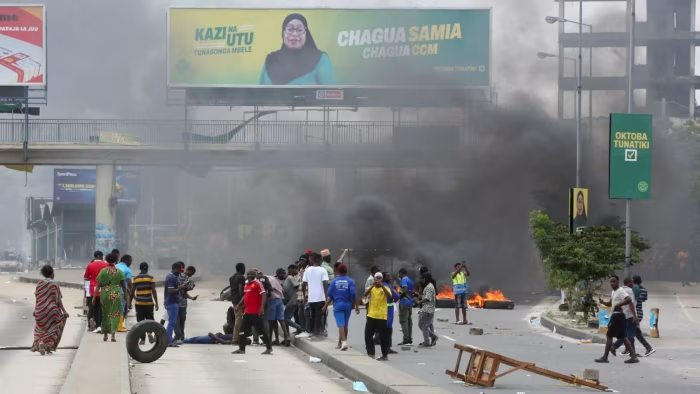
Hundreds of people are feared dead in Tanzania following three days of violent protests triggered by Wednesday’s general election, according to the country’s main opposition party.
A spokesperson for the Chadema party told the AFP news agency that “around 700” people had been killed during clashes with security forces. However, an ongoing nationwide internet shutdown has made it difficult to verify reports or obtain accurate casualty figures.
A diplomatic source in Tanzania said there was credible evidence suggesting that at least 500 people may have lost their lives.
Protests have erupted in several major cities, with many young demonstrators denouncing the election as unfair, after key opposition candidates were barred from running against President Samia Suluhu Hassan.
Widespread unrest despite army warnings
Demonstrations continued on Friday in Dar es Salaam, particularly in the Salasala, Yombo, and Tegetaneighbourhoods, as protesters defied stern warnings from the military.
“Some people went to the streets on 29 October and committed criminal acts. These are criminals and the criminal acts should be stopped immediately,” said Gen Jacob John Mkunda on state TV on Thursday, adding that the army had “controlled the situation.”
Authorities have sought to downplay the scale of the violence, instead extending a nationwide curfew to contain the unrest.
Due to the internet blackout, journalists and human rights groups are struggling to independently verify the reports of fatalities.
Hospitals have reportedly refused to disclose casualty figures. A source at one referral hospital in Dar es Salaam told the BBC that it had been “overwhelmed with casualties” since Thursday and that other hospitals and morgues in the city were also full.
The United Nations has urged Tanzanian security forces to avoid the use of excessive force in responding to the demonstrations.
“We are alarmed by the deaths and injuries that have occurred in the ongoing election-related protests in Tanzania. Reports we have received indicate that at least 10 people were killed.”
Reuters quoted UN human rights spokesperson Seif Magango as saying on Friday that the ambassadors from several foreign embassies have also engaged the Tanzanian government, urging restraint and dialogue in handling the protests.
By late Friday afternoon, the electoral commission had announced results from about 80 of the country’s 272 regions, according to the state broadcaster, TBC.
International observers have reported extremely low voter turnout during the polls held on Wednesday.
President Samia Suluhu Hassan is widely expected to retain power under the Chama Cha Mapinduzi (CCM) party, which has ruled Tanzania since independence in 1961. Official results are expected to be released on Saturday.
Zanzibar election, flight disruptions, and communication blackout
On Zanzibar, the semi-autonomous island that elects its own president, CCM’s Hussein Mwinyi was declared the winner with nearly 80% of the vote. The opposition, however, alleged “massive fraud”, according to the Associated Press (AP).
The protests and internet shutdown have caused significant travel disruptions, leaving tourists stranded at airports across the country.
A Kenyan publicist, Anyiko Owoko, described her ordeal after being trapped in Tanzania for three days due to the communications blackout.
“Internet, shops, petrol stations, email, social media, everything was down. Total disconnect. No international or regional calls in or out. No text messages in or out. There were no Ubers or Bolts available because there was no network,” Owoko posted on Instagram after returning home on Friday via a Kenya Airways flight.
“Many flights were cancelled, and Tanzania’s national airline was grounded. There were so many people stranded at the airport who couldn’t book tickets or reschedule flights because of the connectivity blackout,” she added.
Protesters accuse the government of undermining democracy, citing the detention of key opposition leader Tundu Lissu, who is currently facing treason charges, which he denies. His party boycotted the vote in protest.
Another major opposition figure, Luhaga Mpina of the ACT-Wazalendo party, was disqualified on legal grounds, leaving only 16 minor parties, none with significant popular support to contest the election.
President Samia Suluhu Hassan, who became Tanzania’s first female leader in 2021 following the death of John Magufuli, was initially commended for loosening restrictions on political dissent. However, in recent months, critics say her administration has tightened control, with increased arrests, intimidation, and abductions of political opponents.
Discover more from LN247
Subscribe to get the latest posts sent to your email.


Comments are closed.