
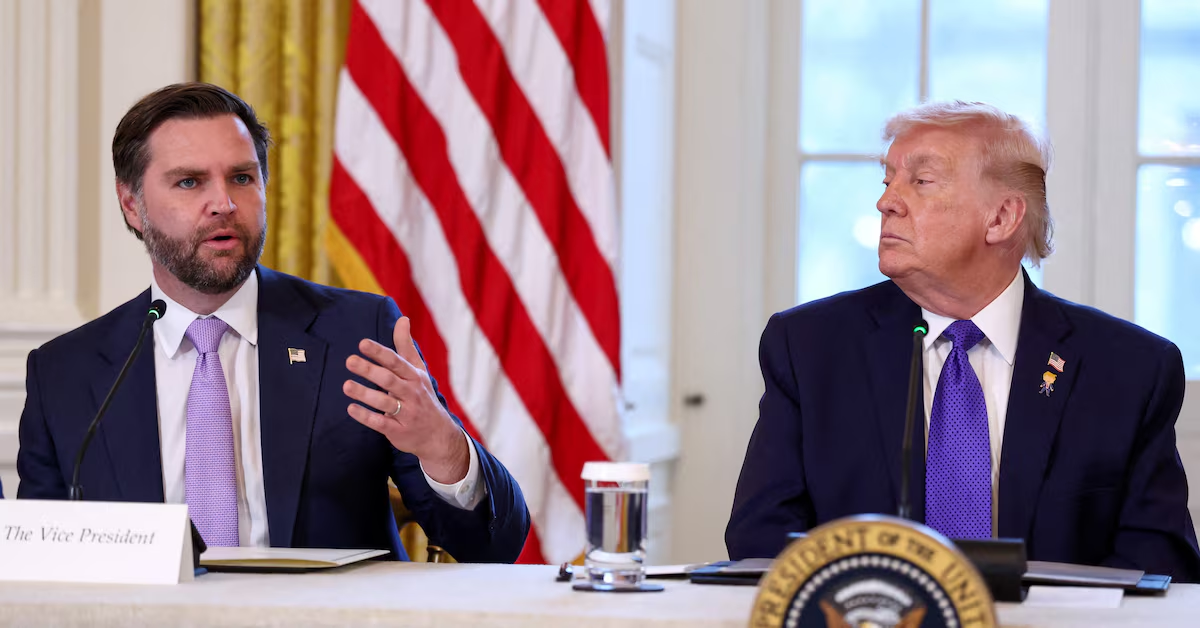
Vice President JD Vance has become the central figure defending the US-Iran agreement, even as President Donald Trump continues to dominate the political narrative around the deal.
At a White House press briefing on Thursday, Vance dismissed suggestions that Trump had positioned him as a “fall guy” for a controversial agreement that has divided Republicans in Washington. Responding to Trump’s remark that he might blame the vice president if the deal fails, Vance said he believed the president was joking.
Throughout the week, Vance has taken on the task of publicly defending the memorandum of understanding with Iran, but his efforts have often been overshadowed or complicated by mixed messages from Trump and other senior officials.
He also faced uncertainty over a planned trip to Switzerland for a signing ceremony with Iranian representatives, with questions about the logistics of the event highlighting the confusion surrounding the deal. The White House later confirmed that Vance would not be travelling, at least for the time being.
Despite the challenges, Vance has remained one of the most vocal supporters of the agreement, delivering strong arguments in its defence and even criticising Israel’s reaction more sharply than the president has publicly done.
However, the timing of the diplomatic push comes at a politically sensitive moment for Vance, who recently released a memoir that has fuelled speculation about a potential 2028 presidential run.
Analysts say his role in the Iran deal could prove politically risky, as the Republican Party remains split between anti-interventionist supporters of Donald Trump’s “Make America Great Again” movement and more traditional foreign policy hawks who view the agreement as overly concessional to Tehran.
Other senior officials have largely avoided the spotlight. Secretary of State Marco Rubio has maintained a lower profile, while Defence Secretary Pete Hegseth has focused more on military aspects of the broader regional conflict rather than the diplomatic negotiations.
Some Republicans argue that Vance has been left carrying responsibility for a politically sensitive agreement, with critics suggesting Trump has deliberately distanced himself from potential backlash. Republican strategist Matt Mackowiak said the situation reflects a pattern in which presidents avoid political fallout by delegating responsibility to deputies.
The agreement itself has also been marked by confusion over its details. Early announcements suggested Iran could access a $300 billion reconstruction fund if it met its obligations, but Trump later dismissed such claims, insisting the US would not contribute financially. The final text included language about working with regional partners on a reconstruction plan, further fuelling debate over its meaning.
On Iran’s nuclear programme, Vance has echoed Trump’s position that the deal represents an initial step toward preventing Tehran from developing nuclear weapons, although key technical issues are still to be negotiated in the coming months.
However, critics in the US Senate have raised concerns that the agreement does not go far enough, arguing it fails to meaningfully limit Iran’s nuclear ambitions and could embolden Tehran diplomatically.
During the same period, Trump alternated between publicly supporting the deal and downplaying its significance, even joking that he might blame Vance if it collapses. At one point, he appeared uncertain about whether the document required a formal signing, before later signing a copy during a high-profile event in France.
The inconsistency has added to the perception that Vance is carrying the diplomatic burden of the agreement while Trump remains the dominant political voice.
Despite criticism, Vance has defended the deal as a pragmatic step forward, pointing to early signs such as falling oil prices as evidence of its potential benefits. He has insisted that the agreement will succeed if Iran complies with its commitments, while warning that failure to do so would have no negative impact on the United States.
“If they change their behaviour, big things are going to happen,” Vance said. “If they don’t, no skin off our backs. Either way, we win.”
As negotiations continue, Vance’s role places him at the centre of one of the most consequential and politically sensitive foreign policy efforts of the Trump administration, with both success and failure likely to carry significant political implications for his future.
Discover more from LN247
Subscribe to get the latest posts sent to your email.

