

In a devastating escalation of violence in Nigeria’s North Central region, the death toll from a brutal attack on villages in Kwara State has risen to at least 170, according to local lawmakers and aid organizations.
The assault, which targeted the remote communities of Woro and Nuku in Kaiama Local Government Area, has been described as one of the deadliest in the country this year.
Reports vary on the exact number of casualties, with the Nigerian Red Cross confirming 162 deaths while others estimate higher figures. The attack highlights Nigeria’s ongoing security challenges, including jihadist insurgencies, banditry, and intercommunal conflicts.
No group has claimed responsibility, but survivors and officials point to jihadist elements linked to groups like Boko Haram or ISIS, who had reportedly preached extremist doctrines in the area prior to the violence.
Details of the brutal attack
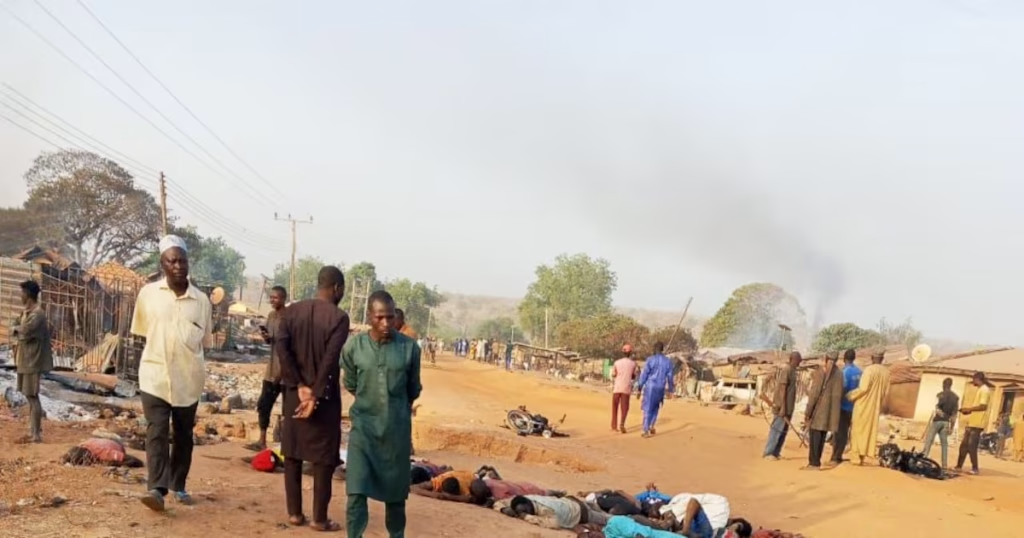
The attack unfolded on Tuesday evening around 6 p.m. local time, when heavily armed gunmen on motorcycles stormed Woro and Nuku villages. Eyewitnesses described a scene of chaos as the assailants encircled the communities, firing indiscriminately and rounding up residents.
Many victims had their hands tied behind their backs before being executed, according to Saidu Baba Ahmed, a local lawmaker representing the Kaiama area.
”The gunmen rounded up residents, bound their hands behind their backs and executed them,” Ahmed said, adding that he was on-site with military personnel sorting bodies and searching for more victims.
Survivors recounted harrowing escapes. Umar Tanko, the village head of Woro, was away at his shop when the attackers struck.
”I was away at my shop where I sell goods when an army of bandits arrived at my residence on Tuesday evening. My daughter and two sons were shot dead, while my second wife and two others were abducted,” Tanko said.
Another resident, Razaq Abdulazeez, who lives on the outskirts, narrowly fled with his family.
”I was returning home from work when I saw many people running towards the outskirts of the town. I asked what happened and was told they were escaping the wrath of bandits who had come to attack the community. I rushed to my house, packed my family members, and we escaped into the deep bush on the outskirts of the town. Many people who could not run out of town climbed trees to avoid the bandits’ attack,” he shared.
The assailants also burnt homes, shops, and food silos, leaving the villages in ruins.
Some footage seen showed bodies lying in pools of blood, some with bound hands, alongside burning structures.
Amnesty International reported that the gunmen had sent “warning” letters to villagers for over five months, demanding they renounce allegiance to the Nigerian state in favor of Sharia law. When residents resisted during a sermon, the attackers opened fire.
Among the victims were Salihu Bio Khalid, a nursing student and former student union president at Kwara State College of Nursing Sciences, who was killed alongside his brother.
Death toll estimates have fluctuated as searches continue. Initial reports pegged the number at around 40, rising to 70 overnight and then to 162 by the Red Cross on Wednesday afternoon.
Lawmaker Ahmed estimated up to 170, while Kwara Governor AbdulRahman AbdulRazaq cited 75 Muslim victims in a mass burial, describing the killings as targeted against those refusing extremist doctrines.
Several people, including the traditional ruler, remain missing, and many fled into surrounding bushland with gunshot wounds. The Red Cross’s Babaomo Ayodeji noted that poor road conditions delayed response efforts, potentially contributing to the rising count.
These attacks underscore Nigeria’s multifaceted security crisis, with jihadists in the northeast, banditry and kidnappings in the northwest, and herder-farmer clashes in central regions.
Government Response
The Nigerian government has condemned the attack and mobilized security forces. Kwara State Police confirmed “scores were killed” and deployed police and military for search-and-rescue operations.
Spokesperson Adetoun Ejire-Adeyemi stated that forces were combing the area, while a curfew had been imposed in parts of the state, with schools closed for weeks amid prior threats.
Governor AbdulRazaq visited the communities on Wednesday night, accompanied by service chiefs and cabinet members.
He described the incident as a “cowardly expression of frustration by terrorist cells” in response to ongoing military operations.
”75 local Muslims were massacred simply for refusing to surrender to extremists who preached a strange doctrine,” he said, emphasizing it was a “pure massacre” unlike typical ransom kidnappings.
The governor also announced a mass burial for 75 victims and called for intensified security measures.
At the federal level, the Peoples Democratic Party (PDP) in Kwara condemned the attack and urged humanitarian aid and justice for perpetrators.
The Kwara State House of Assembly Speaker Yakubu Danladi-Salihu and Senator Saliu Mustapha echoed calls for more troops.
Tinubu Deploys army battalion

In a swift response, President Bola Tinubu directed the immediate deployment of an army battalion to Kwara State to launch counter-offensives.
Codenamed “Operation Savannah Shield,” the operation aims to flush out terrorist elements and restore security.
Governor AbdulRazaq revealed the president’s approval during his visit, stating it would prosecute aggressive actions against the attackers.
Presidential spokesperson Bayo Onanuga condemned the “dastardly act” and assured that perpetrators would “pay the ultimate price.”
This move signals a strategic shift, with intelligence indicating growing terrorist entrenchment in Kwara, a region bordering Niger State where banditry is rampant.
The deployment addresses regional anxieties, as neighboring governors hold emergency meetings to bolster defenses.
However, it highlights the Nigerian military’s overstretched resources amid multiple fronts, including insurgencies in the Northeast and separatist issues in the Southeast.
U.S. Sent Military Team to Nigeria
The massacre coincides with increased international involvement, as the United States confirmed the deployment of a small team of military officers to Nigeria to assist in countering the security crisis.
U.S. Africa Command (AFRICOM) head Gen. Dagvin R.M. Anderson announced the move on Tuesday, stating the team would focus on intelligence support, training, and enhancing cooperation at Nigeria’s request.
Nigerian Defense Minister Christopher Musa confirmed the presence of the U.S. troops, marking the first public acknowledgment of such assistance under the current administration.
This deployment comes amid surging violence and follows U.S. scrutiny of Nigeria’s handling of jihadist threats.
Critics have accused Nigerian authorities of failing to prioritize public safety, prompting international attention.
The U.S. team aims to bolster efforts against groups like Boko Haram and ISIL, which have expanded beyond the Northeast.
While welcomed by some, it raises questions about sovereignty and the long-term impact on Nigeria’s security landscape.
Discover more from LN247
Subscribe to get the latest posts sent to your email.

