
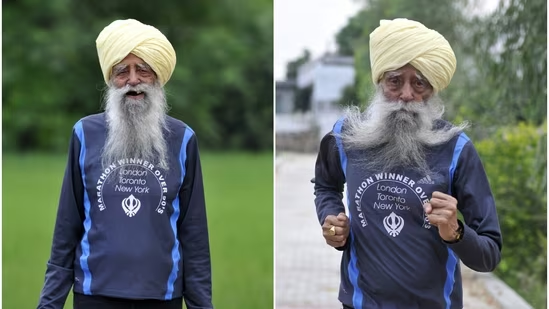
Fauja Singh, the celebrated British-Indian athlete widely regarded as the oldest person to complete a marathon, has died at the age of 114 after a tragic hit-and-run accident in his native Punjab.
Authorities reported that Singh was attempting to cross a street in the village of his birth when he was struck by an unknown vehicle. He was rushed to a nearby hospital by bystanders but unfortunately did not survive.
Known around the world for his remarkable endurance, Singh earned admiration for running marathons well into his centenarian years. He began his athletic journey at 89 and participated in nine full marathons from 2000 until his retirement in 2013.
His running group, Sikhs In The City, announced plans to dedicate their upcoming events in Ilford—where Singh had lived since 1992—to commemorate his legacy.
The fatal accident occurred on Monday while Singh was walking through Beas Pind, the village near Jalandhar where he was born.
“A search is under way, and the accused will be caught soon,” said Harvinder Singh, a top district police officer.
News of his passing sparked a wave of emotional responses from around the globe.
Indian Prime Minister Narendra Modi called him an “exceptional athlete with incredible determination”.
Harmander Singh, who coached Singh through much of his late-life running career, confirmed his death in a public statement from the running group.
The statement said: “It is with great sadness that we can confirm our icon of humanity and powerhouse of positivity Fauja Singh has passed away in India.
“His running club and charity Sikhs In The City will be devoting all of its events until the Fauja Singh Birthday Challenge on Sunday 29 March 2026 to celebrate his life of success and achievements.
“We will be doubling the efforts to raise funds to building the Fauja Singh Clubhouse on the route in Ilford where he used to train.”
When he was visited in June, Singh remained lively and mobile, maintaining a daily walking routine.
“I still go for walks around the village to keep my legs strong. A person has to take care of his own body,” he said.
A symbol of resilience, Singh was selected as a torchbearer for the London 2012 Olympics. One of his most extraordinary feats was completing a full marathon at age 100 in Toronto in 2011—an achievement that drew international attention.
Although Guinness World Records declined to certify his title due to lack of a 1911 birth certificate, Singh’s British passport listed his birthdate as 1 April 1911, and he had even received a letter from the Queen marking his 100th birthday.
His coach, Harmander Singh, explained that official birth documents weren’t issued in India at the time of Singh’s birth.
Guinness World Records officials said they would have loved “to give him the record”, but that they could only “accept official birth documents created in the year of the birth”.
As a child in Punjab, Singh struggled with mobility, often teased for his frail legs and only learning to walk properly at the age of five.
“But the same boy, once mocked for his weakness, went on to make history,” he told BBC Punjabi in June.
Before turning 40, Singh had already witnessed both World Wars and the partition of India.
“In my youth, I didn’t even know the word ‘marathon’ existed,” Singh told BBC Punjabi. “I never went to school, nor was I involved in any kind of sports. I was a farmer and spent most of my life in the fields.”
His introduction to running came through personal tragedy.
After losing his wife Gian Kaur in the early 1990s, he relocated to London to live with his oldest son. However, during a later visit to India, he witnessed his younger son Kuldeep’s fatal accident, which left him emotionally shattered.
He began isolating himself near the site of his son’s cremation, prompting concerned villagers to advise his family to return him to the UK.
Back in London, a visit to the gurdwara led him to discover a group of elderly runners, one of whom introduced him to his future coach, Harmander Singh.
“Had I not met Harmander Singh, I wouldn’t have got into marathon running,” he said in June.
He ran his first London Marathon just weeks before his 89th birthday, participating on behalf of a charity supporting premature babies. His slogan read: “Oldest running for the youngest! May they live as long as him.”
Singh insisted on wearing his turban during the race despite pushback.
“I refused to run without my turban. Eventually, the organisers allowed me to run with it, and for me, that’s my biggest achievement,” he said.
His debut marathon took him nearly seven hours, but with each race, he improved. By his third appearance in London, he had trimmed almost 10 minutes from his time.
In 2003, he achieved his personal best in Toronto, completing the race in 5 hours and 40 minutes—more than an hour faster than his previous time.
“I don’t remember my timings; it is my coach, Harmander Singh, who keeps the record of all my timings. But whatever I have achieved is all because of his training, and I sincerely followed his schedule,” Singh said in June.
“In London, he used to make me run uphill, and because of that, I kept on improving,” he added. “Almost after every training session in London, I used to go to the gurdwara, where my diet was taken care of. Everyone there motivated me to run long distances.”
He rose to international fame in 2003 when he was featured in Adidas’s Impossible is Nothing campaign alongside global icons like Muhammad Ali.
He was later invited to run the first Lahore Marathon by Pakistan’s Prime Minister in 2005, and the following year, he received a special visit to Buckingham Palace at Queen Elizabeth II’s request.
Among his treasured possessions back in Punjab was a framed photograph of that royal encounter.
Nicknamed the “Turbaned Tornado,” Singh competed into his 100s, donating most of his sponsorship earnings to charity.
“I was the same Fauja Singh before I entered the world of running – but running gave my life a mission and brought me global recognition,” he recalled.
He ran his final long-distance race in 2013, completing a 10km event in Hong Kong in just over 90 minutes.
He attributed his remarkable longevity to simplicity and discipline.
“Eating less, running more, and staying happy – that is the secret behind my longevity. This is my message to everyone,” he said in June.
In his later years, he spent time between the UK and India, maintaining close ties with his children and his longtime coach.
When last interviewed, Singh said he hoped to visit London again soon to reconnect with loved ones.
British MP Preet Kaur Gill shared a photo with him, writing: “A truly inspiring man. His discipline, simple living, and deep humility left a lasting mark on me.”
Jas Athwal MP said Singh “inspired millions across the world”. He wrote on X: “His spirit and legacy of resilience will run on forever.”
Discover more from LN247
Subscribe to get the latest posts sent to your email.

