
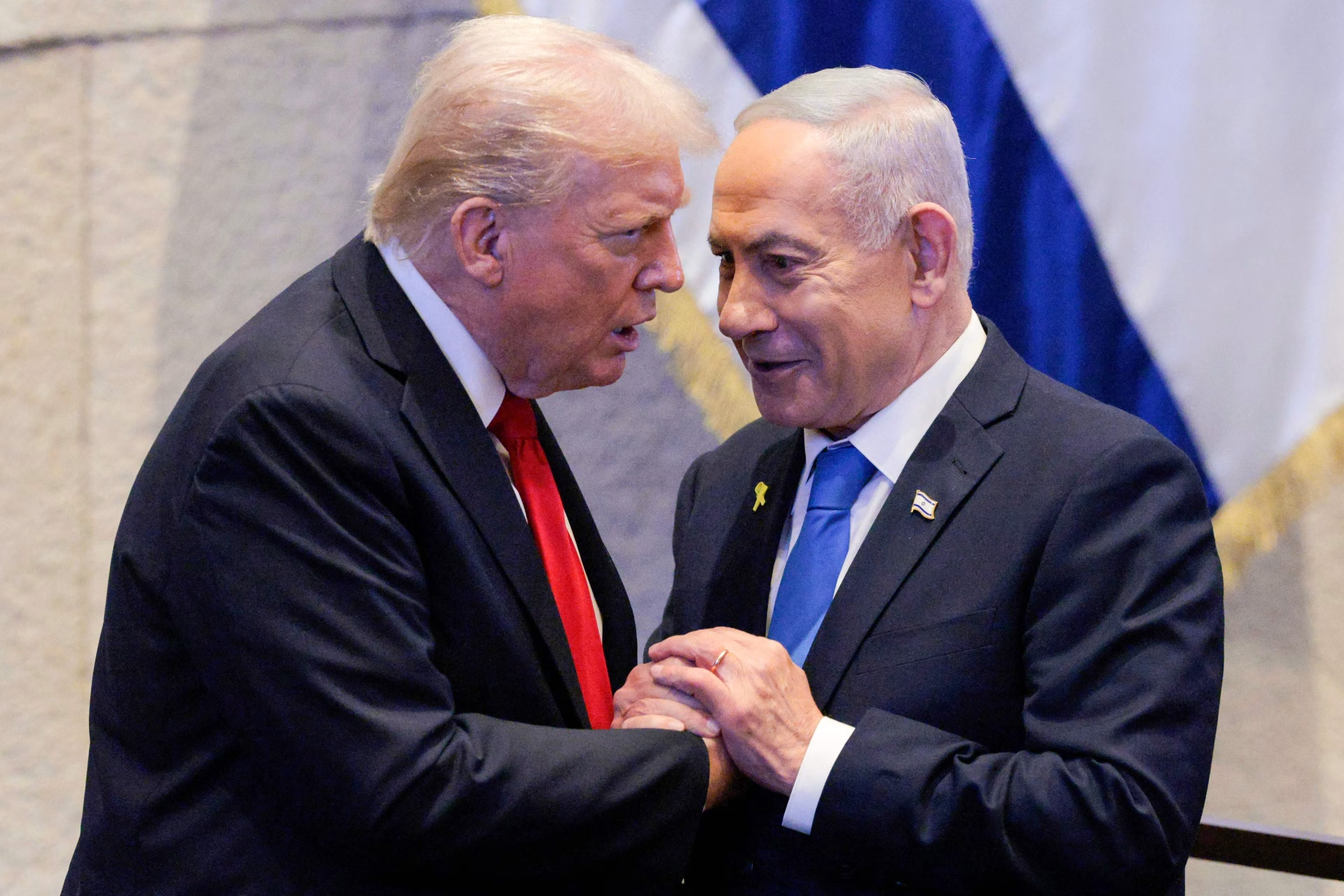
Israeli Prime Minister Benjamin Netanyahu is expected to discuss potential military options against Iran with US President Donald Trump during his visit to Washington this week, as renewed talks between Washington and Tehran get underway.
According to two Israeli sources, Israel is preparing contingency plans in case negotiations between the US and Iran collapse. While talks are still in early stages, Israeli officials remain doubtful about their success and are seeking assurances that Israel’s security interests — including its freedom to act militarily — will be safeguarded under any agreement.
One source said Netanyahu intends to share updated intelligence with Trump regarding Iran’s military capabilities.
“Israel is worried about Iran’s progress in restoring its ballistic missile stockpiles and capabilities to its status before the 12-day war,” the source said. The same source added that Israeli assessments suggest Iran could rebuild its arsenal to between 1,800 and 2,000 ballistic missiles within weeks or months if no action is taken.
Iranian officials have repeatedly stated that while they do not seek war, they are prepared for one if necessary.
Before departing for Washington, Netanyahu made clear that Iran would dominate discussions with Trump.
“On this trip, we will discuss a series of issues: Gaza, the region, but first and foremost, the negotiations with Iran,” Netanyahu said as he boarded his aircraft. “I will present the president with our views regarding the essential principles of the negotiations – principles that, in our eyes, are vital not only for Israel but for anyone in the world who desires peace and security in the Middle East.”
The meeting marks the seventh between Netanyahu and Trump since the start of Trump’s second term. It follows a series of recent high-level exchanges between US and Israeli officials. Last month, Israel Defense Forces Chief of Staff Lt. Gen. Eyal Zamir and Intelligence Division head Maj. Gen. Shlomi Binder visited the Pentagon. More recently, presidential envoys Steve Witkoff and Jared Kushner met with Netanyahu and senior security officials in Jerusalem.
Israel has been urging the US to ensure that any agreement with Tehran includes dismantling Iran’s enriched uranium stockpile, halting uranium enrichment entirely, restricting its ballistic missile program, and ending support for regional proxy groups. These demands align with earlier US calls for broader negotiations addressing Iran’s military activities and regional influence.
However, Iran has maintained that it is only willing to negotiate on nuclear issues. Over the weekend, Trump appeared open to a narrower agreement. When asked aboard Air Force One whether a deal limited to nuclear issues would be acceptable, he responded, “Yeah, that would be acceptable, but the one thing and right up front, no nuclear weapons.”
Analysts suggest that Israel’s main concern would be a limited deal that focuses only on enrichment restrictions. Danny Citrinowicz, an Iran expert at Israel’s Institute for National Security Studies, described that possibility as the prime minister’s worst-case scenario.
“The worst-case scenario for the Israeli prime minister is ‘a narrow nuclear deal in which the US settles for restrictions on enrichment alone.’”
He added: “From Netanyahu’s standpoint, the two preferred options are either the military defeat of Iran through American force, or what he sees as a conceptual defeat, namely an agreement so comprehensive that it effectively dismantles the regime’s ability to defend itself.”
Netanyahu has long opposed the 2015 Iran nuclear agreement — the Joint Comprehensive Plan of Action (JCPOA) — negotiated under former President Barack Obama. He argued the deal left much of Iran’s military capacity intact and allowed uranium enrichment limits to expire after 15 years. If Trump were to sign a similar agreement that restricts weaponization but permits domestic uranium enrichment, Netanyahu could face political and diplomatic challenges in voicing opposition. Uranium, while used as nuclear fuel, can be refined to high levels for weapons purposes.
In June, Israel launched a surprise strike on Iranian military and nuclear facilities, disrupting already fragile negotiations between Washington and Tehran. The 12-day conflict ended after Trump urged Netanyahu to halt further attacks.
Netanyahu’s Washington visit was originally scheduled for February 18 but was moved forward at his request. It remains unclear whether he will attend the upcoming Board of Peace meeting, which will focus on advancing the Gaza ceasefire. He did not attend the board’s inaugural session in Davos last month.
Trump has been pushing to move the Gaza ceasefire into its second phase, alongside the creation of a Palestinian technocratic committee to govern Gaza. Following the recovery of the remains of the last Israeli hostage in January, Israel reopened the Rafah crossing for limited travel between Gaza and Egypt.
Nevertheless, Netanyahu continues to insist that Hamas must disarm before any reconstruction efforts in Gaza can begin.
Discover more from LN247
Subscribe to get the latest posts sent to your email.

