

The National Assembly Joint Committee on Constitution Review has approved the creation of an additional state in Nigeria’s South-East geo-political zone.
According to a statement from the committee’s media unit, the decision was reached on Saturday during a two-day retreat in Lagos, where lawmakers reviewed 55 proposals for state creation across the country.
The session, chaired by Deputy Senate President Barau Jibrin and co-chaired by Deputy Speaker of the House of Representatives Benjamin Kalu, resolved that, “in the spirit of fairness and equity,” the Federal Government should establish another state for the South-East.
Kalu, who has been a strong advocate for the move, said the creation of a new state would “give the people a sense of belonging.” When approved, the South-East will have six states, matching the South-South, South-West, North-Central, and North-East zones, unlike its current five: Abia, Anambra, Ebonyi, Enugu, and Imo.
The statement added that Senator Abdul Ningi (Bauchi Central) moved the motion for the new state, seconded by Ibrahim Isiaka (Ifo/Ewekoro, Ogun State), and that “the motion received the unanimous support of committee members and was adopted.”
Additionally, the committee set up a sub-committee to review 278 proposals for creating new states and local government areas nationwide.
Deputy Senate President Jibrin urged members to build consensus among lawmakers to ensure the resolutions succeed during voting, saying,
“We need to strengthen what we have started so that all parts of the country will key into this process. By the time we get to the actual voting, we should already have the buy-in of all stakeholders from both chambers and the state Houses of Assembly.”
Why The Six States Were Created

One of the core reasons for the demand is a long-standing sense of marginalisation by many in the region. These potential new states would bring Nigeria’s number of states from 36 to 42.
Some leaders argue that the South-East’s five-state structure places it at a disadvantage compared to zones with more states and federal representation.
Senator Ned Nwoko, asserted that “the problem in the South-East has to do with perceived injustice by successive governments,” and that creating a new state would help restore a sense of belonging.
According to the joint committee, one new state will be created in each of the six geopolitical zones: North West, North East, North Central, South West, South East, and South South.
What It Could Mean For The Economy
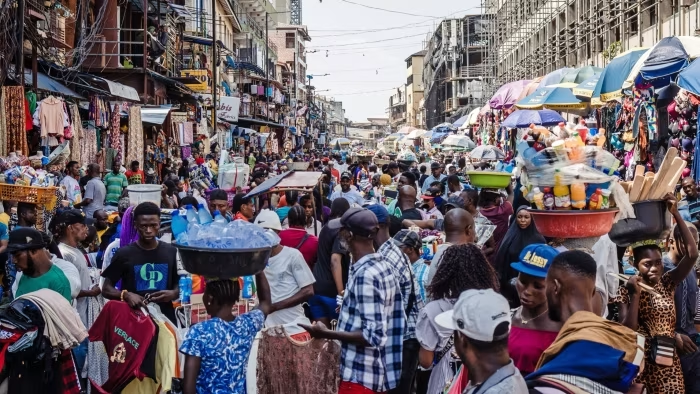
The state creation can stimulate development by bringing government closer to citizens, improving service delivery, and boosting local investment. A study on the proposed Anioma State found that 78 % of respondents believed new statehood would enhance economic development, and 81 % thought it would improve public service delivery.
Yet, there are warnings that many of Nigeria’s 36 existing states are already financially stretched and heavily dependent on federal allocations, raising concerns about the viability of adding more states.
On the opportunity side, a new state could generate jobs (through public service, infrastructure, and local agencies), direct federal projects to underserved areas, and increase regional investment.
However, the risks are significant: more states mean higher overheads (administrative costs, recurrent expenses), and if the new unit cannot raise sufficient Internally Generated Revenue (IGR), the extra burden falls on the national purse. Experts caution that “adding 31 more states will increase financial pressure on the federal government.”
Discover more from LN247
Subscribe to get the latest posts sent to your email.


Comments are closed.