

As the 2026 fiscal year begins across Nigeria, many state governments have moved early to activate their fiscal plans by signing their appropriation bills into law. As of January 2, 2026, no fewer than 22 states had completed this process, with total approved budgets exceeding N20 trillion.
This early passage reflects a coordinated effort across the country to strengthen capital spending, improve revenue generation, and channel resources toward critical sectors such as infrastructure, education, healthcare, agriculture, and security.
The budgets align with broader national economic priorities at a time of fiscal pressure and reform.
Recent data from BudgIT’s State of States report shows that subnational governments spent N15.63 trillion in 2024, representing a 64.69 percent increase from 2023.
Against this backdrop, governors have pledged to prioritize efficient implementation, job creation, and improved service delivery while reducing dependence on federal allocations.
A clear pattern across most states is the strong emphasis on capital expenditure, with many allocating more than 60 percent of their budgets to infrastructure and economic enablers.
Below is an overview of states that have signed their 2026 budgets into law, highlighting key allocations, priorities, and official remarks.
Abia State

Governor Alex Otti signed Abia State’s N1.016 trillion 2026 budget into law on December 29, 2025. The budget, titled Project of Acceleration and New Possibilities, retains an 80 percent allocation to capital expenditure amounting to N811 billion, while recurrent spending stands at N205 billion.
Priority sectors include infrastructure, health, education, and agriculture, aimed at addressing long-standing development gaps.
The governor praised the state assembly for its detailed review process and assured residents of faithful implementation.
Although part of the funding gap will be covered through N409 billion in borrowing and non-recurring sources, Abia’s debt-to-revenue ratio remains relatively low.
Anambra State
Governor Chukwuma Soludo approved Anambra State’s N766 billion budget on December 29, 2025, following an upward revision from the initial N757 billion proposal.
Recurrent expenditure increased to N169.6 billion, while capital allocations were expanded to support infrastructure and economic growth. Soludo described the budget as a strategic plan focused on transparency, inclusiveness, and people-centered development.
The budget was signed alongside several reform-oriented laws covering nursing education, tax administration, and correctional services.
Bayelsa State
Bayelsa State’s N1.016 trillion budget was signed into law by Governor Douye Diri on December 23, 2025.
The figure represents an increase from the initial N998 billion proposal. Capital expenditure accounts for N661.5 billion, or 65.11 percent, while recurrent spending stands at N354.5 billion.
The budget prioritizes infrastructure, education, and healthcare. The governor assured residents of full implementation and noted that borrowing would be kept minimal at N74.9 billion, relying largely on oil revenues and internally generated revenue.
Benue State
Governor Hyacinth Alia signed Benue State’s N695.01 billion 2026 budget into law on January 1, 2026.
Although a detailed breakdown was not provided, the budget focuses on agriculture, security, and social welfare. The governor emphasized timely execution to enhance food security and improve infrastructure across the state.
Delta State

Governor Sheriff Oborevwori signed Delta State’s N1.729 trillion Budget of Accelerating the MORE Agenda on December 16, 2025. Capital expenditure takes up 70 percent of the budget at N1.21 trillion, while recurrent spending is N519 billion.
Key priorities include road construction, education, healthcare, and youth empowerment. Funding plans include N694 billion from loans and grants to support capital projects.
Edo State
Edo State’s N939.85 billion Budget of Hope and Growth was signed into law on December 23, 2025, by Governor Monday Okpebholo. The budget focuses on security, infrastructure, agriculture, and education.
The governor highlighted its role in promoting sustainable development, with about N299 billion expected from loans, grants, and public-private partnerships.
Ekiti State
Governor Biodun Oyebanji signed Ekiti State’s N415.57 billion budget on December 23, 2025. The budget emphasizes human capital development, infrastructure expansion, and effective governance.
Oyebanji stressed continuity in fiscal management and the importance of disciplined implementation.
Gombe State

On December 29, 2025, Governor Inuwa Yahaya signed Gombe State’s N617.95 billion Budget of Consolidation into law. Capital expenditure accounts for N428.5 billion, representing 69.4 percent, while recurrent spending is N189 billion.
The budget includes dedicated funding for regional security, healthcare, education, support for persons with disabilities, and solid minerals development.
The state plans to finance about 60.8 percent of the budget through loans and other receipts.
Imo State
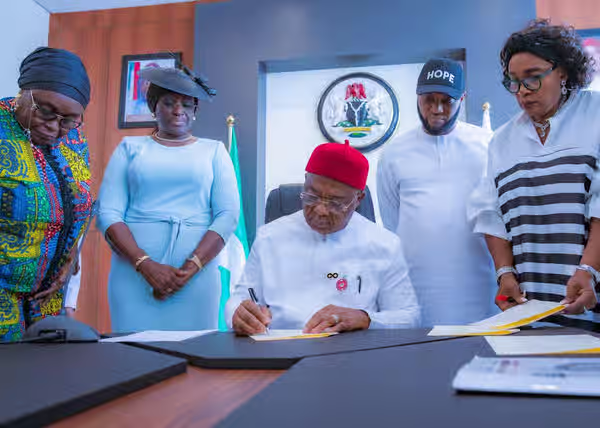
Governor Hope Uzodimma signed Imo State’s N1.44 trillion budget into law on December 31, 2025.
The spending plan focuses on infrastructure, agriculture, and social services, with the governor reaffirming his administration’s commitment to economic prosperity, although detailed allocations were not disclosed.
Jigawa State
Jigawa State’s N901.84 billion budget was signed on December 24, 2025, by Governor Umar Namadi.
The budget reflects public input and prioritizes infrastructure, agriculture, education, and healthcare, with a strong emphasis on capital development.
Kaduna State
Governor Uba Sani signed Kaduna State’s N985.9 billion budget on December 22, 2025. Capital expenditure accounts for N698.9 billion, or 70.9 percent, while recurrent spending is about 29 percent.
Education received the largest allocation at 25 percent, followed by healthcare and infrastructure.
The governor emphasized that no new taxes were introduced and highlighted reforms aimed at economic growth.
Kano State

On December 31, 2025, Governor Abba Yusuf signed Kano State’s N1.47 trillion budget into law.
The budget focuses on improving living standards through investments in education, healthcare, and infrastructure, which the governor described as a significant step toward long-term development.
Katsina State
Katsina State was among the earliest to pass its 2026 budget, with Governor Dikko Radda signing the N897.87 billion appropriation bill on November 26, 2025.
Capital expenditure accounts for 81 percent of the budget, totaling N727 billion, while recurrent spending stands at 19 percent.
The budget, titled Building Your Future III, prioritizes infrastructure, security, and agriculture based on consultations with residents.
Kebbi State
Governor Nasir Idris signed Kebbi State’s N642.9 billion budget into law on December 16, 2025. The budget emphasizes agriculture, education, and water resources development as key drivers of economic growth.
Nasarawa State
On December 29, 2025, Governor Abdullahi Sule approved Nasarawa State’s N545.2 billion Budget of Strategic Consolidation.
The budget focuses on infrastructure development and economic recovery initiatives.
Niger State

Governor Mohammed Bago signed Niger State’s N1.073 trillion budget on December 23, 2025, an increase from the initial N1.031 trillion proposal.
Capital expenditure stands at N783 billion, while recurrent spending is N290 billion. The governor commended the state assembly for its swift and efficient review process.
Ogun State

Ogun State’s N1.669 trillion Budget of Sustainable Legacy was signed into law by Governor Dapo Abiodun on January 1, 2026.
This represents a 58 percent increase from the 2025 budget. Capital expenditure is N1.044 trillion, with infrastructure alone receiving N526.15 billion.
The governor announced that implementation would begin immediately after the holidays and praised the legislature for its diligence.
Ondo State

Governor Lucky Aiyedatiwa signed Ondo State’s N524.4 billion Budget of Economic Consolidation on December 29, 2025.
Capital expenditure is N303.6 billion, accounting for 57.89 percent, while recurrent spending stands at N220.8 billion. The governor described the budget as a firm commitment to economic progress and called for stakeholder support.
Osun State
On December 29, 2025, Governor Ademola Adeleke signed Osun State’s N723.4 billion budget into law.
The budget consolidates his administration’s five-point agenda, with a focus on welfare, infrastructure projects, and timely execution. He pledged full implementation during the final year of his first term.
Oyo State
Governor Seyi Makinde signed Oyo State’s N892 billion 2026 budget on December 22, 2025. The budget emphasizes production over consumption and aims to reduce dependence on federal allocations by expanding the state’s economic base.
Taraba State
Taraba State became the first state to pass its 2026 budget, with Governor Agbu Kefas signing the N653.5 billion Development We Can See budget on December 22, 2025.
Capital expenditure accounts for N457 billion, representing 70 percent of the total budget.
Zamfara State
Governor Dauda Lawal signed Zamfara State’s N861 billion budget into law on December 19, 2025. The budget prioritizes security, education, and healthcare as key areas of intervention.
Overall, the early signing of 2026 budgets across these states reflects a nationwide shift toward capital-driven growth and fiscal discipline.
States such as Abia, Delta, and Katsina have committed more than 70 percent of their budgets to capital projects. With total approved spending approaching N22 trillion and likely to increase as more states finalize their budgets, effective execution will be crucial.
While these fiscal plans could stimulate economic activity and improve living standards, their success will depend on managing inflation, boosting revenue, and ensuring transparency and accountability in implementation.
Discover more from LN247
Subscribe to get the latest posts sent to your email.

