
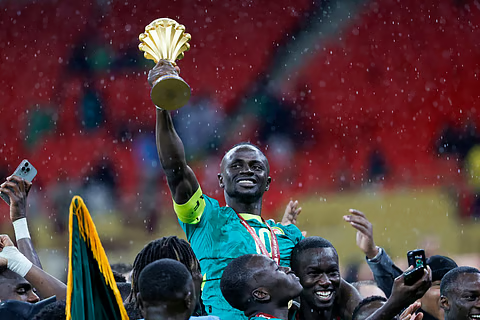
Senegal claimed their second Africa Cup of Nations title after defeating Morocco, but the final will be remembered as much for its chaos as for its football. The showpiece was overshadowed when the Senegalese players briefly refused to continue the match after the hosts were awarded a stoppage-time penalty while the score remained goalless.
Referee Jean-Jacques Ndala pointed to the spot in the 98th minute following a VAR intervention that sent him to the pitchside monitor to review El Hadji Malick Diouf’s challenge on Brahim Díaz. The decision sparked extraordinary scenes inside the stadium.
Still furious over an earlier call that had seen a Senegal goal ruled out, head coach Pape Thiaw instructed his players to leave the pitch in protest. Former Liverpool forward Sadio Mané remained on the field, urging his teammates to return and see the game through.
After a delay of approximately 17 minutes, play eventually resumed. Real Madrid attacker Brahim Díaz, the tournament’s leading scorer with five goals, stepped up to take the penalty. His attempted Panenka was comfortably caught by Senegal goalkeeper Édouard Mendy, and referee Ndala immediately blew the whistle to signal the end of normal time.
The decisive moment arrived early in extra time. Villarreal midfielder Pape Gueye struck in the fourth minute, sealing a 1-0 victory and securing Senegal’s second AFCON triumph in five years.
In the aftermath, Morocco head coach Walid Regragui condemned Senegal’s temporary walk-off, describing the incident as “shameful” and claiming it did not “honour Africa.” Thiaw’s scheduled post-match press conference was cancelled following a disturbance in the media room.
However, speaking to BeIN Sports, Thiaw later admitted his error. “We didn’t agree,” he said. “I don’t want to go over all the incidents. I apologise for football. After reflecting, I made them come back. You can react in the heat of the moment. We accept the referee’s mistakes. We shouldn’t have done it, but it’s done, and we apologise to football.”
Thiaw’s anger stemmed from Ndala’s earlier decision to disallow a goal by Ismaïla Sarr. The Crystal Palace forward had bundled the ball home from close range, but the goal was ruled out for a foul by Abdoulaye Seck on Achraf Hakimi in the build-up. The later penalty decision only intensified Senegal’s frustration.
Several Senegal players followed their coach down the tunnel, while some supporters threw objects and attempted to enter the pitch. Díaz, who was later substituted after Gueye’s goal, was left devastated as Morocco missed the chance to win their first AFCON title since 1976.
Speaking after the match, Mané stressed the importance of protecting the image of the game. “Football is something special. The world was watching, so we have to give a good image,” he said. “It would be crazy not to play because the referee gave a penalty. I would rather lose than see something like that happen to our football. It’s really bad. Football should not stop for 10 minutes, but the good thing is we came back and played.”
Mendy, now with Al-Ahli in Saudi Arabia, said he was proud of how the team responded. “What did we say to each other? That stays between us,” he said. “We did it together and came back together. That’s all that matters.”
Match-winner Gueye echoed those sentiments. “We felt a sense of injustice,” he explained. “Just before the penalty, we believed we had scored and the referee didn’t go to VAR. Sadio told us to come back, we refocused, Edouard made the save, and then we got the goal.”
Despite the thrilling football on display throughout the tournament, the chaotic ending left a sour taste. From the commentary box, the scenes were difficult to comprehend, with fans attempting to enter the pitch and staff members being separated in the technical areas as Senegal’s players walked down the tunnel.
In the weeks leading up to the final, refereeing decisions and the use of VAR had been heavily debated, with some fans and journalists suggesting Morocco had benefited from certain calls. Refereeing appointments themselves had become a talking point on social media, increasing pressure on officials ahead of key matches.
Senegal had also raised concerns prior to the final, including what they described as inadequate security when arriving in Rabat, issues with hotel conditions, limited ticket allocations, and the absence of a training pitch at Morocco’s base. The Senegal Football Federation said players and staff were put at risk after their team bus was surrounded by fans.
“What happened was not normal,” Thiaw said before the match. “With that number of people, anything could have happened. My players could have been in danger. That type of thing should not happen between two brother countries.”
Former Nigeria international Efan Ekoku criticised Senegal’s actions, saying their refusal to continue was “not a good look for African football,” while John Obi Mikel admitted he understood the frustration but did not support walking off the pitch.
Morocco were widely praised for the organisation of the tournament, including infrastructure, stadiums and transport links, with positive feedback from figures such as Mohamed Salah.

However, with four years remaining until they co-host the World Cup, the dramatic scenes surrounding the penalty will likely be the most enduring image of this AFCON.
Amid the controversy, Mané emerged with credit for his efforts to calm both teammates and supporters, urging restraint after full-time. In a turbulent finale, his actions stood out as a reminder of leadership and responsibility in the game.
Discover more from LN247
Subscribe to get the latest posts sent to your email.

