
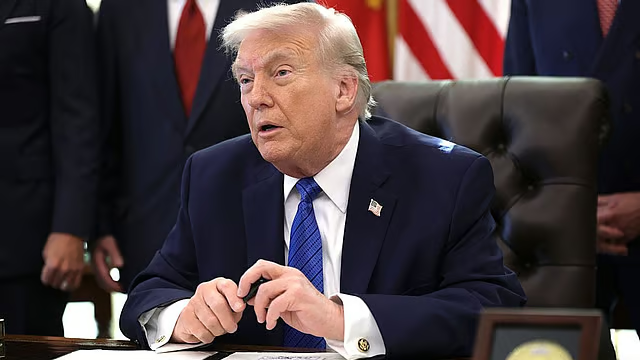
US President Donald Trump has announced that a new round of negotiations with Iran will begin on Monday after deciding against launching fresh military strikes, opting instead to pursue a diplomatic solution to end the ongoing conflict, now in its sixth month.
Speaking to reporters on Sunday, Trump said the discussions would focus on the Strait of Hormuz—a critical global energy corridor that has become a major point of contention in the conflict—as well as Iran’s nuclear programme.
Meanwhile, Iran revealed that it is close to reaching an agreement with Oman on a new maritime route through the Strait of Hormuz. The announcement came as reports emerged of an explosion near a tanker in the strategic waterway, highlighting the continued security risks in the region.
Following Trump’s remarks, global oil prices declined sharply during the opening of Asian trading on Monday. West Texas Intermediate (WTI) crude fell by 4.7 per cent to $80.72 per barrel.
The conflict between Washington and Tehran began on February 28 when the United States and Israel launched coordinated strikes against Iran. Although diplomatic efforts have produced temporary periods of calm, renewed military exchanges in recent weeks have raised fears of further escalation.
Trump had earlier warned that Iran could face severe military action and was reportedly considering strikes on strategic facilities, including energy infrastructure. However, he announced on Saturday that he had decided to suspend those plans, saying the framework for a diplomatic agreement was beginning to take shape.
“Now what we’re doing is we’re talking to them in the form of a negotiation. It begins tomorrow afternoon,” Trump said while speaking aboard Air Force One, although he did not disclose the location of the talks or those expected to participate.
The US president also claimed that Iran, along with regional allies Saudi Arabia, the United Arab Emirates and Qatar, urged him to avoid military action, which he described as potentially “the biggest attack since World War II.”
Iranian state media, however, denied that Tehran had requested the United States to refrain from launching strikes.
A previous ceasefire arrangement that included reopening the Strait of Hormuz eventually collapsed, with Iran tightening its control over the waterway afterward.
Trump has consistently maintained that the conflict is aimed at addressing Iran’s nuclear ambitions. While Western governments accuse Tehran of pursuing nuclear weapons, Iran insists its nuclear programme is solely for peaceful civilian purposes.
Iran Signals Readiness for Further Negotiations
Hassan Ghashghavi, spokesperson for Iran’s parliamentary national security commission, disclosed on Sunday that mediators are working to revive the memorandum of understanding reached between the United States and Iran in June.
Although the agreement was not intended as a permanent peace settlement, it served as a foundation for broader negotiations and included provisions concerning the Strait of Hormuz.
“They know that the main issue and, in fact, the key to the matter right now is the issue of the Strait of Hormuz, so yes, there is an exchange of views,” Ghashghavi said.
Iranian President Masoud Pezeshkian also stressed the need to ensure all parties honour their commitments.
“We must strive to compel the enemy to remain committed to what it has signed.”
Oman Route Proposal Near Completion
Before the conflict, commercial vessels enjoyed unrestricted access through the Strait of Hormuz. However, Iran later imposed restrictions and insisted that ships use routes under its control while charging transit fees—an arrangement rejected by the United States.
The disagreement over shipping access contributed to renewed military tensions after Tehran refused to permit vessels to use routes outside those bordering its coastline.
Iran’s Foreign Ministry spokesperson, Esmaeil Baqaei, said discussions with Oman have progressed significantly toward establishing an alternative route through the strait.
“We are now going to reach an understanding on a route acceptable to both sides — neither the northern route nor the southern route — but one that respects the sovereign rights of both sides and safeguards our national interests and security,” he said.
Despite the progress, Baqaei clarified that the proposed arrangement does not amount to a full reopening of the Strait of Hormuz.
Maritime intelligence firm Kpler recently reported a sharp decline in shipping traffic through the vital waterway.
Adding to concerns, the United Kingdom Maritime Trade Operations (UKMTO) Centre confirmed that a tanker sailing off Oman’s coast reported hearing an explosion nearby on Sunday. The vessel and its crew were reported safe.
Source: AFP
Discover more from LN247
Subscribe to get the latest posts sent to your email.

