
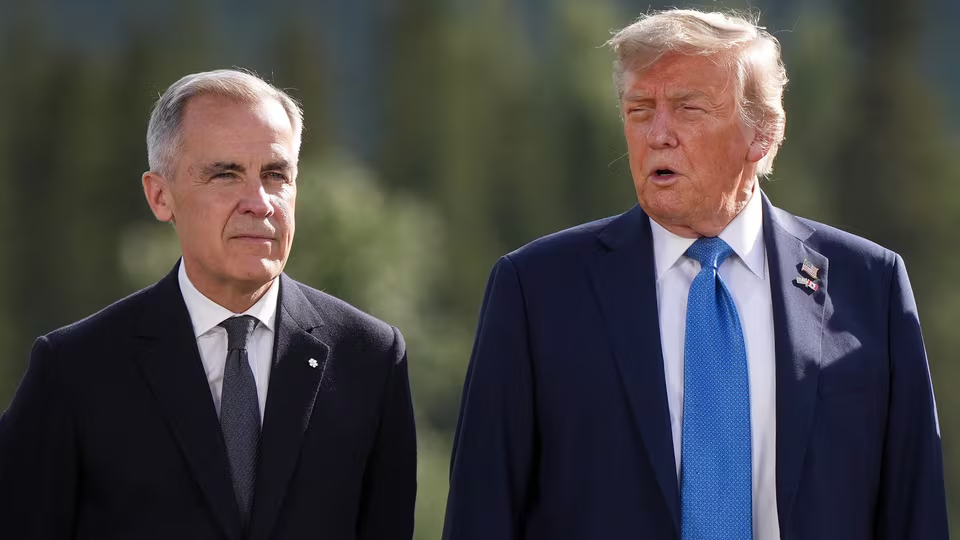
US President Donald Trump has declared plans to enforce a 35% tariff on goods from Canada beginning August 1, despite ongoing last-minute negotiations between both nations on a new trade agreement.
This policy declaration was made public through a letter shared on Trump’s personal social media page, in which he also issued broader warnings about similar tariff hikes—ranging from 15% to 20%—targeting other countries that trade with the United States.
Canadian Prime Minister Mark Carney responded by affirming that his administration remains dedicated to defending Canadian businesses and workers as discussions continue ahead of the self-imposed deadline.
This week alone, Trump has issued over 20 such letters to America’s global trade allies. He has also signaled that Europe will be the next focus of his escalating tariff campaign, with measures expected to be announced shortly.
He has promised that, like Canada, the new trade penalties on other countries will also be activated on August 1.
In addition to this latest warning, Canadian exports are already subject to a 25% general tariff, and previous waves of duties targeting steel, aluminum, and auto imports have already impacted the Canadian economy. However, certain goods still benefit from exemptions due to compliance with an existing North American trade pact.
At this point, it remains uncertain whether the newly announced tariff plans would override protections provided under the Canada-United States-Mexico Agreement (CUSMA).
Trump’s administration has also enacted sweeping tariffs globally, including a 50% duty on aluminum and steel, as well as a 25% import tax on all non-American-manufactured vehicles.
In another move, copper imports are expected to face a 50% tariff next month.
With roughly 75% of Canadian exports heading to the United States—and with Canada being a vital contributor to both the auto and metals sectors—these trade measures are particularly threatening to the nation’s economy.
Trump’s letter emphasized that the 35% duties are in addition to previously imposed tariffs on specific sectors.
“As you are aware, there will be no tariff if Canada, or companies within your country, decide to build or manufacture products within the United States,” Trump stated.
He went on to tie the tariffs to broader concerns, including “Canada’s failure” to prevent fentanyl from reaching American territory, as well as long-standing issues around dairy tariffs and trade imbalances.
“If Canada works with me to stop the flow of Fentanyl, we will, perhaps, consider an adjustment to this letter. These Tariffs may be modified, upward or downward, depending on our relationship with Your Country,” Trump said.
President Trump has in the past pointed fingers at both Canada and Mexico, accusing them of allowing “vast numbers of people to come in and fentanyl to come in” to the US.
In a post on X, Carney stated that Canada had taken significant action to “stop the scourge of fentanyl” and reiterated his country’s commitment to working closely with the US to ensure the safety of communities on both sides of the border.
According to figures from the US Customs and Border Patrol, only a very small fraction—around 0.2%—of fentanyl seizures occur at the border shared with Canada. The overwhelming majority are intercepted along the US-Mexico border.
Earlier in the year, Canada unveiled new funding for border control and appointed a special official to oversee fentanyl-related efforts, responding to rising pressure from Washington.
In recent months, officials from both countries have engaged in extensive dialogue aimed at forging a new bilateral trade and security framework.
During June’s G7 Summit, both leaders publicly reaffirmed their commitment to finalizing a deal within 30 days—setting July 21 as the target date.
Trump’s letter also warned that retaliatory action from Canada could provoke additional duties. Canada, for its part, has already applied some countermeasures and promised further responses if talks break down.
Toward the end of June, Carney repealed a tax targeting large US digital companies after Trump denounced it as a “blatant attack” and threatened to abandon trade discussions altogether.
Carney said the withdrawal of the tax was “part of a bigger negotiation” aimed at securing a broader trade agreement with the United States.
Discover more from LN247
Subscribe to get the latest posts sent to your email.

