
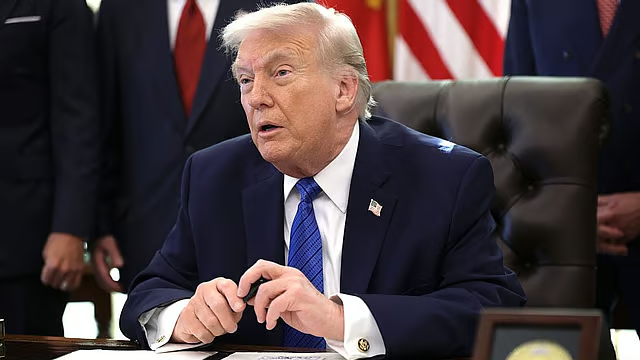
US President Donald Trump has warned Iran that it must reopen the Strait of Hormuz or risk severe military consequences, expressing confidence that a breakthrough agreement could be reached within days.
Speaking to reporters in California on Tuesday, Trump said negotiations had made significant progress and suggested an agreement to restore access to the strategic waterway could be finalised as early as Wednesday.
“Tomorrow or the next day,” Trump said when asked about the timeline, adding that negotiators “had a very good day.”
Trump Issues Fresh Warning
Earlier in the day, the US president adopted a tougher tone during an interview with Fox News, warning Iran that failure to reach an agreement would trigger a strong response.
“The strait is going to be open very soon, or they’re going to get hit very hard — and then the strait’s going to be open.”
He added:
“All you can do is fight your way out.”
The Strait of Hormuz remains a major sticking point in ongoing diplomatic efforts after renewed fighting followed the collapse of an April ceasefire.
Since the conflict began on February 28, Iran has tightened its control over the vital shipping lane and now insists on overseeing maritime traffic and charging tolls, powers it did not exercise before the war.
US Optimistic About Possible Agreement
US Treasury Secretary Scott Bessent also expressed optimism, telling CNBC that an agreement could be reached by Wednesday or Thursday.
Secretary of State Marco Rubio confirmed that Washington is actively involved in mediation efforts between Oman and Iran aimed at increasing shipping traffic through the Strait of Hormuz.
According to Axios, citing unnamed US and regional officials, the United States, Iran and Oman are close to reaching an interim agreement that could be announced on Wednesday.
The proposed arrangement would reportedly establish a 60-day framework for safe maritime passage through the waterway shared by Iran and Oman.
Iran Denies Direct Negotiations
Despite repeated statements from Washington, Iran has continued to deny that it is engaged in direct negotiations with the United States.
Qatar, which has been playing a mediation role, confirmed that diplomatic efforts remain active but said no direct US-Iran talks are currently scheduled.
Qatari Emir Sheikh Tamim bin Hamad Al-Thani also held a telephone conversation with Trump on Tuesday, with Doha stating that both leaders discussed ongoing “efforts to de-escalate tensions.”
Trump previously said he expected clarity on the negotiations by Tuesday, insisting the issues under discussion were straightforward.
The US administration continues to push for both the reopening of the Strait of Hormuz and the eventual dismantling of Iran’s nuclear programme, although Trump acknowledged that denuclearisation “take a little while.”
The president also accused Tehran of sending mixed signals.
He previously described Iran as “duplicitous” for publicly denying negotiations while insisting talks were taking place, adding that the US counter-blockade on Iranian ports would remain in place “unless a Deal, or Total Surrender, is accomplished.”
Maritime Tensions Continue
More than five months into the conflict, Iran retains the capability to launch missile and drone attacks against US and allied interests, as well as commercial shipping in the region.
Early Tuesday, the United Kingdom Maritime Trade Operations (UKMTO) reported that an unnamed merchant vessel was struck by an “unknown projectile” in the Strait of Hormuz off the coast of Oman.
One crew member was reported missing following the attack.
Iran continues to maintain an effective blockade of the strait, requiring vessels to coordinate passage with its authorities.
Red Sea Shipping Also Under Pressure
The disruption in the Strait of Hormuz has increased the importance of alternative shipping routes through the Red Sea.
Saudi Arabia has relied heavily on its Red Sea port of Yanbu to continue exporting oil without passing through Hormuz.
However, Iran-backed Houthi rebels in Yemen have declared a maritime blockade targeting Saudi-linked shipping and have claimed responsibility for several attacks on vessels they accuse of violating their restrictions.
On Tuesday, the Indian cargo vessel MSV Faize Noore Oliya sank in the Red Sea off the coast of Yemen following an unattributed attack. All crew members were safely rescued.
The Red Sea serves as a critical gateway to the Suez Canal, and previous Houthi attacks on commercial vessels during the Gaza conflict forced many global shipping companies to reroute around the southern tip of Africa, significantly increasing travel times and costs.
Discover more from LN247
Subscribe to get the latest posts sent to your email.

