
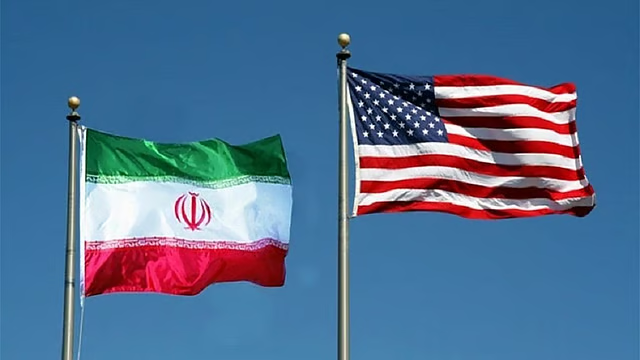
A US–Iran agreement extending the ceasefire between both nations has officially been signed and is now in effect, according to confirmation from a White House official to the BBC.
President Donald Trump signed the deal during the G7 summit in Evian-les-Bains, France. The agreement—described as a 14-point Memorandum of Understanding—aims to reopen the strategic Strait of Hormuz and set the foundation for broader negotiations between Washington and Tehran.
The document states that Iran must never develop a nuclear weapon and outlines a $300bn reconstruction and economic development plan for the country, although the United States is not required to contribute financially. The deal comes months after tensions escalated between Iran, the US, and Israel.
The Trump administration has described the agreement as “performance-based,” meaning Iran will only benefit if it complies with the outlined commitments.
Although several issues remain unresolved, here are the major highlights of the agreement:
An end to conflict ‘on all fronts’
The agreement calls for an “immediate and permanent” end to military operations involving the US, Iran, and allied forces across all regions, including Lebanon.
From Washington’s perspective, concerns remain that Israeli operations against Hezbollah could disrupt the ceasefire framework. Iran, meanwhile, insists Lebanon should be included under the truce.
A spokesperson for Iran’s Ministry of Foreign Affairs said any continued Israeli action in Lebanon would violate the understanding and trigger “necessary measures”.
The agreement also states that neither side will initiate attacks or threats moving forward and will respect Lebanon’s sovereignty.
The final settlement aims at a permanent end to hostilities, though Israel’s response remains uncertain.
Respect for ‘internal affairs’
The document states that both countries will “respect each other’s sovereignty and territorial integrity” and avoid interference in internal political matters.
This clause is expected to be controversial among Iranian opposition groups.
Earlier this year, Trump told Iranian protesters that “help is on the way” during nationwide demonstrations.
60-day negotiation timeline
Both countries have agreed to reach a final deal within 60 days, though this deadline may be extended if mutually agreed.
The countdown begins immediately following the signing of the MoU.
The White House confirmed Trump signed the document in France, alongside Iranian President Masoud Pezeshkian.
A planned signing ceremony in Geneva remains uncertain.
End of US naval blockade
The US will begin lifting its naval blockade on Iranian ports, removing restrictions and “disturbances or impediments,” according to the agreement.
The process is expected to take up to 30 days, during which vessel movement will be gradually restored.
Within 30 days of a final agreement, US forces are expected to withdraw from proximity to Iran, returning to pre-conflict positioning.
Strait of Hormuz reopening
Iran has agreed to ensure safe and uninterrupted passage of commercial vessels through the Strait of Hormuz.
The agreement states that movement will resume “immediately,” while technical and security obstacles are addressed.
Officials also emphasized that no transit fees will be imposed.
Long-term plans include cooperation between Iran, Oman, and Gulf states to manage the waterway.
$300bn reconstruction plan
The agreement includes a proposed $300bn reconstruction and economic development package for Iran, to be finalized within 60 days.
However, the US will not directly contribute funds.
Officials clarified that Washington will not pay “a cent of money” but may support third-party investments under approved conditions.
Lifting of sanctions
The US will remove all economic sanctions on Iran, including UN and unilateral restrictions.
However, the timeline is still under negotiation.
Iran remains heavily affected by sanctions, and easing them is tied to compliance with the agreement.
No nuclear weapons
Iran has committed not to develop or acquire nuclear weapons.
Enriched uranium stockpiles will be managed later through mechanisms agreed in future talks, likely under International Atomic Energy Agency (IAEA) supervision.
A US official described this as a “major win” and a minimum compliance standard.
Maintaining the status quo
Both sides agree to maintain the current status of Iran’s nuclear programme until further arrangements are finalized.
No new sanctions will be imposed during this period, while limited waivers may allow exports and financial transactions to continue.
Frozen funds release
The agreement includes provisions for releasing frozen Iranian assets once the MoU takes effect.
Further details will be negotiated, but some funds may be gradually unblocked based on compliance milestone
Monitoring and final deal structure
A monitoring mechanism will be created to oversee compliance and implementation of the agreement.
Both countries will then begin negotiations for a final settlement.
The agreement is expected to be endorsed by a binding UN Security Council resolution once finalized.
Discover more from LN247
Subscribe to get the latest posts sent to your email.

