Kenya’s private sector contracted in March 2026 for the first time since August 2025, with the Stanbic Bank Kenya Purchasing Managers’ Index (PMI) dropping to 47.7 from 50.4 in February. A reading below 50 indicates contraction in business activity, marking a notable shift in economic momentum.
The slowdown was linked to weaker consumer spending, tighter household budgets and reduced cash flow, pressures that have dampened demand for goods and services across industries. Geopolitical tensions, such as the war in the Middle East, have also compounded the strain by disrupting logistics and driving up transport and energy costs.
While the wholesale and retail trade segments exhibited some resilience, most sectors reported declines in output and new orders. Survey respondents reflected broad unease about future demand, signalling continued challenges ahead for businesses reliant on domestic and regional markets.
President William Ruto’s administration has been monitoring the fallout from global price volatility and supply disruptions. Officials said they were assessing measures to stabilise supplies and support key sectors, while the finance ministry maintained a positive overall growth forecast of about 5.3% in 2026, up from previous years.
Kenya’s private sector has also been affected by fuel shortages linked to the Middle East conflict, with about 20% of fuel outlets reporting supply issues as price freezes clash with higher global oil costs.
Cameroon has officially confirmed that 16 of its citizens were killed while fighting for Russia in the Ukraine war, marking the first time the Central African state has publicly acknowledged such fatalities.
The statement, broadcast on state media and backed by a diplomatic note, said the deceased were described as “military contractors” in Russian‑designated conflict operations.
Details surrounding how these Cameroonians were recruited and transported to the conflict zone remain unclear. The Russian embassy in Yaounde has not responded to requests for comment, deepening questions about the mechanisms that brought these nationals into foreign combat.
This confirmation follows reports by Ukraine that thousands of African fighters have joined Russian forces, either through private intermediaries or contracted arrangements. Independent analyses suggest that African recruits may be drawn by economic incentives, raising diplomatic and humanitarian concerns across the continent.
Cameroon’s defence ministry reiterated that it does not officially send troops into foreign conflicts unless under international or regional mandates. Families of the deceased have been urged to contact the foreign ministry for support, as Yaounde seeks to clarify circumstances and provide consular assistance.
The confirmation may trigger diplomatic engagements with Russia and international partners to address recruitment practices and protections for African nationals. It also spotlights a growing concern among African governments about citizens being drawn into distant conflicts with limited oversight or safeguards.
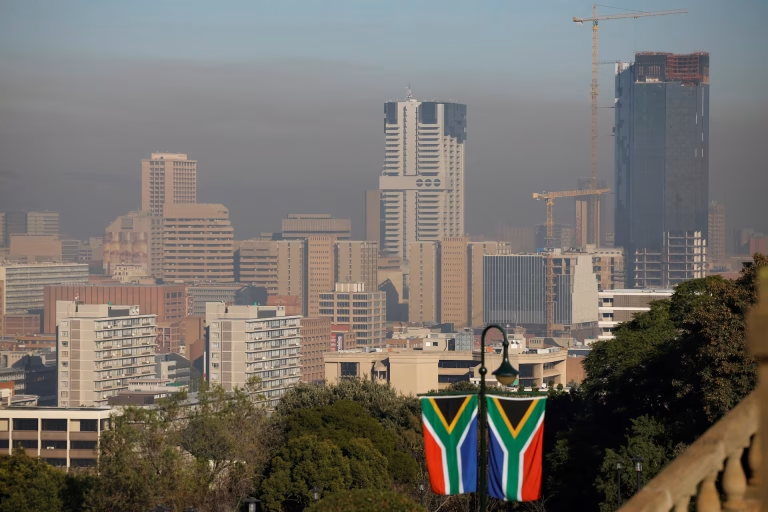
South Africa’s private sector showed tentative signs of recovery in March 2026, as the S&P Global Purchasing Managers’ Index (PMI) climbed to 50.8, up from a flat 50.0 in February, signalling a return to marginal expansion after months of stagnation.
Output saw its fastest rise in six months, led by stock rebuilding and new projects, while employment growth hit its highest pace since mid‑2024, a welcome shift after prolonged demand weakness.
Despite these gains, new orders continued to decline and export sales contracted at the steepest pace in over two years, underlining persistent weakness in foreign demand. Analysts say global uncertainty particularly due to the lingering U.S.‑Israeli war with Iran has dampened business confidence worldwide, contributing to subdued international orders and hesitance among local firms to scale up output.
Business sentiment in South Africa remains fragile: confidence dropped to its lowest level since July 2021. Only about 32% of firms surveyed expect output to rise over the next 12 months, pointing to cautious expectations against a backdrop of volatile commodity prices and fluctuating demand.
The economic backdrop is further complicated by cost pressures. Firms face higher input costs, notably for fuel and logistics, as global energy market disruptions filter through local supply chains. South Africa’s manufacturing sector also expressed concerns about the war’s impact on supply reliability and pricing, a theme echoed in broader geopolitical risk assessments across industries.
Economists caution that while the slight uptick in activity is encouraging, the recovery remains highly vulnerable to external shocks. Continued conflict in the Middle East, weak global demand and elevated inflation risks could undercut investment and slow the pace of expansion. South Africa’s policymakers are now under pressure to maintain growth without triggering inflationary blowbacks.
The government of the Democratic Republic of the Congo has agreed to receive migrants deported from the United States under a new arrangement that includes individuals who are not Congolese nationals. The move is part of Washington’s broader crackdown on illegal immigration.
Authorities stated that the United States would provide “logistical and technical support” for the initiative, while the Congolese government would not bear any financial burden. However, no official figure has been released regarding how many deportees are expected.
Officials in Kinshasa confirmed that the deal took effect this month, with preparations already underway to receive deportees. A temporary reception system has been established, and designated facilities have been selected in the capital, Kinshasa, to accommodate arrivals.
The agreement allows DR Congo to accept so-called third-country migrants—individuals who are neither citizens of the United States nor of DR Congo. Congolese officials said the decision reflects the country’s commitment to international solidarity, human dignity, and the protection of migrant rights.
At the same time, the government emphasized that the arrangement is temporary and should not be viewed as a permanent relocation system or an outsourcing of US immigration policy.
The policy forms part of the immigration strategy of Donald Trump, whose administration has intensified deportations since returning to power. In recent months, the United States has sent deportees to several countries across Africa and beyond.
The US State Department has maintained that it remains committed to curbing illegal migration and strengthening border security, though it declined to comment directly on specific diplomatic agreements.
DR Congo joins a number of countries that have agreed to accept deportees from the US, including Eswatini, Ghana, and South Sudan. In a related development, Uganda recently received eight deportees from different African nations.
A report from the US Senate’s Committee on Foreign Relations suggests that more than $40 million may have been spent on third-country deportation programs as of January 2026, though the total figure remains unclear.
The policy has drawn criticism from human rights groups, who argue that deporting migrants to third countries raises legal and ethical concerns. Some have warned that individuals could eventually be sent back to their home countries, where they may face persecution.
Congolese authorities, however, have assured that no such transfers are currently planned under the agreement.
The migration deal comes amid wider engagement between the US and DR Congo, including ongoing discussions over access to the country’s vast mineral resources such as cobalt, lithium, and copper critical to global technology and energy industries.
The US has also played a role in facilitating a peace agreement between DR Congo and Rwanda, although implementation challenges persist.
As DR Congo begins to receive deportees under the new arrangement, the agreement underscores the expanding scope of US immigration policy beyond its borders. While officials frame the deal as a humanitarian and cooperative effort, it continues to generate debate over its long-term implications for migrants and participating nations alike.
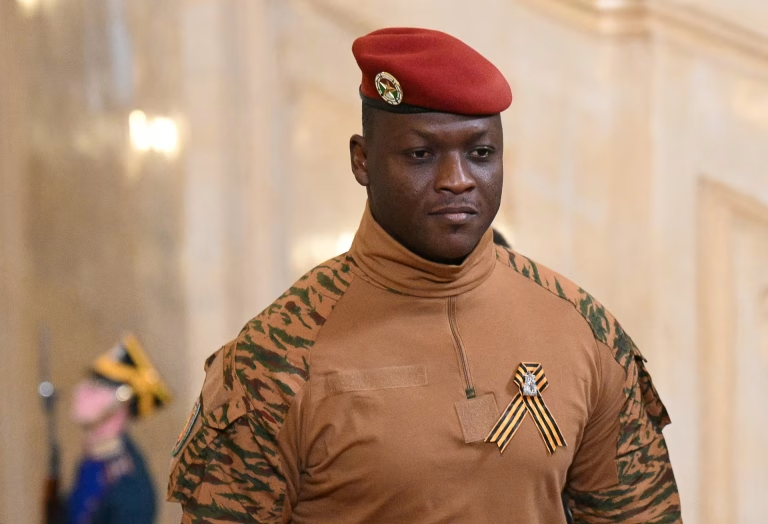
Burkina Faso’s military leader, Ibrahim Traoré, has sparked widespread debate after urging citizens to “forget about democracy,” signaling a major shift in the country’s political direction amid ongoing security challenges.
Speaking during a televised discussion, Traoré stated that democracy is not suitable for Burkina Faso, insisting that the country must prioritise stability over political systems. He controversially argued that “democracy kills” and cited global examples to support his claim, suggesting that attempts to impose democratic systems have often led to violence and instability.
He also referenced countries like Libya as cautionary examples, where external efforts to enforce democracy allegedly resulted in conflict and destruction.
Traoré, who came to power in a 2022 coup, had initially promised a return to civilian rule with elections planned for 2024. However, he has now made it clear that elections will not take place until security conditions improve significantly.
According to him, Burkina Faso cannot conduct a credible nationwide vote while large parts of the country remain affected by insurgency and violence linked to extremist groups.
In a further consolidation of power, the military government earlier dissolved all political parties, effectively halting political activity in the country. Before the ban, Burkina Faso had over 100 registered parties, reflecting a previously active multi-party system.
The move aligns Burkina Faso with neighbouring countries like Mali and Niger, where military-led governments have taken similar steps following coups.
The junta has justified its stance by pointing to the worsening security situation. Burkina Faso has been battling Islamist insurgencies for over a decade, with thousands killed and millions displaced.
Traoré maintains that restoring order and territorial control must come before any discussion of democratic governance, framing his leadership as necessary for national survival.
The remarks have drawn criticism from observers and human rights groups, who warn that abandoning democratic principles could deepen authoritarian rule and limit freedoms. Concerns have also been raised about increasing restrictions on opposition, media, and civil society under the current administration.
Traoré’s comments mark one of the clearest indications yet that Burkina Faso’s transition back to democracy is unlikely in the near future. As the country continues to grapple with insecurity, the debate over governance, stability, and civil liberties is expected to intensify both within the nation and across the region.
A high-stakes geopolitical standoff is unfolding as Donald Trump’s deadline to Iran draws closer, raising fears of a broader Middle East conflict with far-reaching global consequences.
At the center of the crisis is Iran’s refusal to comply with U.S. demands to reopen the Strait of Hormuz, a critical global energy artery through which roughly one-fifth of the world’s oil supply passes. The ultimatum, reopen the route and return to negotiations or face intensified military action, has set the stage for a decisive moment in the ongoing 2026 Iran War.
Iran’s Response: Defiance Over Concession
Tehran has responded with firm resistance, rejecting what it describes as coercive diplomacy. Officials insist that Iran will not bow to pressure or accept temporary measures that fail to address broader geopolitical grievances. Iran has instead proposed a multi-point negotiation framework, signaling willingness for dialogue, but strictly on revised terms that move beyond Washington’s current demands. The country has also warned of potential retaliation should military action escalate, including threats to U.S. assets and allied infrastructure across the Gulf region.
By leveraging its strategic position along the Strait of Hormuz, Iran is effectively using energy supply as both a shield and a bargaining tool, reinforcing its stance that it cannot be forced into submission.
A Divided Global Response
World leaders are reacting with a mix of caution, concern, and strategic calculation. Western allies have largely aligned with Washington’s position, but there is growing unease about the risk of escalation. European governments, in particular, are pushing for renewed diplomacy, wary of the economic and humanitarian fallout of a prolonged conflict.
In Asia, major energy importers such as Japan are exploring ways to secure shipping routes, including possible military support for maritime operations. Meanwhile, China has called for immediate de-escalation, emphasizing the need to protect global trade stability.
Across the Middle East, Gulf states are on high alert, with fears that critical oil infrastructure could become targets if tensions spiral into open warfare.
What Happens Next? Three Possible Scenarios
As the deadline looms, analysts are outlining three likely paths forward.
First, escalation. If Iran refuses to comply, the United States could carry out targeted strikes on key infrastructure, potentially triggering retaliatory attacks across the region and drawing multiple actors into a wider conflict.
Second, last-minute diplomacy. There remains a slim possibility of a breakthrough, with backchannel negotiations leading to a temporary arrangement, such as a partial reopening of the Strait, buying time for further talks.
Third, a prolonged standoff. Both sides could hold their ground without immediate escalation, resulting in continued disruptions to global shipping, sustained economic pressure, and an extended period of geopolitical uncertainty.
Economic Fallout: A World on Edge
The crisis is already sending shockwaves through global markets.
Oil Prices Surge
Crude oil prices have climbed sharply, surpassing $110 per barrel, as fears of supply disruptions intensify. The closure, or even partial disruption, of the Strait of Hormuz has immediate implications for energy markets worldwide.
Trade Disruptions
Shipping activity through the Strait has slowed significantly, forcing vessels to reroute or delay shipments. This has increased transportation costs and disrupted supply chains, affecting industries far beyond the energy sector.
Inflation Pressures
Rising fuel costs are feeding into broader inflation, raising concerns among central banks about a potential stagflation scenario, where economic growth slows while prices continue to rise.
Market Volatility
Global financial markets are reacting with caution. Investors are shifting toward safe-haven assets, while equities face increased volatility amid uncertainty about the conflict’s trajectory.
Impact on Developing Economies
For countries like Nigeria, the implications are mixed but largely challenging. While higher oil prices may boost revenues for exporters, increased fuel import costs, inflationary pressures, and currency instability pose significant risks to economic stability.
A Defining Moment for Global Stability
Beyond immediate military and economic concerns, the standoff highlights a deeper shift in global geopolitics. Energy security has once again emerged as a powerful strategic weapon, and the Middle East remains central to the balance of global economic stability.
The coming days will be critical. Whether through diplomacy, confrontation, or stalemate, the outcome of this crisis will shape not only regional dynamics but also the trajectory of the global economy.
As the deadline approaches, the world watches closely, aware that the next move could determine whether tensions ease or escalate into a conflict with consequences that reach far beyond the Gulf.
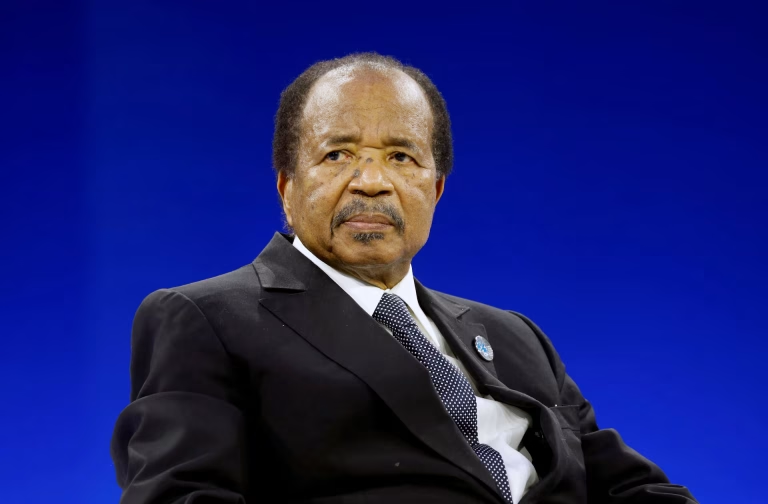
Cameroon is set for a significant constitutional shift as President Paul Biya, the world’s oldest serving leader, prepares to appoint a vice-president for the first time in his more than four decades in power. The move follows the approval of controversial constitutional amendments by parliament.
Constitutional Changes Approved.
Lawmakers overwhelmingly backed the reform during a joint session, paving the way for the reintroduction of the vice-presidential role—an office that was scrapped in 1972. The new law now awaits formal assent from Biya to come into effect.
Under the revised constitution, the vice-president will automatically assume office as head of state if the president dies or becomes incapacitated, completing the remainder of the seven-year term before fresh elections are held.
Before the amendment, Cameroon’s constitution designated the Senate president as interim leader in such circumstances, with the responsibility limited to overseeing a transition until elections were conducted.
The new arrangement marks a major departure, granting the vice-president—who will be appointed directly by the president—full authority to govern until the end of the term.
Government Justifies Reform
Supporters of the amendment argue that the change will improve governance and ensure continuity in leadership. They say it will also reduce the burden on the Senate, allowing it to focus on its legislative duties rather than succession responsibilities.
The reform is also seen by backers as a way to strengthen institutional stability in a country where leadership continuity has long been a sensitive issue.
Opposition Raises Concerns
However, the move has drawn sharp criticism from opposition groups, who claim the amendment was rushed through parliament without sufficient consultation. Some lawmakers have questioned the transparency of the process, describing it as “suspicious.”
The Social Democratic Front boycotted the vote, arguing that the vice-president should be elected alongside the president rather than appointed. The party also pushed for a power-sharing arrangement reflecting Cameroon’s linguistic divide between its English-speaking and French-speaking regions.
Prominent opposition figure Maurice Kamto went further, describing the reform as a “constitutional and institutional coup,” and warning that it risks concentrating power in the hands of the presidency.
Longstanding Leadership and Succession Debate
Biya, now 93, has ruled Cameroon since 1982, making him one of the longest-serving leaders in the world. His extended tenure has fueled ongoing speculation about succession, particularly amid recurring concerns about his health—though such discussions remain largely taboo within the country.
Despite long absences from public view, the president has repeatedly dismissed rumours about his condition by reappearing at official events.
Historical Context of the Vice-Presidency
Cameroon previously had a vice-president during its federal era between 1961 and 1972, when the country maintained a system that balanced its anglophone and francophone regions. The role was abolished after a 1972 referendum that transformed the nation into a unitary state.
The reintroduction of the position marks a return to a structure not seen in over five decades, though under very different political circumstances.
Uncertainty Over the Future
While the constitutional amendment provides clarity on succession procedures, it has also intensified speculation over who will be appointed as vice-president. Political discussions within Cameroon are now increasingly focused on the potential candidate and what the choice could signal for the country’s future.
As Cameroon moves to reinstate the vice-presidency, the reform highlights both an attempt to formalise succession and the enduring tensions surrounding governance in the country. With Paul Biya still firmly in power, questions about the nation’s political future remain unresolved.
A fresh wave of drone warfare between Russia and Ukraine has intensified the conflict, with deadly strikes on civilian targets and a notable shift in battlefield dynamics as Ukraine reportedly outpaces Russia in cross-border drone attacks for the first time since the war began.
Civilians Killed in Escalating Drone Attacks
Recent Russian drone and artillery strikes have caused significant civilian casualties across multiple Ukrainian regions. In southeastern Ukraine, attacks on urban areas, including transport hubs and residential neighborhoods, left several people dead and dozens injured. In one incident, a drone strike on a civilian bus resulted in multiple fatalities and injuries, highlighting the continued vulnerability of non-combatants.
Other regions, including Kherson and Sumy, have also experienced sustained bombardments, with homes, markets, and critical infrastructure damaged. Ukrainian officials accuse Moscow of deliberately targeting civilian areas, a claim Russia continues to deny.
Earlier in the week, Russia launched a massive aerial assault involving hundreds of drones, killing civilians and injuring dozens more, in what Ukrainian authorities described as one of the largest coordinated drone attacks in recent months.
Ukraine Expands Cross-Border Drone Campaign
In a significant development, Ukraine has increased the scale and frequency of its cross-border drone operations into Russian territory. Recent data suggests that Kyiv launched more long-range drones into Russia than Moscow deployed into Ukraine over the same period, marking a strategic turning point in the aerial dimension of the war.
Ukrainian strikes have targeted oil refineries, military-industrial facilities, and logistics hubs deep inside Russia. In recent days, drone attacks have hit critical energy infrastructure, sparking fires and disrupting fuel supply chains.
Additionally, Ukrainian operations have extended to maritime targets, including a grain vessel in the Sea of Azov, underscoring Kyiv’s expanding reach and its focus on economic and supply-chain disruption.
Rising Tensions Beyond the Battlefield
The escalation in drone warfare is also raising geopolitical concerns. Russia has warned neighboring NATO-aligned states against supporting Ukrainian drone operations, signaling the risk of broader regional spillover.
Meanwhile, Ukrainian President Volodymyr Zelenskyy has renewed calls for a temporary ceasefire, particularly around religious observances, but ongoing attacks suggest little appetite for de-escalation on either side.
War Enters a New Phase
Military analysts say the war is entering a new phase defined by drone dominance, asymmetric strikes, and attacks far beyond traditional frontlines. Ukraine’s growing drone capabilities, combined with continued Russian aerial barrages, are transforming the conflict into a high-tech war of attrition.
As both sides intensify long-range attacks, civilians remain at the center of the humanitarian toll, with no immediate resolution in sight.
The escalating conflict involving Iran, Israel, and allied forces has entered a dangerous new phase, marked by sustained airstrikes on Tehran, retaliatory missile attacks on Israel, and expanding hostilities across Gulf states.
Tehran Under Intense Air Assault
Iran’s capital, Tehran, has come under repeated bombardment as Israeli and U.S. forces intensify their military campaign targeting strategic infrastructure. Recent strikes have hit airports, missile facilities, and military compounds, as part of a broader offensive aimed at weakening Iran’s operational capabilities.
Israeli authorities say the attacks are focused on dismantling Iran’s ability to fund and arm regional proxy groups, while also degrading its missile and air defense systems. The scale of the operation has been significant, with hundreds of targets struck in recent days alone.
In a worrying development, airstrikes have also occurred dangerously close to sensitive nuclear infrastructure, raising fears of a potential radiological disaster if the conflict escalates further.
Iran Retaliates with Missile Strikes on Israel
Iran has responded with waves of missile and drone attacks targeting Israeli territory. Several strikes have hit industrial zones and urban areas, triggering air defense responses and sirens across multiple cities.
The retaliation is part of what Iranian officials describe as a broader strategy to impose costs on Israel and its allies, following sustained attacks on its territory and leadership.
Earlier strikes have also caused casualties and infrastructure damage in Israel, highlighting the growing intensity and reach of Iran’s response capabilities.
Conflict Expands to Gulf Targets
Beyond Israel, the conflict has spilled into the Gulf region, with Iranian strikes targeting critical energy and infrastructure assets. Facilities in countries such as the United Arab Emirates and Kuwait have reportedly been hit, including refineries and desalination plants.
In the UAE alone, hundreds of missiles and drones have been intercepted, underscoring the scale of Iran’s regional offensive.
There are also growing concerns over attacks on non-traditional targets such as data centers, signaling a shift toward disrupting digital and economic infrastructure in modern warfare.
Rising Civilian Risk and Warnings
As hostilities intensify, civilian risks are increasing. Israel has issued warnings to Iranian civilians to avoid key infrastructure such as railways, citing the likelihood of further strikes.
Meanwhile, reports indicate that some attacks have impacted residential areas in Tehran, raising humanitarian concerns and fears of escalating civilian casualties.
Global and Economic Implications
The conflict is already sending shockwaves through global markets. Oil prices have surged amid disruptions to shipping routes, particularly around the Strait of Hormuz, a critical artery for global energy supply.
Gulf economies are also feeling the strain, with stock markets reacting cautiously and energy infrastructure increasingly vulnerable to attack.
Analysts warn that prolonged hostilities could destabilize global energy markets, disrupt trade flows, and deepen geopolitical divisions across the Middle East and beyond.
What Comes Next
With diplomatic efforts stalled and military actions intensifying, the situation remains highly volatile. A looming deadline issued by U.S. President Donald Trump for Iran to meet key demands, including reopening vital shipping routes, adds further uncertainty to an already fragile situation.
As both sides signal readiness for continued escalation, the conflict risks evolving into a wider regional war with far-reaching global consequences.
The Confederation of African Football (CAF) has confirmed the 16 nations set to compete at the 2026 U-17 Africa Cup of Nations in Morocco, but the absence of Nigeria national under-17 football team has become one of the biggest talking points. Once a dominant force at youth level, Nigeria’s failure to qualify has raised fresh concerns about the state of grassroots football in the country.
CAF Unveils Qualified Teams
The tournament, scheduled to run from April 25 to May 15 in Morocco, will feature a blend of established football nations and emerging sides.
The 16 qualified teams are: • Algeria • Angola • Cameroon • Côte d’Ivoire • DR Congo • Egypt • Ethiopia • Ghana • Guinea-Bissau • Mali • Morocco (hosts) • Mozambique • Senegal • South Africa • Tanzania • Uganda
These teams will not only compete for continental glory but also for qualification spots at the FIFA U-17 World Cup, where Africa will be represented by 10 nations.
Nigeria’s Absence Raises Questions
For the second consecutive edition, Nigeria will not be part of the tournament, a surprising development for a country widely regarded as one of the most successful in youth football history. The Golden Eaglets’ absence has sparked debate among fans and analysts, many questioning how such a decorated nation continues to fall short at this level.
What Went Wrong for the Golden Eaglets?
Nigeria’s qualification hopes were dashed during the WAFU Zone B qualifiers after a crucial semi-final defeat to Ghana national under-17 football team. That loss effectively ended their chances of securing a place in Morocco.
Analysts have pointed to inconsistent performances, tactical lapses, and a lack of cutting edge in front of goal as key issues. Others believe deeper structural problems, such as insufficient preparation and gaps in youth development—played a significant role.
Nigeria’s Perspective and Response
From within the Nigerian camp, there has been an acknowledgment of shortcomings, alongside calls for a long-term rebuilding process. Officials maintain that youth football development requires patience and sustained investment rather than quick fixes.
There is also the argument that CAF’s zonal qualification system leaves little room for error, meaning even traditional powerhouses can be eliminated after a single poor outing, as was the case with Nigeria.
A Changing Landscape in African Youth Football
Nigeria’s absence may reflect a broader evolution in African youth football. Nations like Senegal national under-17 football team, Mali national under-17 football team, and Morocco national under-17 football team have invested heavily in development, closing the gap and, in some cases, overtaking traditional giants.
This increased competition means qualification is no longer guaranteed based on history alone.
As the 2026 U-17 AFCON approaches, Nigeria’s absence remains one of the tournament’s defining narratives. While the competition will showcase Africa’s next generation of stars, it will do so without one of its most successful contributors.
For Nigeria, the setback could serve as a crucial turning point—one that prompts a deeper reassessment of its youth football structure and a renewed focus on building for the future.
To provide the best experiences, we use technologies like cookies to store and/or access device information. Consenting to these technologies will allow us to process data such as browsing behaviour or unique IDs on this site. Not consenting or withdrawing consent, may adversely affect certain features and functions.
Functional
Always active
The technical storage or access is strictly necessary for the legitimate purpose of enabling the use of a specific service explicitly requested by the subscriber or user, or for the sole purpose of carrying out the transmission of a communication over an electronic communications network.
Preferences
The technical storage or access is necessary for the legitimate purpose of storing preferences that are not requested by the subscriber or user.
Statistics
The technical storage or access that is used exclusively for statistical purposes.The technical storage or access that is used exclusively for anonymous statistical purposes. Without a subpoena, voluntary compliance on the part of your Internet Service Provider, or additional records from a third party, information stored or retrieved for this purpose alone cannot usually be used to identify you.
Marketing
The technical storage or access is required to create user profiles to send advertising, or to track the user on a website or across several websites for similar marketing purposes.