Home Blog Page 118

El-Rufai Says DSS, Not EFCC, Attempted To Arrest Him At Abuja Airport

0

Former Kaduna State Governor, Nasir El-Rufai, has clarified that operatives of the Department of State Services (DSS), were responsible for the attempt to detain him at the Nnamdi Azikiwe International Airport, and not officials of the Economic and Financial Crimes Commission (EFCC) as earlier reported.

El-Rufai made the clarification during a television interview on Friday, insisting that the DSS approached him upon his return from Cairo, Egypt, and attempted to take him into custody without presenting a warrant or formal letter of invitation.

“It wasn’t the EFCC. It was the DSS,” he said. “But the DSS were procured to abduct me by the ICPC that has never communicated with me ever.”

According to him, shortly after disembarking from his flight, a DSS operative approached and asked him to accompany him to their office.

“I came out of the plane and a young man in a suit said he was from the DSS and wanted me to follow him to their office. I asked, ‘Where is the letter of invitation?’ He said his bosses had it and he would escort me to them. I told him I had to go through immigration first, just bring me the letter.”

The former governor alleged that more operatives later surrounded him as he made his way toward the immigration desk.

“Apparently, they had moved about 50 DSS operatives to the airport with specific instructions that I should be detained, abducted and detained,” he claimed.

El-Rufai maintained that he refused to comply without proper documentation.

“They said we need to go to our office. I said I’m not going anywhere. If you don’t have a letter, I’m not going. Even the president cannot tell me I have to do anything. It’s a free and democratic country.”

He said he completed immigration formalities and walked out of the airport, though operatives continued to follow him. He also alleged that one of his aides was assaulted and his passport seized during the confrontation.

“That’s the aide that got beaten up and they seized the passport from him. If I had the passport with me, I would not be talking this,” he said.

Clarifying the role of the anti-graft agency, El-Rufai explained that the EFCC had earlier written to him while he was abroad and that his lawyers had responded.

“The EFCC wrote to me while I was away saying they would like to have a chat. My lawyers replied that I was on annual vacation and once I return I will inform them. I will celebrate my birthday and come to see you at 10 a.m. on February 16.”

He further alleged that the Independent Corrupt Practices and Other Related Offences Commission (ICPC) was behind the airport incident, claiming it enlisted the DSS to intercept him.

“Subsequently, we found out that it was the ICPC that procured the DSS to abduct me and then hand over to them,” he said.

El-Rufai described the development as politically motivated and warned that such actions could erode public trust in security institutions.

“Once people begin to lose confidence in the neutrality of such institutions, we are on our way to anarchy,” he added.

Meanwhile, security sources have maintained that although El-Rufai had been invited by the EFCC, the anti-graft agency was not involved in the airport encounter. The DSS has yet to issue an official statement regarding the incident.

El-Rufai has repeatedly stated that he is willing to honour lawful invitations from relevant authorities but insists that due process must be followed.

“I will go to them. I have nothing to hide. But I will not submit to being abducted. There is a difference between lawful process and political intimidation,” he said.

INEC Submits N873bn Budget Estimate For 2027 General Elections

0

The Independent National Electoral Commission has outlined a projected total expenditure of N873,778,401,602.08 for the organisation of the 2027 general elections.

Joash Amupitan made this disclosure on Thursday while presenting the Commission’s 2026 budget proposal together with a detailed cost breakdown for the 2027 polls before the National Assembly Joint Committee on Electoral Matters.

According to the breakdown, the cost for Election Operational activities is estimated at N375,748,195,271.47, while Election Administrative expenses are projected at N92,311,591,396.58.

The Commission has also allocated N209,205,589,977.70 for Election Technology, covering electronic systems and associated infrastructure, while Election Capital expenditures are projected at N154,904,529,641.94.

Combined, these four budget components total N832,169,906,287.69.

INEC has further set aside N41,608,495,314.39 for Miscellaneous Expenses, bringing the grand total for conducting the 2027 general elections to N873,778,401,602.08.

Amupitan clarified that the proposed election budget is separate from the Commission’s recommended N171 billion allocation for the 2026 fiscal year, which is intended to support routine operations, including by-elections and off-cycle polls.

He noted that the submission is in accordance with Section 3(3) of the Electoral Act 2022, which requires the Commission to present its budget for general elections at least one year before the polls.

During the presentation, lawmakers expressed concerns regarding funding arrangements and the implementation of certain provisions in the amended Electoral Act, particularly the aspect involving electronic transmission of results.

Samuel Lalong, Chairman of the Joint Committee on Electoral Matters, said the National Assembly would conduct a thorough review of the budget proposal before approving what it considers sufficient to ensure smooth nationwide operations.

He emphasised that, while INEC submits its cost estimates, the constitutional responsibility for approving and appropriating funds lies with the legislature.

The committee also mentioned plans to review funding for members of the National Youth Service Corps who are to be deployed for election duties, following a request from the scheme seeking increased financial support.

Under the budget proposal, each corps member is to receive N127,000, in addition to N4,500 for feeding and N5,000 for a five-day training programme.

Approximately 450,000 corps members are expected to be deployed for the upcoming general elections.

The budget submission comes amid debates over the Senate’s amendment of the Electoral Act 2022, which had sparked controversy after initially rejecting a proposal to make real-time electronic transmission of results mandatory.

The controversy began on February 4 when the Senate passed the amendment bill after extensive deliberations, including a provision reducing the timeline for INEC to publish a notice of election from 360 days to 180 days.

Central to the disagreement was Clause 60(3), which would require presiding officers to transmit polling unit results electronically to INEC’s Result Viewing portal in real time after completing Form EC8A.

This clause was intended to make electronic transmission a legal obligation rather than a discretionary action.

However, the Senate rejected this provision, retaining Section 60(5), which allows INEC to determine the method for transmitting results.

The Senate’s decision sparked protests from civil society groups at the National Assembly, led by Labour Party presidential candidate Peter Obi and later joined by former Rivers State governor Rotimi Amaechi.

Meanwhile, the House of Representatives adopted the clause mandating real-time transmission of results.

Under mounting pressure, the Senate convened an emergency plenary on Tuesday, February 10, where it reversed its earlier stance, approving electronic transmission of results to the IReV portal while allowing manual collation as a backup in case of technological failure.

The amendment, sponsored by Tahir Monguno and supported by Minority Leader Abba Moro, was passed by voice vote.

Both chambers of the National Assembly are now expected to reconcile their differing versions of the amendment bill.

INEC Fixes February 20 For 2027 Presidential Election, March 6 For Governorship

0

The Independent National Electoral Commission has officially released the timetable and schedule of activities for Nigeria’s 2027 General Elections, fixing Saturday, February 20, 2027, for the Presidential and National Assembly polls, and Saturday, March 6, 2027, for Governorship and State Houses of Assembly elections.

The announcement was made on Thursday by the INEC Chairman, Joash Amupitan, who said the Commission was acting in strict compliance with constitutional and statutory provisions guiding the conduct of elections in the country.

“By virtue of the Constitution of the Federal Republic of Nigeria, 1999 as amended, the tenure of the President, the Vice-President, the Governors, and Deputy Governors of states of the Federation, except Anambra State, Bayelsa State, Edo State, Ekiti State, Imo State and others with off-cycle elections, will expire on the 28th day of May, 2027,” Amupitan said.

He added that “membership of the National and State Assemblies will stand dissolved on the 8th day of June, 2027.”

Citing relevant constitutional provisions, the INEC Chairman explained: “Pursuant to Sections 76(2), 116(2), 132(2), and 178(2) of the Constitution of the Federal Republic of Nigeria, 1999 as amended, elections to the said offices shall hold not earlier than 150 days, and not later than 30 days, before the expiration of the term of office of the holders.”

He further stated that the Commission’s action aligns with the Electoral Act. “This action we are taking today is pursuant to the provisions of the Constitution of Nigeria, and in particular, Section 28(1) of the Electoral Act, 2022, which mandates the Commission to publish the notice of election not later than 360 days before the date appointed for the election,” he said.

Reaffirming the Commission’s independence, Amupitan declared: “Let me reiterate that the authority and power to publish the date of election is that of the Independent National Electoral Commission.”

Formally setting the dates, he announced: “In exercise of the powers conferred on the Commission by the Constitution of the Federal Republic of Nigeria, 1999 as amended, and the Electoral Act of 2022, the Commission hereby fixes the date of the 2027 general election as follows: Presidential and National Assembly election will come on the 20th February, 2027; Governorship and State Houses of Assembly elections will be on the 6th March, 2027.”

According to him, the 2027 general elections will be conducted nationwide for the offices of President and Vice-President, Governors and Deputy Governors in eligible states, members of the Senate and House of Representatives, as well as members of the State Houses of Assembly.

The Commission also released detailed timelines for party primaries, submission of candidates, campaigns, and voter registration.

Political parties are expected to conduct their primaries between July 1 and September 30, 2026. Submission of nomination forms to INEC will take place from October 1 to October 31, 2026, while the final list of candidates will be published on November 15, 2026.

Campaigns for the Presidential and National Assembly elections will run from November 18, 2026, to February 19, 2027. Governorship and State Assembly campaigns will begin on December 15, 2026, and end on March 5, 2027, exactly 24 hours before the respective election days.

As part of preparations for the polls, INEC announced that Continuous Voter Registration will commence in April 2026 and conclude in January 2027, giving eligible Nigerians time to register or update their voter information.

Amupitan said the detailed timetable had been uploaded to the Commission’s website and circulated to political parties and stakeholders.

“These dates reflect our commitment to ensuring that our electoral processes are transparent, credible, and adhere to the provisions of our laws,” he said.

He also directed Resident Electoral Commissioners across the 36 states and the Federal Capital Territory to publish notices of election in their respective constituencies.

Addressing the pending Electoral Amendment Bill before the National Assembly, the INEC Chairman noted: “We recognise the necessity of enhancing our electoral framework to ensure that it meets the ever-evolving needs of our society and reflects our aspiration for free, fair, and credible election.”

US Congress Deadlock Over ICE Funding Threatens Partial Government Shutdown

0

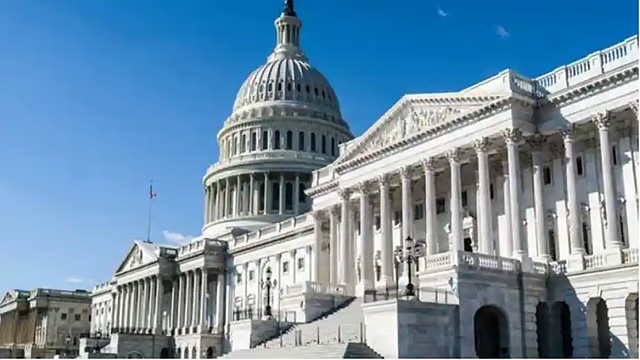
A standoff in Congress over immigration enforcement funding is pushing the United States toward a partial government shutdown, as lawmakers remain divided over reforms tied to President Donald Trump’s migrant crackdown.

“For weeks, we’ve been pushing commonsense reforms,” Senator Chuck Schumer, the top Democrat in the Republican-controlled chamber, said ahead of a partial shutdown that would go into effect after midnight on Friday night.

Democrats are refusing to approve new funding for the Department of Homeland Security (DHS) unless significant changes are made to how Immigration and Customs Enforcement (ICE) conducts its operations. ICE has been central to Trump’s aggressive immigration enforcement strategy.

Among their key demands are limits on roaming patrols, a prohibition on ICE agents wearing facemasks during operations, and a requirement for judicial warrants before entering private property.

Democratic opposition intensified following the January deaths of Renee Good and Alex Pretti, two US citizens who were shot and killed by federal agents in Minneapolis while protesting anti-immigration operations.

Lawmakers are also calling for stricter accountability measures for ICE officers, including adherence to established reasonable use-of-force standards.

“Democrats will not support a blank check for chaos,” Schumer said.

House Minority Leader Hakeem Jeffries echoed those concerns, stating on Thursday that ICE was “completely and totally out of control.”

“Taxpayer dollars should be used to make life more affordable for the American people, not brutalize or kill them,” he said, adding that violence was occurring “whenever these masked and untrained ICE agents show up on the scene.”

Although Republicans hold 53 seats in the Senate, advancing the DHS funding bill requires 60 votes under Senate rules, meaning bipartisan support is essential.

The White House responded to Democratic demands by sending a counterproposal late Wednesday, signaling willingness to negotiate.

Senate Majority Leader John Thune described the offer as “an extremely serious offer,” but cautioned that Democrats are “never going to get their full wish list.”

Democrats quickly dismissed the proposal.

“Half-measures will not cut it,” said Senate Democrat Patty Murray, insisting that their demands are both reasonable and necessary.

If lawmakers fail to reach an agreement, thousands of federal employees could be furloughed, while others may be required to continue working without pay until a budget deal is finalized.

ICE operations, however, would likely continue during a partial shutdown, as the agency still has access to previously approved funds from Congress.

Other agencies could feel the strain more immediately. The Federal Emergency Management Agency (FEMA), responsible for disaster response, may face disruptions. The Transportation Security Administration (TSA), which oversees airport security, warned on X that an extended shutdown could bring “significant” consequences, including staff shortages, longer security lines, and delayed or canceled flights.

If triggered, this would mark the third government shutdown during Trump’s second term, following a record 43-day closure last October and November.

Security Agents Tried To Arrest El-Rufai At Abuja Airport

0

Muyiwa Adekeye, media aide to Nasir el-Rufai, stated that security agents attempted to detain the former Kaduna governor at Nnamdi Azikiwe International Airport in Abuja as he returned from Cairo, Egypt.

In a post on X, Adekeye claimed that operatives approached el-Rufai shortly after he disembarked from his flight on Wednesday, but he refused to go with them without a formal invitation.

“Security agents today attempted to arrest Malam Nasir El-Rufai as he arrived on a flight from Cairo. Malam El-Rufai declined to follow them without a formal invitation. They however snatched his international passport from an aide,” he wrote.

Ubong Akpan, el-Rufai’s lawyer, described the incident as a “flagrant violation of constitutional rights” and “executive overreach,” asserting that Department of State Services (DSS) operatives sought to detain the former governor without a warrant or formal invitation.

According to a statement by Akpan, el-Rufai requested to see the invitation letter, but none was presented.

He said the operatives then “physically snatched” his international passport from an aide, an act the counsel called “stealing” and a breach of property rights.

Akpan added that the Economic and Financial Crimes Commission (EFCC) had delivered an invitation to el-Rufai’s residence in December 2025 while he was abroad, which his team considered impractical.

He said they formally assured the EFCC of compliance and informed the agency on February 11, 2026, that el-Rufai would voluntarily appear at their office by 10:00 am on Monday, February 16, 2026.

Akpan noted that despite this assurance, the attempted arrest went ahead.

The lawyer cited multiple constitutional violations, including rights to personal liberty, fair hearing, human dignity, freedom of movement, and property ownership.

“There exists no justifiable basis for this attempted arrest or the accompanying mistreatment. Despite prior intelligence of plans to effect this arrest, Malam El-Rufai proceeded with his return following medical treatment and rest abroad, publicly affirming his commitment to face any legitimate inquiry. This premeditated interception at the airport exemplifies lawlessness and an abuse of state power,” the statement read.

Akpan demanded the immediate return of the passport, an end to unlawful attempts to detain el-Rufai, and a formal apology.

He emphasized that el-Rufai would never evade law enforcement and would comply with all legitimate summons without conditions.

The incident follows el-Rufai’s recent claims that he could face politically motivated detention upon returning to Nigeria.

The former governor had also alleged that some of his associates were being held following his criticisms of the current administration.

Workers Stage Protest At NAFDAC Lagos Office Over Sachet Alcohol Ban

0

Members of the National Union of Food, Beverage and Tobacco Employees are presently occupying the NAFDAC office complex in Isolo, Lagos, in protest against the agency’s alleged refusal to comply with a Federal Government directive to suspend enforcement of the ban on the production and sale of alcoholic drinks in sachets.

The union is urging NAFDAC to reopen and unseal production lines that were previously shut down, referencing a directive reportedly issued by the Office of the Secretary to the Government of the Federation and the Office of the National Security Adviser.

Meanwhile, NAFDAC on Wednesday rejected reports claiming that the Federal Government had instructed it to suspend enforcement of the ban on sachet and PET-bottled alcohol.

Earlier in the month, the agency began enforcing a nationwide ban on the production and sale of alcohol packaged in sachets and polyethylene terephthalate bottles.

However, social media reports circulating on Wednesday alleged that NAFDAC had been directed to halt enforcement of the prohibition.

In a statement signed by its Director-General, Mojisola Adeyeye, the agency described the reports as “false” and “misleading,” emphasizing that it had not received any directive from the Federal Government to suspend its regulatory operations.

“NAFDAC operates strictly within the ambit of its statutory mandate and in alignment with duly communicated Federal Government policies and directives,” the statement read.

“At no time has the Agency received any formal directive ordering the suspension of its regulatory or enforcement activities in respect of sachet alcohol products.”

The agency reiterated its commitment to protecting public health and ensuring compliance with regulatory standards, adding that any significant decisions affecting national regulatory measures would be officially communicated through appropriate channels.

NAFDAC Denies Federal Directive To Suspend Sachet Alcohol Ban

0

The National Agency for Food and Drug Administration and Control has denied reports claiming that the Federal Government directed it to stop enforcing the ban on alcohol sold in sachets and PET bottles.

Earlier in the month, the agency commenced nationwide enforcement of the ban on the production and distribution of alcohol packaged in sachets and polyethylene terephthalate bottles.

On Wednesday, however, social media reports alleged that NAFDAC had been ordered to suspend the enforcement of the prohibition.

In a statement issued by its Director-General, Mojisola Adeyeye, the agency described the reports as “false” and “misleading,” emphasizing that it had not received any instruction from the Federal Government to halt its regulatory actions.

“NAFDAC operates strictly within the ambit of its statutory mandate and in alignment with duly communicated Federal Government policies and directives,” the statement read.

“At no time has the Agency received any formal directive ordering the suspension of its regulatory or enforcement activities in respect of sachet alcohol products.”

The agency reiterated its dedication to safeguarding public health and ensuring regulatory compliance, adding that any significant decisions affecting national regulatory measures would be officially announced through proper channels.

“NAFDAC urges members of the public, industry stakeholders, and the media to disregard the false report and rely only on verified information issued through the Agency’s official platforms and authorised government communication channels,” the statement added.

NAFDAC also cautioned against the dissemination of unverified information, warning that it could lead to “unnecessary public anxiety, economic uncertainty, or misinterpretation of government policy.”

“NAFDAC remains steadfast in its commitment to public health, economic stability, and national interest,” the statement concluded.

US Lawmakers Introduce Bill Addressing Chinese Illegal Mining In Nigeria

0

A new bill in the United States House of Representatives seeks to tackle illegal Chinese mining operations in Nigeria, linking them to alleged funding of Fulani militias and activities that destabilize the region.

The legislation proposes that the US Secretary of State collaborate directly with the Nigerian government to curb these practices.

Titled the ‘Nigeria Religious Freedom and Accountability Act of 2026,’ the bill was introduced on Tuesday by five Republican lawmakers: Chris Smith, Riley Moore, Brian Mast, Mario Diaz-Balart, and Bill Huizenga.

It aims to address what the sponsors describe as “hostile foreign exploitation of Chinese illegal mining operations” in Nigeria.

The lawmakers claim that some Chinese mining activities in Nigeria contribute to violence by “paying protection money to Fulani militias.”

The bill also directs the US Secretary of State to consider “technical support to the Government of Nigeria to reduce and then eliminate violence from armed Fulani militias.”

Clauses 10 and 11 of the proposed legislation specifically state:
“The Secretary of State should consider technical support to the Government of Nigeria to reduce and then eliminate violence from armed Fulani militias, including disarmament programs and comprehensive counter-terrorism cooperation to rid the region of Foreign Terrorist Organizations that pose a direct threat to the American homeland”

“The Secretary of State should work with the Government of Nigeria to counteract the hostile foreign exploitation of Chinese illegal mining operations and their destabilizing practice of paying protection money to Fulani militias.”

The bill further calls on the US Department of State to engage international partners, including France, Hungary, and the United Kingdom, to collaborate with Nigeria in promoting religious freedom and regional peace.

The Secretary of State is also tasked with determining whether certain “Fulani-ethnic militias” in Nigeria qualify to be designated as “Foreign Terrorist Organizations.”

The proposal echoes concerns raised in an April 2023 report, which noted that Chinese nationals in the Nigerian mining sector were allegedly funding terrorist groups to secure access to mineral resources.

According to the report, “Beijing could be indirectly funding terror in Africa’s largest economy.”

Some Chinese miners in Zamfara were reportedly acting as intermediaries for militant groups in the state and across northwestern Nigeria.

NNPCL Announces Temporary Gas Facility Shutdown For Maintenance

0

The Nigerian National Petroleum Company Limited (NNPCL) has announced that Seplat Energy Plc will temporarily halt operations at its gas production facilities for routine maintenance from February 12 to 15, 2026.

The announcement was made on Thursday by NNPCL’s Chief Corporate Communications Officer, Mr. Andrew Odeh, through an official statement.

He stated, “The public is hereby informed that Seplat Energy Plc, a Joint Venture partner of NNPC Ltd and a key supplier of gas into the NNPC Gas Infrastructure Company Limited (NGIC) pipeline network, has scheduled routine maintenance on its gas production facilities from 12th to 15th February 2026.”

Seplat Energy Plc operates in partnership with NNPC Ltd and is a major supplier of gas to the NNPC Gas Infrastructure Company Limited (NGIC) pipeline system.

The statement highlighted that the maintenance is in line with industry standards emphasizing safety and asset integrity.

The exercise aims to ensure the reliability and efficiency of critical gas infrastructure while maintaining safe operations.

NNPCL stressed that regular maintenance is essential to keep systems operating optimally, strengthen operational stability, and minimize the risk of unexpected disruptions.

It read in part, “During the four-day maintenance period, there will be a temporary reduction in gas supply into the NGIC pipeline network. As a result, some power generation companies reliant on this supply may experience reduced gas availability, which could modestly impact electricity generation levels within the timeframe.

“NNPC Ltd and Seplat Energy are working closely to ensure that the maintenance is executed safely and completed as scheduled. In parallel, NNPC Gas Marketing Limited (NGML) is engaging alternative gas suppliers to mitigate anticipated supply gaps and maintain stability across the network.

“Upon completion of the maintenance exercise, full gas supply into the NGIC system is expected to resume promptly, enabling affected power generation companies to return to normal operations.”

Tinubu Names Ismail Yusuf As Chairman Of NAHCON

0

President Bola Tinubu has appointed Ambassador Ismail Yusuf as the new Chairman and Chief Executive Officer of the National Hajj Commission.

The President’s Special Adviser on Information and Strategy, Bayo Onanugu, announced the appointment in a statement released on Wednesday, noting that it is subject to Senate confirmation in line with Section 3(2) of the NAHCON Act, 2026.

“President Tinubu sent a letter today to the Senate President, Godswill Akpabio, requesting the expeditious confirmation of Ambassador Yusuf to replace Professor Abdullahi Usman, who resigned this week, after about 14 months in the post,” the statement read.

Yusuf is an experienced Nigerian career diplomat who served as Ambassador Extraordinary and Plenipotentiary to the Republic of Türkiye between 2021 and 2024.

Yusuf’s appointment follows the reported resignation of Professor Abdullahi Usman as NAHCON chairman a day earlier.

As of the time of this report, no official explanation had been provided for his resignation.

Usman was appointed NAHCON chairman by President Tinubu in 2024 and supervised his first Hajj operations in 2025, marking his initial experience managing Nigeria’s Hajj affairs at the national level.

He had been selected in 2024 to succeed Jalal Arabi, who was removed from office by President Tinubu.

At the time of his dismissal, Arabi was under investigation for allegedly mismanaging funds allocated by the federal government for the 2024 Islamic pilgrimage.