
The Lagos State House of Assembly has advanced efforts to strengthen landlord-tenant relations as the Tenancy Bill progressed to its second reading on Thursday.
During the plenary session, Speaker Mudashiru Obasa stated that the bill aims to modernise the legal framework governing tenancy agreements, clearly defining the rights, obligations, and eviction procedures in the state.
Titled “A Bill for a Law to Regulate the Relationship between Landlords and Tenants in Lagos State,” the proposed legislation seeks to standardise rental practices across Lagos.
Obasa added that it also outlines the processes for recovering premises and addresses other tenancy-related matters.
If enacted, the law would guarantee that landlords, tenants, and agents have a clear understanding of their rights and obligations.
Obasa encouraged lawmakers to be mindful of tenants who rely on year-end bonuses and annual leave allowances to meet their rent payments.
He also pointed out the rising cost of building materials and emphasized that many landlords depend on rental income for their livelihood.
Obasa emphasized the need for the government to re-evaluate its housing commitments and take concrete steps to fulfill them.
Following deliberations, the Speaker forwarded the bill to the House Committee on Housing for detailed examination.
The committee is expected to present its findings within three weeks.
Mr. Sa’ad Olumoh, representing Ajeromi-Ifelodun I, described the bill as essential, noting that it is designed to bring structure and order to tenancy issues.
He explained that the legislation fosters harmony by clearly outlining rent payment options—whether annually or monthly—and standardizing eviction notice procedures.
Olumoh further stated that the bill defines the specific roles of landlords, tenants, and agents, ensuring that all parties are aware of their obligations.
He added that it also provides legal clarity to assist courts in resolving tenancy disputes efficiently and justly.
Mr. Aro Moshood (Ikorodu II) described the bill as both timely and people-oriented, urging the inclusion of an enforcement agency within the law.
He explained that such a body would monitor and restrain landlords from imposing rent charges that exceed legal limits.
He noted that the bill would ease the burden on tenants, allowing them to manage their finances more effectively and without undue stress.
Mr. Stephen Ogundipe (Oshodi-Isolo I) applauded the bill for its comprehensive and inclusive approach.
He stated that it addresses a wide range of tenancy issues, from agent responsibilities to rental agreements and dispute resolution.
Mr. Femi Saheed (Kosofe II) called the bill a positive step forward, emphasizing that it clearly outlines landlords’ entitlements, including levies such as tenement rates and land use charges.
He added that it also affirms the rights of tenants and recognizes the authority of the courts in resolving tenancy disputes.
“This law is long overdue and will modernise housing relationships in Lagos,” he said.
Mr. Ajayi Oladele (Ibeju-Lekki II) stated that the bill would help minimize disputes frequently triggered by the actions of estate agents.
“For the first time, everyone will understand their legal standing clearly,” he stated.
Ms. Omolara Olumegbon (Lagos-Island I) commended the bill for encouraging fairness and clearly outlining rent payment timelines—whether monthly or yearly—and their connection to eviction procedures.
Lagos Assembly Assesses New Tenancy Law Bill

Two-Time World Cup Champion Tobin Heath Announces Retirement From Football

Tobin Heath, one of the most decorated players in U.S. women’s soccer history, has officially announced her retirement from the sport, bringing an end to a remarkable career that spanned nearly two decades. The news, shared on her RE-CAP Show podcast on Thursday, comes after an extended absence from the game due to injury, leaving fans who hoped for her return disappointed.
Known for her composed presence and exceptional football IQ, Heath amassed an impressive list of achievements: two FIFA Women’s World Cup titles, two Olympic gold medals, and two National Women’s Soccer League (NWSL) championships with the Portland Thorns.
“I think I had a few more mountains I wanted to climb in football, even though I’m incredibly grateful for the career I had,” said the 37-year-old forward. “People often ask, ‘Are you coming back?’ And to be honest, the writing’s been on the wall.”
Heath last played professionally for OL Reign but was sidelined after a season-ending knee surgery in September 2022.
A pivotal figure in the rise of the U.S. women’s soccer dynasty, Heath earned 181 international caps and was named U.S. Soccer Female Athlete of the Year in 2016.
“I never played to be famous or to be noticed,” she reflected. “I played simply because I loved the game.”
Kurdish Militants Burn Weapons as Peace Process Begins

On Friday, thirty members of the Kurdistan Workers Party (PKK) set fire to their weapons near a cave in northern Iraq, marking what may become the beginning of a long-awaited end to the group’s armed campaign against Turkey.
During a symbolic ceremony, male and female fighters lined up to drop AK-47 rifles, bullet belts, and other arms into a large metal container, which was later set ablaze. As flames rose, officials from Kurdish, Iraqi, and Turkish sides observed from a short distance.
The PKK, labeled illegal in Turkey since 1984, announced in May that it would begin disbanding and giving up arms following a call by its imprisoned founder, Abdullah Ocalan, to abandon the decades-long armed struggle for Kurdish independence.
Following years of stalled negotiations, this new move offers a renewed chance for Turkey to resolve a conflict that has claimed more than 40,000 lives, impacted the economy, and caused deep societal rifts both nationally and regionally.
The event took place at the entrance of Jasana cave in Dukan, a town located roughly 60 kilometers northwest of Sulaymaniyah, within Iraq’s northern Kurdish region.
PKK fighters, dressed in matching tan uniforms, stood under the supervision of four commanders. Among them was senior figure Bese Hozat, who delivered a message in Turkish outlining the decision to lay down arms.
“We voluntarily destroy our weapons, in your presence, as a step of goodwill and determination,” she said, followed by a Kurdish version of the statement read by another commander.
Helicopters circled above the rugged landscape while Iraqi Kurdish security personnel secured the area on the ground, according to an observer at the scene.
Attendees included members of Turkish and Iraqi intelligence, officials from Iraq’s Kurdish regional authority, and senior figures from Turkey’s pro-Kurdish DEM party—which has played a central role this year in advancing the PKK’s demilitarization.
It remains uncertain when future disarmament phases will occur.
A Turkish official described the handover as an “irreversible turning point” in the peace effort. Another government insider noted that upcoming plans include reintegrating former PKK members into Turkish society and launching reconciliation efforts in affected communities.
Broader Regional Effects
The PKK moved its base of operations into Iraq’s mountainous north after Turkish forces pushed them out of the country’s southeastern region. Turkey has frequently targeted PKK outposts there and maintains military positions in the area.
Ending hostilities between Turkey and the PKK could influence dynamics in Syria as well—where Kurdish forces, who are aligned with the United States, are viewed by Turkey as extensions of the PKK. As Syria reshapes its security structure after the collapse of its former leadership in December, the PKK’s disarmament may increase the pressure on Syrian Kurds to integrate quickly.
Ocalan, the DEM party, and the PKK have all called on the Turkish government to recognize Kurdish civil rights, especially in southeastern regions that have seen the brunt of the fighting.
In a rare video address released earlier this week, Ocalan—whose image was prominently displayed during the disarmament ceremony—called on Turkey’s parliament to establish a body to monitor the peace and disarmament process.
Initial steps are being taken by Ankara toward creating such a commission. DEM leaders and Ocalan emphasized the need for legal protections and institutional mechanisms to assist in transitioning the PKK from militancy into mainstream politics.
Omer Celik, spokesperson for Turkey’s ruling AK Party, described the ceremony as an initial phase in achieving a “terror-free Turkey,” noting that the process must move swiftly.
President Erdogan has stated that this demilitarization will allow for reconstruction in the country’s southeastern region.
According to Finance Minister Mehmet Simsek, Turkey has spent nearly $1.8 trillion fighting terrorism over the last fifty years.
Ihezuo Strikes Late As Nigeria Edge Botswana To Seal WAFCON Quarter-Final Spot

Substitute Chinwendu Ihezuo netted a dramatic 89th-minute winner to help Nigeria overcome a resilient Botswana side and secure a 1-0 victory in their Women’s Africa Cup of Nations (WAFCON) Group B encounter at the Larbi Zaouli Stadium in Casablanca on Thursday. The win guaranteed the Super Falcons a place in the quarter-finals.
Despite being record nine-time champions, Nigeria had to dig deep against a well-organised Botswana side, who were once again kept in the game by the brilliance of goalkeeper Sedilame Boseja. However, the Mares’ resistance was finally broken in the dying moments of the match.
Esther Okoronkwo delivered a precise low cross into the six-yard box, and Ihezuo was perfectly positioned at the back post to turn the ball home for her second goal of the tournament.
With the victory, Nigeria have now won four consecutive WAFCON group stage matches, scoring 10 goals and keeping four clean sheets in the process. Following their opening 3-0 triumph over Tunisia, this marks the first time since 1998 that Nigeria have not conceded in their first two matches of a WAFCON campaign.
Botswana, meanwhile, are still searching for their first-ever clean sheet at the finals. Thursday’s narrow loss extends their losing streak at the tournament to five matches, with each of their four defeats coming by a single-goal margin.
Despite the result, the Mares were tactically disciplined and defensively solid, although they struggled to create clear scoring opportunities of their own.
Nigeria left-back Ashleigh Plumptre was instrumental, regularly delivering dangerous balls into the box and offering consistent attacking threat. She came close early on, shooting wide under pressure, while Toni Payne fired over from close range after being set up by Asisat Oshoala.
Ihezuo, introduced at halftime as one of three substitutions, had an early headed chance from a Plumptre cross but sent her effort over the bar. Fellow substitute Jennifer Echegini also came close shortly after her introduction, narrowly missing the target with a well-struck shot.
Boseja once again stood out for Botswana, making a series of vital stops — including a brave save at Ihezuo’s feet and a spectacular fingertip save to deny Echegini’s curling effort heading for the top corner.
But Nigeria’s persistence paid off in the final moments, with Ihezuo’s decisive strike capturing all three points a hallmark of a team with championship pedigree.
Red Sea: Why the Renewed Attacks And What’s At Stake

A fresh wave of maritime assaults in the Red Sea is reigniting fears over the safety of global trade routes, as Yemen’s Houthi rebels step up their military campaign, now extending into direct missile attacks on Israeli territory.
This week, the Iran-aligned group claimed responsibility for striking Israel’s Ben Gurion Airport with a ballistic missile, in what they described as a “qualitative military operation.”
The Israeli military reported intercepting the missile, preventing damage, but the symbolic significance of the attack is undeniable.
These developments come on the heels of two major maritime incidents in the Red Sea. Two cargo ships, the Eternity C and Magic Seas, were attacked and sunk within the space of two days.
One of the vessels, operated by a Greek firm and sailing under a Liberian flag, had 25 crew members on board. At least four sailors were confirmed dead, while 11 remain unaccounted for. Six of them are reportedly being held by the Houthis, who say they rescued the crew and provided them medical assistance.
This escalation signals a renewed commitment from the Houthis to disrupt Red Sea shipping, targeting vessels they believe are linked to Israel.
According to the group, the recent attacks were provoked by companies violating an existing ban on transporting Israeli-related cargo through the Red Sea, Gulf of Aden, and Arabian Sea.
The group’s leader reaffirmed that this ban remains in place, warning that any perceived violations will be met with force. “It was never cancelled,” he said, emphasizing that the attacks were a response to what he called a breach of the group’s declared restrictions.
Since November 2023, the Houthis have attacked over 100 ships, launching their campaign in what they claim is an act of solidarity with Palestinians amid the ongoing conflict in Gaza. While these actions have slowed in recent months, the recent wave of incidents makes it clear the group’s intent remains unchanged.
In response to the Red Sea attacks, Israel launched airstrikes on multiple coastal sites in Yemen, including ports and infrastructure believed to be under Houthi control.
One of the targets included a vessel previously captured by the Houthis, raising further questions about maritime safety in the region.
The security implications are profound. The cost of insuring ships traveling through the Red Sea has nearly doubled, with war risk premiums now rising to nearly 0.7% of a vessel’s value. Shippers are reconsidering traditional routes, some opting to reroute around the Cape of Good Hope, a costly and time-consuming alternative.
What This Attcks Mean

The return of these attacks suggests a long-haul disruption to one of the world’s busiest maritime arteries.
More than a geopolitical gesture, the Red Sea offensive has grown into a calculated strategy aimed at economic pressure. By threatening global supply chains and imposing financial strain on commercial shipping, the Houthis are leveraging their position far beyond Yemen’s borders.
At the core of this crisis lies a message: as long as the war in Gaza persists, the Red Sea will not be safe. The Houthis have made it clear, this is not merely about Yemen or Israel, but about reshaping the regional balance of power using the arteries of global trade as the battleground.
As international naval forces increase their presence in the area, and commercial shipping firms adjust their routes, a broader question emerges: how long can the world afford this standoff in the Red Sea, and what are the long-term consequences of leaving it unresolved?
The Long-Term Consequences
If the crisis remains unaddressed, the Red Sea may steadily lose its viability as a secure commercial route, forcing a permanent shift in global shipping patterns.
This would drive up transport costs, inflate the prices of essential goods, and place new pressure on fragile economies dependent on maritime trade.
Strategically, it could embolden non-state actors elsewhere to weaponize trade routes for political leverage, setting a dangerous precedent for global commerce and regional stability.
Jihadist Attacks Leave Eight Dead in Burkina Faso

A fresh wave of jihadist attacks has rocked Burkina Faso, leaving seven police officers and one soldier dead. The attacks, carried out by militants linked to Al-Qaeda, come as the country continues to battle growing insecurity despite promises of stability by the ruling military junta.
Two of the attacks occurred near the eastern town of Fada N’Gourma, close to the border with Niger, where extremist groups are known to operate. According to a resident who spoke with AFP, “Last Monday, terrorists launched an attack against the police post of the university of Fada N’Gourma, north of the town.” The attack reportedly caught officers off guard.
In an official document seen by AFP, Burkina Faso’s police director general, Wennelebsida Jean-Alexandre Darga, confirmed that seven officers were killed in the assault. Just three days later, the same location came under fire again. “Three days later, the terrorists again attacked the site of the university… this time causing damage to the building,” said a student, who also confirmed the June 30 incident.
The Group for the Support of Islam and Muslims (JNIM), an Al-Qaeda-affiliated militant group, has claimed responsibility for both attacks.
On the same day as the second university attack, June 30, another assault occurred near Boulsa, in central Burkina Faso. According to a security source, the jihadists targeted an army position, killed a soldier, and took two civilian volunteer fighters captive. JNIM later published a video showing the two captured men inside a hut, urging authorities to negotiate their release.
Although the ruling junta in Burkina Faso, which seized power in September 2022, has repeatedly stated that national security is its top priority, attacks by extremist groups continue to escalate. Since 2015, more than 26,000 people — both civilians and military personnel — have been killed due to terrorist violence, according to data from the Armed Conflict Location & Event Data Project (ACLED). Disturbingly, over half of those deaths have occurred in the last three years alone.
Despite repeated attacks and mounting casualties, the military government rarely comments publicly on jihadist activity. Meanwhile, residents across affected communities live in fear, often with limited protection and little communication from officials.
These latest attacks underscore the growing threat posed by extremist groups in the Sahel region and the urgent need for better coordination, both locally and across neighboring borders. As Burkina Faso’s civilians and volunteer fighters continue to bear the brunt of the violence, calls are growing louder for a more strategic, people-centered approach to national security.
Alausa Criticizes Overlapping Roles of University Accreditation Bodies

The Minister of Education, Dr. Marufu Tunji Alausa, has criticised the overlapping roles of more than 25 accreditation bodies overseeing Nigerian universities, describing the current system as burdensome, chaotic, and counterproductive.
Speaking during a meeting with professional bodies in Abuja, Alausa highlighted how conflicting requirements, high costs, and logistical challenges have disrupted the effectiveness of Nigeria’s university accreditation process. He raised concerns about universities being forced to fund accreditation visits, stating that accreditation should not become a business that enriches a few individuals while complicating the system. According to him, “If you want to accredit, go and accredit. It’s not the university’s duty to fund your process.”
He maintained that the accreditation of academic programmes remains the statutory responsibility of the National Universities Commission (NUC), and called for a balanced approach that upholds university autonomy while protecting public funds and academic standards.
Alausa traced the increase in accrediting bodies from just seven professional councils five decades ago to more than 25 today. He warned that this proliferation is hindering access and limiting institutional growth. “Access is no longer the major challenge—capacity is. These burdensome requirements are limiting student intake and reducing access,” he said.
He advocated the introduction of a standardised accreditation model featuring a five-year cycle, a two-to-three-day assessment window, and self-funded visits by professional bodies.
Also speaking at the meeting, the Registrar of the Joint Admissions and Matriculation Board (JAMB), Prof. Ishaq Oloyede, supported the call for reform and urged stakeholders to adopt a unified framework that safeguards institutional roles while promoting accountability and quality.
The Executive Secretary of the NUC, Prof. Abdullahi Ribadu, expressed concern over the duplication of accreditation responsibilities, warning that such practices damage the credibility of Nigeria’s higher education system. He called for a harmonised national approach, citing international best practices where professional bodies and universities either collaborate or operate with clearly defined responsibilities.
However, the Registrar and Chief Executive Officer of the Council of Nigerian Mining Engineers and Geoscientists (COMEG), Prof. Zacheus Opafunso, argued that professional bodies play a distinct and essential role in regulating qualifications in their respective fields and should be allowed to continue conducting accreditation exercises.
NELFUND Begins Disbursement Of Upkeep Funds To Students With Updated Bank Accounts

The Nigerian Education Loan Fund (NELFUND) has commenced the disbursement of upkeep allowances to student beneficiaries who have successfully updated their bank account details from digital wallet platforms to traditional commercial banks.
This move follows prolonged delays in payment experienced by over 3,600 students who initially registered with digital-only banking services. According to NELFUND, those students have now received their backlog of payments after updating their bank details on the official NELFUND portal.
The agency expressed appreciation for the patience and cooperation of affected students, describing the development as a “significant breakthrough” in efforts to streamline disbursement processes.
Students who are still awaiting payment and are yet to switch from digital wallets are advised to raise a support ticket through the NELFUND portal to request access for updating their account information. Alternatively, such students can report their cases through the IT office of their institution, which will compile and forward them to NELFUND for resolution.
NELFUND reaffirmed its commitment to ensuring that no eligible beneficiary is left behind, adding that the ongoing resolution process is part of a broader strategy to improve transparency, efficiency, and student-centered service delivery.
The agency urged students to engage only through its official communication channels and to assist fellow students who may face difficulties navigating the update process.
For further inquiries, students can contact NELFUND via email at info@nelf.gov.ng or through its verified social media handles:
X (formerly Twitter): @nelfund
Instagram: @nelfund
Facebook & LinkedIn: Nigerian Education Loan Fund – NELFUND
Trump Threatens New 35% Tariff on Canada’s Exports
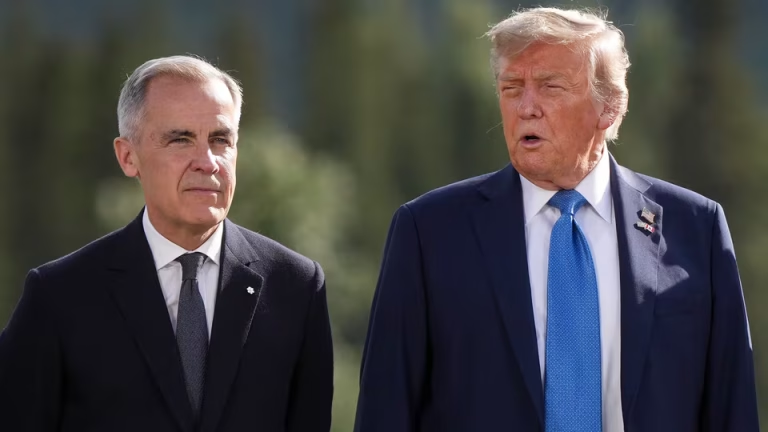
US President Donald Trump has declared plans to enforce a 35% tariff on goods from Canada beginning August 1, despite ongoing last-minute negotiations between both nations on a new trade agreement.
This policy declaration was made public through a letter shared on Trump’s personal social media page, in which he also issued broader warnings about similar tariff hikes—ranging from 15% to 20%—targeting other countries that trade with the United States.
Canadian Prime Minister Mark Carney responded by affirming that his administration remains dedicated to defending Canadian businesses and workers as discussions continue ahead of the self-imposed deadline.
This week alone, Trump has issued over 20 such letters to America’s global trade allies. He has also signaled that Europe will be the next focus of his escalating tariff campaign, with measures expected to be announced shortly.
He has promised that, like Canada, the new trade penalties on other countries will also be activated on August 1.
In addition to this latest warning, Canadian exports are already subject to a 25% general tariff, and previous waves of duties targeting steel, aluminum, and auto imports have already impacted the Canadian economy. However, certain goods still benefit from exemptions due to compliance with an existing North American trade pact.
At this point, it remains uncertain whether the newly announced tariff plans would override protections provided under the Canada-United States-Mexico Agreement (CUSMA).
Trump’s administration has also enacted sweeping tariffs globally, including a 50% duty on aluminum and steel, as well as a 25% import tax on all non-American-manufactured vehicles.
In another move, copper imports are expected to face a 50% tariff next month.
With roughly 75% of Canadian exports heading to the United States—and with Canada being a vital contributor to both the auto and metals sectors—these trade measures are particularly threatening to the nation’s economy.
Trump’s letter emphasized that the 35% duties are in addition to previously imposed tariffs on specific sectors.
“As you are aware, there will be no tariff if Canada, or companies within your country, decide to build or manufacture products within the United States,” Trump stated.
He went on to tie the tariffs to broader concerns, including “Canada’s failure” to prevent fentanyl from reaching American territory, as well as long-standing issues around dairy tariffs and trade imbalances.
“If Canada works with me to stop the flow of Fentanyl, we will, perhaps, consider an adjustment to this letter. These Tariffs may be modified, upward or downward, depending on our relationship with Your Country,” Trump said.
President Trump has in the past pointed fingers at both Canada and Mexico, accusing them of allowing “vast numbers of people to come in and fentanyl to come in” to the US.
In a post on X, Carney stated that Canada had taken significant action to “stop the scourge of fentanyl” and reiterated his country’s commitment to working closely with the US to ensure the safety of communities on both sides of the border.
According to figures from the US Customs and Border Patrol, only a very small fraction—around 0.2%—of fentanyl seizures occur at the border shared with Canada. The overwhelming majority are intercepted along the US-Mexico border.
Earlier in the year, Canada unveiled new funding for border control and appointed a special official to oversee fentanyl-related efforts, responding to rising pressure from Washington.
In recent months, officials from both countries have engaged in extensive dialogue aimed at forging a new bilateral trade and security framework.
During June’s G7 Summit, both leaders publicly reaffirmed their commitment to finalizing a deal within 30 days—setting July 21 as the target date.
Trump’s letter also warned that retaliatory action from Canada could provoke additional duties. Canada, for its part, has already applied some countermeasures and promised further responses if talks break down.
Toward the end of June, Carney repealed a tax targeting large US digital companies after Trump denounced it as a “blatant attack” and threatened to abandon trade discussions altogether.
Carney said the withdrawal of the tax was “part of a bigger negotiation” aimed at securing a broader trade agreement with the United States.
Senate Demands Answers As NNPCL Fails To Account For ₦210 Trillion In Audit Report

The Senate Committee on Public Accounts had previously summoned the Group Chief Executive Officer of NNPCL, Bayo Ojulari, to appear on July 10 to answer audit queries regarding the reported ₦210 trillion unaccounted for between 2017 and 2023.
This directive was issued during a session held on June 26, along with a warning that failure to honour the invitation could lead to the issuance of an arrest warrant. After Ojulari failed to appear on the specified date, the committee restated its position, emphasizing that he must show up in person to address the financial discrepancies flagged in the audit report.
Outcome Of The Senate Meeting
The Senate has stated that the Nigerian National Petroleum Company Limited (NNPCL) has not yet provided a proper account of the ₦210 trillion highlighted in the 2017–2023 audit report issued by the Office of the Auditor-General for the Federation.
This was revealed on Thursday by the Chairman of the Senate Committee on Public Accounts, Senator Aliyu Wadada, during a continued hearing on the audit report, which reviewed the expenditures of various Ministries, Departments, and Agencies (MDAs), according to the News Agency of Nigeria (NAN).
Wadada clarified that the Senate is not accusing NNPCL of theft but is demanding transparency and accountability regarding the ₦210 trillion flagged in the audit report.
“The Senate on Thursday clarified that the alleged N210 trillion financial infractions raised against Nigerian National Petroleum Company Limited (NNPCL) in the 2017-2023 audit report had yet to be accounted for by the company,” the source read in part.
It added that “Wadada maintained that NNPCL did not account for the said fund as raised by the reports, contrary to media reports that the money had been stolen by the company.”
NNPCL’s Group Chief Executive Officer, Bayo Ojulari, was absent at Thursday’s hearing, reportedly because of an OPEC meeting in Vienna.
However, the committee dismissed a presentation delivered by the company’s Chief Financial Officer, Dapo Segun, stressing that only Ojulari can personally address the audit concerns. Wadada emphasized that the Senate’s demand was not a personal attack but rather a constitutional responsibility to ensure accountability in the use of public resources.
Senator Abdul Ningi, also a member of the Senate Committee, expressed concern over Ojulari’s continued absence from committee hearings since his appointment, despite being notified of the latest invitation prior to the OPEC meeting.
In a related comment, Senator Adams Oshiomhole cautioned against disregarding the authority of the Senate, asserting that no individual is above the country and that such conduct is unacceptable in public service. He emphasized that the committee’s directive must be taken seriously, warning that further delays could trigger more stringent measures.
The committee has now ordered that NNPCL’s next appearance must be led by its Group CEO, Bayo Ojulari. The exact date for this appearance will be announced soon, and failure to comply could result in the Senate invoking its coercive powers.
