
Home Blog Page 123

‎Kwara Death Toll Rises To 170: Here Is What We Know About The Massacre

0

‎In a devastating escalation of violence in Nigeria’s North Central region, the death toll from a brutal attack on villages in Kwara State has risen to at least 170, according to local lawmakers and aid organizations.
‎
‎The assault, which targeted the remote communities of Woro and Nuku in Kaiama Local Government Area, has been described as one of the deadliest in the country this year.
‎
‎Reports vary on the exact number of casualties, with the Nigerian Red Cross confirming 162 deaths while others estimate higher figures. The attack highlights Nigeria’s ongoing security challenges, including jihadist insurgencies, banditry, and intercommunal conflicts.
‎
‎No group has claimed responsibility, but survivors and officials point to jihadist elements linked to groups like Boko Haram or ISIS, who had reportedly preached extremist doctrines in the area prior to the violence.

Details of the brutal attack
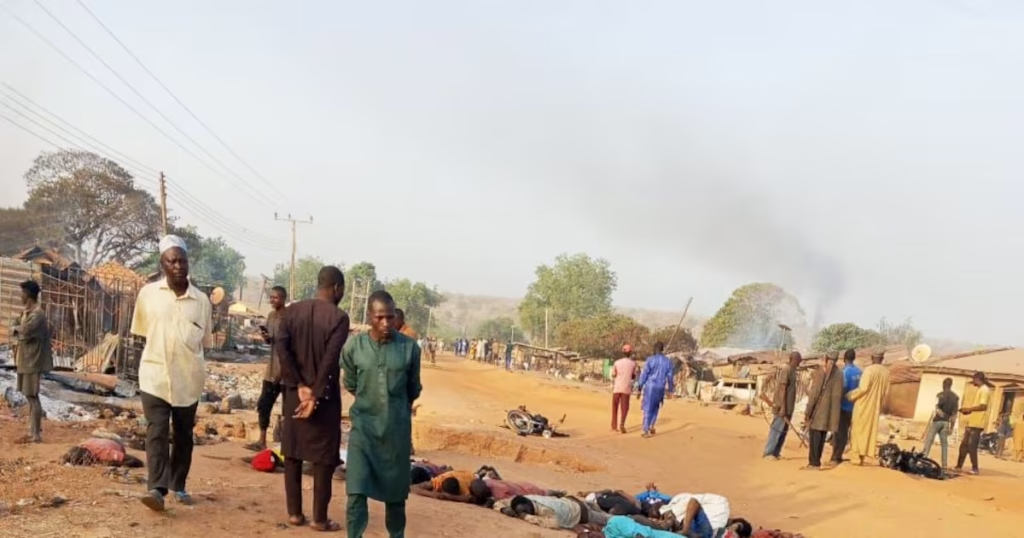
‎The attack unfolded on Tuesday evening around 6 p.m. local time, when heavily armed gunmen on motorcycles stormed Woro and Nuku villages. Eyewitnesses described a scene of chaos as the assailants encircled the communities, firing indiscriminately and rounding up residents.
‎
‎Many victims had their hands tied behind their backs before being executed, according to Saidu Baba Ahmed, a local lawmaker representing the Kaiama area.
‎
‎”The gunmen rounded up residents, bound their hands behind their backs and executed them,” Ahmed said, adding that he was on-site with military personnel sorting bodies and searching for more victims.
‎
‎Survivors recounted harrowing escapes. Umar Tanko, the village head of Woro, was away at his shop when the attackers struck.
‎
‎”I was away at my shop where I sell goods when an army of bandits arrived at my residence on Tuesday evening. My daughter and two sons were shot dead, while my second wife and two others were abducted,” Tanko said.
‎
‎Another resident, Razaq Abdulazeez, who lives on the outskirts, narrowly fled with his family.
‎
‎”I was returning home from work when I saw many people running towards the outskirts of the town. I asked what happened and was told they were escaping the wrath of bandits who had come to attack the community. I rushed to my house, packed my family members, and we escaped into the deep bush on the outskirts of the town. Many people who could not run out of town climbed trees to avoid the bandits’ attack,” he shared.
‎
‎The assailants also burnt homes, shops, and food silos, leaving the villages in ruins.
‎
‎Some footage seen showed bodies lying in pools of blood, some with bound hands, alongside burning structures.
‎
‎Amnesty International reported that the gunmen had sent “warning” letters to villagers for over five months, demanding they renounce allegiance to the Nigerian state in favor of Sharia law. When residents resisted during a sermon, the attackers opened fire.
‎
‎Among the victims were Salihu Bio Khalid, a nursing student and former student union president at Kwara State College of Nursing Sciences, who was killed alongside his brother.
‎
‎Death toll estimates have fluctuated as searches continue. Initial reports pegged the number at around 40, rising to 70 overnight and then to 162 by the Red Cross on Wednesday afternoon.
‎
‎Lawmaker Ahmed estimated up to 170, while Kwara Governor AbdulRahman AbdulRazaq cited 75 Muslim victims in a mass burial, describing the killings as targeted against those refusing extremist doctrines.
‎
‎Several people, including the traditional ruler, remain missing, and many fled into surrounding bushland with gunshot wounds. The Red Cross’s Babaomo Ayodeji noted that poor road conditions delayed response efforts, potentially contributing to the rising count.
‎
‎ These attacks underscore Nigeria’s multifaceted security crisis, with jihadists in the northeast, banditry and kidnappings in the northwest, and herder-farmer clashes in central regions.‎

Government Response


‎‎The Nigerian government has condemned the attack and mobilized security forces. Kwara State Police confirmed “scores were killed” and deployed police and military for search-and-rescue operations.
‎
‎Spokesperson Adetoun Ejire-Adeyemi stated that forces were combing the area, while a curfew had been imposed in parts of the state, with schools closed for weeks amid prior threats.
‎
‎Governor AbdulRazaq visited the communities on Wednesday night, accompanied by service chiefs and cabinet members.
‎
‎He described the incident as a “cowardly expression of frustration by terrorist cells” in response to ongoing military operations.
‎
‎”75 local Muslims were massacred simply for refusing to surrender to extremists who preached a strange doctrine,” he said, emphasizing it was a “pure massacre” unlike typical ransom kidnappings.
‎
‎The governor also announced a mass burial for 75 victims and called for intensified security measures.
‎
‎At the federal level, the Peoples Democratic Party (PDP) in Kwara condemned the attack and urged humanitarian aid and justice for perpetrators.
‎
‎The Kwara State House of Assembly Speaker Yakubu Danladi-Salihu and Senator Saliu Mustapha echoed calls for more troops.‎

Tinubu Deploys army battalion

‎In a swift response, President Bola Tinubu directed the immediate deployment of an army battalion to Kwara State to launch counter-offensives.
‎
‎Codenamed “Operation Savannah Shield,” the operation aims to flush out terrorist elements and restore security.
‎
‎Governor AbdulRazaq revealed the president’s approval during his visit, stating it would prosecute aggressive actions against the attackers.
‎
‎Presidential spokesperson Bayo Onanuga condemned the “dastardly act” and assured that perpetrators would “pay the ultimate price.”
‎
‎This move signals a strategic shift, with intelligence indicating growing terrorist entrenchment in Kwara, a region bordering Niger State where banditry is rampant.
‎
‎The deployment addresses regional anxieties, as neighboring governors hold emergency meetings to bolster defenses.
‎
‎However, it highlights the Nigerian military’s overstretched resources amid multiple fronts, including insurgencies in the Northeast and separatist issues in the Southeast.
‎

U.S. Sent Military Team to Nigeria

‎The massacre coincides with increased international involvement, as the United States confirmed the deployment of a small team of military officers to Nigeria to assist in countering the security crisis.
‎
‎U.S. Africa Command (AFRICOM) head Gen. Dagvin R.M. Anderson announced the move on Tuesday, stating the team would focus on intelligence support, training, and enhancing cooperation at Nigeria’s request.
‎
‎Nigerian Defense Minister Christopher Musa confirmed the presence of the U.S. troops, marking the first public acknowledgment of such assistance under the current administration.
‎
‎This deployment comes amid surging violence and follows U.S. scrutiny of Nigeria’s handling of jihadist threats.
‎
‎Critics have accused Nigerian authorities of failing to prioritize public safety, prompting international attention.
‎
‎ The U.S. team aims to bolster efforts against groups like Boko Haram and ISIL, which have expanded beyond the Northeast.
‎
‎While welcomed by some, it raises questions about sovereignty and the long-term impact on Nigeria’s security landscape.

82 Kidnapped Church Worshippers Released – Governor Sani

0

Governor Uba Sani of Kaduna State has confirmed the release of 82 worshippers who were abducted by bandits during a church service in Kurmin Wali village, Kajuru Local Government Area, on January 18, 2026.

The governor disclosed this during a visit to the freed victims at the Women and Children Shelter in Kaduna, where they are undergoing medical treatment and receiving psychosocial care.

The worshippers were among 177 congregants taken hostage when bandits stormed the village during a church service. Eleven victims had earlier regained their freedom, leaving 166 in captivity before the latest release.

While addressing the victims, Governor Sani sympathised with them over their traumatic experience and assured residents of Kurmin Wali that sustained efforts were underway to rescue those still held by the abductors.

He expressed confidence that the remaining captives would be released within the next few days.

The governor reaffirmed his administration’s determination to eradicate banditry and kidnapping across Kaduna State, emphasising that every necessary step would be taken until all captives are safely rescued and reunited with their families.

He also praised security agencies for their bravery, prompt action and commitment to combating criminal activities, and called on residents to continue supporting security efforts to restore lasting peace in affected communities.

According to Governor Sani, “It was with a heavy yet hopeful heart that I visited our courageous brothers and sisters from Kurmin Wali at the Kaduna State Women and Children’s Shelter, where they are receiving medical care and psychosocial support after their return from the harrowing grip of banditry.

“The encounter was deeply moving, a solemn reminder of the cost of insecurity, and at the same time a testament to the resilience of our people. I am encouraged by the positive response to treatment and confident that, in due course, they will be medically and psychologically certified fit to reunite with their families and reclaim the rhythms of normal life.

“Despite their ordeal, the survivors received me with visible warmth and optimism. Their expressions of gratitude to the Kaduna State Government, coupled with their determination to put this painful experience behind them, spoke volumes about their strength of character and enduring hope.

“Our duty does not end with care and compassion. The Kaduna State Government remains steadfast in working closely with security agencies to secure the release of those still in captivity and ensure their safe return. In furtherance of this resolve, I have made a strong and compelling case to the Office of the National Security Adviser, the Honourable Minister of Defence, and the Chief of Defence Staff for the establishment of a military base in Kurmin Wali.

“This critical step will significantly enhance security in the area and its environs, affirming our unyielding commitment to protect lives, restore peace, and uphold the dignity of every citizen of Kaduna State.”

Kogi Government Orders Temporary School Closure

0

The Kogi State Government has ordered a temporary shutdown of schools statewide as part of precautionary steps informed by credible intelligence to protect pupils, students, and teachers.

In a message circulated to members, Reuben Jimoh, Chairman of the National Association of Proprietors of Private Schools (NAPPS), Kogi State Chapter, disclosed that the government has brought forward the midterm break.

He explained that the break will now function as an emergency lockdown, running until February 16, 2026.

Addressing journalists in Lokoja on Tuesday, the State Commissioner for Information and Communications, Kingsley Fanwo, said the move was driven by responsibility rather than fear, stressing that the government opted for early action instead of waiting for preventable incidents.

“The safety of our children, teachers, and educational institutions remains non-negotiable. This administration will always prioritize lives while ensuring continuity in governance and education,” Fanwo said.

The commissioner added that Governor Usman Ododo has instructed all relevant agencies to put in place necessary measures to enable schools to resume academic activities once it is safe, with minimal disruption to the academic calendar.

Fanwo also praised security agencies for providing timely and actionable intelligence, describing the collaboration as proof of the strength of Kogi’s security framework.

He assured residents that the government remains fully in control of the situation, with security agencies operating round the clock to identify, locate, and decisively dismantle criminal hideouts.

Senate Urges Tinubu To Establish Military Barracks In Katsina

0

The Senate on Wednesday expressed deep concern over the deteriorating security situation in Katsina State, particularly in the Funtua Zone, after fresh bandit attacks reportedly left at least 35 people dead within 24 hours across three local government areas.

Lawmakers called on President Bola Tinubu to urgently implement his promise to set up a military barracks in the area, while warning against any negotiations with armed groups terrorising rural communities.

The issue was raised through a motion of urgent public importance under Order 42, sponsored by Senator Dandutse Mohammed of Katsina South, demanding immediate and comprehensive federal intervention to stop the escalating violence.

The President of the Senate, Godswill Akpabio, admitted the motion for debate after it received overwhelming support from senators.

Moving the motion, Dandutse said Katsina had been plunged into mourning by a renewed wave of coordinated attacks, including an ambush on Mobile Police Force personnel in Guga, Bako Local Government Area, where three policemen were killed and two others critically injured.

He further revealed that by Tuesday, at least 35 people had been killed in attacks across the Funtua Zone within less than 24 hours.

According to him, 24 people were killed in Faskari Local Government Area, eight in Bakori, two in Funtua Local Government Area, and one in Kankara Local Government Area.

The lawmaker warned that the ongoing violence had left more than 50,000 farmlands uncultivated, threatening food security, agricultural productivity, and the livelihoods of residents in the largely agrarian zone.

He said, “The continuous bandit attacks on communities will significantly affect food production and agricultural activities, as more than 50,000 farmlands are presently inaccessible, thereby jeopardising food security and the livelihoods of the people.

“The Governor of Katsina State led a delegation of elders from Funtua Zone, where issues of insecurity were raised, and Mr President pledged to site a military barracks in the area.

“I urge President Bola Tinubu and the security agencies to ensure rapid and sustained intervention until all criminal elements are eliminated. I also urge him to fulfil his pledge to establish a new military barracks in the Funtua Zone.”

Seconding the motion, Deputy Senate President Senator Jibrin Barau said the Federal Government had already directed the military to intensify operations in Katsina, particularly in the Funtua axis.

While commending the armed forces and Katsina State Government for ongoing efforts, Barau stressed the need for increased troop deployment, advanced technology, and more decisive action.

He said, “I am aware that Mr President had instructed the military to be fully engaged in Katsina, particularly around the Funtua axis, to tackle the menace of banditry.

“The military is doing well, and I commend them, but the determination of these bandits shows that we need to do more. We need to add more force, deploy more technology, and deal with this situation decisively.

“I strongly support this motion because of its importance to food security and national stability.”

Contributing, Senator Mohammed Tahir Monguno of Borno North described the motion as timely and relevant, noting that security is the foremost responsibility of government.

He warned that the worsening situation in Katsina was already undermining national food supply chains and urged full implementation of plans to establish a permanent military formation in the area.

“This clearly shows that this Senate is responsible and responsive to the yearnings of the Nigerian people, especially on matters of security.

“This area is an agricultural heartland where large quantities of food and cash crops are produced, but insecurity has displaced farmers and disrupted food production.

“I urge that the directive of Mr President to establish a military formation in the area should be fully implemented as captured in the prayers of this motion,” he stated.

Senator Ahmed Wadada of Nasarawa West warned against negotiating with bandits, describing such engagements as counterproductive and dangerous.

He stressed the importance of effective intelligence gathering and called on communities to support security agencies with timely and credible information.

“Security is everything. If a society is not secure, it cannot achieve anything meaningful. It is disastrous and unacceptable for any individual or group to negotiate with bandits.

“Negotiating with bandits empowers them on one hand while pretending to fight them on the other. These criminals are indoctrinated and driven by extremism; negotiation does not yield lasting peace.

“We must face them squarely, using intelligence as the first line of action. I strongly advise against negotiating with bandits, as recent experiences have shown that it does not produce the desired peace.”

Following the debate, the Senate resolved to urge President Tinubu to fulfil his pledge to establish a military barracks in the Funtua Zone; direct the Inspector-General of Police to equip the newly established police squadron in the area with at least three Armoured Personnel Carriers, and call on the Federal Ministry of Humanitarian Affairs and the National Emergency Management Agency to provide immediate relief to affected families and communities.

The chamber also observed a one-minute silence in honour of those killed in the attacks.

In a related contribution, Senator Titus Zam of Benue North sympathised with the people of Katsina and noted that while sustained military operations had reduced attacks in parts of Benue State, fresh killings had recently occurred in Kwande Local Government Area.

He urged the military to further intensify operations nationwide.

In his closing remarks, Senate President Akpabio acknowledged lawmakers’ anger and frustration over the continued insecurity across the country, assuring that the National Assembly would prioritise increased funding for the military in the 2026 budget.

He noted that Nigeria’s vast territorial size made it impractical to station troops in every community, advocating greater use of modern surveillance technology, including sophisticated drones, to secure hard-to-reach areas.

Akpabio also warned against collaboration with criminals, emphasising that intelligence leaks from within communities often undermine security operations.

He assured senators that the chamber’s resolutions would be followed up with the executive to ensure not only approvals but timely release of funds, expressing optimism that sustained efforts would eventually end banditry.

Three months ago, the Senate urged President Tinubu to approve the recruitment of 100,000 additional military personnel to confront rising insurgency and banditry across the country.

The call followed an attack on Government Girls’ Secondary School, Maga, in Kebbi State, where gunmen reportedly killed a vice-principal and abducted 25 students.

The incident sparked a heated debate during plenary after additional prayers were raised by Senator Adams Oshiomhole of Edo North, highlighting growing legislative concern over Nigeria’s worsening security situation.

‎How To Check 2025 NECO SSCE Results

0

‎The National Examinations Council (NECO) has released the 2025 Senior School Certificate Examination (SSCE) External results.
‎
‎It was announced by Registrar Prof. Dantani Ibrahim Wushishi on February 3, 2026, in Minna, Niger State, that over 80% of candidates achieved five credits or more.
‎
‎ 96,979 registered (95,160 sat), 71.63% got five credits including English and Mathematics, while 86.26% did so irrespective of those subjects. Candidates can now check results online or via SMS.
‎
‎To check your 2025 NECO SSCE results, whether for the Internal (June/July) or External (Nov/Dec) examination, here is a clear step-by-step Guide.
‎‎‎

Step-by-Step Guide to Check 2025 NECO Results Online

Purchase a Result-Checking Token (if you don’t have one)
‎
‎• Visit the official NECO results portal at https://results.neco.gov.ng/.

‎ • On the homepage, look for the “Purchase Token” option (it may be under a login or dashboard section).

‎ • If you’re a new user, create an account by providing your email address, phone number, and a password. If you already have an account, log in.

‎ • Once logged in, navigate to the “Purchase Token” section.

‎ • Select the payment method (typically via debit/credit card, bank transfer, or other online payment gateways like Remita).

‎ • Pay the required fee (around 1,000 Naira; confirm the exact amount on the site as it may vary slightly).

‎ • After successful payment, the token (a 12-digit PIN) will be displayed on your dashboard or sent to your registered email. Note it down securely.
‎
‎Note that a result-checking token is required for both online and SMS methods. The token costs approximately 1,000 Naira and can be used up to five times per result.
‎
‎ If payment fails, check your card details, ensure sufficient funds, or try a different payment option. Tokens are non-refundable, so verify all details before confirming.
‎
‎Access the Results Portal

• Go back to https://results.neco.gov.ng/ using a web browser on your computer, smartphone, or tablet. Ensure you have a reliable internet connection to avoid interruptions.
‎
‎Select Examination Details
‎ • On the portal’s main page, select the “Check Result” button.
‎ • Choose the examination year from the dropdown menu: Select “2025”.
‎ • Choose the examination type: Select “SSCE Internal (June/July)” if you took the school-based exam, or “SSCE External (Nov/Dec)” if you took the private candidate exam.
‎
‎Enter Your Details
‎ Ensure you have your examination registration number handy, as it’s a unique 10-digit or 12-digit alphanumeric code provided during registration
‎
‎• Input your examination registration number in the provided field (e.g., 12345678AB).
‎ • Enter the 12-digit token PIN you purchased.
‎ • Complete any CAPTCHA or security verification if prompted to prevent automated access.
‎
‎Submit and View Results
‎ • Click the “Check My Result” or “Submit” button.
‎ • Your result will load on the screen, showing your grades for each subject, overall performance, and any remarks.
‎ • Review the details carefully. If everything is correct, you can print the result slip by clicking the “Print” button or save it as a PDF for records.
‎
If the result shows “No Record Found” or an error, confirm you’re using the correct year and type. For External results specifically released in 2026, ensure the portal has been updated.
‎
‎Contact NECO support at support@neco.gov.ng if issues persist. Also, note that results may be withheld or pending due to malpractice investigations; check the status message.
‎
‎Logout and Secure Your Information
‎After viewing, log out of your account to protect your privacy, especially on shared devices.

‎Step-by-Step Guide to Check 2025 NECO Results via SMS

‎This method is useful if you have limited internet access but requires at least N50 airtime on your phone (plus the token cost). It’s quick but provides a summarized version of your results without the full grade breakdown.
‎
‎Purchase a Token
‎ Follow the online purchase steps above, or buy one from authorized NECO outlets if available (though online is recommended for convenience).
‎
‎Prepare Your SMS
‎ • Open your phone’s messaging app.

‎ • Compose a new message in this exact format (without spaces or quotes): NECOExamRegistrationNumberTokenPINExamYear. ‎
• Example: If your registration number is 12345678AB, token is 123456789012, and year is 2025, type: NECO12345678AB1234567890122025.
‎
‎Send the Message
‎• Send the SMS to the short code 32327.
‎• This works on major Nigerian networks like MTN, Airtel, Glo, or 9mobile. Ensure you have sufficient airtime, as the service charges a fee (typically N50 per SMS).
‎
‎Receive and Review Your Result
‎ •Wait for a reply SMS from NECO, which should arrive within minutes containing your subject grades and overall performance.
‎ •If no response, check your message format, resend, or ensure network coverage. Avoid multiple sends to prevent extra charges.
‎
‎
‎SMS results are concise; for a detailed printout, use the online method. If the SMS fails repeatedly, it could indicate portal downtime. Try online instead.
‎
‎By following these steps, you can easily access your 2025 NECO SSCE results.
‎
‎If you encounter issues like invalid details or network errors, double-check your inputs, ensure a stable internet connection, or try during off-peak hours.
‎
‎For security, avoid sharing your token or registration number with unauthorized parties.
‎
‎Remember, these certificates are crucial for further education or job applications, so keep them safe and consider verifying them through NECO’s e-Verify system if needed for official purposes.
‎
‎If you need to resit or improve grades, check NECO’s website for upcoming registration details https://www.neco.gov.ng.

Israeli Airstrikes Kill 20 In Gaza Following Wounded Israeli Soldier

0

At least 20 Palestinians, including children and a paramedic, have been killed and nearly 40 others injured in Israeli strikes across Gaza, according to hospital officials. Several of the victims were taken to Nasser Hospital in the southern city of Khan Younis, while others were received at Al-Shifa Hospital in Gaza City.

The Israeli military said its tanks and aircraft carried out what it described as “precise strikes” targeting individuals it labelled as “terrorists” after Israeli troops came under fire in northern Gaza, leaving an officer seriously wounded.

According to the military, the incident occurred near the Yellow Line, beyond which Israeli forces are deployed inside Gaza, and amounted to a “blatant violation” of the three-month-old ceasefire agreement with Hamas.

Hamas rejected Israel’s explanation, accusing it of using the shooting as “a flimsy pretext to justify the continuation of killing and aggression against our people”.
Al-Shifa Hospital said it received 13 bodies, including five children, after tents sheltering displaced families and residential homes were struck in the eastern Zeitoun and Tuffah neighbourhoods of Gaza City.

Among those mourning at the hospital was Abu Mohammed Haboush, who said his family was asleep when their home was shelled.
“Our children were martyred – my son was martyred, my brother’s son and daughter were martyred,” he told Reuters.

“We have nothing to do with anything, we are peaceful people.”
Nasser Hospital reported receiving four bodies, including one child, following strikes on tents in the southern Qizan Rashwan area. Hospital officials later confirmed that two sisters, Rahaf and Remas Abu Jamea, along with paramedic Hussein al-Samiri, were killed in a separate attack in the coastal al-Mawasi area west of Khan Younis.

A first responder from Gaza’s Hamas-run Civil Defence agency, Jihad al-Hinnawi, said the paramedic had rushed to assist victims of an initial strike on a tent in al-Mawasi before being killed in a second strike on the same location.

The Palestinian Red Crescent confirmed that Samiri was killed “while carrying out his humanitarian duty in Khan Younis” and accused the Israeli military of a “grave violation” of international humanitarian law, which protects medical personnel.
An Israeli military source later confirmed that strikes were carried out in Gaza on Wednesday in response to the shooting that wounded the Israeli officer.

Israel and Hamas have repeatedly accused each other of near-daily ceasefire violations since the truce came into effect on 10 October. On Sunday alone, more than 30 people were reported killed in Israeli strikes across Gaza. Israel said those attacks followed an incident in which gunmen emerged from a tunnel in the southern Rafah area, beyond the Yellow Line.

According to Gaza’s Hamas-run health ministry, at least 556 people have been killed by Israeli fire since the ceasefire began, while the Israeli military says four of its soldiers have been killed in Palestinian attacks during the same period.
The conflict began after the Hamas-led attack on southern Israel on 7 October 2023, which killed about 1,200 people and saw 251 others taken hostage. Israel’s subsequent military campaign in Gaza has resulted in more than 71,820 deaths, according to the territory’s health ministry.

Tinubu Requests World Bank Backing To Drive Agricultural Growth And Economic Reforms

0

President Bola Tinubu has appealed to the World Bank for support in advancing Nigeria’s ongoing economic reforms, with particular emphasis on agriculture, youth employment, and private sector expansion, as part of efforts to strengthen the economy and widen opportunities for citizens.

The President made the call on Tuesday while hosting a World Bank delegation led by its Managing Director of Operations, Anna Bjerde, at the State House in Abuja.

“Since we went into this tunnel of reform, we have our hands on the power and we’re never going to look back. Initially, it was painful and difficult, but those who win are not the ones who give up in difficult times,” Tinubu said.

He stressed that mechanisation and modernisation of the agricultural sector are critical to boosting productivity and unlocking opportunities for Nigeria’s large youth population.

“We have mechanization centers to help farmers with improved seedings and fertilizers to enhance their programs. The goal is to move farmers from small-scale holders to large cooperatives that can create opportunities for Nigerians,” he explained.

Tinubu also identified the petrochemical industry and other local sectors as key areas where the government is working to raise output and strengthen domestic markets, adding that reforms must be continuous and anchored on transparency, accountability, and stability.

“The first reaction to reforms was high inflation, but it has come down dramatically, and the Naira is now stable. We want to help investors operate with ease, reduce bureaucracy, and develop the skills of our people,” he said.

Anna Bjerde praised the Tinubu administration for maintaining a consistent and measured reform agenda over the past two years, noting that Nigeria has emerged as a global reference point for reform implementation, which has boosted confidence among investors and policymakers.

“The results achieved in the last two years are commendable. Your steady communication of the importance of reforms has given confidence and clarity, and there is no turning back,” Bjerde said.

She underscored the need for job creation, especially for young people, pointing out that Africa’s youth population is expanding rapidly and that small and medium-sized enterprises play a central role in generating employment.

“Agriculture is a huge part of the economy and a major employer. Innovations in mechanization, cooperatives, value-chain development, and infrastructure can be scaled to create more opportunities,” Bjerde said.

Bjerde further outlined the World Bank’s financial commitments to Nigeria, including $17 billion in public sector financing, $5 billion in private sector support through the International Finance Corporation, and investment guarantees of more than $500 million.

She explained that these funding instruments align with Nigeria’s reform priorities in areas such as trade, digital development, and inflation control, aimed at stimulating private sector growth and improving human development outcomes.

“We want to work with Nigeria to accelerate growth, improve access to finance for SMEs, and support early childhood development as part of a comprehensive human development strategy,” she added.

The engagement highlighted Nigeria’s drive to secure international support for key reforms, particularly in sectors that directly influence youth employment, food security, and overall economic development.

Senate Calls For Mandatory Antivenom Availability In Hospitals After Abuja Singer’s Death

0

The Senate on Tuesday called on state governments and the Federal Capital Territory Administration to set up coordinated emergency referral and response systems connecting public and private hospitals, amid rising concerns over preventable deaths caused by poorly managed medical emergencies.

Lawmakers said such a system would guarantee swift access to life-saving drugs, especially in emergencies like snakebites, scorpion stings, poisoning, and drug overdoses, where delays are often deadly.

The decision followed the adoption of a motion sponsored by Senator Idiat Oluranti Adebule (APC, Lagos West), titled “Urgent Need for the Federal and State Governments to ensure adequate stocking, availability, and access to life-saving antidotes and emergency medicines in Public and Private Hospitals across Nigeria.”

The motion was triggered by widespread public anger over the death of Abuja-based singer Ifunanya Nwangene, who reportedly died after a snakebite due to delays in accessing antivenom.

News of Nwangene’s death gained traction over the weekend after her choir confirmed the incident in a Facebook statement signed by its Music Director, Sam Ezugwu.

Reports alleged that she sought emergency treatment at two hospitals but was not attended to because antivenom was unavailable.

The management of the Federal Medical Centre, Abuja, where she was later taken, however stated that its medical team made determined efforts to save her, but those efforts did not succeed.

While presenting the motion, Adebule said Nigeria was witnessing a troubling increase in emergency cases that require immediate medical attention, adding that gaps in hospital readiness were resulting in unnecessary loss of lives.

“Nigeria continues to record increasing cases of medical emergencies, including snakebites, scorpion stings, poisoning, drug overdoses, and other forms of envenomation, all of which require the immediate administration of specific antidotes and emergency medicines in both public and private hospitals to prevent avoidable deaths and irreversible health complications,” she said.

She added, “We also note with grave concern the tragic and avoidable death of Miss Ifunanya Nwangene, who reportedly died following a snakebite in Abuja, thereby revealing serious gaps in emergency preparedness and antidote availability within public and private hospitals in Nigeria.”

The senator further noted that the World Health Organisation categorises snakebite envenoming as a neglected tropical disease and emphasises the need for timely access to safe and effective antivenoms, particularly in countries like Nigeria where such cases are prevalent.

Adebule also said the Senate was worried that many public and private hospitals across the country either do not stock essential life-saving antidotes such as antivenoms and anti-toxins or keep inadequate supplies, resulting in dangerous treatment delays, unnecessary referrals, and avoidable deaths.

She stated, “We are concerned that victims of snakebites and other poisoning emergencies are frequently compelled to move from one public hospital to a private hospital, or vice versa, in search of antidotes during the critical ‘golden hour,’ thereby substantially increasing mortality and morbidity rates.”

After deliberations, the Senate urged the Federal Ministry of Health and Social Welfare, in collaboration with the National Agency for Food and Drug Administration and Control, to ensure the procurement, quality assurance, proper storage, and nationwide distribution of safe, effective, and affordable antivenoms and other vital antidotes, with special focus on high-risk areas.

Lawmakers also appealed to state governments, through their ministries of health and hospital management boards, to immediately conduct audits of public and private hospitals to determine compliance with antidote stocking and emergency preparedness requirements.

In addition, the Senate directed relevant professional and regulatory bodies to strengthen emergency response guidelines and mandate regular training for healthcare workers on the correct use of antidotes.

It further called on health regulatory authorities to make the availability of essential antidotes a compulsory condition for licensing, registration, and renewal of accreditation for private hospitals, while ensuring adequate funding and supply systems for public hospitals.

The senators also requested that the Federal Ministry of Housing and Urban Development reinforce the National Building Code by making Non-Return Valves compulsory in buildings to prevent snakes and rodents from entering homes through drainage channels.

During the session, the Senate observed a minute of silence in memory of the late Ifunanya Nwangene.

Soldiers And Forest Guards Secure Kwara Communities As Death Toll Rises To 40

0

After the bandit attack on Woro and Nuku communities in Kaiama Local Government Area of Kwara State on Tuesday evening, soldiers and forest guards have been deployed to the affected areas, while the number of those killed has risen to forty.

A dependable source within the local government confirmed the development on Wednesday morning, speaking to journalists on the condition of anonymity.

“The casualties are over Forty as we speak, and soldiers and Forest Guards have taken over the two communities. It’s such a very sad development at a time we think we are having peace from the bandits’ attacks of the past,” she said.

The attack occurred on Tuesday evening when bandits launched a fresh assault on Woro and Nuku communities in Kaiama Local Government Area.

Investigations showed that many families were bereaved during the violence, and several houses were allegedly burnt by the attackers.

Sources disclosed that the assailants, suspected to have come from nearby villages in Niger State, reportedly entered the communities to preach to residents, urging them to abandon the Nigerian Constitution and adopt the Qur’an.

It was further learned that the same group had earlier gone around villages in Niger State delivering similar messages before making their way into the affected communities in Kaiama Local Government Area of Kwara State.

During the preaching, some members of the congregation reportedly objected to the message, a development that enraged the bandits and led them to open fire.

“The angry bandits open attack indiscriminately on the congregation, and no fewer than forty residents of the two communities died; few of them escaped.
They should be preparing mass burial for them as we speak,” the source said, requesting anonymity.

Meanwhile, the Kwara State Government has confirmed the attack in a statement issued by the Chief Press Secretary to the Governor, Rafiu Ajakaye.

According to the statement, Governor Abdulrahman Abdulrazaq expressed deep sorrow over the attack in Kaiama and noted that security agencies were making progress in counterterrorism efforts.

“Kwara State Governor AbdulRahman AbdulRazaq is saddened by the cowardly attack on civilians in Woro and Nuku communities of Kaiama Local Government Area.

“The Governor condemns the attack, which he says is a cowardly expression of frustration by terrorist cells following the ongoing counterterrorism campaigns in parts of the state and the successes so far recorded.

“Governor AbdulRazaq says the attack was apparently to distract the security forces who have successfully hunted down several terrorist and kidnapping gangs across many parts of the state.

“The Governor expresses heartfelt condolences to Woro and Nuku communities on the sad incident, especially the families affected in the Tuesday attack,” he said.

Senate Moves To Increase Federal Government Share Of Federation Revenue

0

The Senate on Tuesday initiated steps to amend the 1999 Constitution to raise the Federal Government’s share of revenue from the Federation Account, saying the current formula no longer matches the scale of responsibilities handled by the centre.

The proposed constitutional change comes amid renewed discussions on fiscal federalism, following criticism from labour unions, civil society organisations, and opposition figures who argue that higher allocations to states have not improved citizens’ welfare.

Under the existing revenue allocation formula, the Federal Government receives 52.68 percent of federation revenue, the 36 states receive 26.72 percent, while the 774 local government councils share 20.60 percent.

Despite already receiving the largest portion, the Senate, through a bill sponsored by Senator Sunday Karimi of APC, Kogi West, is pushing for an increase in the Federal Government’s allocation.

The bill passed its first reading at plenary and seeks to amend constitutional provisions governing revenue distribution among the three tiers of government.

“The proposed alteration seeks to increase federal government revenue allocation to address mounting financial obligations and national responsibilities across Nigeria.

“The current revenue sharing formula is outdated and unsustainable because it places excessive financial pressure on the federal government amid rising infrastructure decay and insecurity nationwide,” he stated.

Karimi said there was an urgent need to revise the formula to grant the Federal Government a higher share so it can effectively carry out its statutory duties.

“There is a need for adjustment in the revenue allocation coming to the Federal Government so that we can have a slight increase in what is coming to the Federal Government for it to meet its responsibilities,” he said.

He explained that limited funding has continued to hinder the maintenance of federal roads and efforts to combat banditry and terrorism nationwide.

“Responsibilities borne by the Federal Government, particularly the construction and maintenance of federal roads across the country, have become overwhelming under the existing revenue formula aside from the enormous responsibilities on internal security.

“So what is needed now is an adjustment in the revenue allocation formula to increase the federal government allocation,” he added.

Karimi expressed optimism that an increased allocation to the Federal Government would strengthen Nigeria’s ability to tackle insecurity and address infrastructure decay.
