Home Blog Page 139

Tinubu Appoints EFCC Prosecutor Oyedepo As New Director Of Public Prosecutions

0

President Bola Tinubu has approved the appointment of Mr. Rotimi Oyedepo (SAN) as Director of Public Prosecutions in the Federal Ministry of Justice, following his transfer from the Economic and Financial Crimes Commission to the mainstream Federal Civil Service.

The approval was communicated in a letter dated December 23 and signed by Omolabake Mafe on behalf of the Chairman of the Federal Civil Service Commission, and the development was announced on Tuesday by the State House Director of Information and Public Relations, Abiodun Oladunjoye.

“Mr. Oyedepo’s appointment was made in the public interest,” the letter stated.

At 42, Oyedepo will assume the role left vacant by the retirement of Mr. Abubakar Babadoko, who completes his mandatory eight-year tenure as a director on December 31, 2025.

The Presidency said Oyedepo played a pivotal role as part of the Federal Government’s legal team in the landmark Process and Industrial Developments Limited versus Federal Republic of Nigeria case, widely known as the P&ID case, which resulted in Nigeria’s decisive victory at the London High Court in October 2023.

In a judgment delivered on October 23, 2023, Justice Robin Knowles of the English High Court overturned an $11bn arbitral award that P&ID had secured against Nigeria through fraud, bribery, and perjury.

The arbitral award, initially valued at $6.6bn when issued in January 2017, had risen to more than $11bn by 2023 due to accumulated interest, an amount equivalent to almost one-third of Nigeria’s annual budget at the time.

Justice Knowles ruled that P&ID obtained the award through “severe abuses of the arbitral process,” including the bribery of Nigerian officials, the presentation of false evidence, and the improper acquisition and retention of privileged Nigerian government documents by P&ID’s lawyers.

“The awards were obtained by fraud,” Justice Knowles declared, adding that “the Arbitration was a shell that got nowhere near the truth.”

The judge also condemned the conduct of P&ID’s lawyers in handling privileged materials as “indefensible,” noting that they stood to earn “life-changing sums of money”, estimated at up to £3bn for the solicitor and as much as £850m for the King’s Counsel, had the claim succeeded.

Nigeria’s legal team, which included Oyedepo, successfully argued that enforcing the award would violate public policy, leading the High Court to refuse enforcement and ultimately nullify the entire award.

The Tinubu administration said the outcome of the case spared Nigeria from a potentially crippling financial burden that could have severely constrained government spending on education, healthcare, and infrastructure for many years.

Before his appointment, Oyedepo spent more than 15 years at the EFCC, where he specialised in prosecuting complex economic and financial crimes.

He also served as Head of the Monitoring Unit at the anti-graft agency, earning a reputation as one of the country’s most effective prosecutors of financial crimes.

In recognition of his contributions, Oyedepo was named EFCC Outstanding Staff of the Year in 2014 and Best Financial Crimes Prosecutor in 2019.

His prosecutorial record includes high-profile corruption cases involving former Central Bank Governor Godwin Emefiele, former Attorney General of the Federation Mohammed Adoke, and several other public officials and corporate executives accused of economic sabotage.

Oyedepo graduated with a law degree from the University of Ilorin in 2007 and attended the Nigerian Law School in 2008, where he was called to the Nigerian Bar.

He was conferred with the rank of Senior Advocate of Nigeria in 2022.

According to the Presidency, Oyedepo is expected to “deploy his expertise to reduce reliance on external counsel for critical prosecutions and to ensure greater coherence and consistency in the Federal Government’s legal strategies.”

The Director of Public Prosecutions serves as the chief law officer in charge of public prosecutions in Nigeria and operates directly under the Attorney-General of the Federation.

The role entails oversight of all criminal prosecutions initiated by the Federal Government, the provision of legal advice on prosecutorial matters, and the promotion of uniform application of criminal law across federal jurisdictions.

The DPP also represents the Federal Government in criminal appeals before the Court of Appeal and the Supreme Court, coordinates with state Directors of Public Prosecution on interstate criminal matters, and advises on international criminal cooperation.

Otedola Sells Geregu Power Shares: Meet The New Owners

0

In a major development for Nigeria’s power sector, billionaire investor Femi Otedola has sold his controlling interest in Geregu Power Plc, ending more than a decade of direct influence over one of the country’s most important electricity generation companies.

The transaction, valued at about $750 million (approximately N1.088 trillion), was completed on December 29, 2025, and transfers indirect control of Geregu Power to MA’AM Energy Limited.

The deal marks a turning point for Geregu Power, which Otedola transformed from a struggling asset into a flagship power company after acquiring it during the 2013 privatization exercise.

It also ushers in a new ownership structure, a reconstituted board, and fresh political and business interests into one of Nigeria’s most strategic power assets.

Under the agreement, MA’AM Energy acquired 95 percent of Amperion Power Distribution Company Limited, Otedola’s investment vehicle that held a 77 percent controlling stake in Geregu Power.

While Geregu’s direct shareholding on the Nigerian Exchange remains unchanged, effective control has shifted. The transaction was financed by a consortium of lenders led by Zenith Bank Plc, with BlackBirch Capital acting as financial adviser.

Former Zamfara State Governor and Senator Abdul-Aziz Abubakar Yari has emerged as the new chairman of Geregu Power’s board, signaling a sweeping governance transition.

Since its listing on the NGX in October 2022 at a valuation of N250 billion, Geregu Power’s market capitalization has climbed to about N2.9 trillion. With an installed capacity of 435 megawatts, the plant contributes roughly 10 percent of Nigeria’s grid electricity supply, making the ownership change a matter of national economic significance.

Why Otedola Sold His Stake

Otedola’s exit from Geregu Power appears to be a calculated strategic shift rather than a retreat from business. Sources close to the billionaire say the sale is driven by his growing focus on the financial services sector, particularly banking.

He is currently the single largest shareholder in First HoldCo Plc, the parent company of First Bank of Nigeria, with a 17.01 percent stake.

The proceeds from the Geregu transaction are expected to be deployed toward increasing his holdings in First HoldCo, where he has steadily built influence.

His earlier investments helped push First Bank’s share price from about N5 to N53 by late 2025, reinforcing confidence in his long-term banking strategy.

The move mirrors Otedola’s history of bold portfolio rebalancing. In 2019, he sold his controlling stake in Forte Oil for about N64.9 billion and redirected the capital into power generation, consolidating his position in Geregu.

Having overseen Geregu’s transformation and massive valuation growth, more than tenfold since listing, he is now cashing in at peak value to pursue new opportunities in finance.

The timing also coincides with mounting challenges in Nigeria’s power sector, including liquidity pressures, gas supply constraints, and rising operating costs.

While Geregu remains profitable, its net profit for the first nine months of 2025 grew modestly by 3.8 percent to N25.1 billion. Otedola has retained a minor stake in the company, suggesting continued interest without day-to-day control, as he reallocates capital toward sectors he believes offer stronger long-term returns.

Meet the New Owners of Geregu Power

The new controlling force behind Geregu Power is MA’AM Energy Limited, an Abuja-based energy company with interests spanning power generation, oil and gas exploration, refining, processing, and energy trading.

Incorporated to deliver integrated energy solutions, MA’AM Energy is owned equally by four individuals, each holding a 25 percent stake and assuming significant control in October 2025.

Their emergence has attracted attention due to their political ties, regional influence, and relatively low public profile until now.

Abdulkarim Tsafe

Abdulkarim Tsafe, born November 1967, combines technical expertise, management experience, and public service. He is CEO of Ajap Financial Services, overseeing investments, compliance, and strategy.

Tsafe holds an MBA and postgraduate diploma in management from Abubakar Tafawa Balewa University, and HND and OND in Mechanical Engineering from Federal Polytechnic, Kaduna. He is a member of the Nigerian Society of Engineers and an associate of the National Institute of Marketing of Nigeria.

He has served on the Nigeria Police Trust Fund Implementation Team, as chief of staff to former Zamfara Governor Bello Matawalle, and as Zamfara State commissioner for water resources. His mix of engineering, finance, and governance makes him key in Nigeria’s energy sector.

Jari Jafar

Born in July 1980, Jari Jafar is one of the less publicly known members of the MA’AM Energy ownership group. Despite limited available information about his professional background, his equal stake alongside more established figures suggests strong ties within northern Nigeria’s business and political networks.

His emergence as a person with significant control in October 2025 points to a role focused on strategic investments and deal-making within the energy space. Jafar represents a quieter but potentially influential component of the new ownership structure.

Abdulaziz Yari

Abdulaziz Yari, born in April 1994, is the son of Senator Abdul-Aziz Abubakar Yari, former Zamfara State governor and current chair of Geregu Power’s board. At 31, he became a major stakeholder in MA’AM Energy in October 2025.

His inclusion reflects strong familial and political connections in the new ownership. With his father’s experience in governance, having served as governor from 2011 to 2019 and now representing Zamfara West in the Senate, Abdulaziz Yari is expected to focus on strategic oversight and managing relationships across government and industry.

Abdulaziz Ahmad

The youngest of the quartet, Abdulaziz Ahmad was born in April 2003 and assumed significant control in MA’AM Energy at just 22 years old.

Public details about his professional background remain scarce, but his equal ownership stake suggests close family or regional ties to influential northern business and political circles.

His presence underscores MA’AM Energy’s blend of youth and establishment power. While his operational role is not yet clearly defined, his inclusion reflects the consolidation of ownership within a tightly connected group with long-term ambitions in Nigeria’s energy landscape.

With MA’AM Energy now in control, Geregu Power enters a new phase marked by a restructured board and fresh strategic direction.

The new board includes professionals with backgrounds in finance, law, and energy, signaling an effort to strengthen governance and institutional credibility.

As Femi Otedola pivots toward banking and financial services, attention will turn to how the new owners manage one of Nigeria’s most critical power assets.

In a sector central to economic growth and reform, the transition at Geregu Power is set to shape investor confidence and policy conversations well beyond the company itself.

Alleged Money Laundering: Court Orders Remand Of Malami, Son, Wife In Kuje

0

Justice Emeka Nwite of the Federal High Court in Abuja has ordered that former Attorney General of the Federation (AGF) and Minister of Justice, Abubakar Malami, his son Abdulaziz Malami, and one of his wives Bashir Asabe be remanded at the Kuje Correctional Facility pending the hearing and determination of their bail application.

Ruling on an oral bail application filed by the defendants’ counsel, Justice Nwite noted that granting bail at this stage would amount to an ambush, as the defence had already submitted a written bail application.

After pleading not guilty to the sixteen-count charges of alleged corruption, the defendants had their case adjourned to January 2, 2026, for the hearing of the bail application.

The trio were arraigned before the Federal High Court in Abuja on Tuesday.

The Economic and Financial Crimes Commission (EFCC) brought a 16-count charge against Abubakar Malami, his son Abdulaziz Malami, and their associate Hajia Bashir Asabe.

The charges include large-scale money laundering and the illegal acquisition of properties valued at over N8.7 billion.

The case, identified as FHC/ABJ/CR/700/2025, alleges that the defendants conspired to conceal, disguise, and retain proceeds from illegal activities.

The indictment claims that they used multiple bank accounts, corporate entities, and high-value real estate transactions over nearly ten years to acquire illicit funds indirectly.

The charge sheet states that the alleged offences occurred between 2015 and 2025, primarily in the Federal Capital Territory, Abuja, during Malami’s tenure as Attorney-General.

The EFCC alleges that Malami and his son used Metropolitan Auto Tech Limited to hide N1.014 billion in a Sterling Bank account from July 2022 to June 2025 and deposited an additional N600.01 million between September 2020 and February 2021.

The properties involved include a luxury duplex on Amazon Street, Maitama, purchased for N500 million; a property on Onitsha Crescent, Garki, bought for N700 million; and another in Jabi District for N850 million.

Additional acquisitions include real estate on Rhine Street, Maitama (N430 million); in Asokoro District (N210 million and N325 million); and at Efab Estate, Gwarimpa (N120 million).

The EFCC further alleges that Malami used unlawful proceeds totaling N952 million to acquire multiple properties in Abuja, Kano, and Birnin Kebbi between 2018 and 2023, using proxies and corporate entities to conceal ownership.

Hajia Bashir Asabe, described as an employee of Rahamaniyya Properties Ltd, is said to have played a key role in facilitating these property deals and disguising ownership on Malami’s behalf.

The commission claims that the alleged actions violate the Money Laundering (Prohibition) Act, 2011 (as amended) and the Money Laundering (Prevention and Prohibition) Act, 2022.

The EFCC has listed several witnesses, including investigators, bank officials, bureau de change operators, and company representatives, to support its case.

Anthony Joshua Accident In Nigeria: Latest Updates On His Condition

0

World heavyweight boxing star Anthony Joshua was involved in a serious road traffic accident in Nigeria on Monday, December 29, 2025, an incident that claimed the lives of two people travelling with him and sparked widespread concern across the global sporting community.

The crash occurred along the Lagos–Ibadan Expressway, one of Nigeria’s busiest highways, as Joshua and members of his team were travelling in a luxury SUV. According to preliminary reports from emergency responders and road safety officials, the vehicle lost control and collided with a stationary truck. The impact of the crash was severe, leaving the car badly damaged.

Two occupants of the vehicle, widely reported to be close friends and associates of Joshua, died at the scene. Their deaths have since been confirmed by authorities, casting a sombre shadow over what would otherwise have been a festive period.

Joshua, who was seated in the vehicle at the time, survived the crash and was rescued by first responders before being transported to the hospital for medical attention. Investigations into the exact cause of the accident are still ongoing, with officials examining factors such as speed, road conditions, and possible mechanical failure.

His Present State

Following the accident, Anthony Joshua was taken to a specialist medical facility where he underwent a thorough medical evaluation. Government officials and medical sources have since confirmed that the former two-time heavyweight champion is in a stable condition.

Although images and videos circulating on social media showed Joshua visibly shaken at the scene, doctors have stated that he did not sustain life-threatening injuries. He remains conscious and responsive and is being closely monitored as a precaution. At present, there is no indication that he requires emergency surgery.

Medical professionals have described his injuries as minor, though they have emphasised the importance of continued observation due to the severity of the crash. Joshua’s team has also confirmed that he is receiving adequate care and has been in contact with close family members.

Reactions From the Boxing World and Beyond

News of the accident quickly drew reactions from across the boxing community, fellow athletes, and fans worldwide. Promoter Eddie Hearn expressed deep sorrow over the tragic loss of life, offering condolences to the families of the deceased while expressing gratitude that Joshua survived the incident.

Long-time rival Tyson Fury also reacted publicly, describing the situation as heartbreaking and extending his sympathies to Joshua and the families affected. Other fighters and sports personalities echoed similar sentiments, stressing that life and health transcend sporting rivalries.

Beyond the boxing ring, fans across Nigeria, the United Kingdom, and around the world flooded social media with messages of support and prayers for Joshua’s recovery. At the same time, the tragedy reignited conversations about road safety in Nigeria, with many calling attention to poor road conditions, speeding, and delayed emergency response on major highways.

Looking Ahead

While Anthony Joshua is expected to make a full physical recovery, the emotional impact of losing close companions is likely to weigh heavily on the boxer in the coming weeks. Questions have already arisen about how the incident may affect his immediate boxing plans and any prospective fights.

As investigations continue, authorities have reiterated the need for improved safety measures on Nigeria’s major roads. For now, attention remains focused on Joshua’s recovery and the families mourning those who lost their lives in the tragic accident.

Fire Outbreak Triggers Explosion At Kebbi General Hospital

0

A loud explosion rocked the General Hospital in Bagudo, Kebbi State, in the early hours of Tuesday, sparking panic among residents and initial fears of a security incident.

However, the Kebbi State Government has clarified that the blast was caused by a fire outbreak, not a bomb or terrorist attack as speculated on social media.

The incident occurred around midnight, affecting a building within the hospital’s staff quarters. Fortunately, no casualties were reported, as occupants had safely evacuated the area before the explosion.

In a statement issued by Yahaya Sarki, Special Adviser to Governor Nasir Idris on Media and Publicity, the government emphasized that preliminary investigations pointed to a fire as the source of the explosion.

Reports from security agencies, including experts from the Explosive Ordnance Disposal (EOD) unit, confirmed no involvement of explosives.

“The explosion resulted from a fire outbreak, contrary to widespread rumors of a bomb blast,” the statement read.

The government commended the swift response of the Kebbi State Police Command and other security operatives, who secured the area and restored calm.

Kebbi State Police Public Relations Officer, SP Bashir Usman, earlier confirmed the incident and assured residents that the situation was under control.

“We have full control of the security situation following the explosion at the General Hospital, Bagudo,” he said. Additional tactical teams were deployed, and a thorough probe is ongoing to ascertain the exact circumstances leading to the fire.

Although one building sustained damage, hospital operations have not been severely disrupted, and normalcy has returned to the community.

The Kebbi State Government reiterated its commitment to the safety of lives and property, urging residents to disregard misinformation and cooperate with authorities.

This clarification comes amid heightened security concerns in parts of northern Nigeria, but officials stressed that this was an isolated accidental incident with no links to insurgency. Further updates will be provided as investigations progress.

Four Times Nigeria’s National Grid Collapsed In 2025

0

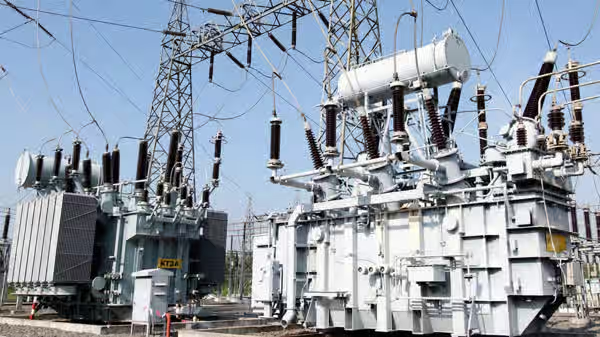
Nigeria’s national electricity grid suffered its latest collapse on Monday, December 29, 2025, plunging large parts of the country into darkness during the festive season.

The outage occurred around 2:01 p.m., when power generation crashed sharply from over 3,600 megawatts to as low as 50 megawatts in some readings, disrupting homes, businesses, and critical services nationwide.

Distribution companies immediately confirmed the blackout and appealed for patience as recovery efforts began. By late Monday evening, gradual restoration was underway, and by Tuesday morning the Nigerian Independent System Operator confirmed that the grid had been fully stabilized.

This most recent failure has again drawn attention to the fragility of Nigeria’s power infrastructure and capped a year marked by repeated system disturbances.

Number of times it has collapsed

The December 29 incident was the fourth major national grid collapse recorded in 2025. Earlier in the year, the grid failed on February 12, triggering widespread blackouts across multiple regions.

A second collapse followed on March 7, while a third incident in September saw generation drop to near zero nationwide.

Although this represents a reduction from the more than twelve collapses recorded in 2024, four nationwide failures in a single year still underscore persistent structural weaknesses in transmission, gas supply, and system management.

Power sector officials and analysts continue to attribute these collapses to a combination of aging infrastructure, gas shortages, vandalism, frequency management challenges, and delayed upgrades.

FG response to it

The Federal Government has responded to the recurring collapses with a mix of emergency interventions and longer-term reforms.

Following the December incident, authorities pointed to the earlier vandalism of the Escravos–Lagos Pipeline System on December 10, which constrained gas supply to thermal power plants and left the grid in a fragile state.

The Nigerian National Petroleum Corporation Limited announced that repairs to the pipeline were completed in record time, helping to restore generation capacity.

More broadly, the government has continued to promote reforms under the Electricity Act 2023, aimed at liberalizing the power market and encouraging private investment.

The Ministry of Power has emphasized faster restoration times after grid failures, while the Nigerian Independent System Operator has opened investigations into each collapse.

The administration has also highlighted initiatives such as the Presidential Power Initiative to upgrade transmission infrastructure, plans to validate and settle long-standing debts owed to generation companies, and proposals to decentralize power supply by encouraging states and large consumers to develop independent electricity solutions.

Critics, however, argue that slow funding, stalled execution, and ongoing gas constraints have limited the real impact of these measures.

State of power supply in Nigeria today

As of December 30, 2025, electricity supply has been fully restored across the national grid, with generation gradually ramping up to nearly 3,000 megawatts by Monday night and stabilizing further by Tuesday morning.

Distribution companies in major cities such as Abuja, Lagos, Ibadan, Enugu, Kaduna, and Benin resumed supply, although restoration was uneven in some areas, including parts of Port Harcourt.

Despite the recovery, Nigeria’s power situation remains fragile. Peak generation still hovers around 4,800 megawatts, far below the estimated demand of over 30,000 megawatts for a population exceeding 200 million.

Intermittent supply remains common, forcing households and businesses to rely heavily on petrol and diesel generators amid high fuel costs.

Social reactions

The latest collapse sparked widespread reactions on social media, especially due to its timing during the holiday season. Many Nigerians expressed frustration, exhaustion, and anger at what they described as a recurring national embarrassment.

Others responded with sarcasm and dark humor, that grid collapses have become an expected part of the calendar.

On X, @jokotagbaposi (Ayomiposi) lamented the timing of the outage, writing, “Small holiday wey person dey enjoy. National grid don decide to collapse again. Nigeria which way self?”

Another user, @adedapo_adigun (Oba Cruise) reacted with biting sarcasm, saying, “There is only one thing that is guaranteed in Nigeria and it’s power outage. Nigerian power grid has collapsed again… it can never disappoint me.”

Calling for accountability, @saintIsaiah7 (Son of Grace) wrote, “The system is not working and nobody cares. Nigeria is deteriorating every day.”

Adding humor to the outrage, @charlexzy11 (Charles) wrote, “Dear Guinness World Records, I am writing to formally request that Nigeria be awarded a world record for the most national grid collapses.”

At the same time, many Nigerians reflected a sense of resignation, noting how dependence on generators has become a survival strategy rather than an emergency response.

What 2026 will look like

Looking ahead to 2026, energy analysts express cautious optimism mixed with skepticism. On the positive side, the full implementation of the Electricity Act is expected to attract more private investment into sub-national and decentralized power projects.

Increased domestic fuel supply, including contributions from facilities like the Dangote Refinery and the expected progress on major gas infrastructure such as the Ajaokuta–Kaduna–Kano pipeline, could improve gas availability for power generation.

There is also growing interest in renewables and independent power solutions for industries, data centers, and large commercial users, which could reduce pressure on the national grid.

However, experts warn that without urgent action to address vandalism, insecurity around transmission lines, funding delays, and aging infrastructure, grid instability may persist.

While the reduction in collapses compared to 2024 offers a small measure of hope, many Nigerians remain wary.

For 2026 to mark a true turning point, reforms will need to move beyond promises and translate into visible, sustained improvements in power reliability.

Nationwide Power Grid Failure, Recovery Underway

0

The national electricity grid suffered a collapse on Monday afternoon, plunging power supply across much of the country to near-zero levels, based on distribution load data released at 3:12 pm on December 29, 2025.

Figures from the Distribution Companies (DisCos) indicated that only two operators were receiving power at the time of the incident.

Ibadan Electricity Distribution Company recorded a load of 30 megawatts (MW), while Abuja Electricity Distribution Company received 20 MW.

All other DisCos were assigned zero megawatts.

Benin, Eko, Enugu, Ikeja, Jos, Kaduna, Kano, Port Harcourt, and Yola DisCos each recorded 0 MW, pointing to a widespread outage affecting major cities and regions nationwide.

Total electricity distributed across the country at that moment was just 50 MW, significantly below normal operating capacity and inadequate to support homes, businesses, and essential services.

Nigeria’s national grid has suffered multiple system collapses in recent years, frequently triggering nationwide blackouts and extended restoration periods.

Meanwhile, the NNG stated that restoration efforts are ongoing.

As of the time of reporting, neither the Transmission Company of Nigeria nor the Federal Ministry of Power had issued an official statement explaining the cause of the collapse or outlining a timeline for full power restoration.

2025 Fala Awards: Spotlight On Africa’s Next Generation Changemakers

0

The Future Africa Leaders’ Foundation (FALF), an initiative of renowned Tele-evangelist, President of Loveworld Incorporated, Pastor Chris Oyakhilome, DSC, DD; is one of Africa’s most visible platforms for identifying, nurturing and celebrating young leaders while, driving positive change across the continent.

Established in 2013, the foundation works to spotlight exceptional African youths whose community-based initiatives are transforming lives, often in challenging environments and social structures. Over the past 12 years, FALF has invested more than $1.5 million in empowering young Africans through mentorship, recognition, and direct financial support.

This flagship programme, the Future Africa Leaders Awards (FALA), is held annually during the New Year’s Eve service hosted by Pastor Chris. The ceremony has become a high-profile continental event, recognizing outstanding leadership, innovation and service among Africa’s next generation.

FALA has attracted the presence of some of Africa’s most iconic African leaders and Pan-Africanist as Guests of Honour reflecting its growing stature. Past editions have been graced by high-Profile figures such as H.E Ellen Johnson Sirleaf – Former Liberian President, Chief Olusegun Obasanjo – Nigeria’s Former President and Former President Dr. Goodluck Jonathan, Former President of Malawi – Joyce Banda, South Sudan’s first female Parliamentary Speaker Jemma Nunu Kumba, and Former African Union Ambassador for the United State of America/ President African Diaspora Development Institute Arikana Chihombori Quao.

The most prestigious honour, the FALA Star Award, comes with a $25,000 grant to scale the winner’s impact, while other finalists receive $10,000 each in recognition of their contributions. According to the organisers, these awards are designed not merely as prizes, but as strategic investments in grassroots leadership across Africa.

Since inception, winners have emerged from 33 African countries, with nine nations claiming the coveted Star Prize at least once. Now in its 13th edition, the selection process draws thousands of applications from across the continent. From these, 30 candidates are shortlisted, with 10 winners eventually emerging on the night of the awards. This year’s Loveworld New Year’s Eve celebration will see 10 young Africans empowered as winners of the 2025 edition by the President of the foundation.

At the 2024 ceremony, 23-year-old Julienne Ariori from the Republic of Benin emerged as the FALA Star Prize winner, beating over a thousand participants from across the continent to top the final list of ten awardees.

The 2025 FALA Award ceremony is scheduled to take place during the New Year’s Eve service with Pastor Chris at the Loveworld City Asese, southwest Nigeria, where young leaders from multiple African countries will once again be celebrated for their impact and vision.

Organizers describe the Future Africa Leaders’ Foundation as “a beacon of hope for aspiring leaders in Africa”, providing the recognition, resources and support needed to drive sustainable, community-focused change.

Africa’s Top Five Busiest Airports In December 2025

0

As air travel rebounds and grows across the continent, December 2025, a peak month for holiday travel, paints a compelling picture of Africa’s most active aviation hubs. From bustling gateway cities to transformative tourism corridors, these airports show how Africa is reconnecting, regionally and globally, through air transport.

Below, we highlight the top five busiest African airports this December, based on the most recent passenger traffic and scheduling data available.

1. Cairo International Airport (Egypt) — Africa’s No. 1 Aviation Hub

At the top of the list is Cairo International Airport, firmly holding its position as Africa’s busiest airport in 2025.

  • Why it’s #1: Strategic connections between Africa, Europe, the Middle East, and Asia make Cairo a focal point for both international and domestic travel.
  • Passenger volume: Around 29 million passengers in 2025, the highest on the continent.
  • Drivers of growth: Expansion of EgyptAir’s network, recovery of international tourism, and Cairo’s role as a major transit hub contributed to its lead this year.

Cairo’s impressive performance underscores Egypt’s investment in tourism and air infrastructure—and its strategic geographic advantage that keeps global and continental air traffic flowing through its terminals.


2. O.R. Tambo International Airport (South Africa) — Southern Africa’s Kingpin

South Africa’s busiest airport, O.R. Tambo International in Johannesburg, secures the second spot.

  • Traffic figures: Roughly 18 million passengers in 2025.
  • Regional importance: A vital hub connecting Southern Africa to Europe, the Americas, and Asia.
  • Economic role: The airport supports business travel, tourism to South Africa’s top destinations, and continues to rebound from pandemic-era slowdowns.

O.R. Tambo remains essential for both international connections and domestic flights, contributing significantly to South Africa’s aviation industry.

3. Addis Ababa Bole International Airport (Ethiopia) — East African Connector

Third on the continent is Addis Ababa Bole International Airport, Ethiopia’s flagship airport and the home base of Ethiopian Airlines.

  • Passenger traffic: Around 11.8 million passengers in 2025.
  • Strategic role: Positioned at the heart of Africa, it serves as a key transfer point for passengers traveling between Africa and global destinations.
  • Growth factor: Ethiopian Airlines’ expanding network boosts traffic as the airline increases destinations and flight frequencies.

Addis Ababa’s continuing rise reflects the city’s aviation-led growth strategy and regional connectivity ambitions.

4. Mohammed V International Airport (Morocco) — North Africa’s Gateway

Morocco’s busiest airport, Mohammed V International Airport in Casablanca, ranks fourth.

  • 2025 traffic: Approximately 10.45 million passengers.
  • Connectivity boost: Strong air links to Europe, Africa, and the Americas underlined by Royal Air Maroc’s expanding network.
  • Tourism and transit: The airport serves as a crucial transit and tourism gateway, supported by Morocco’s strategic location and robust tourism numbers.

Continued infrastructure improvements and airline partnerships are likely to keep Mohammed V busy through peak seasons.

5. Cape Town International Airport (South Africa) — Tourists’ Favorite

Rounding out the top five is Cape Town International Airport, South Africa’s gateway to one of the continent’s most iconic destinations.

  • Passenger volume: Roughly 10.37 million in 2025.
  • Tourism strength: Cape Town’s global appeal as a leisure destination drives steady international and domestic air traffic.
  • Seasonal boosts: December typically sees heightened tourist flows, lifting Cape Town up the ranks.

With its blend of business and leisure travelers, Cape Town continues to solidify its position among Africa’s busier airports.

What the Rankings Reveal

These top five airports reflect broader trends shaping African aviation in 2025:

  • Post-pandemic rebound: Airports across the continent are seeing renewed growth in passenger volumes.
  • Strategic hubs matter: Geographic positioning and airline networks play key roles in busyness.
  • Tourism’s influence: Cities like Cairo and Cape Town benefit enormously from holiday travel peaks.

The ranking also highlights growing competition within the continent’s aviation landscape, with West African airports like Lagos’ Murtala Muhammed International Airport increasing traffic—entering broader lists of busiest hubs thanks to strong regional demand this December.

Tax Law Alteration Dispute: Reps Minority Urges FG To Pause Implementation

0

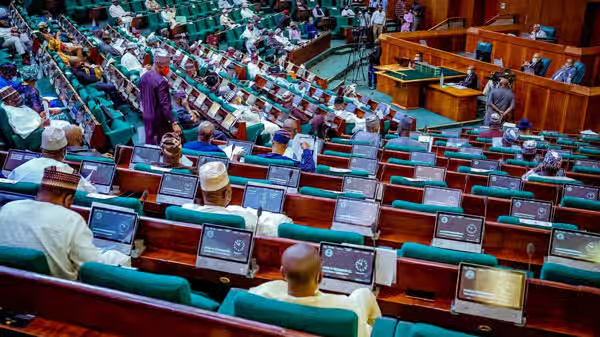
The Minority Caucus in the House of Representatives has called on the Federal Government to suspend the rollout of the proposed tax laws amid allegations of alterations that have sparked nationwide concern.

The demand for a pause comes despite the firm stance taken last week by the Chairman of the Presidential Committee on Fiscal Policy and Tax Reforms, Taiwo Oyedele, who maintained that the commencement date for the Nigerian Tax Act and the Nigerian Tax Administration Act remains non-negotiable.

“The plan to commence the new laws on January 1, 2026, will go ahead as planned on schedule because these reforms are designed to provide relief to the Nigerian people,” he said after a meeting attended by the Chairman of the Federal Inland Revenue Service (FIRS), Zacchaeus Adedeji, and the Chairman of the National Tax Policy Implementation Committee, Joseph Tegbe.

“Bottom 98 per cent of workers will see either no Pay As You Earn (PAYE) tax or lower taxes to be paid, small businesses 97 per cent of them will be exempted from Corporate Income Taxes, Value Added Tax (VAT), and Withholding Tax, and large businesses will see a drop in the taxes that they pay.

“The whole idea is to try and promote economic growth, inclusivity, as well as shared prosperity for our people,” he added.

Despite this position, Oyedele expressed support for the National Assembly’s decision to probe the alleged alterations. He stated that the Federal Government is prepared to collaborate with lawmakers to resolve the issues raised by Nigerians, including those voiced by opposition leaders.

Meanwhile, a joint statement signed by Minority Leader Rep. O.K. Chinda, Minority Whip Rt. Hon. Ali Isa J.C., Deputy Minority Leader Rt. Hon. Aliyu Madaki, and Deputy Minority Whip Rt. Hon. George Ozodinobi urged the Federal Government to halt implementation of the tax laws pending the conclusion of investigations.

“…we call on the government to suspend the implementation of the tax laws until investigations are concluded and there is clarity and certainty of the law to be implemented.”

The caucus further stressed that Nigerians and the business community have a right to access the exact versions of the laws “they are expected to obey.”

The lawmakers assured the public of their commitment to ensuring that any alleged irregularities in the gazetted tax laws are corrected in the national interest.

“We have noted with great consternation and an overwhelming sense of disappointment the current storm brewing over the Tax Reform laws that were duly passed by the National Assembly and properly signed into law by President Bola Ahmed Tinubu, GCFR.

“Ordinarily, the controversy will have been dismissed as needless, but the gravity of the cause of the controversy is an issue of great concern to all Nigerians, especially since it borders on the accusations of unlawful alterations to the laws as passed by both Chambers of the National Assembly and subsequently signed by the President.

“We are also aware that this issue has been raised by a member of the House of Representatives during one of our recent plenaries, following which the House innugurated a high-powered committee to investigate the allegations made by the member that the tax laws have been fraudulently altered, gazetted and the altered copy circulated to the public.

“As such, we want to assure Nigerians that the Minority Caucus of the House of Representatives will stand with the entire House to see that the circumstances surrounding this illegality is exposed and the culprits brought to book in the interest of justice for all Nigerians.

“We are aware that the legitimate procedure for gazetting laws begins with the Clerk to the National Assembly transmitting the authentic copies to the relevant federal agency, making the National Assembly the custodian of the genuine laws of the federation.”

The caucus advised Nigerians to disregard any tax laws circulating without the signatures of the Clerk to the National Assembly and the President and Commander-in-Chief.

“Any attempt to foist fake laws on Nigerians is an attack on the independence and constitutional role of the National Assembly in safeguarding our democracy.”

The controversy intensified after House member Abdussamad Dasuki raised concerns over discrepancies between the tax laws approved by lawmakers and the versions later gazetted and released to the public.

“Before you can say there is a difference between what was gazetted and what was passed, we have what has not been gazetted. We don’t have what was passed,” he said.

President Bola Ahmed Tinubu had earlier signed four tax reform bills into law, which the government described as the most significant overhaul of Nigeria’s tax system in decades.

The laws are scheduled to take effect on January 1, 2026, and include the Nigeria Tax Act, the Nigeria Tax Administration Act, the Nigeria Revenue Service (Establishment) Act, and the Joint Revenue Board (Establishment) Act, all to be administered under a single authority, the Nigeria Revenue Service.