Home Blog Page 141

Seven Nigerian States Take Over Power Regulation

0

Nigeria’s electricity sector is undergoing a historic shift as seven states—Enugu, Ondo, Ekiti, Imo, Oyo, Edo, and Kogi—have assumed regulatory control of their electricity markets under the Electricity Act 2023, signed into law by President Bola Tinubu.

This decentralization allows states to independently generate, transmit, distribute, and regulate power, marking a departure from the centralized authority previously held by the Nigerian Electricity Regulatory Commission (NERC).

Four additional states—Lagos, Ogun, Niger, and Plateau—are expected to complete their transitions by September 2025, while Anambra is preparing to join after enacting its own electricity law.

The move aims to foster a competitive market and address Nigeria’s persistent power shortages but has sparked concerns about state capacity, regulatory consistency, and potential disparities in electricity access.

The Electricity Act 2023 enables states to issue licenses to private investors for power projects, encouraging localized solutions and investment. For example, Lagos has launched plans for 500-megawatt power hubs to boost energy reliability. Distribution companies in transitioned states, such as Enugu Electricity Distribution Company, have established subsidiaries like Mainpower Electricity Distribution Limited to operate under state regulations.

At a recent stakeholders’ meeting in Lagos, discussions focused on the need for capacity building, regulatory alignment, and investment readiness to ensure sustainable state-led markets. Eleven states are currently transitioning, with NERC providing guidance to navigate challenges.

However, industry experts warn that many states lack the technical expertise to handle complex tasks like setting cost-reflective tariffs, a skill globally limited to a small pool of professionals. Manpower shortages and weak institutional frameworks could undermine the transition. Asset delineation—dividing infrastructure like transmission lines that span multiple states—poses another hurdle, potentially causing regulatory conflicts.

Electricity theft remains a concern, as state regulators may lack the enforcement capacity to address violations effectively, especially since NERC must now transfer such cases to state commissions.

A critical issue is subsidies, with governors deciding whether to fund electricity subsidies or adopt market-based pricing.

This could lead to unequal access, as wealthier states may afford subsidies while others impose higher tariffs, impacting low-income households. Enugu stands out as a leader, with an experienced regulator and operational framework, while other states face early challenges.

Critics caution that fragmented oversight risks inconsistent standards and consumer exploitation, urging harmonized policies to maintain fairness.

The Act also promotes renewable energy and private investment, with provisions for tax incentives and rural electrification initiatives to expand access.

Since April 2024, NERC has issued transfer orders to 11 states, each with a six-month timeline for full operational handover.

As Nigeria navigates this transformative period, the success of state-led electricity markets depends on addressing capacity gaps, ensuring regulatory clarity, and fostering federal-state collaboration to deliver reliable, affordable power to millions.

NSCDC, NIS, NCoS, FFS Nationwide Recruitment: What You Should Know

0

The Federal Government of Nigeria has officially announced the commencement of a fresh nationwide recruitment exercise into four major paramilitary agencies under the Ministry of Interior. These agencies include the Nigeria Security and Civil Defence Corps (NSCDC), Nigerian Correctional Service (NCoS), Nigeria Immigration Service (NIS), and the Federal Fire Service (FFS).

This was made known in an official statement released by the Secretary to the Civil Defence, Correctional, Fire and Immigration Board (CDCFIB), retired Maj.-Gen. Abdulmalik Jubril, who urged qualified and interested Nigerians to submit their applications through the board’s official portal: https://recruitment.cdcfib.org.

According to him, “Applications should be submitted online within three weeks from the date of this publication and note that the application is absolutely free.” He also warned applicants to apply for only one of the four agencies, as multiple applications would lead to automatic disqualification.

The recruitment covers various cadres, including:

  • Superintendent Cadre:
    Superintendent of Corrections (CONMESS 09) for NCoS applicants holding a Bachelor’s Degree in Medicine and Surgery.
  • Assistant Superintendent Cadre I (CONPASS 09):
    Applicable to FFS applicants with a Degree in Law or BSc in Mechanical, Civil, Chemical, Water Engineering or other related fields.
  • Assistant Superintendent Cadre II (CONPASS 08):
    Applicable to NSCDC, FFS, and NIS applicants with BSc or HND in relevant disciplines.
  • Inspectorate Cadre (CONHESS 06):
    For NCoS, NSCDC, and FFS; applicants must be Registered Nurses or Midwives.
  • Assistant Inspector (CONPASS 06):
    ND or NCE holders in any relevant field.
  • Assistant Cadre (CONPASS 04/03):
    General duty roles for holders of GCE O’Level, SSCE/NECO, or equivalent with a minimum of 4 or 5 credits in not more than two sittings. General Requirements:

-Must be Nigerian by birth

-Between the ages of 18 and 35

-Medically fit

-No criminal record or history of financial crimes

Official Confirmation via X (formerly Twitter):

To further authenticate this recruitment exercise, the Federal Fire Service of Nigeria posted the following on their official X handle, @fedfireng:

“PRESS RELEASE 2025 RECRUITMENT EXERCISE”

The general public is hereby informed that recruitment into the following four agencies under the Ministry of Interior has officially commenced:

Nigerian Correctional Service

Nigerian Immigration Service

Federal Fire Service

Nigeria Security and Civil Defence Corps (NSCDC)

Interested applicants are to apply via the official recruitment portal:
https://recruitment.cdcfib.org

The application portal will be opened on Thursday, 26th June, 2025.

Applicants are strongly advised to beware of fraudsters. The recruitment exercise is entirely free of charge, and no payment is required at any stage.

Public Relations Unit
Federal Fire Service Headquarters
23rd June, 2025”

You can view the official post:

How and Where to Apply:

  1. Visit the official recruitment portal: https://recruitment.cdcfib.org.
  2. Select only one agency to apply to.
  3. Fill out the online form carefully and attach the required documents.
  4. Submit the form before the application deadline (three weeks from 23rd June 2025).
  5. Note that no fee is required at any stage of the process.

Applicants are warned to beware of individuals or websites requesting payment. The exercise is transparent and free, as emphasized by the CDCFIB.

Why US Warns Citizens To Avoid Military Facilities In Nigeria

0

The United States Mission in Nigeria has issued a security alert advising its citizens to avoid non-essential travel to military and government facilities in Abuja. The advisory is part of a broader response to rising global security concerns that have prompted increased caution around high-risk locations.

In a statement released on Monday, the U.S. Embassy stated that all embassy staff and their families are now restricted from visiting military or government sites in the Nigerian capital unless required for official duties.

Why Did the U.S. Advise Citizens to Avoid These Locations?


The alert was triggered by unspecified global developments that have heightened security threats worldwide. In response, the U.S. Mission is taking precautionary measures to limit exposure to potential risks, particularly in areas that could be targets due to their political or strategic significance.

American citizens in Nigeria have been urged to remain especially vigilant in public spaces, particularly in locations frequented by Westerners, expatriates, and government officials.

The embassy also advised citizens to avoid large gatherings, vary their daily routines, and become familiar with emergency exits in buildings they enter.

U.S. nationals are encouraged to review their personal safety plans and maintain increased awareness throughout their stay in the country.

The statement read in part:

“Due to increased security concerns arising from current global developments, US Mission Nigeria informs US citizens that all US Embassy employees and their families are prohibited from non-official travel to a Nigerian military site or other government venue in Abuja at this time.

“Actions to take: Stay alert in public places, with particular attention to locations and venues where Westerners, expatriates, and government officials frequent.

“Avoid large gatherings and consider limiting unnecessary travel. Avoid predictable routines. Familiarise yourself with emergency exits when you enter buildings. Review your personal security plans.”

Despite these measures, the Consular Sections of the U.S. Embassy in Abuja and the Consulate General in Lagos remain open and fully operational.

Brazil’s Vice President Arrives In Nigeria For Strategic Discussions

0

Brazil’s Vice President, Geraldo Alckmin, and his wife, Maria Alckmin, arrived in Nigeria on Tuesday to participate in the second session of the Nigeria-Brazil Strategic Dialogue Mechanism.

They were received at the Presidential Wing of the Nnamdi Azikiwe International Airport by Senator Ibrahim Hadejia, Deputy Chief of Staff to the President, and Dr. Jumoke Oduwole, Minister of Industry, Trade and Investment.

Welcoming the delegation alongside them were the Minister of Livestock Development, Idi Maiha, and the Minister of Agriculture and Food Security, Senator Abubakar Kyari, among other top officials.

The visit is seen as a pivotal step in strengthening Nigeria’s diplomatic ties within the South-South cooperation framework.

It is projected to generate significant policy advancements across various sectors.

At a brief airport reception, Hadejia described the visit as “a pivotal moment in Nigeria’s Renewed Hope Agenda.”

He underscored the importance of enhancing ties with Brazil.

“This dialogue mechanism represents our commitment to leveraging South-South partnerships that deliver tangible benefits to our citizens.

“Brazil’s expertise in agribusiness, energy transition, and industrial development aligns perfectly with Nigeria’s transformation priorities and the Renewed Hope Agenda of President Bola Tinubu,” Hadejia said.

The three-day summit will conclude with the signing of over 30 Memoranda of Understanding in key sectors.

These sectors include defense cooperation, agricultural technology transfer, energy collaboration, and cultural exchange programs.

Tinubu Lauds Wike, Inaugurates 15km Abuja Road

0

On Monday, President Bola Tinubu launched the 15-kilometre A2–Pai Town Road in Kwali Area Council of the Federal Capital Territory. This road forms part of the 150 kilometres of roads either completed or in progress across the six Area Councils since May 29, 2023.

President Tinubu underscored the vital role of rural connectivity in promoting national progress and prosperity.

Bayo Onanuga, Special Adviser to the President on Information and Strategy, shared this in a statement he released on Monday.

“Infrastructure means nothing if it is not developed for the benefit of the people. The true value of this progress lies in how it lifts lives and expands opportunity. And indeed, this administration will continue prioritising infrastructure development in all zones,” President Tinubu stated.

He praised the FCT Minister for emphasizing rural development.

“You are doing commendable work in the underserved rural areas. We will ensure that development is not one-sided but balanced, inclusive, and aimed at improving lives.

“The commissioning of this newly constructed road, from the A2 junction on the Abuja–Lokoja expressway to Pai Town, is symbolic and strategic. It is symbolic because it represents Renewed Hope.

“It is strategic because it opens a new corridor for agriculture, commerce, education, and mobility—all of which are essential to strengthening our national economy from the grassroots up,” he said.

President Tinubu encouraged the Pai community to take ownership of the road and maintain it for local advancement.

“Let this road serve as a pathway to growth and a bridge to a better life for farmers, traders, students, and youth,” he said.

He also remarked, while traveling from Sheda to Pai after inaugurating 2000 tractors for mechanised farming, the critical need for grain farmers and livestock owners to establish grazing opportunities and take measures to boost productivity.

“We will help you. We will work with you. We will convert what used to be a liability and a source of conflict into a means of prosperity,” the President said.

Minister Wike stated that 150 kilometres of roads have been completed or are underway across all six Area Councils of the FCT since the onset of the Tinubu administration.

“This is not propaganda. All six emergency roads approved in the 2023 supplementary budget have been completed and commissioned. These roads have transformed access and connectivity for our rural populations,” Wike said.

The six road projects that have been completed are the 9km Paikon-Kore–Ibwa road in Gwagwalada Area Council, the 5km Gaba–Tokulo road in Bwari Area Council which includes a two-span river bridge, and the 5km asphalt road stretching from Tipper Garage Junction to the LEA Secretariat in Kuje Area Council.

Other completed roads include the 11km Yangoji–Sukuku–Ebo road in Kwali Area Council, the 5km Saburi 1 & 2 road within the Abuja Municipal Area Council (AMAC), and the Aguma Palace–Radio Nigeria–New Market road located in Gwagwalada Area Council.

The Minister also announced several roads set to be commissioned later in the week. These include the 18km Karshi–Nyanya road, the 7.4km Old Ushafa Road, the rehabilitation of the Dutse–Lower Usman Dam road, and the 16.4km dualisation of the Ushafa–War College–Army Checkpoint road.

According to Wike, the value of these projects goes beyond improving transportation. He stated that they are also key to enhancing food security, bolstering security efforts, and promoting inclusive socioeconomic growth.

“With better access, isolated communities can be reached, farmers can access their farmlands, and security agencies can patrol more effectively. We encourage real farmers—not speculators—to use this infrastructure to support the government’s food security agenda,” he said.

The Minister stressed that the FCT Administration, under President Tinubu’s leadership, is committed to expanding development outside the city centre, particularly in road and electricity infrastructure.

“You can give someone an appointment, but nothing happens if you don’t support them. You have done both, and the results are visible across the FCT,” he said.

The traditional ruler of Pai, Sarkin Pai, Alhaji Sani Abubakar, expressed heartfelt thanks to President Tinubu for his leadership and for appointing the current FCT Minister.

“Mr President, we want to thank you for two things. One is appointing Mr Project to the FCT because the FCT Minister has transformed how we live in rural communities. He is the right man for this job. We cannot thank you enough,” said the monarch.

He noted that the new road has greatly improved local economic activities and recalled past struggles with moving goods to the market.

“This road has opened up many economic activities for us. Many of us had serious challenges transporting goods to market in the past—it hasn’t been fun. But now, you can see that everybody is happy. They have shown a large amount of appreciation for you and the Honourable Minister.”

He added that the Minister has consistently called for leadership and praised both the President and the Minister for the improvements being witnessed.

“The Minister used to say that we need leadership in this country, and you have given us that leadership. We want to thank you, Mr. President. I want to thank the Honourable Minister; he has been doing well for us, and a lot is still coming in this direction. We thank you, Mr. President,” Abubakar added.

FIFA Club World Cup: Key Clubs Secure Knockout Spots

1

The 2025 FIFA Club World Cup reached a boiling point on Monday, June 23, as teams battled for the last remaining spots in the Round of 16. With eight goals in a single game, comeback thrillers, and vintage performances from some of football’s biggest stars, fans across the globe were treated to a memorable night of world-class football.

PSG Silence Seattle to Top Group B

At a packed Lumen Field in Seattle, Paris Saint-Germain displayed composure and experience to beat Seattle Sounders 2–0. First-half goals from Khvicha Kvaratskhelia and Achraf Hakimi were enough to send the French giants through as group leaders.

Seattle, needing a high-margin victory to qualify, were energetic early on but couldn’t break PSG’s disciplined defense. “We knew the crowd and atmosphere would be intense,” said PSG boss Luis Enrique post-match. “But our players handled it well and got the job done.”

Griezmann Scores but Atletico Crash Out

At the Rose Bowl in Pasadena, Atletico Madrid edged Brazilian side Botafogo 1–0 thanks to a late strike from Antoine Griezmann. However, the result wasn’t enough, as Botafogo qualified ahead of Atletico based on superior goal difference.

Botafogo’s disciplined defense frustrated the Spanish side for much of the match, and despite Griezmann’s goal, Atletico left the pitch disappointed. “It’s tough,” said Griezmann. “We gave everything but small margins define tournaments like this.”

Late Palmeiras Rally Denies Inter Miami Victory

In Miami Gardens, Inter Miami were moments away from topping Group A after goals from Tadeo Allende and Luis Suárez had given them a 2–0 lead. But Palmeiras fought back, with late goals from Paulinho (80’) and Mauricio (87’) earning a crucial 2–2 draw.

Though the draw was frustrating for Miami fans, both clubs advanced, with Palmeiras topping the group. “Luis [Suárez] was spectacular,” said coach Gerardo Martino, “but we need to manage games better when we’re ahead.”

Eight-Goal Thriller Ends Porto and Al Ahly’s Hopes

Perhaps the most jaw-dropping match of the day came at MetLife Stadium in New Jersey, where FC Porto and Al Ahlyplayed out a 4–4 classic. Egyptian striker Wessam Abou Ali bagged a stunning hat-trick, but the shared points meant both sides were eliminated.

Porto led 3–1 before a flurry of goals from both sides turned the final 20 minutes into chaos. “We gave it everything, but it just wasn’t enough,” said Porto captain Pepe, in what may be his final Club World Cup appearance.

Round of 16 Fixtures Confirmed

Following Monday’s results, the Round of 16 matchups have been confirmed:

  • Palmeiras vs Botafogo – June 28, Philadelphia
  • Inter Miami vs PSG – June 29, Atlanta

The highly anticipated Inter Miami vs PSG fixture is expected to draw global attention as Lionel Messi faces his former club in a blockbuster clash.

As the tournament heads into the knockout phase, attention now turns to matchups featuring star-studded squads and continental giants. With top scorers emerging and underdogs still alive, the 2025 Club World Cup continues to thrill fans across the world.

“This tournament is unlike any other,” said FIFA President Gianni Infantino. “We are seeing passion, skill, and drama at every turn—and this is just the beginning.”

Oil Prices Falls By 4% As Iran Targets U.S. Bases

Oil prices dropped sharply by over $3 on Monday, falling nearly 4%, after Iran launched missile strikes on a U.S. military base in Qatar in response to American attacks on its nuclear facilities. The move, however, did not affect the flow of oil and gas tankers through the vital Strait of Hormuz.

By 1:13 p.m. ET (1713 GMT), Brent crude futures were down $2.91, or 3.8%, trading at $74.09 a barrel. U.S. West Texas Intermediate (WTI) crude fell by $2.80, also 3.8%, to $71.06.

Shortly after midday, explosions were heard over Doha, Qatar’s capital, according to a Reuters witness. This followed a Western diplomat’s warning of a credible Iranian threat to the U.S.-operated Al Udeid air base in Qatar.

“Oil flows for now aren’t the primary target and is likely not to be impacted, I think it’s going to be military retaliation on US bases and/or trying to hit more of the Israeli civilian targets,” said John Kilduff, a partner at Again Capital.

Qatar confirmed it had closed its airspace in response to the situation. Flight paths and air traffic control audio also indicated that the UAE shut its airspace, according to Flightradar.

U.S. President Donald Trump stated that he had “obliterated” Iran’s key nuclear facilities during weekend strikes that aligned with an Israeli military offensive. Tehran vowed to defend itself against the joint assault.

In addition, Israel launched fresh attacks on Iran on Monday, including strikes on the capital Tehran and the Fordow nuclear facility, which was also targeted by U.S. forces.

Ship tracking data revealed that at least two supertankers made U-turns near the Strait of Hormuz following the U.S. strikes. Many vessels in the region either altered their routes, paused, or increased speed amid more than a week of regional conflict.

The Strait of Hormuz handles around 20% of the world’s oil supply. Despite recent events, analysts believe a full shutdown of the strait remains unlikely.

According to Energy Aspects, a deliberate strike on a heavily fortified U.S. base could be an opening for de-escalation if it results in no American casualties.
“Unless there are indications of further Iranian retaliation or escalation by Israel/the US then we may see some geopolitical risk premium come out of the price in subsequent days,” the firm said.

Qatar reported no casualties from the attack on the U.S. base.

Iran, the third-largest crude producer in OPEC, declared that the U.S. attacks had broadened the scope of legitimate targets for its armed forces. It also labeled Trump a “gambler” for supporting Israel’s military actions against Tehran.

Amid concerns about rising oil prices due to the conflict, Trump urged for increased domestic production. Posting on Truth Social, he directed the U.S. Department of Energy to “drill, baby, drill” and added, “I mean now.”

Investors remain cautious about how much of a geopolitical risk premium is factored into current prices, as the conflict has not yet disrupted global supply.

HSBC projected Brent crude could temporarily spike above $80 per barrel if risks to the Strait of Hormuz grow, though prices would likely fall again if those threats don’t materialize.

Meanwhile, Iraq’s state-run Basra Oil Company said that major international oil companies—including BP, TotalEnergies, and Eni—had evacuated some personnel from oilfield sites.

The Spirituality Around the Labubu Doll: Myth, Meaning And Modern Obsession

What started as a collectible art toy has evolved into something far more curious. The Labubu doll, created by Hong Kong-based artist Kasing Lung and distributed by POP MART, has gained global popularity, accompanied by whispers of emotional attachment, folklore-inspired origins, and even supernatural encounters.
Is Labubu just a cute designer toy, or does it carry a deeper, possibly spiritual, presence?

Labubu’s Origin: From Fairy Tale to Folklore

Labubu is part of Kasing Lung’s The Monsters series, known for blending whimsical design with elements from Nordic mythology and fairy tales. Lung’s intention, according to art critics and toy collectors, is to evoke childlike wonder, not fear.
However, as with many myth-inspired creations, cultural context and public perception can influence how a character is received. Labubu’s slightly eerie look has fueled everything from admiration to suspicion.

Why People Feel Labubu Has a “Spirit”

Many owners have reported forming emotional or even spiritual connections with their Labubu dolls. Whether it’s placed on a desk, cuddled during sleep, or used as a calming visual companion, the doll seems to exude a presence that some describe as “watchful” or “protective.”
This kind of bond aligns with spiritual practices that suggest objects, especially those we spend time with, can carry or reflect energy.
Common experiences include:

  • Feeling calmer or comforted in Labubu’s presence
  • Experiencing vivid dreams when the doll is nearby
  • Attributing a sense of companionship or “life” to the figure

The Paranormal Reports and Social Media Buzz

On social platforms like TikTok and X(Twitter), some users have shared eerie encounters involving their Labubu dolls:

  • Dolls allegedly moving slightly overnight
  • Animals reacting fearfully
  • Owners feeling unexplained chills or disturbances
    While these stories lack concrete proof, they add to the mystique, especially among younger buyers seeking something mysterious or unconventional.

Expert Perspective: A Christian View on Labubu

One of the more grounded critiques of the Labubu phenomenon comes from journalist Henry Williams, who examined the toy’s cultural and spiritual implications through a Christian lens.
Williams explains that while Kasing Lung’s creations are rooted in fairy tales and Nordic folklore, they are not inherently malevolent:
“Kasing Lung’s artistic creations—particularly the Labubu character and the Monsters series, are deeply rooted in Nordic mythology and folklore. They draw inspiration from fairy tales and a childlike sense of playfulness… not intended to carry negative or dark symbolism but rather to evoke a sense of wonder.”

However, he warns that fascination with “monsters,” even artistically rendered ones, may lead people, especially young believers, into spiritual gray zones.
“There have been unsubstantiated reports urging people not to buy these creations, with claims that those who did began experiencing paranormal activity in their homes… Ironically, this may fuel a surge in purchases. We live in a generation drawn to controversy.”

Williams concludes with a biblical reminder from Philippians 4:8:
“Whatever is true, whatever is noble, whatever is right, whatever is pure… think about such things.”
“On every count, the Labubu doll fails this biblical test,” he states. “As believers, our hearts and minds should be set on things that reflect God’s light, not the shadowy allure of mythological creatures.”

Aesthetic Appeal or Spiritual Symbol?

Labubu’s appeal lies in its ambiguous design—cute, but slightly creepy. This contrast is part of its charm in pop culture, especially in communities that embrace dark or alternative aesthetics. Yet this also makes it open to spiritual interpretation.
In some Eastern traditions, toys, dolls, and statues are believed to attract spirits—either protective or mischievous. While Kasing Lung likely did not intend Labubu to hold such connotations, the way people interact with the doll can turn it into a spiritual object, intentionally or not.

Consumerism, Identity, and Symbolic Ownership

Today’s obsession with Labubu is not only spiritual or aesthetic, it’s also social. Rare editions are sold for hundreds of dollars, turning the doll into a status symbol as much as a collectible. Owning one signals taste, exclusivity, and in some cases, boldness.
Some buyers admit to getting the doll not for its art, but:

  • To test the supernatural rumors
  • To feel part of a niche, rebellious culture
  • To own a trendy, mysterious object
    This blend of curiosity, controversy, and clout fuels the frenzy.

The Labubu doll may be art. It may be energy. It may be a myth in the making. Whether you see it as a whimsical creation or a potential spiritual channel depends on your beliefs and experiences.
As Henry Williams aptly puts it, in a world where spiritual boundaries are increasingly blurred, discernment is key, especially for those who strive to walk in light and not in shadow.

Iran Retaliates: Missile Strikes Target U.S. Base in Qatar


Iran launched missile strikes on U.S. military installations in Qatar and Iraq on Monday, marking a sharp escalation following recent American airstrikes on Iran’s nuclear facilities.

In Qatar, the missiles targeted the Al Udeid Air Base, which houses the U.S. Combined Air Operations Center and the 379th Air Expeditionary Wing, the largest of its kind globally. Qatar’s government swiftly condemned the attack, labeling it a breach of its sovereignty and international law. According to the Qatari Foreign Ministry, the missiles were intercepted without casualties, and the country has since declared its airspace secure.

Iran’s state media broadcast the strikes with patriotic music and dramatic captions, describing them as “a mighty and successful response” to what it termed “America’s aggression.” The Iranian government stated that the number of missiles fired corresponded with the number of bombs dropped by the U.S. over the weekend, hinting at an intention to signal proportionate retaliation rather than full-scale escalation.

An Iranian military spokesperson noted that the Qatari base was chosen in part because it lies outside densely populated areas. Meanwhile, the Ain al-Assad Air Base in western Iraq also hosting U.S. troops was hit in a separate strike, according to an Iraqi security official who requested anonymity. The extent of damage or injuries at the Iraqi site remains unclear.

The missile strikes follow a surprise U.S. assault on three Iranian nuclear sites early Sunday. Shortly before Monday’s missile launches, Iranian President Masoud Pezeshkian wrote on X (formerly Twitter):
“We neither initiated the war nor seek it. But we will not let an attack on Great Iran go unanswered.”

Meanwhile, Israel broadened its military campaign against Iran, targeting key symbols of the Islamic Republic’s authority. Notable strikes included an attack on the notorious Evin Prison known for detaining political activists and the headquarters of Iran’s security forces responsible for quelling recent protests. These symbolic strikes drew thick plumes of smoke over Tehran as Iran retaliated with another wave of drones and missiles against Israel.

Now in its 11th day, the conflict between Israel and Iran continues to intensify. Israel claims its recent strikes aim at repressing institutions within Tehran but denies seeking regime change. The Israeli military warned of further attacks in the coming days, even as widespread internet outages across Iran make it difficult for citizens to access information from the outside world.

Iran’s Response To U.S. Nuclear Strikes Looms

The geopolitical tensions between Iran and the United States have escalated sharply following the recent U.S. airstrikes on three Iranian nuclear facilities. The strikes, carried out on Sunday under the directive of President Donald Trump, have triggered widespread international reactions and heightened fears of a broader conflict in the already volatile Middle East region.

While Israel hailed the move as a bold step towards curbing Iran’s nuclear ambitions, Iran has condemned the action as a grave violation of international law and the United Nations Charter. As the world watches closely, Iran’s next move remains uncertain, but its leaders have signaled the possibility of retaliatory measures under the right to self-defense. The ripple effects of this development are also evident in the varied reactions of global and regional leaders.

World Leaders Reaction To The U.S. Action

Israel was swift in praising the U.S. decision. Prime Minister Benjamin Netanyahu described President Trump’s action as a historic and righteous move that would alter the course of global security by denying Iran the ability to possess nuclear weapons.

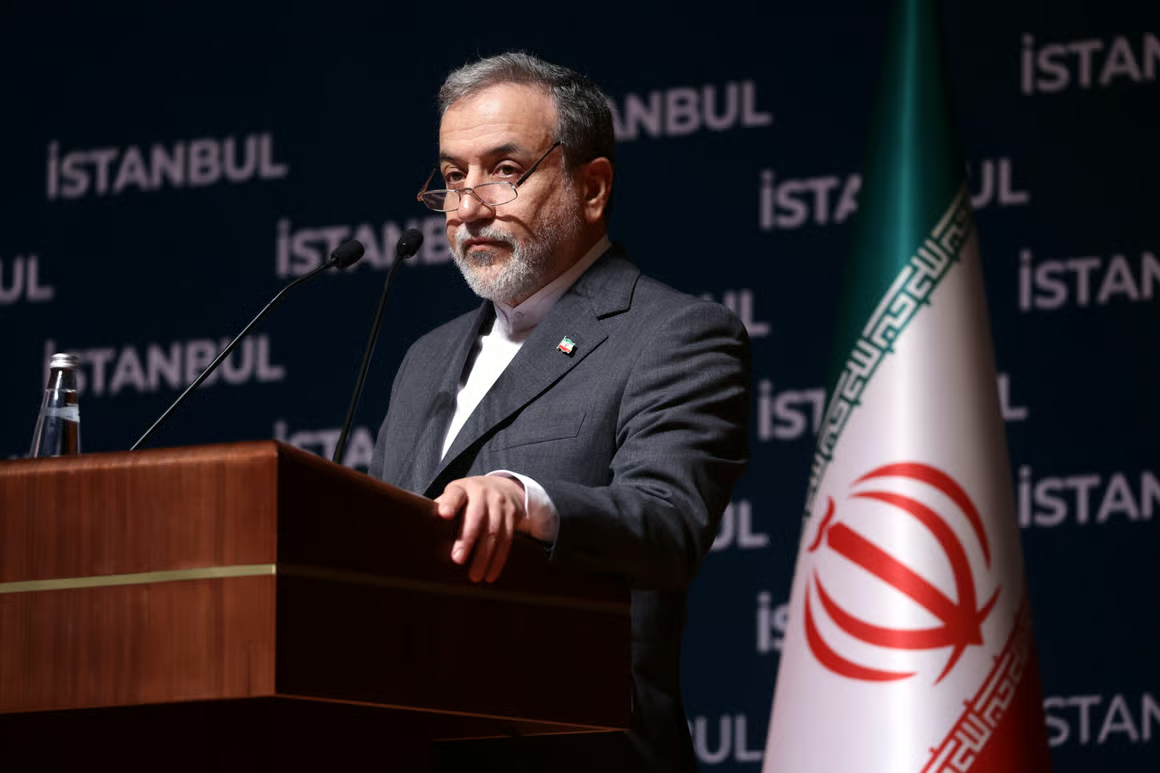
Iran, through its Foreign Minister Abbas Araqchi, vehemently denounced the strikes as illegal and provocative, accusing the U.S. of breaching the Nuclear Non-Proliferation Treaty. Tehran has declared that all options remain on the table to defend its sovereignty and interests.

The United Nations expressed deep concern over the development. Secretary-General Antonio Guterres warned that the strikes mark a dangerous escalation with the potential to destabilize not just the region but global peace and security. He urged all nations to prioritize de-escalation and diplomacy.

The European Union, represented by Commission President Ursula von der Leyen, criticized the use of force, emphasizing that diplomatic avenues had not yet been exhausted. Similar sentiments were echoed by France, which reaffirmed the need for a negotiated solution within the framework of existing international treaties.

Russia’s Dmitry Medvedev mocked the move, suggesting that President Trump’s military action contradicts his image as a peacemaker and further diminishes any prospects of being recognized for peace efforts.

The United Kingdom, through Prime Minister Keir Starmer, acknowledged Iran’s nuclear activities as a significant threat but also called on Tehran to return to the negotiating table to seek a peaceful resolution.

Other global powers, including Japan, Italy, New Zealand, and Australia, emphasized the importance of restraint and diplomacy. They stressed that continued military actions would only worsen the crisis, urging all sides to commit to peaceful dialogue.

Some nations, including Mexico, Venezuela, Cuba, and North Korea, outright condemned the U.S. strikes, labeling them acts of aggression that violate international law and risk plunging the world into deeper instability.

Arab Leaders Reaction To The U.S. Action

Reactions from the Arab world have been largely cautious and focused on the potential consequences of further escalation.

The United Arab Emirates voiced serious concern over the rising tensions, urging both the United States and Iran to halt actions that could destabilize the region further. The UAE called on the United Nations and its Security Council to act decisively in resolving the underlying disputes that threaten regional stability.

Qatar echoed these concerns, warning that the attack could lead to “catastrophic repercussions” if the situation continues to deteriorate. Doha stressed the importance of restraint and immediate diplomatic intervention to prevent a wider conflict.

Other Arab nations, while not issuing detailed public statements, are reportedly engaged in quiet diplomacy aimed at de-escalation, mindful of the impact a broader Iran-U.S. conflict would have on Gulf security, oil markets, and regional alliances.

As the international community reacts, all eyes remain on Tehran’s possible response. Whether Iran chooses a direct military retaliation, covert operations, or diplomatic pushback will shape not only its future with the U.S. but also the stability of the Middle East in the months to come.