Home Blog Page 141

Nigeria’s New Tax Requirement: Implications For Citizens And Businesses

0

Nigeria’s Tax Administration Act now requires every taxable person to have a Tax Identification Number (TIN) to operate bank, insurance, pension, or investment accounts. A TIN is a unique number used to track tax payments and access key financial services. From January 1, 2026, this new tax policy will take effect, raising concerns about how it will impact individuals and businesses nationwide.

The requirement applies to individuals with business income, companies, and non-residents earning income in Nigeria, although people earning below ₦800,000 annually are exempt. The reforms also introduce new levies, including a 4% development levy on company profits, a 5% tax on fossil fuels, and a 15% minimum effective tax rate for large firms, while VAT stays at 7.5% but now covers more items. Nigerians can verify or register their TIN for free on the JTB portal using their BVN and date of birth or by visiting a FIRS office.

Court Grants Temporary Bail To Ex-AGF Malami

0

The Federal Capital Territory High Court in Abuja has granted interim bail to former Attorney-General of the Federation, Abubakar Malami, SAN, in a case instituted against him by the Economic and Financial Crimes Commission (EFCC).

Justice Bello Kawu delivered the ruling on Monday, allowing Malami provisional freedom while the court considers the substantive bail application before it.

According to court records, the judge adopted bail conditions similar to those earlier proposed by the EFCC, including the surrender of Malami’s international passport and the provision of two sureties to execute the necessary bail bonds.

The court specified that the sureties must be the Director-General of the Nigerian Legal Aid Council and a serving member of the House of Representatives representing the Augie/Argungu Federal Constituency.

In the ruling, Justice Kawu also reinstated bail conditions previously satisfied by the applicant on November 28, 2025, reaffirming the requirement for two sureties and the submission of the international passport to the court.

The judge held that granting interim bail was warranted on the grounds of exceptional hardship, pending the hearing and determination of the main motion seeking bail.

The matter has been adjourned to January 5, 2026, when the court is scheduled to hear the motion on notice.

PDP Leadership Dispute: INEC Declines To Recognise Turaki-Led NWC

0

The Independent National Electoral Commission (INEC) has officially declined a request seeking the recognition of the National Working Committee (NWC) of the Peoples Democratic Party (PDP) headed by Kabiru Turaki.

The commission explained that existing court judgements restrain it from taking such a step, stating that it cannot grant the request to publish the list of national officers allegedly elected at the party’s National Convention held on November 15 and 16, 2025.

In a letter dated December 22, 2025, and signed by its Secretary, Dr Rose Oriaran-Anthony, and addressed to Akintayo Balogun and Co., legal representatives of the PDP, INEC said it is legally obligated to comply with final decisions of courts of competent jurisdiction that expressly prohibit it from recognising or enforcing the outcome of the convention.

INEC disclosed that the request followed a series of correspondences from different PDP legal representatives, including Taiwo Abe and Co. on November 14, 2025; Musibau Adetunbi, SAN and Co. on November 19, 2025; and Akintayo Balogun and Co. on November 21, 2025, all urging the commission to recognise and update on its website the list of national officers purportedly elected at the convention.

The Turaki-led PDP NWC is reportedly backed by Oyo State Governor Seyi Makinde and Bauchi State Governor Bala Mohammed.

In November, the opposition party, with the support of Makinde and Mohammed, organised a national convention in Ibadan, the Oyo State capital, which produced a new set of national officers.

The convention followed a series of conflicting court rulings, including decisions by Federal High Courts in Abuja that halted the exercise over alleged violations of the party’s constitution and electoral laws, while the Oyo State High Court in Ibadan cleared the PDP to proceed and directed INEC to monitor the event.

Subsequently, a faction of party members led by the Minister of the Federal Capital Territory (FCT), Nyesom Wike, who opposed the convention, established a parallel NWC, Board of Trustees (BoT) and National Executive Committee (NEC).

The Makinde-backed PDP, through its lawyers, formally requested that INEC recognise Turaki as the party’s legitimate national chairman.

INEC, however, said it thoroughly examined the demands in light of the prevailing facts, relevant laws and, most importantly, existing court judgements directly linked to the issue.

According to the commission, two final judgements of the Federal High Court, Abuja Division, form the basis of its decision.

These are Suit No. FHC/ABJ/CS/2120/2025 — Austine Nwachukwu & two others v. INEC & eight others, delivered on October 31, 2025, and Suit No. FHC/ABJ/CS/2299/2025 — Alhaji Sule Lamido v. PDP & four others, delivered on November 14, 2025.

INEC stated that both rulings, which are final and binding on all parties, expressly restrained the commission from supervising, monitoring, recognising or giving effect “in any manner whatsoever” to the outcome of the PDP National Convention held on November 15 and 16, 2025, or any other date, pending full compliance with the court’s orders.

The commission further noted that although notices of appeal had been filed against the judgements, established legal principles hold that filing an appeal does not operate as a stay of execution.

“Until the said judgments are set aside or stayed by a competent court, the commission remains bound to obey and give full effect to them in line with Section 287(3) of the Constitution of the Federal Republic of Nigeria, 1999 (as amended),” the letter said.

INEC also addressed an interim order issued by the Oyo State High Court in Suit No. 1/1336/2025 — Folahan Malomo Adelabi v. PDP & others, noting that the commission had already been struck out of the case for lack of jurisdiction.

It added that, in any event, an interim order cannot override or invalidate subsisting final judgements of a court of coordinate or superior jurisdiction.

The commission further revealed that the PDP had filed another suit, Suit No. FHC/IB/CS/121/2025 — PDP v. INEC, seeking an order compelling INEC to recognise the NWC and members of the NEC elected at the Ibadan convention as the party’s lawful leadership for all electoral purposes.

According to INEC, the pendency of this suit and the related appeals makes the request for recognition prejudicial.

“In the light of the above pending suits, your request is prejudicial and cannot be acceded to until the determination of the pending appeals,” the commission stated.

INEC emphasised that, in compliance with the rule of law and existing court orders, it is unable to recognise or update the list of national officers said to have emerged from the PDP National Convention of November 15 and 16, 2025.

The commission added that this position had already been clearly communicated to PDP representatives during a meeting held with the party on Friday, December 19, 2025.

Latest Epstein Document Release Includes Numerous References To Trump

0

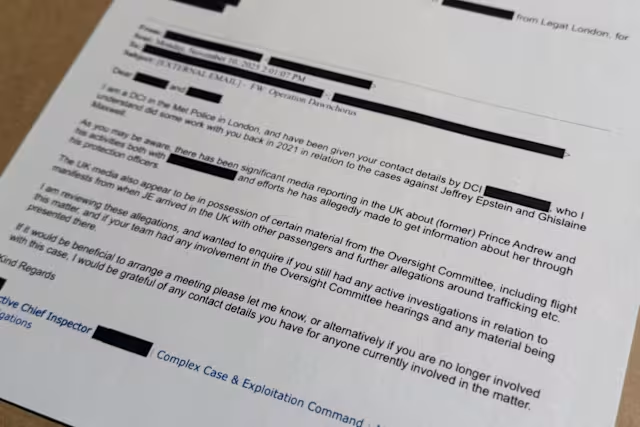
A newly released set of documents related to Jeffrey Epstein, made public on Tuesday, contains several references to President Donald Trump, including records of flights he allegedly took on his former associate’s private jet, alongside other claims the Justice Department has described as “untrue and sensationalist.”

The release features previously undisclosed materials from investigations into Epstein, a wealthy American financier who died in custody in 2019 while awaiting trial on charges of sex trafficking underage girls.

An earlier batch of heavily redacted files published last Friday had drawn criticism, with accusations that the Justice Department was deliberately delaying full disclosure and omitting references to Trump.

In contrast, Trump appears frequently in the thousands of documents released on Tuesday, although many of the mentions stem from media reports rather than direct evidence.

In response, the Justice Department quickly issued a statement defending the 79-year-old Republican president.

“Some of these documents contain untrue and sensationalist claims made against President Trump that were submitted to the FBI right before the 2020 election,” the department said on X, without identifying which allegations it considered false.

Trump, who has not been accused of any criminal wrongdoing, had previously sought for months to block the release of the extensive cache of Epstein-related documents, noting that Epstein was already a convicted sex offender when the more serious trafficking investigation began.

Pressure from within Trump’s own Republican Party eventually compelled him to approve legislation requiring the full release of the files.

That decision reflected mounting political pressure to confront what many Americans — including Trump supporters — have long believed was a cover-up designed to shield wealthy and influential individuals linked to Epstein.

Private jet trips

On Monday, Trump said he did not support the document releases, warning that individuals who had “innocently met” Epstein over the years could suffer reputational damage.

“Everybody was friendly with this guy,” he said.

He offered no immediate response to Tuesday’s release, instead posting on Truth Social about economic matters and other unrelated issues.

Trump maintained a friendship with Epstein for several years and has provided varying explanations for how their relationship ended.

He has claimed they fell out after Epstein “stole” young women employed at the spa of his Florida golf club, and has also said he expelled Epstein from the club for being “a creep.”

However, the newly released documents appear to strengthen evidence of Trump’s close association with Epstein, contradicting some of his earlier claims.

Among the records is a January 2020 note from New York federal prosecutors investigating Epstein’s associate, Ghislaine Maxwell, which details Trump’s repeated travel aboard Epstein’s private jet.

“Records we received yesterday reflect that Donald Trump traveled on Epstein’s private jet many more times than previously has been reported (or that we were aware),” the note states.

One reported flight allegedly carried only three passengers — Epstein, Trump and an unidentified 20-year-old woman.

Delays

Some of the references involving Trump — who has never been charged with any crime related to Epstein — cannot be independently verified.

One such reference appears in a handwritten letter purportedly written by Epstein from jail to Larry Nassar, the former US gymnastics doctor imprisoned for widespread abuse of female athletes.

In the letter, Epstein is shown complaining to Nassar about their imprisonment while claiming that the “president shares our love of young, nubile girls. When a young beauty walked by he loved to ‘grab snatch.’”

Senate Democratic Minority Leader Chuck Schumer said the files contain an email revealing that the Justice Department had investigated “at least” ten possible Epstein co-conspirators.

“The Department of Justice needs to shed more light on who was on the list, how they were involved, and why they chose not to prosecute,” Schumer said.

Meanwhile, the lawmakers who co-sponsored the legislation mandating the document release — Democrat Ro Khanna and Republican Thomas Massie — warned over the weekend that they could pursue contempt of Congress charges against Attorney General Pam Bondi for failing to release all the materials by the previous Friday’s deadline.

Deputy Attorney General Todd Blanche attributed the delay to the need to redact identifying details of more than 1,000 Epstein victims contained in the records.

Ghislaine Maxwell, Epstein’s former girlfriend, remains the only individual convicted in connection with his crimes.

NASS Extends 2025 Fiscal Year To March 2026

0

In a sweeping fiscal adjustment intended to address revenue gaps, poor capital project execution and overlapping budget cycles, the National Assembly on Tuesday approved a revised N43.5 trillion 2024 Appropriation Act and a restructured N48.3 trillion budget for 2025, extending the 2025 fiscal year to March 31, 2026.

The approvals came after prolonged plenary sittings in both chambers, which ended with the passage of the Appropriation Act (Repeal and Re-enactment) Bills for the 2024 and 2025 fiscal years submitted by President Bola Ahmed Tinubu last Friday.

In the Senate, the revised budgets were adopted following the consideration of a consolidated report by the Committee on Appropriations, presented by its chairman, Senator Solomon Adeola (Ogun West).

Lawmakers said the review was aimed at aligning Nigeria’s budget framework with current economic realities, closing implementation gaps and restoring discipline to the budgeting process.

While presenting the report, Adeola explained that the bills sought to repeal earlier budget provisions and replace them with updated figures reflecting revenue constraints, debt sustainability concerns and evolving national priorities.

He noted that the 2024 Appropriation Act was repealed from its original N35.005 trillion and re-enacted with a revised total expenditure of N43.561 trillion, with statutory transfers, debt servicing, recurrent spending and capital expenditure fully captured in the committee’s report.

On the 2025 fiscal year, Adeola said the initial N54.99 trillion Appropriation Act was repealed and replaced with a revised total of N48.316 trillion, adding that part of the capital allocation was deferred to the 2026 fiscal year due to funding limitations identified during the presidential budget presentation.

He disclosed that extensive consultations between the committee and the economic management team informed the repeal and re-enactment of the budgets, particularly to resolve issues relating to revenue performance, debt exposure and effective implementation.

Highlighting major adjustments, Adeola said an additional N8.5 trillion was injected into the capital component of the 2024 budget to fund special interventions addressing security, humanitarian and economic emergencies nationwide.

He added that the revised framework was designed to strike a balance between responsiveness and fiscal responsibility, ensuring that debt-related spending does not weaken legislative oversight or fiscal prudence.

For the 2025 budget, the committee observed that N6.674 trillion was removed from the capital allocation and deferred to the 2026 fiscal year to improve budget effectiveness in anticipation of improved revenue inflows.

Adeola cautioned against the continued practice of operating multiple budgets at the same time, warning that extending one budget while another remains in force erodes fiscal discipline, transparency and accountability.

Based on these findings, the committee recommended that the Senate approve the repeal and re-enactment of the 2024 Appropriation Act to authorise total spending of N43.5 trillion from the Consolidated Revenue Fund, alongside the revised N48.3 trillion framework for the 2025 fiscal year, and extend the implementation of the 2025 budget to March 31, 2026.

The Senate subsequently passed the bills after extensive debate and third reading.

Meanwhile, the House of Representatives also approved the revised N43.56 trillion 2024 budget and the N48.31 trillion 2025 budget after considering and adopting the report of its Committee on Appropriations.

The passage followed a clause-by-clause review of the estimates at the Committee of Supply and their final approval at plenary, presided over by the Speaker, Rt. Hon. Tajudeen Abbas.

Details of the revised 2024 budget show allocations of N1.74 trillion for statutory transfers, N8.27 trillion for debt servicing, N11.26 trillion for recurrent (non-debt) expenditure, and N22.27 trillion for capital expenditure and development fund contributions for the fiscal year ending December 31, 2025.

Under the revised 2025 budget, N3.64 trillion is allocated for statutory transfers, N14.31 trillion for debt service, N13.58 trillion for recurrent (non-debt) expenditure, and N16.76 trillion for capital expenditure through development fund contributions.

As with the Senate version, the implementation of the 2025 budget is expected to run until March 31, 2026.

In his communication to the National Assembly, President Tinubu said the revisions were required to accommodate previously omitted budget items and adjust capital implementation targets in line with Nigeria’s revenue realities and execution capacity.

He explained that the revised framework adopts a more realistic capital implementation benchmark of 30 per cent.

The president acknowledged persistent weaknesses in the execution of the capital component of the 2024 budget, noting that these shortcomings significantly undermined infrastructure delivery and development projects across the country.

According to him, extending the 2025 budget timeline to March 31, 2026, would give Ministries, Departments and Agencies sufficient time to access and utilise the targeted 30 per cent capital releases.

Tinubu said the move forms part of a broader fiscal reform agenda aimed at correcting structural flaws in Nigeria’s budgeting system, including the long-standing issue of overlapping budgets.

He stressed that ending the practice of running multiple budgets simultaneously would improve planning, enhance implementation and strengthen transparency and accountability in public expenditure.

The president added that the revised budget framework is intended to deliver more credible budget outcomes, better coordination of government programmes and improved value for money for Nigerians.

FG To Introduce New Emergency Passport In 2026

0

The Federal Government has announced plans to introduce a new emergency travel document, the Single Travel Emergency Passport (STEP), which will replace the existing Single Travel Emergency Certificate (STEC) by 2026.

The Comptroller-General of the Nigeria Immigration Service (NIS), Kemi Nandap, disclosed this during the decoration ceremony of 46 newly promoted Assistant Comptrollers of Immigration (ACIs) to the rank of Comptroller of Immigration, held in Abuja.

She said the service is focused on deploying technological innovations to improve service delivery and effectively discharge its constitutional responsibilities.

Speaking on the reforms, she stated: “I am looking forward to embracing 2026, which will also be part of all the reforms we’re introducing to optimise our services both in terms of our visa, passport production line, contactless solutions and new ones we’re putting in place, like the ENBIC (ECOWAS National Biometric Identity Card), which we just started. We want to ensure that our processes are seamless and the STEP, which is also a new programme we’re going to launch early next year. It is going to be biometric-based, and it is going to be in alternative ways.”

The Comptroller-General urged the newly decorated officers to exhibit increased vigilance and uphold the highest standards of professionalism amid prevailing security challenges.

She reminded them that advancement in a disciplined service is “neither automatic nor solely a function of years in service,” but is achieved through “sustained dedication, professional competence, integrity and an unwavering commitment to duty.”

Nandap commended President Bola Tinubu for his “visionary leadership and steadfast commitment to institutional reforms and national security,” adding that the ongoing transformation within the service reflects the administration’s determination to strengthen security institutions.

She also acknowledged the Minister of Interior, Dr Olubunmi Tunji-Ojo, for providing “strategic direction, diligent oversight and resolute dedication to strengthening our operational capacities,” noting that the presence of key stakeholders demonstrated the collective support sustaining the service.

The Immigration chief told the officers that their decoration represented the confidence placed in them and carried expectations of “enhanced leadership, sound judgment, accountability and exemplary conduct.”

She explained that occupying senior positions demands clear vision, decisiveness, empathy, and the capacity to mentor and inspire others.

“At this advanced stage of your careers, professional competence must be matched with strong leadership attributes.

Considering the security challenges our nation faces, we must remain vigilant and unrelenting in the fight against multifaceted threats. Your actions will set the tone, and your conduct will continue to reflect the core values and reputation of this service.”

Nandap reiterated that the NIS would “not tolerate any form of indolence or unprofessional conduct,” while encouraging officers to embrace innovation, respond to emerging challenges and prioritise the interest of the Service above personal considerations.

She also encouraged officers who were not promoted to stay committed, assuring them that, “There is a time for everyone. Keep working hard and your time will come.”

INEC Fixes February 21 For Rivers State By-Elections

0

The Independent National Electoral Commission (INEC) has scheduled by-elections for the Ahoada East II and Khana II state constituencies in Rivers State to take place on February 21, 2026.

This was announced in a statement released on Monday in Abuja by Malam Mohammed Haruna, Chairman of INEC’s Information, Voter Education and Publicity Committee.

Haruna explained that the decision followed an extraordinary meeting held on Monday, during which the commission assessed its readiness for the Federal Capital Territory (FCT) Area Council end-of-tenure elections, which are also slated for February 21.

He said the meeting also considered and approved the draft timetable and schedule of activities for the by-elections in the Ahoada East II and Khana II state constituencies.

Explaining the legal framework for the decision, Haruna cited Section 116 of the 1999 Constitution (as amended), which authorises INEC to determine election dates and conduct by-elections to fill vacant seats.

“The vacancy in the Ahoada East II Constituency arose as a result of the resignation of its member while that of Khana II resulted from the death of its member.
“The Speaker of the State’s House of Assembly had since notified the commission of the existence of the vacancies.
“By the Commission’s decision today, the notice for the two elections will be published on Jan. 22, 2026, while political parties will conduct their party primaries, including the resolution of disputes arising from the primaries, between Jan. 23 and Jan. 27, 2026.

“Parties and candidates will then commence their campaigns on Feb. 8, 2026 to end on Feb. 19. The elections will hold on Feb. 21, 2026.”

Six Rivers Reps Members Deflected From PDP To APC

0

Six lawmakers from Rivers State in the House of Representatives, who were elected under the Peoples Democratic Party, have crossed over to the All Progressives Congress.

The Speaker, Abbas Tajudeen, announced their defection notices during the special sitting convened for the 2024 and 2025 Appropriation Bills.

In their defection letters, the representatives attributed their decision to ongoing crises that are destroying unity in their erstwhile party.

They praised the impressive performance of President Bola Tinubu’s government in the past two years and committed to supporting the administration’s efforts to reconstruct the country.

The defecting members include Dum Dekor (Khana/Gokana Federal Constituency), Solomon Bob (Ahoada East/Abua/Odual Federal Constituency), and Victor Obuzor (Ahoada West/Ogba Federal Constituency).

The others are Blessing Amadi (Port Harcourt Federal Constituency 2), Felix Nweke (Eleme/Tai/Oyigbo Federal Constituency), and Hart Cyril (Degema/Bonny Federal Constituency).

Several national APC officials were permitted into the chamber to observe the proceedings, including Deputy National Chairman (North) Ali Bukar, National Secretary Ajibola Basiru, and National Youth Leader Dayo Israel.

However, invoking a point of order, Minority Leader Kingsley Chinda asserted that defections announced on the floor of the House lack legal support, while Deputy Minority Leader Ali Isa maintained that the defectors risk losing their seats.

In his response, the Speaker recognised their concerns but emphasised that any lawmaker who wishes to formally notify the House of their defection is always allowed to do so.

US Launches Surveillance Flights Over Nigeria

0

Since late November, the United States has conducted intelligence collection flights across extensive areas of Nigeria, indicating stronger security ties between the two nations, based on flight tracking records and statements from US officials referenced by Reuters.

Monday’s report stated that the exact objectives of these surveillance operations could not be verified independently.

Nonetheless, these missions occur in the wake of November warnings from U.S. President Donald Trump about potential military action in Nigeria due to what he called the government’s inadequate response to attacks on Christian populations.

Reuters highlighted that the surveillance activities are also taking place several months after the abduction of a US pilot employed by a missionary organization in nearby Niger.

December flight tracking records indicate that the aircraft, operated by contractors, generally departs from Ghana, conducts operations over Nigeria, and lands back in Accra.

The spokesperson for Nigeria’s military and Ghana’s deputy defence minister declined to comment on inquiries.

Trump has additionally withdrawn Ambassador Richard Mills to Nigeria along with several other career diplomats from their overseas assignments.

Per Politico, this action forms part of an initiative to ensure US overseas diplomatic posts reflect President Trump’s “America First” agenda.

A State Department spokesperson told the outlet that the impacted ambassadors were originally nominated under the Joe Biden administration and would finish their roles as heads of mission in January.

Although the diplomats may return to Washington for alternative roles if desired, their terms as mission leaders will end.

Africa has been the hardest-hit area in these withdrawals, with ambassadors to 13 nations, such as Nigeria, Burundi, Cameroon, Côte d’Ivoire, Senegal, and Uganda, included in the recalls.

Other impacted areas encompass the Asia-Pacific, Europe, the Middle East, South Asia, and the Western Hemisphere.

Former Attorney-General Malami Remains In EFCC Custody

0

Abubakar Malami, Nigeria’s former Attorney-General and Minister of Justice, continues to be held by the Economic and Financial Crimes Commission (EFCC) more than two weeks after his detention, as investigations into allegations of corruption, abuse of office, and money laundering intensify.

Malami, who served from 2015 to 2023 under President Muhammadu Buhari, was detained on December 8 after reportedly failing to meet administrative bail conditions initially granted in late November.

The EFCC’s probe stems from multiple petitions accusing Malami of financial misconduct.

Key allegations include the improper payment of $16.9 million in legal fees to two lawyers for recovering funds looted by the late military ruler Sani Abacha, as well as involvement in the management of $346.2 million recovered from Switzerland.

Other claims involve a N4 billion loan from the Central Bank of Nigeria, a $496 million payout to Global Steel Holdings after it had waived claims, a $200 million compensation deal with Sunrise Power over the Mambilla hydropower project dispute, and his role in a $419 million Paris Club judgment debt to consultants.

The agency is also examining a purported N10 billion investment in schools, hotels, and rice mills in Kebbi State, which critics say is unexplained, along with 46 bank accounts allegedly linked to him.

Reports have further mentioned suspicions of terrorism financing, though Malami’s camp has dismissed these as baseless and sensationalized.

In recent developments, EFCC operatives raided Malami’s residences and offices in Abuja and Kebbi State around mid-December, actions his team described as intimidation tactics following his public reference to Chapter 9 of the unreleased Justice Ayo Salami Judicial Commission Report, which allegedly contains adverse findings against current EFCC Chairman Ola Olukoyede.

Additionally, police have taken over the Azbir Hotel and Arena in Birnin Kebbi, properties allegedly owned by Malami and linked to the probe into assets disproportionate to his earnings.

A Federal Capital Territory High Court dismissed Malami’s bail application last week, ruling that the EFCC’s detention was lawful and that he must remain in custody pending further investigation.

Malami has vehemently denied the allegations, calling the investigation a political witch-hunt motivated by his recent defection to the African Democratic Congress (ADC) and his gubernatorial ambitions in Kebbi State.

He has accused EFCC Chairman Olukoyede of bias, citing the Salami report, and demanded that Olukoyede recuse himself from the case. In a statement from custody, Malami urged for his immediate release, claiming his life is at risk and describing the process as a smear campaign without evidence.

His supporters echo these sentiments, arguing that no charges have been filed in court yet and insisting on a fair process.

The case has sparked widespread protests in Kebbi State, where youths have demonstrated for Malami’s release, holding prayers and rallies while decrying what they call oppression and selective prosecution.

Protesters and opposition figures, including former Vice President Atiku Abubakar, have pointed to perceived inconsistencies in anti-corruption efforts, noting that figures like former Kano Governor Abdullahi Ganduje and ex-Kogi Governor Yahaya Bello face similar allegations but remain free.

“If Malami had defected to the APC, the EFCC would have left him untouched,” Atiku reportedly stated, framing the detention as politically motivated.

On the other side, civil society groups have urged Malami to cooperate fully with the investigation rather than making demands that undermine it.

The Human Rights Writers Association of Nigeria (HURIWA) criticized his call for Olukoyede’s recusal as “baseless and evasive,” emphasizing that no one is above the law and that the probe should proceed without interference.

Critics of the protests, including some Kebbi residents, have labeled them as politically sponsored and embarrassing, arguing that accountability must apply to all public officials and that investigations are not equivalent to convictions.

As the situation evolves, no formal charges have been brought against Malami in court, and the EFCC has maintained that its actions are based on credible petitions and evidence, not political vendettas.

The case has fueled broader debates on the independence of Nigeria’s anti-corruption institutions, selective justice, and the intersection of politics and law enforcement under President Bola Tinubu’s administration.

The public continue to monitor for updates, with calls from all sides for transparency and due process.