Angry crowds flooded the streets of Nairobi, voicing their outrage over the death of a blogger who had been detained by police a week earlier. This protest comes amid fresh revelations from the police oversight body that 20 people have died in custody over the past four months.
Officers fired tear gas to scatter demonstrators gathered near the Parliament building on Thursday. The protesters were demanding justice for 31-year-old Albert Ojwang, who was arrested in Homa Bay after publishing criticism against Deputy Police Chief Eliud Lagat.
Police originally claimed Ojwang lost his life “after hitting his head against a cell wall.” But pathologist Bernard Midia, who participated in the post-mortem examination, said that the head trauma, neck compression, and tissue damage observed indicated that he died as a result of an assault.
On Wednesday, President William Ruto acknowledged Ojwang’s death “at the hands of the police,” contradicting the initial official version. He described the incident as “heartbreaking and unacceptable.”
Reports indicated that a police constable was taken into custody in connection with Ojwang’s death.
According to an eyewitness account from the protests, Ojwang known for commenting on political and social matters had previously made online posts accusing Lagat of involvement in a “bribery scandal.”
“It’s angered people that he was detained for that, and then days later, dead in a police station,” the reporter noted, adding that demonstrators were insisting Lagat be held responsible and were “persisting in throwing stones at the police in spite of one volley of tear gas after the next being fired at them.”
Ojwang’s case has stirred public concern about long-standing allegations against security forces, including unlawful killings and enforced disappearances.
During a parliamentary briefing on Thursday, Issak Hassan, chair of the Independent Policing Oversight Authority, confirmed that “20 deaths in police custody in the last four months” have occurred.
An official inquiry into Ojwang’s death has now begun.
Inspector General Douglas Kanja on Wednesday apologized for the previous claim that Ojwang’s death was self-inflicted, telling senators: “He did not hit his head against the wall.”
His death comes nearly a year after protesters and activists were killed or disappeared during demonstrations over a controversial finance bill — with several individuals still unaccounted for.
Those rallies triggered widespread criticism of President Ruto over the violent handling of dissent.
Amnesty International has called for Ojwang’s death in detention last Saturday to “be urgently, thoroughly and independently investigated.”
China has revealed its decision to completely remove tariffs on imports from African nations that share diplomatic ties with it. This development marks a significant adjustment aimed at strengthening its economic relationship with the continent as it solidifies its role as a vital partner in trade and investment.
This zero-tariff policy applies to Nigeria along with 52 other African nations but does not include Eswatini the sole country on the continent that maintains official relations with Taiwan.
This major shift was revealed after Chinese Foreign Minister Wang Yi met with top African representatives during a gathering held in Changsha, located in China’s Hunan province.
Previously, such exemptions from tariffs were granted only to the continent’s poorest economies, but this latest policy represents a broad extension beyond that limited scope.
Chinese leader Xi Jinping, in his official message to African foreign ministers, declared that “zero-tariff treatment for 100 per cent of tariff lines” will now benefit all 53 African countries that have formal diplomatic connections with Beijing.
This new approach expands upon promises made earlier at a China-Africa summit last September when preferential access was given to 33 of the continent’s least-developed nations.
The impact of these efforts is already showing, with Chinese exports to Africa climbing by 12.4% within the first five months of the year, hitting an unprecedented 963 billion yuan ($134 billion), as disclosed by China’s Foreign Ministry.
This gesture from Beijing arises against the backdrop of increasing friction in trade relations between Africa and the United States.
In the joint statement released after the meeting, countries, particularly the US, were urged to “return to the right track” of resolving trade disputes through dialogue based on mutual respect.
This message comes in response to President Trump’s latest move to impose high tariffs on various African countries.
The levies introduced include duties of up to 50 per cent on goods from Lesotho, 47 per cent on items from Madagascar, 40 per cent on products from Mauritius, 38 per cent on Botswana’s exports, and 31 per cent on goods coming from South Africa — the continent’s top industrial hub and leading U.S. trade partner.
More than 30 African nations now stand at risk of losing the trade benefits provided under the U.S. African Growth and Opportunity Act (AGOA), a critical trade framework that has faced growing doubts in recent times.
President Donald Trump had previously hinted at plans to introduce reciprocal tariffs on all American trading partners, raising fresh concerns about the continuity of AGOA and other similar special agreements.
China’s latest zero-tariff initiative is seen as offering Africa a more reliable and steady economic partnership, especially as global trade tensions intensify.
Protests swept across Kenya on Thursday following the shocking death of 31-year-old blogger and former teacher, Albert Ojwang, who died in police custody under suspicious circumstances sparking outrage over alleged police brutality and impunity.
Ojwang was arrested last week in Homa Bay, western Kenya, after publishing social media posts criticizing Deputy Inspector General of Police, Eliud Lagat, and linking him to a reported bribery scandal. After his arrest, Ojwang was transported over 200 miles to Nairobi, where he died just hours later.
Police initially claimed that the blogger had “hit his head on a cell wall,” but that narrative quickly unraveled after an autopsy revealed multiple signs of torture.
“The cause of death is very clear head injury, neck compression, and other injuries spread all over the body that are pointing towards assault,” said Dr. Bernard Midia, one of five pathologists who examined the body. “Multiple soft tissue injuries” were also documented.
Six police officers were on duty at the time of Ojwang’s death. One officer has been arrested and charged with murder, while two others remain at large. Kenya’s Independent Policing Oversight Authority has confirmed that more arrests are expected.
Demonstrations erupted almost immediately after news of Ojwang’s death became public earlier in the week, but Thursday’s protests were the largest yet paralyzing parts of Nairobi and several towns in western Kenya and the Rift Valley. Many businesses closed their doors as protestors blocked roads, set vehicles on fire, and clashed with police in attempts to march on Parliament.
“There’s no value for life; they are killing us every day,” said journalist and activist Hanifa Adan at one of the rallies. “We are here demanding justice.”
Chants of “No justice, no budget!” and “Lagat must go!” rang out from demonstrators holding signs and newspaper front pages highlighting the incident. The protests also served as a powerful echo of last year’s anti-tax demonstrations, which left more than 60 people dead and underscored growing public dissatisfaction with the government and security forces.
In a dramatic turn, Police Chief Douglas Kanja issued a public apology for initially misleading the nation about Ojwang’s death. During a tense parliamentary hearing, lawmakers grilled senior police officials amid growing pressure to reform law enforcement and account for the over 20 deaths in custody recorded in just the past four months.
As the investigation continues and more arrests loom, Kenyans are demanding real accountability not just for Ojwang, but for a police system many say has operated with near-total impunity.
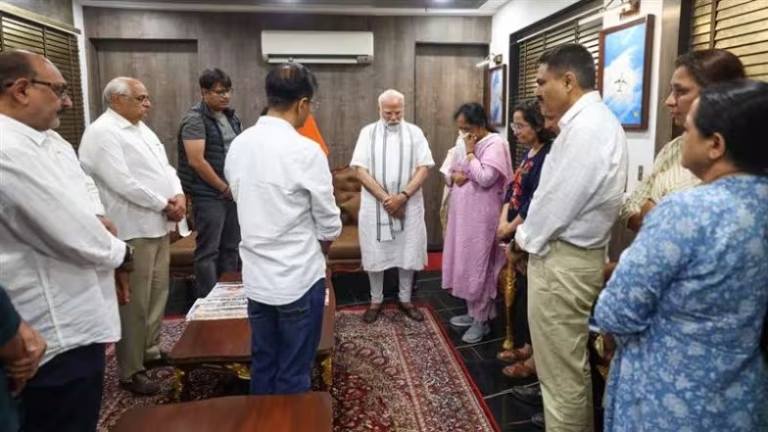
In a deeply emotional moment for Indian politics, Prime Minister Narendra Modi has paid a personal visit to the grieving family of Vijay Rupani, the former Chief Minister of Gujarat and a senior leader of the Bharatiya Janata Party (BJP), who was among the many killed in the catastrophic Air India plane crash on Thursday.
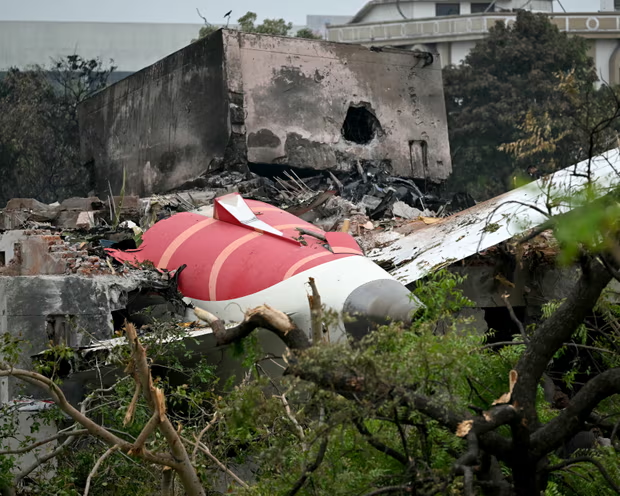
Rupani, a veteran politician and a close aide of the Prime Minister, was on board the ill-fated Boeing 787 Dreamliner that crashed shortly after takeoff from Ahmedabad. The crash claimed the lives of all passengers and crew — including Rupani, 169 Indian nationals, 52 British citizens, and others — marking one of the deadliest aviation disasters in recent Indian history.
As news of Rupani’s death sent shockwaves through the nation, Prime Minister Modi took to X (formerly Twitter) to share a heartfelt tribute to the man he had worked alongside for decades.
“It is unimaginable that Vijaybhai is not in our midst. I’ve known him for decades. We worked together, shoulder to shoulder, including during some of the most challenging times,” the Prime Minister wrote.
Modi’s visit to the Rupani family in Rajkot was marked by visible sorrow. Accompanied by senior BJP leaders and security personnel, Modi offered his condolences, spending several moments with family members — a rare personal gesture that underlined the deep political and emotional bond the two leaders shared.
“Will always cherish the interactions we had. My thoughts are with his family and friends in this hour of grief,” Modi added in his post.
Rupani, who served as Gujarat’s Chief Minister from 2016 to 2021, was a well-regarded figure in state and national politics, known for his quiet, effective leadership and organizational acumen within the BJP. His tenure was marked by infrastructural development, administrative reforms, and a firm alignment with Modi’s national vision for growth.
Modi described him as “humble and hardworking” and someone who had served “diligently” in his time as Gujarat’s top executive.
In the wake of the crash, tributes have poured in from across the political spectrum. Leaders from the Congress party, regional parties, and civil society have all expressed shock and extended condolences, particularly acknowledging Rupani’s contributions to Gujarat’s governance.
The Air India flight, bound for London, crashed into a building used for medical staff accommodation at Byramjee Jeejeebhoy Medical College and Civil Hospital, just minutes after takeoff. Authorities are still investigating the cause of the crash, though early reports suggest a sudden mechanical failure mid-air. A full inquiry has been launched by the Directorate General of Civil Aviation (DGCA).
In the midst of national mourning, Modi’s message has resonated with many who saw Rupani as part of the core leadership that helped shape the BJP’s rise in Gujarat and, eventually, India.
The Prime Minister’s deeply personal tone in the wake of the tragedy has not gone unnoticed. His words carried the weight of decades of shared political life, and for those familiar with Modi’s rarely public emotional expressions, the message on X served as both a eulogy and a tribute.
As India prepares to cremate and honor those lost in the tragedy, Vijay Rupani’s legacy will be remembered not just through his political career, but through the very personal loss felt by his closest ally — the Prime Minister of India himself.
The Movement for the Survival of Ogoni People (MOSOP), under the leadership of Fegalo Nsuke, has commended President Bola Tinubu for granting a posthumous presidential pardon to the nine Ogoni rights activists executed in 1995 by the military regime of General Sani Abacha.
Those pardoned include Ken Saro-Wiwa, Nubari Kiobel, Nordu Eawo, Saturday Doobee, John Kpuinen, Paul Levura, Daniel Gbokoo, Felix Nuate, and Baribor Bera. Nsuke described the gesture as a “historic and courageous act of national reckoning” and a crucial step toward healing the wounds inflicted on both the Ogoni people and the nation.
He further praised Tinubu for showing boldness and compassion in addressing a long-standing demand for justice, saying, “The President’s acknowledgment of the grave injustice done to the Ogoni Nine, especially the statement that their execution should never have happened, has been met with gratitude both within Nigeria and around the world.” However, Nsuke argued that while the pardon is important, it implies forgiveness of a crime that was never committed.
He urged the president to go further by establishing a Judicial Commission of Inquiry, stating, “Such an exoneration would be a stronger moral and legal correction, ensuring that their names are no longer burdened by the stain of injustice.”
Who Were The Ogoni Nine?
The Ogoni Nine were a group of nine activists from the Ogoni region of Nigeria who opposed the operating practices of the Royal Dutch Shell oil corporation in the Niger Delta.
Led by social activist Ken Saro-Wiwa, the group also included Saturday Dobee, Nordu Eawo, Daniel Gbooko, Paul Levera, Felix Nuate, Baribor Bera, Barinem Kiobel, and John Kpuine. Saro-Wiwa was the founder of Movement for the Survival of the Ogoni People (MOSOP) a movement representing over 700,000 Ogoni people campaigning for social, economic, and environmental justice through peaceful protest.
Ken Saro-Wiwa had previously been a critic of the Royal Dutch Shell oil corporation, and had been imprisoned for a year.
In 1995, under the military regime of General Sani Abacha, the Ogoni Nine were tried and executed by hanging on the 10th of November 1995 accused without presenting any evidence of inciting the murder of four Ogoni chiefs. They were buried in Port Harcourt Cemetery.
According to Amnesty International, “in May of 1994, the Ogoni chiefs Albert Badey, Edward Kobani, Samuel Orage and Theophilus Orage, were killed in Gokana. R. Boele, known to be opponents of MOSOP.
The executions provoked international condemnation and led to the increasing treatment of Nigeria as a pariah state until General Abacha’s mysterious death in 1998.
Ogoni Nine And What They Fought For?
The Ogoni Nine, through MOSOP, were engaged in a nonviolent struggle against environmental destruction, economic marginalization, and social injustice caused by oil exploration in their homeland.
Ogoniland had suffered extensive environmental degradation, primarily due to oil spills, These oil spills made the land uninhabitable in some areas, and unable to be farmed, a common livelihood of the Ogoni people and polluted the air and water crippling agriculture and fishing, the backbone of the Ogoni economy.
By 1992, MOSOP’s activism became sharply focused on the operations of oil companies in the Niger Delta, particularly Royal Dutch Shell. In early 1993, the movement intensified its international engagement, including appeals to the United Nations.
On January 4, 1993, over 300,000 Ogoni people marched peacefully in protest against oil production in their region. During that demonstration now commemorated annually as Ogoni Day, one Ogoni leader said, “We have woken up to find our lands devastated by agents of death called oil companies. Our atmosphere has been totally polluted, our lands degraded, our waters contaminated, our trees poisoned, so much so that our flora and fauna have virtually disappeared.”
The years that followed were marked by increased violence, particularly between 1993 and 1994. The Nigerian military was frequently deployed to suppress the movement, often resulting in brutal crackdowns.
In May 1994, four Ogoni chiefs were murdered, and the government swiftly blamed MOSOP, arresting dozens of its members including the Ogoni Nine despite lack of credible evidence. Later in 1994, Shell reportedly sought military assistance to secure a pipeline route through Ogoniland. Amid this, violence escalated dramatically, and it is estimated that as many as 2,000 people lost their lives during that period.
The continued resistance by MOSOP, led by Ken Saro-Wiwa, challenged both multinational corporations and the military dictatorship, drawing global attention to the plight of the Ogoni people and the human rights abuses in the Niger Delta.
What Has The Government Done Towards Ogoni Land’s Liberation
The Nigerian government has taken some steps toward addressing the environmental and social issues in Ogoniland. Various agencies, including the Federal Ministry of Environment, have engaged in cleanup efforts in collaboration with international partners.
In 2011, the United Nations Environment Programme (UNEP) released a comprehensive report detailing the extensive contamination in Ogoniland, calling for urgent remediation. Since then, initiatives aimed at environmental restoration and community rehabilitation have been launched, though progress has been slow and often criticized as inadequate by activists and local communities. The recent presidential pardon and calls for exoneration of the Ogoni Nine signal a renewed commitment at the federal level to acknowledge past injustices and promote reconciliation.
MOSOP and other civil society groups continue to urge the government to implement comprehensive cleanup and development programs that respect the rights and livelihoods of the Ogoni people, ensuring that environmental justice becomes a lasting reality.
The Current State Of Ogoni Land
Since the execution of the Ogoni Nine and throughout the early 2000s, Nigeria has witnessed numerous oil spills and extraction-related fires affecting many areas. While no further drilling has occurred in Ogoniland since 1993, the land remains severely damaged.
Underground pipelines continue to leak, worsening the environmental degradation. Shell has yet to conduct comprehensive cleanup efforts, though it paid £55 million in reparations in 2014 for two oil spills that happened in 2008.
Although gas flaring and acid rain across Ogoniland have reduced, pollution still severely impacts the vegetation and the land. Ogoni Day continues to be commemorated each year on January 4, with the 30th anniversary celebrated in 2023, as a reminder of the ongoing struggle for justice and environmental restoration.
Chief Olu Falae, a former Secretary to the Government of the Federation and the joint presidential candidate of the Alliance for Democracy (AD) and the All Peoples Party (APP) in the 1999 general elections, has claimed that he was the actual winner of the election that marked Nigeria’s return to civilian rule not former President Olusegun Obasanjo.
In an interview on Thursday, part of a Democracy Day special, Falae alleged that the results of the 1999 election were tampered with to favour Obasanjo, who ran on the platform of the Peoples Democratic Party (PDP).
Referencing a legal review conducted by his late lawyer, Chief J.O.K. Ajayi, Falae insisted he won the election by a wide margin.
“My lawyer, the late Chief J.O.K. Ajayi, after carefully reviewing the declared results, concluded that I won by more than one million votes,” Falae stated.
However, Falae explained that he opted not to challenge the outcome in court, choosing instead to preserve national peace and focus on ensuring a smooth return to civilian rule.
“We were more concerned about ensuring a peaceful transition to civilian rule after prolonged military governance. That was our focus at the time,” he said.
His statements have sparked renewed debate over the legitimacy of the 1999 transition process, which followed the death of General Sani Abacha and was coordinated under the leadership of General Abdulsalami Abubakar. That election was widely seen as a calculated effort to stabilize the country and address grievances from the South-West region following the annulled 1993 elections, which many believe were won by MKO Abiola.
Falae’s joint candidacy, supported by the two main opposition parties, was viewed as a conciliatory gesture to the Yoruba ethnic group. Obasanjo, also Yoruba and a former military ruler, was perceived to have the support of the political elite and military establishment.
“There was immense pressure on us not to upset the transition process,” Falae noted. “We made sacrifices to ensure that democracy could return. I accepted the outcome then in good faith, but the truth remains I won that election.”
Stressing the importance of setting the historical record straight, he added:
“This isn’t about me. It’s about the truth. Nigerians deserve to know what really happened at the dawn of this democratic era.”
Falae also expressed concern over the continued lack of credible elections in Nigeria, asserting that no truly free and fair election has taken place in the country since the annulled 1993 vote.
Benue State Governor, Hyacinth Alia, on Friday reaffirmed his commitment to ensuring the safety of all National Youth Service Corps (NYSC) members deployed to the state. Addressing the 2025 Batch A Stream II corps members, he encouraged them to regard Benue as their “home away from home.”
Represented by the Permanent Secretary of the Ministry of Youth, Sports, Development and Creativity, Dr. Phillip Nongu, the governor gave the assurance at the swearing-in ceremony of 1,303 corps members held at the NYSC Orientation Camp in Wannune, Tarka Local Government Area.
“It is understandable that finding yourselves in a strange land would create all sorts of doubt and fear, but I assure you that being in Benue State is just a home away from home,” he said.
He acknowledged the security issues confronting the country, noting that Benue State had also been affected. “Sadly, our nation is currently bedevilled by security challenges, and Benue State has not been left out. Therefore, let me quickly allay your fears and assure you that as a government, we are poised to ensure your security throughout your stay in the state,” he said.
“For the avoidance of doubt, our administration, in conjunction with all security agencies, has put in place proactive measures to ensure the safety of all locations and residential areas of corps members in the state.”
Governor Alia also urged the corps members to embrace all activities in camp and take their primary assignments seriously. He described these phases as crucial opportunities that could “open doors to great fortune.”
Earlier, the State Coordinator of the NYSC, Mrs. Veronica Garba, expressed appreciation to the governor for his continuous support. She encouraged the corps members to engage actively with the four core NYSC programmes, which include orientation courses, physical training, intellectual and motivational lectures, sporting activities, and Skill Acquisition and Entrepreneurship Development (SAED).
The Chief Judge of the state, Justice Maurice Ikpambese, represented by Justice J.N. Adagba, administered the oath of allegiance to the corps members.
Dangote Sugar Refinery Plc has announced the appointment of Mr. Arnold Ekpe as Chairman of its Board of Directors, effective June 16, 2025.
This was disclosed in a corporate statement dated June 11, 2025. Mr. Ekpe will be succeeding Alhaji Aliko Dangote (GCON), who is stepping down on the same date after nearly two decades of outstanding leadership and service to the company.
The Board stated that Mr. Ekpe’s appointment came after a thorough selection process to find a qualified successor capable of continuing the standard of excellence set during Alhaji Dangote’s tenure.
Highlighting the confidence in the new leadership, the Board described Mr. Ekpe’s deep knowledge of engineering, finance, and executive management as essential for guiding the company’s future growth and innovation.
About Mr. Arnold Ekpe
Mr. Arnold Ekpe is a highly regarded corporate leader with more than 30 years of experience in global banking and industrial sectors.
Born in Nigeria in August 1953, he attended King’s College, Lagos, graduating in 1972. He then moved to the United Kingdom for his higher education. Between 1973 and 1976, he studied Engineering at the University of Manchester, graduating with First Class Honours as a Shell Scholar. He later earned an MBA from Manchester Business School (1977–1979).
Mr. Ekpe began his career in 1977 at Schlumberger SA as a Wireline Logging Engineer. In 1979, he joined Alcan Aluminium Nigeria, where he served as Executive Assistant to the CEO, overseeing key operations such as purchasing and labour relations.
His shift into banking came in the early 1980s when he joined International Merchant Bank (IMB), affiliated with First Chicago, as Head of Strategy. From 1980 to 1986, he served as General Manager of IMB Securities, leading its investment banking and stockbroking activities.
From 1986 to 1987, he was General Manager and Head of Corporate Finance at City Securities Limited, part of First City Monument Bank. He later moved to Nigeria International Bank (now Citibank Nigeria), serving as General Manager from 1987 to 1990.
Mr. Ekpe is perhaps best known for his time as Group CEO of Ecobank Transnational Incorporated, a position he held until his retirement in 2012.
In 2024, he joined the Board of Dangote Sugar Refinery as an Independent Non-Executive Director, bringing extensive governance experience and strategic insight to the company. His elevation to Board Chairman reflects the company’s commitment to strong leadership and continued progress.
A tragic air disaster struck western India on Thursday when an Air India Boeing 787 Dreamliner crashed just moments after takeoff from Ahmedabad’s Sardar Vallabhbhai Patel International Airport.
The London-bound Flight AI171 was carrying 242 passengers and crew members and in a heartbreaking turn, only one person survived the crash, marking it as the deadliest plane disaster the country has seen in years and the first-ever crash involving the Boeing 787 Dreamliner model.
The crash also claimed lives on the ground as the aircraft plummeted into the BJ Medical College and Hospital hostel, bringing the total death toll to at least 290.
How It Happened
Shortly after taking off at 1:39 p.m. local time, the aircraft struggled to gain altitude, barely making it past 625 feet before its signal disappeared. Data from FlightRadar 24 shows that the plane suddenly plunged earthward at a rate of 475 feet per minute.
The flight crew quickly issued a Mayday call less than a minute after takeoff, signaling critical trouble to air traffic control.
Disturbing footage captured by eyewitnesses showed the jet struggling to stay aloft, its tail sinking as the nose pointed forward — before disappearing behind apartment buildings, followed by a towering fireball and dark smoke billowing into the sky.
“Thirty seconds after take-off, there was a loud noise and then the plane crashed. It all happened so quickly,” recalled the sole survivor, Vishwash Kumar Ramesh.
When It Happened
The crash occurred on Thursday, shortly after 1:39 p.m. local time, mere seconds after takeoff. The plane was scheduled to land at London Gatwick nine hours later but never made it past the skies of Ahmedabad.
Were There Nigerians on Board?
According to Air India, there were no Nigerians on board the ill-fated flight. The passengers included:
169 Indian nationals
53 British nationals
7 Portuguese nationals
1 Canadian national
Many on the flight were either returning to Britain after visiting family in India or traveling to reunite with relatives in the UK, reflecting the large Indian diaspora in Britain.
The Survivor’s Account
Astonishingly, one man survived the horrific disaster.
Vishwash Kumar Ramesh, a 40-year-old British father, walked away from the wreckage with injuries to his chest, eyes, and feet. Rescued by local authorities from a residential area near the crash site, Ramesh was taken to a nearby hospital for treatment.
Speaking from his hospital bed, Ramesh described the terrifying moments onboard:
“When I got up, there were bodies all around me. I was scared. I stood up and ran. There were pieces of the plane all around me. Someone grabbed hold of me and put me in an ambulance and brought me to the hospital,” he said.
Ramesh was flying home to London after visiting family in India. Tragically, he reported that his brother, who was also on the flight but seated elsewhere, was missing.
“I can’t find him anymore,” Ramesh said quietly.
As investigations continue into what caused this catastrophic crash, the world mourns the loss of so many lives in what should have been a routine journey.
The aviation industry and travelers alike are left with heavy hearts, awaiting answers and hoping for improved safety measures to prevent such a tragedy from ever happening again.
In the not too distant past of the Benue River — silent, brooding, and beautiful — there echoes the pulse of a people so blessed as the best freshwater capital of Nigeria’s inland waterways. The banks of this great river, once a cradle of culture and commerce, have in recent times drawn deep sighs from bruises of anguish and suspicion, not for want of beauty, but for the insecurity that shadows its course like a lingering ghost.
Indeed, there is a poetic truth in the assertion that in every group there lies a deviant strain — an inevitable deviation from the moral arc of the collective. These deviants, if left unchecked, metastasize into saboteurs — carving from the sacred body of community their own selfish fiefdoms of chaos. In a society worth its salt, such saboteurs, who compromise the communal fabric, have often faced swift and resolute justice.
Yet, while it is valid to raise concern about the creeping threat that lurks upon the riverbanks, in arms trafficking, unregulated settlements, informants of the underworld, and the growing opacity around the identities and activities of riverine dwellers; it is equally important to balance this apprehension with sober appreciation of the sweeping, strategic actions already being undertaken by the Benue State Government under the visionary and dynamic leadership of His Excellency, Rev. Fr. Dr. Hyacinth Iormem Alia.
Lest, it is forgotten in a hurry that, for decades, the question of security along the Benue River and its tributaries had remained a rhetorical echo; raised in local gossip, muted in policy circles, and abandoned on the drawing tables of administrations past. But with the emergence of the Alia-led government, this ghost is currently underway of being confronted head-on.
For the first time in the history of Benue State, in a decisive demonstration of leadership courage by Governor Alia, the Chief of Naval Staff, Vice Admiral Emmanuel Ogalla, visited Makurdi in a landmark strategic tour made possible through the audacious diplomatic engagements of the Governor. The purpose was not ceremonial; it was surgical. This was followed swiftly by the groundbreaking establishment of a Naval Base and a Navy Marine Command outpost in Benue State. These installations are not mere symbolic gestures; they represent an unprecedented pivot to secure our inland waterways, monitor riverine movements, and flush out criminal enterprises operating under the veil of darkness along the banks.
Furthermore, under the Alia administration, the reinvigoration of the Benue State Community Protection Guards, and the mobilization of coordinated vigilante efforts have extended to critical flashpoints like Agatu, North Bank, Abinsi, Gbajimba, Buruku, New Garage and Katsina-Ala. Modern surveillance and digital mapping technologies are also being implemented for the profiling of riverbank households and boat operators, ensuring that no shadow remains without scrutiny.
In the Governor’s holistic vision of “Alianomics,” security is not a standalone pillar, but interwoven with development, social renewal, and administrative accountability. In partnership with federal agencies, there is a growing synergy to harmonize traditional, religious, and local leadership into a united front, not just for intelligence gathering but also for moral rearmament of our society.
Yes, the call to action is noble, but let it not descend into despair or unwarranted indictment of our collective progress. Where shadows loom, light must be acknowledged, and where efforts are in motion, encouragement is due. What we must do, as informed patriots, is amplify these gains, support the structures, report with accuracy, and refuse to glorify fear where hope is germinating.
Makurdi’s river island, once the pride of our youth’s recreation and cultural life, is not lost; it is being reclaimed. The reclamation, however, must happen not only in policy and enforcement but in the conscious re-awakening of our civic dignity and communal will. Let the people become the first line of defense, standing shoulder to shoulder with government efforts, not as accusers, but as co-builders.
We stand at a historic cusp: where the Benue River may no longer be whispered about as a corridor of insecurity, but proudly reclaimed as a lifeline of security, commerce, recreation, and culture — a new testament of possibility under a leadership that listens, acts, and leads with divine courage.
Let history record it today that the Alia administration has not only heard the cries from the riverbanks; His Excellency has responded, decisively, and history shall testify that Benue rose again because her leadership dared where past leadership floundered, and the good people of Benue State dared to believe.
Prof. Qrisstuberg Amua is a Pastor and a firm believer in the visionary and focused leadership of His Excellency Rev. Fr. Dr. Hyacinth Iormem Alia’s AliaNomICs blueprint, agenda and governance of Benue State.
To provide the best experiences, we use technologies like cookies to store and/or access device information. Consenting to these technologies will allow us to process data such as browsing behaviour or unique IDs on this site. Not consenting or withdrawing consent, may adversely affect certain features and functions.
Functional
Always active
The technical storage or access is strictly necessary for the legitimate purpose of enabling the use of a specific service explicitly requested by the subscriber or user, or for the sole purpose of carrying out the transmission of a communication over an electronic communications network.
Preferences
The technical storage or access is necessary for the legitimate purpose of storing preferences that are not requested by the subscriber or user.
Statistics
The technical storage or access that is used exclusively for statistical purposes.The technical storage or access that is used exclusively for anonymous statistical purposes. Without a subpoena, voluntary compliance on the part of your Internet Service Provider, or additional records from a third party, information stored or retrieved for this purpose alone cannot usually be used to identify you.
Marketing
The technical storage or access is required to create user profiles to send advertising, or to track the user on a website or across several websites for similar marketing purposes.