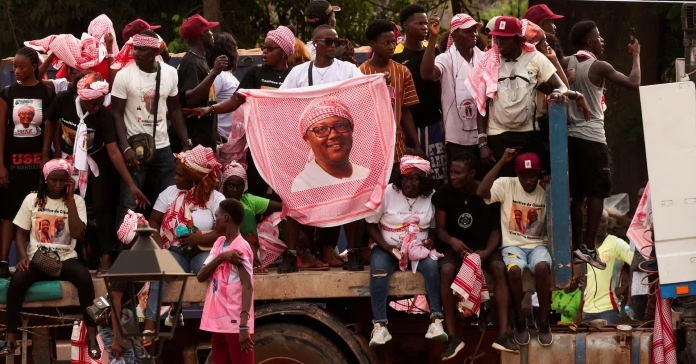
Vote counting is underway in Guinea-Bissau following Sunday’s presidential and legislative elections, with President Umaro Sissoco Embaló locked in a closely fought race as he seeks a second term. If successful, he would become the country’s first leader in 30 years to secure consecutive mandates in a nation long marked by political instability.
Embaló, 53, a former army general, is competing against 11 challengers. His strongest opponent is Fernando Dias da Costa, 47, a rising political figure supported by former prime minister Domingos Simões Pereira. Dias da Costa is also backed by the African Party for the Independence of Guinea and Cape Verde (PAIGC), the country’s historic liberation movement.
This election is particularly contentious as PAIGC was barred from presenting its own candidates for the first time, after being deemed to have submitted required documents too late. The exclusion has fuelled criticism and heightened tensions around the vote.
Analysts expect a narrow contest between Embaló and Dias da Costa. A runoff will be necessary unless one candidate secures more than 50% of the vote in the first round.
Nearly half of the country’s 2.2 million population registered to vote, with turnout surpassing 65%. The national electoral body said provisional results are expected on Thursday.
Observers say the political climate has become increasingly divisive. Analysts argue that the current environment reflects a system shaped heavily by individual influence rather than institutional norms.
Guinea-Bissau remains one of the world’s poorest countries, with about half of its population living in poverty. The country has also become a significant transit point for drug trafficking routes connecting Latin America and Europe.
Since gaining independence from Portugal in 1974, the coastal nation has endured repeated coups—nine before Embaló took office in 2020. The president says he has survived three more attempts since then, though opponents argue he exaggerates instability to justify political crackdowns, an accusation he rejects.
Nigeria witnessed one of its most alarming security crises in recent memory between November 18 and 21, 2025.
On November 18, gunmen struck Christ Apostolic Church, Oke-Isegun in Eruku, Kwara State, leaving three worshippers dead and abducting 38 others during a church service.
Just days later, on November 21, St. Mary’s Catholic Primary and Secondary School in Papiri, Niger State, was overrun by heavily armed kidnappers. Reports suggest roughly 303 students and 12 teachers were seized, marking one of the largest school abductions in Nigeria’s history.
By November 23–24, authorities and families reported the return of 50 students who had escaped, while state and federal officials declared all 38 churchgoers “rescued.”
Rescued, released, or ransomed? What really happened?
President Bola Ahmed Tinubu framed the developments as a security success. In a November 23 statement, he announced he had canceled a planned G20 trip to South Africa to coordinate security efforts and celebrated the “rescue” of the Kwara church worshippers and the recovery of 51 Niger school students.
But how were these rescues achieved? Were ransom payments involved, or were the captives freed through military action or their own daring escape?
Local accounts complicate the official narrative: for the Niger school, many pupils reportedly “escaped” during the chaos rather than being extracted by security forces.
In Eruku, relatives allege kidnappers demanded up to N100 million per victim, though discussions reportedly reduced the figure. So, were these lives saved by negotiation, paid ransom, or tactical intervention — and if money changed hands, why is the government silent about it?
What Tinubu Said and What It Means
“My fellow Nigerians, thanks to the efforts of our security forces over the last few days, all the 38 worshippers abducted in Eruku, Kwara State, have been rescued. I am equally happy that 51 out of the missing students of the Catholic School in Niger State have been recovered,” Tinubu declared.
He emphasized that his canceled G20 trip allowed him to coordinate efforts at home, while pledging continued vigilance: “Every Nigerian, in every state, has the right to safety — and under my watch, we will secure this nation and protect our people.”
Yet, the statement leaves critical questions unanswered: how were the captives recovered? Were the kidnappers confronted, neutralized, or quietly negotiated with? Did ransom payments fuel this release, and if not, what operational successes enabled it?
Social media erupted as Nigerians challenged the official narrative. Users questioned the absence of operational details, highlighting the lack of arrests, weapons seizures, or evidence of direct military engagement.
Many demanded proof, asking for video evidence of the rescued students and other victims, questioning how the rescue occurred without arrests or shootouts, and seeking clarity on whether ransom payments were involved.
With an X user, @sho1shaw, saying “Show us the video evidence of these rescued students and the other victims. Until we see some proof, we don’t believe you.” Another user @Ugochukwu_Zilla: “Rescued? No arrest, no shootout. Tell us how much you have paid.”
This reaction illustrates a national sentiment: without transparency, the term “rescue” risks being interpreted as political theater rather than a tangible security success.
The Bigger Picture of what is happening
Ransom payments are illegal in Nigeria, yet they remain the practical currency of the kidnapping industry. In Eruku, reports suggest initial demands were reduced after negotiation, while Niger’s abduction shows kidnappers prioritizing rapid transfers over confrontation. Paying ransom saves lives short-term but fuels criminal networks; refusing to pay without arrests or neutralization risks perpetuating insecurity. Transparency is strategic — without it, the state signals incapacity or unwillingness to disrupt the kidnapping economy.
Investigative efforts by local reporters and youth journalists have pieced together partial details. In Eruku, victims were held in forest corridors known for criminal activity. Many Niger school pupils were found weak, dehydrated, and disoriented, consistent with escape rather than a coordinated extraction. Several recovered students returned after interventions that remain unclear to the public. However, verification of ransom payments, the tracking of kidnappers, or any concrete law enforcement follow-up remains elusive. Until authorities provide clarity, each “rescue” risks being seen as a temporary relief with long-term consequences left unaddressed.
What Nigerians should watch for next
To move beyond public relations, the government must provide tangible proof of success, such as presenting arrested suspects, displaying recovered weapons, sharing forensic findings, and pursuing prosecutions.
Families of victims, civil society groups, and the international community are closely observing these efforts. Without such concrete actions, the story will likely be remembered as a temporary relief overshadowed by the failure to dismantle the criminal networks behind the kidnappings.
Nigerians face a harsh reality: while some captives are now safe, the threat of future abductions remains.
Tinubu’s canceled G20 trip and triumphant statements may offer temporary reassurance, but without transparency, accountability, and decisive law enforcement, this week’s “rescues” could simply pave the way for next week’s kidnappings.
It is important to celebrate the return of survivors, but the public also deserves proof, clear accountability, and a concrete plan to dismantle the kidnapping networks. Relief alone is politically convenient, but without action, it leaves the country vulnerable and strategically exposed.
Israel carried out an airstrike in Beirut’s southern suburbs on Sunday, targeting one of Hezbollah’s most senior military figures in what marks a significant escalation nearly a year after a ceasefire paused months of cross-border clashes.
Hours after the strike, the Israeli military announced that Haytham Ali Tabatabai, widely regarded as Hezbollah’s chief of staff, had been killed. Lebanese health officials reported at least five deaths and 28 injuries, saying multiple missiles hit a building in the Haret Hreik district, a densely populated Hezbollah stronghold.
Hezbollah later confirmed the death of Tabatabai, describing him as a “great commander,” while avoiding specific details about his role. Footage circulating online showed heavy damage, shattered buildings, and emergency teams working at the scene.
The strike follows a surge in Israeli attacks across southern Lebanon this month. Israel says the operations are aimed at preventing Hezbollah from rebuilding its military capabilities near the border and pressuring Lebanese authorities to speed up steps required under last year’s ceasefire, including curbing the group’s weaponry.
Before the attack, Israel’s prime minister said the country would continue acting against groups it views as threats, vowing to prevent Hezbollah from regaining strength. After the strike, his office stated that Israeli forces had targeted a key figure responsible for the group’s military expansion.
Despite the operation, Israeli officials insisted they remain committed to the ceasefire agreement.
US officials said Israel did not provide advance notice of the strike. They said Washington was informed shortly afterward, though they had been aware that Israel intended to intensify operations in Lebanon.
Tabatabai, 58, joined Hezbollah shortly after its formation in the 1980s and survived a previous Israeli assassination attempt in 2015. He later became a central commander for Hezbollah’s foreign operations, playing roles in Syria alongside forces loyal to Bashar al-Assad and in Yemen, where he was involved in training Houthi fighters. The US previously sanctioned him and offered a multimillion-dollar reward for information on his activities.
He was among the few senior commanders who avoided Israel’s sweeping campaign against Hezbollah leadership during the 2023–24 conflict that erupted after Hamas launched its October 7 attack in southern Israel. By the end of that war, most of Hezbollah’s top military figures had been killed, including its leader Hassan Nasrallah.
Lebanese authorities condemned Sunday’s strike and urged stronger international intervention to halt Israeli military actions. The president said Lebanon expected the global community to “act decisively” to protect civilians and prevent further escalation.
Regional analysts have warned in recent weeks that Lebanon has become the most vulnerable point in the broader conflict, with several commentators predicting the likelihood of a major escalation involving Hezbollah.
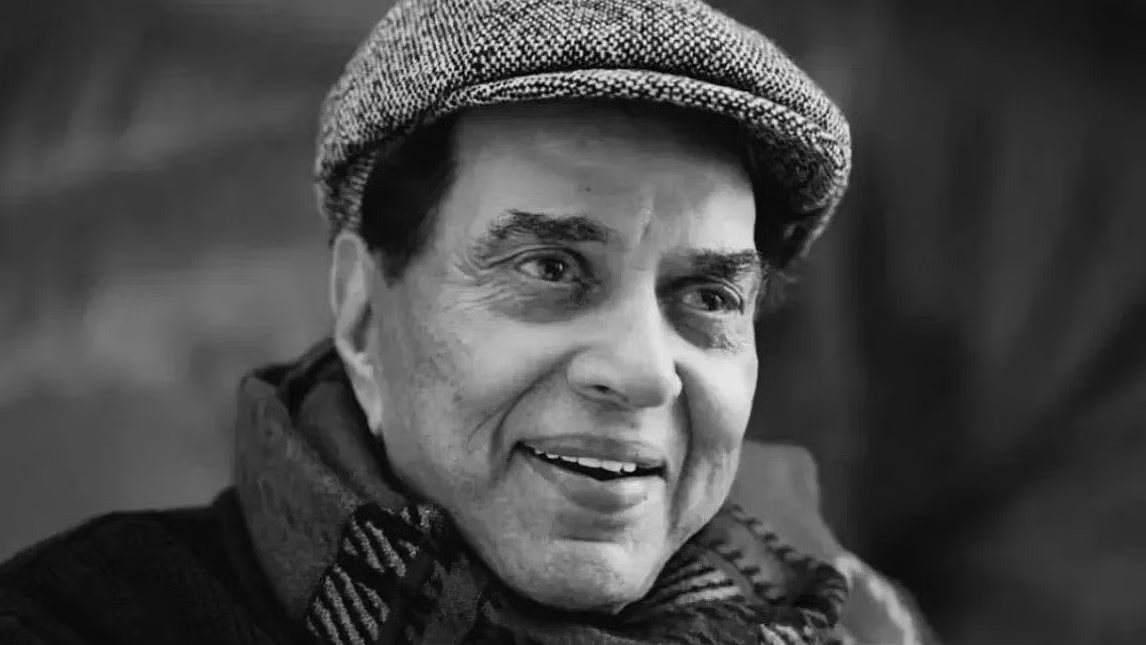
Veteran Bollywood actor Dharmendra, one of India’s most beloved and enduring film stars, has died in Mumbai at the age of 89. His death marks the passing of a performer whose charm, versatility, and longevity left an unmistakable imprint on Indian cinema.
India’s Prime Minister, Narendra Modi, described his death as the “end of an era,” paying tribute to a figure who inspired generations of moviegoers.
Dharmendra, often referred to as the “original He-Man of Bollywood,” enjoyed a career spanning more than six decades, appearing in over 300 films. Though widely admired for his rugged looks, he often insisted that he was “a simple man,” and credited any praise about his appearance to his parents and good fortune.
He achieved iconic status with his role as Veeru in the 1975 blockbuster Sholay, a film that became a cultural landmark. His portrayal of the mischievous yet courageous outlaw remains one of the most celebrated performances in Hindi cinema. Despite acting in numerous box-office hits across romance, action, comedy, and suspense, he frequently said that no role surpassed Veeru.
Born Dharam Singh Deol on 8 December 1935 in Punjab’s Ludhiana district, Dharmendra grew up in a middle-class Jatt-Sikh family. He was drawn to films as a teenager and dreamt of becoming an actor, even as his family urged him to focus on academics. His life changed after he won a national talent competition, which brought him to Mumbai and launched his film career.
He made his debut in 1960 and quickly rose to prominence with acclaimed performances, including a standout role in the 1963 classic Bandini. In the years that followed, he established himself as a romantic lead opposite some of the biggest actresses of the time, before transitioning into a celebrated action star with films like Phool Aur Patthar and Mera Gaon Mera Desh. Known for performing many of his own stunts, he earned a reputation for athleticism and screen presence.
Dharmendra’s on-screen partnership with actress Hema Malini became one of the most successful in Bollywood history. Their romance off-screen drew intense media attention, particularly because he was already married with children. The pair married in 1980, despite significant public scrutiny, and went on to become one of the industry’s most recognisable couples.
He briefly ventured into politics, serving one term as a member of parliament, though he later admitted that public office was not suited to his temperament. He continued working in films well into his later years and maintained a strong connection with fans through public appearances and social media.
Throughout his career, Dharmendra received several honours, including a Lifetime Achievement Award for his contribution to cinema and one of India’s highest civilian awards, the Padma Bhushan. Yet he often said that awards mattered less to him than the affection of his audience.
“I came here for the love,” he once said. “All I ever wanted was people’s love, and I’m grateful that I received it.”
Tributes poured in after news of his passing. Actors, directors, and fans described him as an irreplaceable force in Indian cinema. Many credited him with shaping modern Bollywood and inspiring generations of performers.
Dharmendra leaves behind a legacy defined not only by his films, but by the warmth, humility, and charisma that endeared him to millions across India and beyond.
Five people have been killed after two suicide bombers launched an attack on the headquarters of Pakistan’s Federal Constabulary in Peshawar early Monday. At least a dozen others, including civilians, were injured.
According to security officials, the attackers approached the entrance of the paramilitary force’s complex armed and detonated their explosives after opening fire. The facility is located in one of Peshawar’s most heavily fortified zones, making the breach notable given the multiple layers of security typically in place.
Explosions were heard shortly after 8:00am local time, prompting an immediate lockdown of the area. Emergency responders arrived at the scene to evacuate the wounded and secure the premises.
Officials said the assailants were stopped at the gate and prevented from entering the main compound, describing the incident as a thwarted attempt at a larger-scale attack.
Pakistan’s Prime Minister Shehbaz Sharif condemned the assault and called for an urgent investigation to identify those involved and bring them to justice.
The Federal Constabulary, previously known as the Frontier Constabulary, handles security operations that exceed the capacity of regular police forces, including tribal clashes and organised criminal activity.
Peshawar, located in Khyber Pakhtunkhwa province near the Afghan border, has long faced militant violence. The Pakistani Taliban, or Tehreek-i-Taliban Pakistan, is active in the region and has carried out similar attacks in the past, though no group has claimed responsibility for the latest incident.
Eberechi Eze stole the show with a majestic hat-trick on his derby debut as Arsenal swept aside Tottenham 4–1 at the Emirates. Leandro Trossard opened the scoring before Eze struck late in the first half and then again immediately after the break; Richarlison produced a stunning 45-metre lob to briefly revive Spurs, but Eze completed his treble to seal the win. The victory left Arsenal six points clear at the top and underlined how quickly Eze has become a match-decider for Mikel Arteta’s side.
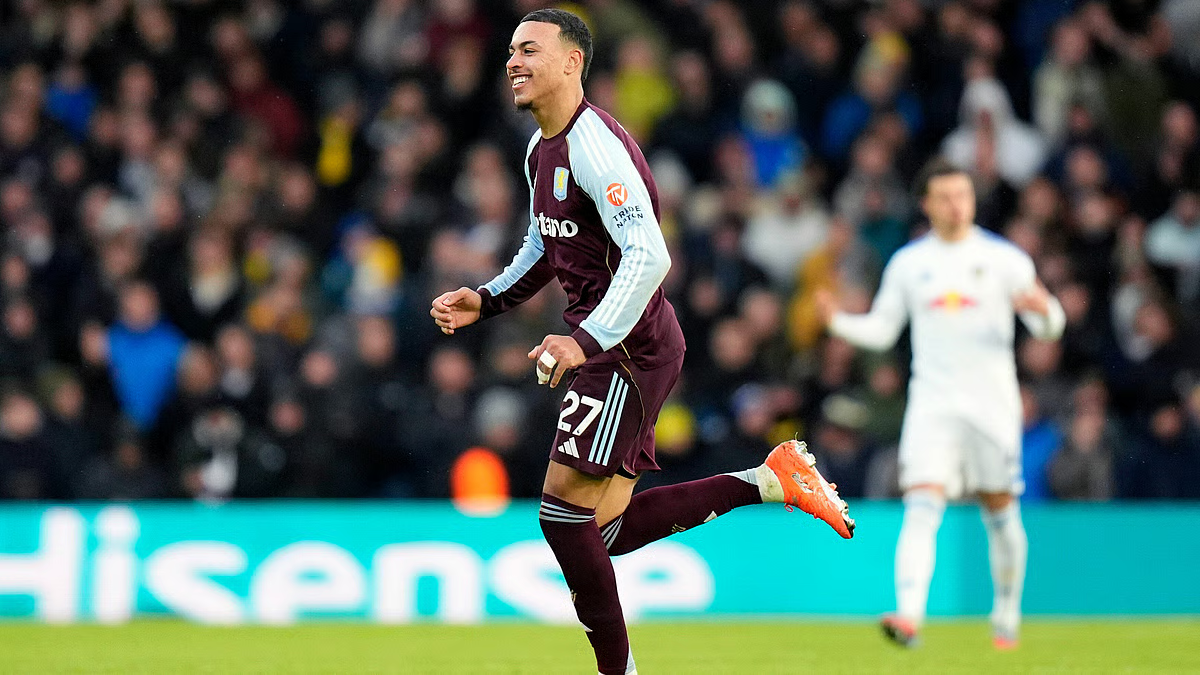
Leeds United 1–2 Aston Villa
A tight contest at Elland Road ended 2–1 to Aston Villa. Lukas Nmecha put Leeds ahead early, but Morgan Rogers produced a second-half brace — including a superb free-kick — to turn the game around and lift Villa into the top four. Rogers’ match-winning day continued Villa’s impressive recent run.
LaLiga (Spain)
Elche 2–2 Real Madrid
A dramatic match at Martínez Valero finished 2–2: Elche twice took the lead (Aleix Febas and Álvaro Rodríguez among the key contributors), Dean Huijsen pulled Madrid level late, and Jude Bellingham bundled in a late equaliser in the 87th minute to rescue a point for Real. The draw kept Real Madrid top (on the day), but raised questions about their cutting edge away from home. (Attendance and timeline details in the match report.)
Getafe 0–1 Atlético Madrid
Atlético ground out a 1–0 away victory thanks to an own goal from Domingos Duarte late on (around the 82nd minute). Diego Simeone’s side has now put together a run of wins and extended their unbeaten domestic sequence, a resilient, substitution-driven win rather than a flashy one.
Real Betis 1–1 Girona
A 1–1 draw at Estadio de La Cartuja: Vladyslav Vanat struck early for Girona (20′) and Valentín Gómez levelled for Betis (75′). The game was notable for a hot atmosphere and a tight tactical battle; Betis held on to extend an unbeaten-ish run, while Girona grabbed a valuable point. LaLiga’s official match notice confirms the scorers and timing.
Serie A (Italy)
Inter 0–1 AC Milan (Derby della Madonnina)
AC Milan edged the derby 1–0 at the San Siro thanks to Christian Pulisic’s strike (around the 54th minute). It was a compact, tactical game — Inter dominated possession, but Milan were clinical when chances arrived. The win nudged Milan up the table and was a big morale booster in a tight title race.
Saudi Pro League
Al-Nassr 4–1 Al-Khaleej
Al-Nassr ran out 4–1 winners in Riyadh. João Félix and Wesley Ribeiro were on the scoresheet in the first half (helping to build the lead), Murad Al Hawsawi pulled one back for Al-Khaleej, and Sadio Mané, plus a stoppage-time Cristiano Ronaldo strike, wrapped up the scoring for the champions. The result maintained Al-Nassr’s perfect start and kept them clear at the top.
Major League Soccer (MLS) — Playoffs (Eastern Conference semifinal)
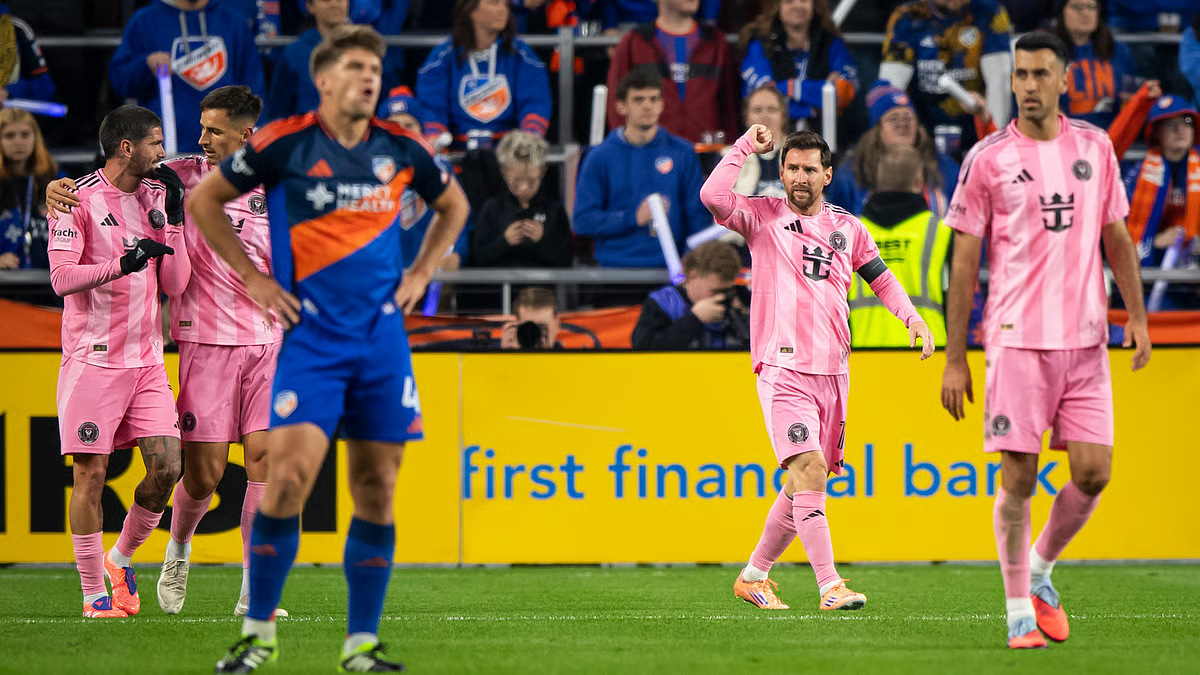
FC Cincinnati 0–4 Inter Miami CF
Inter Miami powered past Cincinnati 4–0 at TQL Stadium to reach the Eastern Conference final. Lionel Messi was at the heart of everything — he scored and provided three assists, while Tadeo Allende netted twice. It was a statement playoff performance from Miami’s star and his supporting cast, sending them through in authoritative fashion.
Quick tactical takeaways
Eze’s emergence: Arsenal’s new No.10 is no longer just a rotation option — the derby hat-trick showed he can change the biggest games. Arsenal’s creativity has multiple outlets now, and Eze gives Arteta a potent late-box arrival.
Madrid’s resilience: Real picked up a point thanks to Bellingham’s late intervention — but Elche exposed gaps in Madrid’s earlier play, suggesting Xabi Alonso will have plenty to tweak.
Derby fine margins: Milan vs Inter underlined that in the big local games, one decisive moment (Pulisic’s finish) can be the season-shaping difference.
Messi in playoff mode: The MLS result was a reminder that when Messi is involved, he can both create and finish. Miami looks dangerous in knockout football.
At Night of Bliss, a woman diagnosed with terminal pancreatic cancer testified to a complete healing after Pastor Chris ministered. Doctors had stopped treatment and given her only months to live, but she reported that all symptoms; nausea, weakness, and pain instantly disappeared as she stood in the service. Pastor Chris declared, “No cancer in your body,” confirming her miraculous transformation.
Several other testimonies followed. A woman whose eyesight had deteriorated regained clear vision and could read again. Another attendee, injured years earlier in an accident that damaged her spine and knee, removed her brace and walked freely. A stroke survivor also lifted her right hand for the first time since 2019. The night was marked by undeniable moments of healing and restoration.
The Catholic Diocese of Kontagora has strongly criticized the abduction of pupils, students, and teachers from St. Mary’s Catholic Primary and Secondary Schools in Papiri, Agwara Local Government Area of Niger State.
It also denounced the fatal shooting of a security officer during the attack.
The assault took place in the early hours of Friday, November 21, 2025, between 1 a.m. and 3 a.m., when armed men stormed the school premises.
Numerous pupils, students, and teachers were reportedly taken, generating widespread fear and anxiety throughout the school community.
In an official statement signed by the Diocesan Secretary, Rev. Fr. Jatau Luka Joseph, the diocese described the incident as shocking and deeply troubling, highlighting serious concerns for the safety and welfare of the abducted victims.
“The Catholic Diocese of Kontagora strongly condemns this attack and expresses deep concern for the safety of the kidnapped children and their families,” the statement partly read.
The statement further noted that security agencies were promptly notified and have since initiated coordinated rescue operations to ensure the victims’ safe return.
The diocese assured the public that it is working closely with security forces, community leaders, and government officials to locate and rescue those taken.
Appealing for calm among residents, the diocese urged the public to support ongoing security measures and to continue praying for the swift and safe release of all abducted individuals.
It also reaffirmed its dedication to safeguarding the children under its care and promised to provide verified updates as further information emerges.
“May the Lord grant quick release to those abducted and continue to protect His people from all danger,” the statement added.
If you want, I can also condense this into a tighter, news-ready version while keeping all the key quotes.
Participants are at the starting point during the 10-kilometer Capital City Race 2024 in Ikeja, Lagos, Nigeria, on November 23, 2024. The inaugural edition, hosted by Ikeja City Mall and supported by the Lagos State Government in collaboration with the Lagos Sports Commission, aims to encourage fitness, community spirit, and a healthy lifestyle. (Photo by Adekunle Ajayi)
The Lagos State Government has released a traffic diversion plan in preparation for the 2025 Capital City Race, set for Saturday, November 22, 2025, between 6:00 a.m. and 9:00 a.m.
In a statement shared by the Director of Public Affairs, Lagos State, Bolanle Ogunlola, on X on Friday, the government announced that the 10km race, organised by the Lagos State Sports Commission in partnership with the Capital City Race Organisers, will begin at Ikeja Shopping Mall.
Competitors will move through Billings Way, Kudirat Abiola Way, Opebi Link Bridge, Adeniyi Jones, and Oba Akran before finishing at Archbishop Vining Memorial Church, Oba Akinjobi Way, Ikeja.
“As a result, several roads, junctions, and intersections along the race route will be partially closed.
These closures will be opened intermittently as the race progresses to ease movement within the axis,” the statement read.
The statement added that officers from the Nigerian Police Force, Federal Road Safety Corps, and Lagos State Traffic Management Authority will be deployed along the route to manage traffic flow and ensure the safety of participants and motorists.
Motorists have been urged to remain patient and plan their trips accordingly, as the temporary closure is part of the government’s traffic management strategy for the event.
The prime minister has touched down in Johannesburg, where global leaders are gathering for this year’s G20 summit.
Despite the event drawing representatives from the world’s major economies, Donald Trump will not be present, citing widely debunked assertions that white citizens in South Africa are facing persecution.
Sir Keir Starmer — often mocked by opponents as “never here Keir” due to his frequent diplomatic travel — has argued that these international engagements help champion opportunities for British industries overseas.
Officials say the trip will also serve as a platform to coordinate with partners on bolstering backing for Ukraine.
Ahead of the summit, Sir Keir joined French President Emmanuel Macron and German Chancellor Friedrich Merz on a call with Ukrainian President Volodymyr Zelensky, during which they reviewed a peace proposal supported by the United States.
On X, Zelensky wrote: “We value the efforts of the United States, President Trump, and his team aimed at ending this war. We are working on the document prepared by the American side. This must be a plan that ensures a real and dignified peace.”
He added that the leaders were “coordinating closely to make sure that the principled stances are taken into account”.
However, growing anxiety surrounds parts of the proposal, which seem to align closely with several demands put forward by Russia.
According to details circulating widely, the draft agreement would require Ukraine to surrender key areas of Donetsk still under its control, reduce the size of its military, and forgo any plans to join NATO — concessions Ukrainian officials have long rejected.
Before the summit begins, Sir Keir will tour a rail depot in Johannesburg where trains manufactured in Derby are in service, and he is expected to unveil a new partnership under which the UK will “provide strategic advice and consultancy services” to the South African rail sector.
The project will be executed by a government-owned organisation called Crossrail International.
A similar arrangement has also been reached with Vietnam.
Government aides say Africa represents a significant commercial opportunity for Britain, noting that half of the continent’s population is under 20 and that it is projected to account for more than a quarter of the world’s population by 2050.
“I will focus on the deals we can do, the business we can do, with our partner countries and make sure that the work we do internationally is impacting directly at home,” he told reporters during the flight.
“If you want to deal with the cost of living and make people better off with good secure jobs, investment from G20 partners and allies is really important,” he added.
Trump plans to boycott the summit, having labelled it a “total disgrace” online while repeating his claim that white Afrikaners are being targeted.
His administration has already made white South Africans eligible for refugee status in the United States and granted them priority over other applicants.
South Africa’s President Cyril Ramaphosa responded to the US absence by saying it was “their loss” and commented that “boycott politics doesn’t work”.
No political party in South Africa — including those representing Afrikaners or the wider white population — has alleged that genocide is taking place in the country.
To provide the best experiences, we use technologies like cookies to store and/or access device information. Consenting to these technologies will allow us to process data such as browsing behaviour or unique IDs on this site. Not consenting or withdrawing consent, may adversely affect certain features and functions.
Functional
Always active
The technical storage or access is strictly necessary for the legitimate purpose of enabling the use of a specific service explicitly requested by the subscriber or user, or for the sole purpose of carrying out the transmission of a communication over an electronic communications network.
Preferences
The technical storage or access is necessary for the legitimate purpose of storing preferences that are not requested by the subscriber or user.
Statistics
The technical storage or access that is used exclusively for statistical purposes.The technical storage or access that is used exclusively for anonymous statistical purposes. Without a subpoena, voluntary compliance on the part of your Internet Service Provider, or additional records from a third party, information stored or retrieved for this purpose alone cannot usually be used to identify you.
Marketing
The technical storage or access is required to create user profiles to send advertising, or to track the user on a website or across several websites for similar marketing purposes.