Elena Rybakina claimed her first-ever season-ending WTA Finals title in Riyadh, defeating world No. 1 Aryna Sabalenka 6-3, 7-6 (0) in the final. With the victory she became the first player representing Kazakhstan — and indeed the first from Asia — to lift the WTA Finals trophy.
Over the tournament she remained unbeaten, winning all five matches including in the group stage, semifinal and final. Her straight-sets win in the final rounded off a week in which she displayed ruthless serving (eight aces in the final, 13 in that match alone) and clinical baseline aggression. The prize money awarded — US $5.235 million — is the largest ever for a women’s sports event, underscoring the commercial growth of women’s tennis.
Rybakina’s resurgence comes after a challenging 2025 marked by coaching disruptions and questions around form. Her coach, Stefano Vukov, had earlier faced a suspension and her momentum had wobbled. By reclaiming top-level form when it mattered most, she sent a message to the tennis world: she remains among the elite.
Sabalenka, scorer of a landmark season and new record-holder for most prize money earned in a single year on the WTA Tour, remains a formidable force — but her inability to convert dominance into a Finals title adds a new twist to the rivalry. The flawless tiebreak (7-0) in the second set of the final underlined Rybakina’s mental strength under pressure.
The broader implications are significant. The Riyadh event signals the WTA’s aggressive push into new markets, and Rybakina’s triumph in that context amplifies the shift in power structures in women’s tennis. Meanwhile, the controversy around off-court issues — such as her earlier coach suspension and tense relationship with the tour — added a narrative of redemption to the title. She now finishes the season ranked No. 5, with momentum heading into 2026.
Kenya’s gospel community is mourning the loss of one of its beloved voices, Beatrice Wairimu Mbugua, popularly known as Betty Bayo, who passed away on Monday, November 10, 2025, at the Kenyatta National Hospital in Nairobi.
According to family sources, the 40-year-old gospel minister succumbed to acute leukemia, a form of blood cancer, after a period of treatment. She had reportedly been hospitalized for several days before her passing.
Church leaders, gospel artists, and fans across the country have shared heartfelt tributes in her honor. Bishop Muthee Kiengei described her as “a soul that maximized its full potential in serving God and uplifting others through music.”
President William Ruto also paid tribute, saying her voice “carried hope into the hearts of many and inspired countless believers through her songs.”
As messages of condolence continue to pour in, her colleagues and followers remember her for her humility, deep spirituality, and a ministry that went beyond music to touch lives and strengthen faith.
Early Life
Betty Bayo was born Beatrice Wairimu Mbugua in Banana, Kiambu County, Kenya, as the last-born in a family of eight. She spent part of her childhood in Ol Kalou, Nyandarua County, before her family later returned to Kiambu.
Raised in a humble Christian home, Betty’s journey was marked by perseverance and faith. She once shared in interviews that she dropped out of school in Form Two due to financial challenges and worked as a house help for two years before resuming her education. These early experiences shaped her strong work ethic and faith-centered outlook, which would later become the foundation of her gospel music ministry.
Career
Betty Bayo’s musical journey began in the early 2010s, when she joined Kenya’s vibrant gospel music scene. She rose to prominence with her hit song “Eleventh Hour”, a powerful track about divine intervention that resonated widely with worshippers across the country.
Her music, sung mainly in Agikuyu and Swahili, carried messages of hope, faith, and perseverance, often reflecting the everyday struggles of believers. Other notable songs in her catalogue include “Jemedari,” “Thiiri,” “Udahi,” “Maneno,” “Agocwo,” and “Ndîkerîria.”
Through her soulful voice and relatable lyrics, Betty built a loyal audience and became one of the most respected gospel artists of her generation. Her performances, both in churches and concerts, inspired many to draw closer to God and find strength in worship.
Achievements
Over more than a decade in ministry, Betty Bayo became a household name in Kenya’s gospel industry. Her song “Eleventh Hour” remains one of the most played gospel hits across radio stations and church gatherings.
She received several recognitions for her contribution to gospel music and was often celebrated for using her platform to uplift young, upcoming artists. Her authenticity and unwavering faith earned her admiration within the Christian community, and she was widely respected for maintaining her commitment to spreading the gospel through music.
Family
Betty Bayo was a devoted mother and cherished family woman. She leaves behind two children, who were the center of her life. Family members describe her as a caring, prayerful, and compassionate woman whose faith remained steadfast even during her illness.
Her passing has deeply affected her family, friends, and the broader gospel fraternity, all of whom remember her as a woman who lived her faith daily and shared God’s love through song.
Betty Bayo’s journey on earth may have ended, but her songs, faith, and testimony continue to speak to generations. Her legacy will live on in the hearts of those she inspired through her music and her unshakable belief in God’s goodness, even in the face of life’s greatest trials.
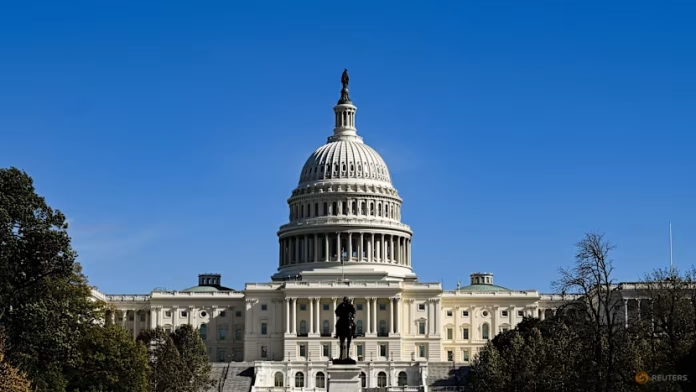
The U.S. Senate on Sunday took steps toward passing legislation to reopen the federal government and end the 40-day shutdown that has left federal employees idle, disrupted food assistance, and caused significant air travel delays. In a procedural move, senators advanced a bill previously passed by the House, which will be amended to keep the government funded until January 30 and incorporate three full-year appropriations measures. If the Senate approves the amended version, it will still require approval by the House of Representatives before being sent to President Donald Trump for signing, a process expected to take several days. Under a deal negotiated with several Democrats who defied their party’s leadership, Republicans agreed to hold a December vote on extending Affordable Care Act subsidies. These subsidies, which help low-income Americans afford private health insurance and are set to expire at year’s end, have been a key Democratic demand in the funding standoff. The procedural vote passed 60–40, the exact margin required to overcome a Senate filibuster. “It looks like we’re getting very close to the shutdown ending,” Trump told reporters at the White House before the vote. The bill would prevent federal agencies from terminating employees until January 30 — a victory for federal worker unions and their supporters and temporarily halt Trump’s efforts to reduce the size of the federal workforce. At the beginning of Trump’s second term, about 2.2 million civilians were employed by the federal government, according to official data. Roughly 300,000 workers are projected to exit by year’s end as part of the downsizing initiative. The measure would also guarantee back pay for all federal employees, including military personnel, Border Patrol officers, and air traffic controllers. When the Senate reconvenes on Monday, Republican leaders will seek bipartisan support to bypass standard procedures and expedite the bill’s passage. Otherwise, the chamber would have to spend much of the week completing procedural steps before a final vote, potentially prolonging the shutdown into the next weekend. “It was a good vote tonight,” Senate Majority Leader John Thune told reporters after adjournment on Sunday. “Hopefully, we’ll get an opportunity tomorrow to set up the next votes. Of course, that’s going to take some cooperation and consent.” Sunday’s agreement was brokered by Democratic Senators Maggie Hassan and Jeanne Shaheen of New Hampshire and Independent Senator Angus King of Maine, according to a source familiar with the discussions. “For over a month, I’ve made clear that my priorities are to both reopen government and extend the ACA enhanced premium tax credits. This is our best path toward accomplishing both of these goals,” Shaheen posted on X. Senate Minority Leader Chuck Schumer, the top Democrat in the chamber, voted against the measure. Many Democrats on Capitol Hill reacted with frustration as the deal took shape. “Senator Schumer is no longer effective and should be replaced,” U.S. Representative Ro Khanna wrote on X. “If you can’t lead the fight to stop healthcare premiums from skyrocketing for Americans, what will you fight for?” Sunday marked the 40th day of the shutdown, which has kept federal employees off the job, disrupted food programs and national parks, and strained travel systems amid air traffic control shortages that threaten to upend Thanksgiving travel later this month. Senator Thom Tillis, a Republican from North Carolina, said the worsening effects of the shutdown prompted lawmakers to find common ground. “Temperatures cool, the atmospheric pressure increases outside and all of a sudden it looks like things will come together,” Tillis told reporters. White House economic adviser Kevin Hassett warned on CBS’s “Face the Nation” that if the shutdown continues much longer, economic growth could turn negative in the fourth quarter particularly if air travel remains disrupted during the Thanksgiving season, which falls on November 27 this year. Meanwhile, President Trump on Sunday renewed calls to replace the Affordable Care Act’s insurance subsidies with direct payments to individuals. The subsidies, which helped boost ACA enrollment to 24 million since their introduction in 2021, remain the central issue in the shutdown. Republicans insist the matter should be addressed only after federal funding is reinstated. Trump posted on Truth Social, condemning the subsidies as a “windfall for Health Insurance Companies, and a DISASTER for the American people,” while urging that the money instead go directly to individuals to purchase coverage independently. “I stand ready to work with both Parties to solve this problem once the Government is open,” Trump wrote. Health experts estimate that Americans shopping for 2026 Obamacare plans could see their monthly premiums more than double on average as pandemic-era subsidies expire at the end of the year. The ACA enrollment period runs through January 15, leaving a short window for Congress to act on extending the credits for next year.
Nigeria is the largest economy in Africa, but its low trade-to-GDP ratio and heavy dependence on crude oil show that the country is not fully capitalizing on its economic strength.
This is why the Africa Continental Free Trade Agreement (AfCFTA) becomes critical. With its goal of creating a single African market, AfCFTA presents a major opportunity for Nigeria to diversify exports, expand regional trade, and reduce vulnerability to global price shocks benefits that can only be realized through active engagement.
At the same time, the future of AGOA remains uncertain, and the recent removal of other African countries highlights how unpredictable the arrangement can be. Relying on AGOA alone puts Nigeria at risk, especially with compliance concerns and shifting U.S. policies.
The Minister of the Federal Capital Territory (FCT), Nyesom Wike, has given a final 14-day grace period to property owners who breached land use and development regulations in Abuja’s highbrow areas, Asokoro, Maitama, Garki, and Wuse to regularise their titles and pay a N5 million penalty. According to a statement issued on Sunday by the Minister’s Senior Special Assistant on Public Communications and Social Media, Lere Olayinka, the new deadline takes effect from Tuesday, November 11, 2025. It warned that defaulters who fail to comply within the stipulated period would face enforcement action by the FCT Administration. The extension follows the expiration of a previous 30-day window granted to affected allottees after public notices were published between September 8 and 10, 2025. Areas affected by the directive include Gana and Usuma Streets in Maitama; Yakubu Gowon Crescent in Asokoro; Aminu Kano and Adetokunbo Ademola Crescents in Wuse II; as well as Ladoke Akintola Boulevard, Gimbiya Street, and Onitsha Street in Garki II. Others are Ogbomosho Street, Lafia Close, Yola Street, Abriba Close, Danbatta Street, Ringim Close, and Ilorin Street in Garki I. The statement added that Wike approved the issuance of new title documents including Statutory Rights of Occupancy and Certificates of Occupancy with a renewed 99-year term for property owners who meet all requirements. However, the concession excludes titles already revoked for non-development, non-payment of ground rent, or other violations. Findings by The Guardian show that stricter enforcement of land administration policies under Wike has pushed annual revenue from land-related charges in the FCT beyond ₦1 trillion, the highest in the territory’s history. Officials of the Abuja Geographic Information System (AGIS) and the Department of Land Administration attributed the surge to aggressive recovery of unpaid ground rents, new penalties, and higher processing fees for certificates and occupancy rights. A senior FCTA official revealed, “From about ₦40 billion generated last December, land revenue has been climbing steadily. At the current pace, we could hit ₦100 billion monthly by year-end, crossing the ₦1 trillion mark.” Analysts have linked the increase to growing demand for plots, spurred by the administration’s extensive road infrastructure projects across Abuja’s districts and area councils. Ongoing and completed projects include the Kabusa–Takushara and Kabusa–Ketti access roads, the 15km A2 Junction–Pia Road in Kwali, the Kwaita/Yebu Road, and several dual carriageways connecting Dutse, Gwagwalada, and Katampe. However, the reforms have stirred anxiety among over 260,000 landowners and 443 estate developers affected by the minister’s two-year mandatory development policy. Many fear that the stringent deadlines and new fees, including a 21-day payment rule for acceptance and documentation could lead to widespread revocations and reallocation of plots to politically favoured individuals. Real estate developer Shehu Nuhu described the policy as “draconian,” saying it overlooks the prevailing economic hardship. “The policy is not about development but about creating artificial breaches to enable reallocation of land under ministerial discretion,” he said. Nuhu urged President Bola Tinubu to initiate an independent review of the FCT land reform framework and suspend ongoing revocations until broad stakeholder consultations are held. Residents such as Patrick Okoh and Nabel Ikame expressed similar concerns, noting that the cost of obtaining Certificates of Occupancy, ranging from ₦3.5 million to ₦6 million, including advisory fees has become unaffordable for many citizens, particularly civil servants. Wike, however, insists the reforms are designed to curb land speculation, not to dispossess rightful owners. “Anyone who cannot develop a plot in two years is a speculator. Land in Abuja is not for decoration,” he said, adding that the 21-day payment deadline is “reasonable and necessary” to enhance efficiency and boost government revenue. He maintained that he has the legal mandate to enforce the new policy framework, which also includes the regularisation of area council land titles, revised Right of Occupancy conditions, and titling of mass housing projects.
Abdulmumin Jibrin, who represents Kiru/Bebeji Federal Constituency in the House of Representatives, has announced his return to the All Progressives Congress and declared his support for President Bola Tinubu’s 2027 re-election campaign. Jibrin, who left the APC in May 2022, made the announcement during a political gathering in his hometown, Kofa, Bebeji Local Government Area of Kano State, on Sunday. On Monday, he confirmed his defection in a Facebook post, stating that his supporters had unanimously decided to leave the NNPP and the Kwankwasiyya Movement to align with the APC. He wrote, “Today, in a show of solidarity, I was warmly received by thousands of my constituents in my hometown of Kofa, Bebeji, Kano. “The gathering resolved to leave the NNPP/Kwankwasiyya, join the APC, and endorse President Bola Ahmed Tinubu, GCFR, for a second term in office. “From the beginning, almost 2,000 scholars from my constituency have prayed special prayers for the President and sought peace, development, and progress for Kiru/Bebeji, Kano, and Nigeria altogether.” Jibrin’s return to the APC comes less than two months after he resigned from the NNPP, following his expulsion over allegations of anti-party activities and non-payment of membership dues. Reacting to his suspension at the time, Jibrin described the move as “shocking and unjustified,” arguing that the interview he granted in English and Hausa, which the party cited as the reason for his suspension, did not warrant such a “heavy penalty.” He accused the NNPP of breaching due process and the principles of fair hearing, saying he was expelled without being allowed to defend himself. The lawmaker said he had accepted the decision in good faith and would not take legal action. Responding to claims that he defaulted in paying his membership dues, Jibrin maintained that he had always met his financial obligations to the party. Taking aim at the NNPP’s leadership, the former Director-General of the Tinubu Support Groups accused the party of not valuing its members. Nonetheless, Jibrin expressed appreciation to the NNPP for the support he enjoyed during his time there and urged his supporters to accompany him on his “new journey,” while keeping cordial relations with those who remain in the party. His return is viewed as a notable boost for the APC in Kano, as political alliances begin to take shape ahead of the 2027 general elections.
The United Kingdom has sounded the alarm on Nigeria’s security situation, this time, warning its citizens against traveling to several northern states. The latest travel advisory, issued by the UK’s Foreign, Commonwealth and Development Office (FCDO), paints a troubling picture of rising violence, and terrorist activity across large parts of the country’s North.
The alert has stirred renewed debate over Nigeria’s worsening insecurity and whether the northern region remains safe for travel, business, and daily life.
What the UK Said
In its November 2025 update, the UK government advised against all travel to a number of northern states, including Borno, Yobe, Adamawa, Katsina, Zamfara, and Gombe, and against all but essential travel to others such as Kaduna, Kano, Sokoto, Kebbi, Bauchi, Niger, Kogi, Plateau, Taraba, and parts of Abuja’s outskirts.
The FCDO cited “heightened risks of terrorism, kidnapping, and violent crime”, urging British nationals in Nigeria to review their personal security plans and stay vigilant.
A Worsening Security Landscape
The situation across northern Nigeria has grown increasingly complex, with multiple threats converging:
Insurgency in the Northeast: Boko Haram and its splinter group, ISWAP, continue to mount attacks on communities and security forces in Borno and Yobe states.
Banditry in the Northwest: Armed gangs, often referred to as bandits, raid villages, kidnap travelers, and extort farmers — creating zones of fear in Zamfara, Katsina, and Kaduna.
Communal and Resource Conflicts in the Middle Belt: Clashes between farmers and herders in Plateau, Benue, and Niger states have taken on ethnic and religious dimensions, leaving hundreds displaced.
Criminal Violence Along Highways: Kidnappings-for-ransom and ambushes have spread to major inter-state roads and rural routes.
The result is a patchwork of insecurity that affects both rural and urban areas, with limited government control in certain regions.
The Numbers Tell the Story
According to a Reuters report from July 2025, more people were killed by insurgents and bandits in the first half of 2025 than in all of 2024, underscoring a dangerous escalation. Human rights groups, including Amnesty International, have recorded dozens of mass killings and abductions since the start of the year.
In Plateau and Benue states alone, community attacks between January and October reportedly left over 1,000 people dead, with many more injured or displaced. The Nigeria Security Tracker (NST) also reported a steady rise in violent deaths in the North, driven by terrorism, banditry, and intercommunal clashes.
Government Response and Criticism
The Nigerian government has repeatedly launched joint military and police operations to counter the threats. While some arrests and tactical victories have been reported, insecurity persists. Critics argue that the government’s efforts have been fragmented and reactive, often failing to address root causes such as poverty, unemployment, and the proliferation of arms.
Amnesty International and other observers have also accused authorities of underreporting casualties and neglecting victims, especially in remote communities where attacks often go unreported.
The Human and Economic Cost
Beyond the casualty numbers lies a massive humanitarian toll. The United Nations estimates that over three million people remain internally displaced in Nigeria’s Northeast, while thousands in the Northwest live under constant threat of attack.
The impact on agriculture, the mainstay of many northern communities, has been severe. Farmers have abandoned farmlands, leading to lower yields and rising food prices nationwide. Businesses and humanitarian organizations also face growing logistical and insurance challenges, as foreign partners reconsider operations in red-listed states.
Implications of the UK Advisory
For British citizens, the advisory means that traveling to the affected areas could void insurance coverage and limit consular assistance in emergencies. However, its ripple effects extend beyond the UK, other Western countries and investors often model their travel policies after such advisories, leading to broader economic implications for Nigeria.
Local communities also feel the impact directly. Tourism, cross-state trade, and even local NGO activities can be disrupted when international warnings label areas as unsafe.
Is the North Completely Unsafe?
Security in Nigeria is not uniform. While some areas in the North are conflict zones, others, including major urban centers like Kano and Kaduna metropolis, remain functional, with markets open and daily life continuing. However, unpredictable violence makes it difficult to guarantee safety anywhere. Highway travel, rural routes, and night movements remain particularly risky.
Visitors are advised to stay updated with official advisories, avoid unnecessary movement, and consult trusted local contacts for situational awareness.
Looking Ahead
With the rise in insurgent and bandit activity, the coming months will test Nigeria’s ability to restore order in its northern territories. The federal government’s renewed counterterrorism campaigns and community policing programs will need sustained funding, intelligence coordination, and accountability to produce real results.
Until then, the UK’s latest warning is a stark reminder that, for now, Nigeria’s North remains one of the most volatile regions in West Africa, a place of resilience and potential, yet shadowed by persistent insecurity.
The Senate has established a strict deadline for sachet alcohol, instructing the National Agency for Food and Drug Administration and Control (NAFDAC) to cease its production and sale by December 2025. The legislators cautioned that these inexpensive, high-proof alcoholic drinks, distributed in small bottles and sachets, are severely impacting young Nigerians, escalating addiction, violent behavior, and traffic incidents nationwide. This resolution was passed following a motion introduced by Senator Asuquo Ekpenyong (Cross River South), who pressed the upper legislative chamber to prevent any further delays in enforcing the prohibition. Ekpenyong expressed regret that NAFDAC had repeatedly postponed the phase-out deadline due to pressure from manufacturers, despite numerous commitments. He stated that any additional extension would “betray public trust” and undermine Nigeria’s responsibilities regarding public health protection. He argued, “Packaging alcohol in sachets makes it as easy to consume as sweets, even for children,” and added, “It destroys futures, fuels domestic violence, and endangers lives daily on our roads.” The motion garnered extensive support from both parties, with senators warning that sachet alcohol had become a pervasive, silent public health crisis in schools, markets, and motor parks. Senator Anthony Ani (Ebonyi South) labeled the widespread availability of cheap, potent drinks as “a slow poison spreading among the youth.” The Senate’s position reflects mounting apprehension about the health and societal repercussions of unregulated sachet alcohol. Lawmakers observed that many of these products contain alarmingly high alcohol concentrations and are priced low enough for minors to purchase using small sums of money. Nigeria previously entered into a five-year Memorandum of Understanding (MoU) in 2018 with NAFDAC, the Federal Ministry of Health, and industry groups to eliminate the products by 2023. The deadline was subsequently moved to 2025 to give manufacturers time to adjust their production methods. Nevertheless, senators voiced anger that some corporations were still pushing for more postponements, calling this a challenge to regulatory authority and a danger to national welfare. Concluding the session, Senate President Godswill Akpabio praised the unanimous decision, characterizing it as “a moral and patriotic stand to protect Nigeria’s future.”
The Abuja Electricity Distribution Company (AEDC) has initiated a large-scale retrenchment, affecting approximately 800 employees, occurring while Nigerians contend with increasing inflation, mounting living costs, and unreliable power delivery. The job cuts, which started on Wednesday, November 5, 2025, are reportedly part of an internal restructuring and rightsizing programme underway at the utility firm, which provides service to the Federal Capital Territory (FCT), Kogi, Niger, and Nasarawa states. Initial reports suggested that AEDC had intended to dismiss 1,800 workers, but the final number was reportedly reduced to 800 following intensive negotiations with the National Union of Electricity Employees (NUEE) and the Senior Staff Association of Electricity and Allied Companies (SSAEAC). A specimen of the dismissal letter, labeled “Notification of Disengagement from Service” and dated November 5, 2025, which was signed by AEDC’s Chief Human Resources Officer, Adeniyi Adejola, confirmed that the action was taken as part of the company’s “ongoing rightsizing process.” The letter stipulated that all owed entitlements would be paid to the affected staff once they completed the exit clearance procedure. “We regret to inform you that your services with the company will no longer be required, effective 5th November 2025. This decision follows the outcome of the company’s ongoing rightsizing exercise,” the letter read in part. “Please note that applicable deductions, including PAYE, check-off dues, outstanding loans, and unretired advances (if any), will be made in accordance with company policy and relevant statutory provisions. AEDC acknowledges your contributions during your period of service and extends best wishes for success in your future endeavours.” This development underscores the growing instability within Nigeria’s power sector, which continues to struggle with low investment, outdated infrastructure, and inadequate cost recovery, despite more than ten years of reforms and privatization. AEDC has repeatedly faced financial and regulatory challenges in recent years. In 2023, the Nigerian Electricity Regulatory Commission (NERC) nearly suspended its operational license due to management disagreements and defaults on payments. Analysts caution that this new round of layoffs could potentially strain AEDC’s already overworked staff and exacerbate customer dissatisfaction, especially in Abuja and surrounding states, where residents frequently complain about poor electricity supply and unfair billing. AEDC’s Head of Customer Experience, Kenechukwu Ofili, confirmed the job cuts but characterized the event as a “routine restructuring process.” “Yes, the process is ongoing and is being handled in line with the agreed framework. A formal statement will be issued soon,” he stated.
Anambra heads to the polls tomorrow, November 8, in a crucial off-cycle governorship election that will decide the state’s political direction for the next four years. Over 2.8 million registered voters are expected at 5,718 polling units across 21 local government areas as voting begins at 8:30 a.m. and closes by 2:30 p.m. The election marks the first major test for the new INEC Chairman, Prof. Joash Amupitan. The commission has deployed upgraded BVAS 2.0 devices and will transmit results to the IReV portal in real time. Only Permanent Voter Cards (PVCs) will be accepted, with collection ending November 2. Although 16 candidates are on the ballot, the race is widely seen as a four-way battle among Governor Charles Soludo of the All Progressives Grand Alliance (APGA), Nicholas Ukachukwu of the All Progressives Congress (APC), George Moghalu of the Labour Party (LP), and Jude Ezenwafor of the Peoples Democratic Party (PDP). Two women, Chioma Ifemeludike of the AAC and another female contender add a historic note, while six parties feature women as deputy candidates. Soludo, seeking re-election, is banking on his record of infrastructure and social reforms: 450 kilometres of roads, free antenatal care, free schooling for junior students, and prompt salary payments. His slogan, “Anambra ga-adi mma ọzọ” (Anambra will be better again), echoes across markets and schools, reinforcing his image as a results-driven technocrat. Ukachukwu, a billionaire businessman running alongside former Senator Uche Ekwunife, promises to leverage federal connections to transform the state into an industrial hub with agro-cities and modern airports. His deep pockets and vast campaign machinery make him Soludo’s biggest challenger. Moghalu draws strength from the “Obidient” movement that swept the South-East in 2023. Backed by Peter Obi’s loyal base, he presents a five-point plan centred on security, jobs, health, education, and infrastructure. PDP’s Ezenwafor, meanwhile, hopes to revive the party’s old grassroots network, particularly in Anambra East and Ogbaru. Security is a central concern. Following a peace accord signed on November 3, over 34,000 police officers, soldiers, and civil defence operatives will be deployed statewide, with gunboats patrolling riverine areas and helicopters hovering over Onitsha and Awka. Voters are advised to avoid using phones inside polling booths, wearing campaign materials, or clustering after voting ends. Turnout remains the biggest variable. Only 10 percent of voters participated in the 2021 election. To boost participation, Friday was declared a public holiday, while churches and town unions are mobilising youths to return home to vote. Analysts say a turnout above 800,000 could secure Soludo’s re-election, while a figure below 500,000 may tilt the race toward his challengers. Key battlegrounds include Idemili North, Awka South, and Ogbaru home to nearly 650,000 voters combined. The winner must secure the highest number of votes and at least 25 percent in two-thirds of the LGAs to claim outright victory. By nightfall on Saturday, Anambra should know its next governor. Whether APGA consolidates its dominance, APC breaks new ground, LP capitalises on its momentum, or PDP resurges, the outcome will echo far beyond the state’s borders signalling the mood of Nigeria’s democracy ahead of 2027.
To provide the best experiences, we use technologies like cookies to store and/or access device information. Consenting to these technologies will allow us to process data such as browsing behaviour or unique IDs on this site. Not consenting or withdrawing consent, may adversely affect certain features and functions.
Functional
Always active
The technical storage or access is strictly necessary for the legitimate purpose of enabling the use of a specific service explicitly requested by the subscriber or user, or for the sole purpose of carrying out the transmission of a communication over an electronic communications network.
Preferences
The technical storage or access is necessary for the legitimate purpose of storing preferences that are not requested by the subscriber or user.
Statistics
The technical storage or access that is used exclusively for statistical purposes.The technical storage or access that is used exclusively for anonymous statistical purposes. Without a subpoena, voluntary compliance on the part of your Internet Service Provider, or additional records from a third party, information stored or retrieved for this purpose alone cannot usually be used to identify you.
Marketing
The technical storage or access is required to create user profiles to send advertising, or to track the user on a website or across several websites for similar marketing purposes.