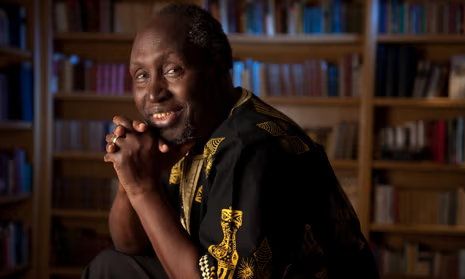
Professor Muhammad Ali Pate, Nigeria’s Coordinating Minister of Health and Social Welfare, has stated that the Federal Government is actively working to reduce the country’s reliance on foreign pharmaceutical imports.
Experts in the pharmaceutical field have pointed out that Nigeria’s healthcare sector remains highly exposed due to the fact that 70 percent of medicines used in the country are imported.
Nevertheless, the Minister emphasized that President Bola Tinubu’s government is taking deliberate steps to revive and strengthen the domestic pharmaceutical industry, which has suffered years of decline.
In an interview, Professor Pate explained that the President has launched the Presidential Initiative for Unlocking the Healthcare Value Chain (PVAC) to tackle these challenges.
The PVAC initiative is designed to overhaul Nigeria’s healthcare system and position the country as a key global player in health product manufacturing through significant investment and greater private sector involvement.
“For decades, Nigeria has been systematically de-industrialised. We were dependent on imports of the most basic things like generic pharmaceuticals, which we could have produced; yes, we did have some local manufacturers, but they struggled. They struggled because the policy environment was not structured.
“This administration tries to address it head on, and President Bola Ahmed Tinubu initiated an effort to unlock the healthcare value chain, what we call PVAC, with policy reforms, the executive order to reduce the tariffs on raw materials and manufacturing equipment,” the minister said.
He further noted that the “Nigeria First” policy, which is designed to prioritise local content, will help promote the use of locally produced drugs and strengthen the country’s medical industry.
Professor Pate also mentioned that the government’s interventions are beginning to yield results, as private investors are now taking interest in the pharmaceutical sector and setting up manufacturing facilities.
“Recently, we commissioned a manufacturing plant in Sagamu in Ogun state, and several others have now started setting up. One here in Abuja is able to produce 600 million test kits.
“Two years ago, in all of Sub-Saharan Africa, there was no local manufacturer of rapid diagnostic kits, even to tell whether you have malaria or an infection. But now we do have local manufacturers, and that’s just the beginning. There are many more that are in the line because of this direction that this government has taken to produce locally,” he revealed.
He concluded by affirming that the Tinubu’s administration has laid a strong foundation to drive the medical industrialisation of Nigeria.
Ngugi wa Thiong’o, the revered Kenyan novelist, playwright, and scholar whose fearless critique of colonialism and post-independence elites reshaped African literature, passed away on Wednesday, May 28, 2025, in Buford, Georgia, at the age of 87.
His death, confirmed by his son Nducu wa Ngugi and his U.S. publisher, The New Press, marks the end of a remarkable six-decade career dedicated to chronicling Kenya’s turbulent journey from colonial subjugation to self-rule and advocating for the use of African languages in literature.
His Early Life
Born James Thiong’o Ngugi on January 5, 1938, in Kamiriithu, near Limuru, Kenya, Ngũgĩ grew up in a large Kikuyu family during the height of British colonial rule. His early life was profoundly shaped by the Mau Mau Uprising (1952–1960), a pivotal rebellion against colonial oppression.
The conflict touched him personally, his half-brother Mwangi was killed as a member of the Kenya Land and Freedom Army, another brother, Gitogo, was fatally shot by British forces due to his deafness preventing him from hearing a command, and his mother was tortured at a local home guard post.
These experiences of loss and resistance became a cornerstone of Ngũgĩ’s literary voice, infusing his work with themes of resilience and defiance.
Early Achievements and Literary Ascent
Ngũgĩ’s intellectual journey began at Alliance High School, an elite institution run by British missionaries, where his family’s sacrifices enabled his education.
He later attended Makerere University in Kampala, Uganda, earning a B.A. in English in 1963. At Makerere, he attended the 1962 African Writers Conference, where he shared manuscripts of his debut novel, Weep Not, Child, with Nigerian author Chinua Achebe. Published in 1964, it became the first major English-language novel by an East African writer, earning critical acclaim for its poignant depiction of the Mau Mau struggle.
His subsequent novels, The River Between (1965) and A Grain of Wheat (1967), solidified his reputation as a leading voice in African literature.
In 1967, Ngũgĩ embraced Fanonist Marxism and began teaching at the University of Nairobi, where he sparked a movement to abolish the English department, advocating for African literature and languages to take center stage.
By 1970, he renounced his colonial name, James, adopting Ngũgĩ wa Thiong’o, and vowed to write primarily in his native Gikuyu, a radical act to reclaim cultural identity.
His 1977 novel Petals of Blood sharply criticized Kenya’s post-independence elite, accusing them of perpetuating colonial inequalities.
Imprisonment and Exile
That same year, his play Ngaahika Ndeenda (I Will Marry When I Want), co-written with Ngũgĩ wa Mirii, provoked the Kenyan government under President Jomo Kenyatta, leading to its shutdown after six weeks and Ngũgĩ’s arrest.
Imprisoned without trial for nearly a year in Kamiti Maximum Security Prison, Ngũgĩ turned adversity into creativity, writing Caitaani Mũtharaba-Inĩ (Devil on the Cross), the first modern novel in Gikuyu, on toilet paper. Released in 1978 after Daniel arap Moi assumed the presidency.
Ngugi faced continued harassment and learned in 1982 of a plot to kill him, prompting a 22-year exile in the UK and later the US. During this period, he held professorships at Yale, New York University, and the University of California, Irvine, where he founded the International Center for Writing & Translation.
Literary Legacy and Awards
Ngũgĩ’s commitment to decolonizing literature extended beyond his fiction. In his seminal 1986 essay collection Decolonising the Mind, he argued that African writers must reject colonial languages like English and French to reclaim cultural authenticity, famously challenging peers like Chinua Achebe for writing in English.
His short story The Upright Revolution: Or Why Humans Walk Upright became the most translated African literary text, available in over 100 languages, surpassing Achebe’s Things Fall Apart.
His extensive body of work includes novels like Matigari (1986), Wizard of the Crow (2006), and The Perfect Nine (2020), as well as plays, memoirs (Detained: A Writer’s Prison Diary, 1981; Dreams in a Time of War, 2010), and children’s books.
Ngũgĩ’s accolades include the 2001 International Nonino Prize, the 2016 Park Kyong-ni Prize, the 2019 Premi Internacional de Catalunya, and the 2022 PEN/Nabokov Award, though the Nobel Prize for Literature, for which he was frequently nominated, eluded him, to the dismay of fans and scholars.
Personal Challenges and Health Struggles
Ngũgĩ’s personal life was complex and not without controversy. Married twice, first to Nyambura, with whom he had six children, and later to Njeeri, with whom he had two, he faced allegations of domestic abuse from his son Mũkoma wa Ngũgĩ in 2024.
Mũkoma claimed Ngũgĩ physically abused Nyambura, who died in 1996, sparking debate about his legacy. Ngũgĩ did not publicly respond to the allegations, which some argued overshadowed his literary contributions.
Health challenges also marked his later years. Diagnosed with prostate cancer in 1995 and given three months to live, Ngũgĩ defied the prognosis. He underwent triple bypass heart surgery in 2019 and battled kidney failure, yet continued writing and teaching until his final days.
Global Tributes and Enduring Impact
Ngũgĩ’s passing has prompted an outpouring of tributes. Kenyan President William Ruto praised his “undeniable patriotism” and “quest for truth,” while Professor Macharia Munene called his work a “true reflection of society.”
On X, South African politician Mbuyiseni Ndlozi mourned him as “Africa’s greatest literary pen” and a “warrior for indigenous African languages.”
Ngũgĩ wa Thiong’o leaves behind a towering legacy as a storyteller, activist, and scholar who challenged the linguistic and cultural vestiges of colonialism. His insistence on the power of African languages continues to inspire writers and readers worldwide, ensuring his voice endures in the global literary canon.
Chelsea have made football history by becoming the first club to win all five major European competitions, capping off the achievement with a dramatic 4-1 comeback victory over Real Betis in the UEFA Conference League final in Wroclaw.
The victory in Poland means Chelsea now hold: UEFA Champions League UEFA Europa League UEFA Conference League UEFA Super Cup UEFA Cup Winners’ Cup (defunct)
This monumental feat cements Chelsea’s place in European football folklore, achieving something no other club has managed – winning all of Europe’s elite and historic competitions.
A Night of Drama: How the Final Unfolded
Early Dominance by Real Betis Real Betis started the brighter side, and their lively display was rewarded when Abde Ezzalzouli fired home a brilliant finish after a classy pass from Isco. Betis created multiple chances in the first half, with Antony heading over and Marc Bartra forcing a save from Filip Jorgensen. Chelsea looked shaky and were fortunate not to be further behind by halftime.
Chelsea’s Tactical Adjustments Spark a Turnaround Head coach Enzo Maresca made a crucial change at the break, bringing on Reece James as an inverted right-back to provide more control and width. That move proved decisive, as Chelsea began to dominate possession and force Betis deeper into their own half.
Cole Palmer’s Moment of Magic With 25 minutes left and Chelsea trailing, Cole Palmer took charge. He cut in from the right and delivered an inch-perfect inswinging cross for Enzo Fernandez to nod home the equalizer. Just five minutes later, Palmer was at it again, picking out Nicolas Jackson who bundled in at the near post to complete the turnaround.
Sancho and Caicedo Seal the Deal The Blues didn’t stop there. Substitute Jadon Sancho added a third with a superb curling finish from Kiernan Dewsbury-Hall’s pass, while Moises Caicedo capped the night with a deflected strike from 20 yards in injury time. Chelsea’s second-half performance was a masterclass in composure and finishing.
Maresca’s Masterstroke: A First Season to Remember
Enzo Maresca’s decision to field his strongest XI in the final paid off. Unlike previous Conference League games where he rotated heavily, Maresca kept faith with six of the players who secured Champions League qualification on the final day of the Premier League season.
His tactical tweak with James and the impactful substitutions of Sancho and Dewsbury-Hall highlighted his growing credentials as a manager at the highest level.
The victory ends Chelsea’s two-year wait for silverware, their last triumph being the Club World Cup in February 2022. More importantly, it marks a promising start to Maresca’s tenure at Stamford Bridge.
Chelsea’s Unmatched European Trophy Haul: A Closer Look
UEFA Champions League
Titles: 2 (2011/12, 2020/21)
Chelsea’s first European crown came in 2012 when they beat Bayern Munich on penalties at the Allianz Arena. Nine years later, they triumphed again in 2021, downing Manchester City 1-0 in Porto thanks to Kai Havertz’s decisive goal.
UEFA Europa League
Titles: 2 (2012/13, 2018/19)
After winning the Champions League in 2012, Chelsea dropped into the Europa League the following season and lifted the trophy under Rafa Benitez. In 2019, they repeated the feat with a commanding 4-1 win over Arsenal in Baku, led by Eden Hazard’s final act in blue.
UEFA Cup Winners’ Cup
Titles: 2 (1970/71, 1997/98)
In 1971, Chelsea defeated Real Madrid in a replay to lift their first Cup Winners’ Cup. In 1998, Gianfranco Zola’s goal in Stockholm secured a 1-0 win over Stuttgart, adding another cherished trophy to the club’s history.
UEFA Super Cup
Titles: 2 (1998, 2021)
Chelsea lifted their first Super Cup in 1998 and claimed their second in 2021, showcasing their continued relevance in Europe across generations.
UEFA Conference League
Title: 1 (2024/25)
The final piece of the puzzle. This triumph over Real Betis completes Chelsea’s clean sweep of Europe’s most prestigious competitions.
Heartbreak for Real Betis
For Real Betis, this was a first-ever European final, and they showed plenty of quality in the first half. Isco, a five-time Champions League winner, was instrumental in their early dominance, creating the opener for Ezzalzouli and orchestrating Betis’ attacking moves.
However, after halftime, Betis struggled to cope with Chelsea’s intensity and clinical finishing. Antony and Bartra had chances to extend their lead, but ultimately they fell short, leaving players in tears at the final whistle. Manager Manuel Pellegrini will be left to ponder what might have been after such a promising start.
What’s Next for Chelsea?
Chelsea’s European conquest isn’t the end of their season. The Blues will head to the United States in mid-June to compete in the FIFA Club World Cup, aiming to add even more silverware to their overflowing trophy cabinet.
This victory in Wroclaw, though, will be remembered for years to come. Chelsea’s clean sweep of European trophies is a testament to their enduring ambition and growing European pedigree.
Chelsea’s 4-1 triumph over Real Betis in the UEFA Conference League final is more than just another trophy – it’s a landmark achievement in European football. From Isco’s first-half brilliance to Cole Palmer’s second-half magic, the night belonged to the Blues. Chelsea’s unprecedented clean sweep of Europe’s top competitions confirms their status as one of the continent’s elite.
The 2025 West African Senior School Certificate Examination (WASSCE) descended into chaos on Wednesday, May 28, 2025, as a leakage of the English Language Essay Paper 1 triggered widespread delays across Nigeria, forcing thousands of secondary school students to write exams late into the night under dire conditions.
The West African Examinations Council (WAEC) attributed the disruption to its efforts to curb examination malpractice, but logistical failures, power outages, and insecurity amplified the crisis, sparking outrage among students, parents, and educators.
As Nigeria prepares for a full transition to Computer-Based Testing (CBT) by 2026, questions linger about whether this shift will resolve such systemic issues.
Why the WASSCE English Paper Was Delayed
The English Language Paper 1, a compulsory component of the WASSCE, was marred by an alleged leakage of the essay questions, prompting WAEC to take drastic measures to protect the examination’s integrity.
In a statement issued on May 29, 2025, WAEC spokesperson Moyosola Adeshina confirmed that the council reprinted and redistributed new question papers to counter the leak, a process that caused significant logistical setbacks.
“Our focus on curbing question paper leakage unintentionally led to delays in the smooth running of the paper.”
Adeshina said, noting that the council achieved its objective of safeguarding the exam’s credibility but at the cost of timely delivery
The impact was felt across multiple states, including Lagos, Oyo, Osun, Ogun, Kwara, and Benue.
In Lagos, the objective paper, originally scheduled for 9:30 a.m., commenced at 11:30 a.m., with the essay paper starting at 4:55 p.m. and ending at 6:55 p.m.
In Ibadan, schools such as Oba Akinbiyi High School, Ibadan Boys High School, and Vale College reported the essay paper beginning at 5:30 p.m., while in Ilorin, question papers arrived past 4:00 p.m., pushing exam start times to 7:00 p.m. or later.
In Benue, some centers saw students writing as late as 11:00 p.m.
A WAEC supervisor in Lagos, speaking anonymously, revealed that supervisors were forced to wait for the delayed delivery of reprinted papers, exacerbating the disruption
Dr. Kayode Adeyemi, National Secretary of the National Association of Proprietors of Private Schools (NAPPS), attributed the delays to WAEC’s logistical challenges, noting that most schools were unprepared for such a setback.
“Schools with electricity supply might not have faced significant challenges, but those without alternative power sources struggled to finish before it was dark,” Adeyemi said, highlighting the uneven impact across centers.
In Ilorin, Kwara State Commissioner for Education, Dr. Lawal Olohungbebe, clarified that the delay was not a state-level issue but a result of WAEC’s need to reprint papers, describing it as an “unusual occurrence” unprecedented in the state’s examination history
Impacts on Student, Parents, and Educators
The late-night exams were compounded by power outages in many centers, forcing students to rely on mobile phone flashlights and headlamps to complete their papers.
In Ilorin’s Adewole area, Mubarak Akande, whose sister was a candidate, described a harrowing scene:
“I walked into the school around 7:00 p.m. and saw students writing in a dark classroom using flashlights. Imagine anyone with a sight defect there. I’m livid.”
Similar reports emerged from Osun, where students wrote until 9:00 p.m., and Benue, where exams extended to 11:00 p.m. under torchlight.
Insecurity added another layer of concern, as many exam centers were located in areas with known safety risks.
Parents expressed fears for their children’s safety, noting that teenagers traveling home late at night were vulnerable.
A parent at Vale College in Ibadan criticized the lack of communication from WAEC, stating,
“The gap between the first and second papers was too long, and no tangible reason was given other than logistics. This is unfair for a compulsory subject like English.”
Another parent in Osun, Julius Olufemi, echoed these sentiments, arguing that WAEC should have postponed the exam to a later date rather than endangering students.
The National Association of Nigerian Students (NANS) issued a press release condemning the “inhumane conditions” and called for a thorough investigation into WAEC’s handling of the situation.
The crisis sparked a firestorm on social media, particularly on X, where Nigerians voiced their anger and demanded accountability.
An X user, @trendingblog247: confirmed that the delays were due to WAEC reprinting questions after the leak, resulting in “unfavorable writing conditions.”
@Beta9ja1: suggested that WAEC should have collaborated with JAMB to use CBT centers and postponed the exam, stating, “You would have eliminated malpractice.”
@izak_black: an exam officer, corroborated the leakage as the cause, noting that WAEC’s decision to change questions led to the delays.
Meanwhile, @MrLekanAdigun: praised the government’s push for CBT by 2026, calling it a step toward reform.
x user @Uncle_Dips: shared a personal account of his son’s ordeal, emphasizing the stress caused by the disruption.
The sentiment on X reflects deep frustration with WAEC’s recurring logistical failures, with users describing the situation as “disgraceful” and “beyond incompetence.” Many called for systemic reforms.
Will CBT come to rescue for WAEC Examinations?
In response to persistent issues like question leaks, the Nigerian government has mandated a full transition to Computer-Based Testing (CBT) for WAEC and NECO examinations by May/June 2026.
Minister of Education Tunji Alausa, during a monitoring exercise in Abuja on April 28, 2025, announced that objective papers will be administered via CBT starting November 2025, with essay components included by 2026.
“If JAMB can conduct CBT exams for over 2.2 million candidates, WAEC and NECO can do the same,” Alausa said, emphasizing that CBT would eliminate malpractices like leaks.
WAEC’s Head of National Office, Dr. Amos Dangut, previously noted that the council’s inaugural CBT-WASSCE for private candidates in 2024, which involved over 8,000 participants, was a success, paving the way for broader adoption.
The shift to CBT is expected to address vulnerabilities associated with physical question papers, such as leaks, by using encrypted digital formats and biometric verification.
WAEC has already introduced measures like unique question sets for each candidate in the 2025 WASSCE to deter malpractice, but the recent leakage shows that paper-based systems remain susceptible.
Additionally, CBT’s automated scoring and real-time surveillance could enhance security and efficiency, as seen in JAMB’s model, which has reduced cheating through robust digital infrastructure.
However, significant challenges loom. Alausa admitted on May 28, 2025, that Nigeria may not be fully equipped with the necessary infrastructure by November 2025, particularly in remote areas.
“Are we going to be ready to provide every single needed infrastructure? Absolutely not. But we have to challenge ourselves,” he said during a CBT exam monitoring session in Abuja.
The recent WASSCE incident, where students wrote in darkness due to power outages, underscores the critical need for reliable electricity and computer facilities.
Ike Onyechere, founding chairman of Exam Ethics Marshals International, warned that 67% of Nigeria’s secondary schools function as “exam magic centres,” highlighting the scale of infrastructure and integrity challenges.
Concerns also arise about student and teacher readiness. An X user from northern Nigeria, @ChuksEricE , expressed worry that many students and teachers lack computer literacy, which could hinder performance in a CBT environment.
Another X user, @Naija_PR , noted, “The Federal Government’s directive for CBT by 2026 is ambitious, but we need to see action on the ground.” For now, the 2025 WASSCE candidates, who endured hours of waiting and wrote under torchlight, are left hoping that future examinations will prioritize their welfare and safety.
A committee reviewing examination standards is expected to submit recommendations by June 2025, potentially addressing these gaps through investments in digital infrastructure, training programs, and power solutions.
Future Outlook
The 2025 WASSCE English Language paper delay exposed deep-rooted issues in Nigeria’s examination system, from question leaks to logistical failures and inadequate infrastructure.
WAEC’s apology and commitment to collaborate with security agencies to prevent future leaks are positive steps, but they do little to assuage the immediate frustration of candidates and parents.
The transition to CBT by 2026 offers hope for a more secure and efficient system, but its success hinges on addressing Nigeria’s power crisis, equipping schools with computers, and ensuring digital literacy for all stakeholders.
The government’s push for reform, as seen in Alausa’s directives and the ongoing standards review, signals a commitment to change.
However, without urgent investment in infrastructure and contingency planning, the shift to CBT risks replicating the same logistical failures seen in 2025.
On Wednesday night at Brentford’s Gtech Community Stadium, a strike from Cyril Dessersand forced own goal helped Nigeria’s Super Eagles claim a 2-1 Win over West African rivals Ghana in the 2025 Unity Cup.
As is often the case with encounters between Nigeria and Ghana, the game was a feisty affair laced with equal parts meaty challenges and absurd skills, despite of both sides sending out significantly less than full strength lineups.
Nigeria, missing the likes of Victor Osimhen, Ademola Lookman and William Troost-Ekong, started with three players from the domestic league.
But the Nigerians looked the better side for most of the first half and richly deserved their two-goal advantage. It should have been at least three, but for Razak Simpson making a goal line clearance just before the half.
The second half largely belonged to the Black Stars, especially after Eric Sekou-Chelle’s three-player substitution on the hour mark, and they were rewarded when substitute Brandon Thomas-Asante stretched to poke past Stanley Nwabali.
The result means that the Super Eagles proceed to the final of the four-nation Afro-Caribbean tournament, where they will meet Jamaica on Saturday.
The Reggae Boyz claimed their place in Saturday’s showpiece with a 3-2 triumph over fellow islanders Trinidad and Tobago on Tuesday at the same venue.
Revenge not so sweet?
Brentford is a city that provokes some banter-trauma amongst Super Eagles fans. It was the venue when the Black Stars handed the Eagles a 4-1 hiding in a 2007 friendly.
For those who may argue that it was just a friendly, it most certainly was not. Not for the players at the time and certainly not for the fans. The long standing rivalry between both teams apart, that score was unexpected.
Going into the fixture, Nigeria were riding an eight-game unbeaten streak against Ghana going back 15 years to 1992, the last time they lost to the Black Stars, at the African Cup of Nations in Senegal.
Despite the usual haphazard preparations, the expectations were for another win, or at least a tie, but nothing prepared Super Eagles fans for the nightmare of that night.
Austin Eguavoen’s side were so demolished by Ghana that stunned Nigeria fans were frozen into disbelieving silence… and not just by the freezing conditions.
It has been 18 long years since, and the Super Eagles have claimed various victories against Ghana, but that memory sticks around like a bad smell.
Wednesday’s victory, at the scene of the original pain, has gone some way to avenge that loss, but it will be a while before it is finally assuaged.
Have domestic players convinced coach Chelle?
True to his pre-game promise, Eric Chelle handed starting roles to four new players, three of those from the domestic league, the NPFL.
Slavia Prague’s Igoh Ogbu was handed his international debut alongside home boys Taiwo Alimi and Papa Daniel, with Ismaila Sodiq winning a start on his second international appearance.
One thing was not in doubt, all three fizzed as they brought exactly the sort of energetic display of lung and muscle that Chelle wants to see in his players.
Sodiq was especially eye-catching when he challenged for what looked like a lost cause, won the ball, bounded down the line and delivered a measured cross that avoided the defence and landed on a plate for Rangers’ Dessers to open the scoring.
The Super Eagles were pushed to the back foot when they were yanked back to parity on the hour mark.
The question however, would be if they are better than or even as good as what is currently available to the coach. One would be hard-pressed to pick Sodiq over Ola Aina or Bright Osayi-Samuel; Alimi over Lookman, or Moses Simon and Papa Daniel still has a ways to go before he can challenge Alex Iwobi or Frank Onyeka.
Still, the sample size is still small and it is the opening chapter of their international experience.
As long as they do not run off to some backwater club abroad and drop off the radar, but continue to learn, improve and be mentored by the more experienced players, the promise is certainly there.
Is Nwabali getting complacent?
Let’s start by saying that Chippa United’s Nwabali remains the best Nigeria has in goal at this time, and he showed it with minutes to go when he went down to make a game-saving save late in the second half.
However, the goalkeeper appears to have either become lax, or way too comfortable in his position without a lack of real competition, at least during this game.
Twice, his laissez-faire attitude saw him come close to gifting Ghana goals. A lazy play out pass that was meant for Wilfred Ndidi in the first half was intercepted by Ghana and only a contortionist save by Nwabali himself made up for the error.
There is no excuse for such lapses in judgement, especially for an international goalkeeper, irrespective of the opposition.
Chelle will need to light a fire under Nwabali, perhaps by playing Maduka Okoye in the second game, or even against Russia. Such g a kick up the backside might be exactly what the doctor ordered.
Are late goals becoming an issue?
It is only three games so, deep breath, we are not panicking. Yet. But a pattern of conceding late in the game seems to have developed recently.
Against Rwanda, the Super Eagles were under the cosh for large parts of the latter stages of the game. They weathered the storm and returned with three valuable points in the bag. Such a barrage is to be expected when playing away from home and holding onto a lead.
But alarm bells went off a bit when they surrendered a late, late goal to Zimbabwe at home, a goal that severely compromised their World Cup qualification hopes.
On Wednesday against Ghana, a similar late collapse led to Ghana’s goal and but for Nwabali’s timely last-stand goalkeeping, could well have turned a victory into a tie.
Three games, three variations of self-implosion late in the game… It is hard not to be more than a little concerned, and it’s something to keep an eye on when Nigeria play Jamaica on Saturday, and Russia a few days later.
So… did Musa ‘prove himself’?
Ahmed Musa is the elephant in the room. On the one hand, his leadership and tribal knowledge of the Super Eagles would make him an invaluable resource to the team, both player and coaches.
On the other hand, with his dwindling powers as time catches up with him, would the team benefit more from having a younger player in the squad?
Chelle said ahead of the game that Musa would get the minutes he needed to prove his worth and earn a place in the squad. Against Ghana, he got half an hour. On the basis of those thirty odd minutes, it is hard to make a case one way or another.
There are another 90 minutes to go, and perhaps at least another thirty in there for the Nigeria captain. After 108 appearances, his international future hangs in the balance of the next game he plays for Nigeria.
The Super Eagles of Nigeria made it to the final of the Unity Cup friendly tournament with a 2-1 win over Ghana in the tournament’s other game.
Jamaica have earlier booked their spot with a 3-2 win over Trinidad and Tobago yesterday, and goals from Cyriel Dessers and Semi Ajayi ensured that the Super Eagles join them in the final.
Cyriel Dessers made up for missing two opportunities with a smart finish in the 14th minute by making the best of an unfortunate slip by a Ghanian defender in his bid to clear a cross from Samaila Sodiq.
Semi Ajayi’s deflected header from a free kick from Samuel Chukwueze doubled the lead for the Eric Chelle led side in the 19th minute, leaving Ghana confused.
Super Eagles failed to put the game to bed with Papa Daniel attempting a lob with the goalkeeper beaten and a deflected effort from Frank Onyeka had the Ghanaian goalkeeper Benjamin Asare scrambling wasn’t enough to give Nigeria a commanding break.
Ghana returned from the break the better side and got rewarded when Brandon Thomas-Asante pulled a goal back for them in the 70th minute. It ended up as a consolation goal with the Super Eagles hanging on for the win.
As the curtain falls on the 22nd National Sports Festival, tagged the Gateway Games, seven-time Olympian and Nigerian table tennis legend, Funke Oshonaike, has called for urgent investment in grassroots sports development, particularly for young girls, warning that without strategic support and funding, Nigeria risks stagnating in global table tennis.
During a surprise visit to the Alake Sports Centre, one of the venues for the Gateway Games, Oshonaike emphasised that while male players are making notable progress, the same cannot be said for their female counterparts.
“We need to build more girls in table tennis. The boys are doing well, but there’s been little improvement on the girls’ side. It’s still the same names we hear. We need fresh talent, and for that to happen, we must create more opportunities and competitions,” Oshonaike said.
The 25-time national champion decried the sharp decline in local tournaments, noting that the current calendar is inadequate for developing competitive athletes.
“In the past, we had about 10 to 12 competitions in a year. Now, we’re lucky to have even four. That’s not enough to grow world-class players,” she lamented.
She also stressed the need for international exposure, saying many talented Nigerian players are stuck competing only locally due to lack of funding.
“We can’t rely on just one name like Quadri Aruna to represent us globally. There are many gifted players, but without financial support, they can’t participate in international events or improve their rankings. We need to send them to junior and senior World Table Tennis (WTT) competitions,” she said.
Oshonaike, who was drawn to the festival after hearing glowing reports from her international network, praised the organizers and expressed joy at the enthusiasm within the sports hall.
“Yes, the hall is hot and crowded, but the energy here is beautiful. It’s amazing to see both local and foreign-based athletes competing. This shows table tennis is still very loved in Nigeria,” she noted.
Funke Oshonaike is a 25-time national champion, 11-time African Games medallist, and three-time continental champion.
Many people questioned how much winning the UEFA Conference League would mean to Chelsea , but their reaction at the final whistle left no doubts.
After a season of mostly easy wins in Europe’s third-tier competition, Chelsea were truly tested in the final by Real Betis in Wroclaw, especially during a tough first half. But four second-half goals gave them a 4-1 victory and sparked wild celebrations among players and fans alike.
Man of the match Cole Palmer played a big role, setting up goals for Enzo Fernandez and Nicolas Jackson. Jadon Sancho and Moises Caicedo also found the net.
“Winning this trophy is massive,” said former Chelsea goalkeeper Mark Schwarzer on BBC Radio 5 Live. “You can see how much it means to the players. This is what football is about — building team spirit and enjoying success together.”
The win marked Chelsea’s first piece of silverware since the FIFA Club World Cup in February 2022, and their first major European trophy since the 2021 Champions League.
Former Chelsea midfielder Joe Cole, speaking on TNT Sports, added: “People might not rate this competition, but just look at the smiles on the players’ and fans’ faces. That’s what football is all about.”
Pundit Lucy Ward agreed, saying: “People mock this trophy, but for these Chelsea players, it’s a big deal. It gives them a platform as they return to the Champions League next season.”
Chelsea’s journey nearly ended last August in the qualifying play-off — a stage English clubs must go through in the Conference League.
After a 2-0 first-leg win at home, they scored early in the second leg in Geneva to lead Servette 3-0 on aggregate. But Servette struck back with two goals and almost equalised in added time.
“That kind of game is risky — you have more to lose than gain,” said Chelsea boss Enzo Maresca, who was just four games into his job at the time.
Throughout the competition, Chelsea used a different team for Europe compared to the Premier League. On average, they made 8.5 changes per European match based on their last league line-up.
In fact, star man Cole Palmer wasn’t even registered for the group stage and only joined the European squad for the knockout rounds. As the competition progressed, key players like Palmer, Caicedo, and Marc Cucurella began to feature more.
Still, even in the final, Chelsea made four outfield changes from the side that beat Nottingham Forest in their last league game.
Amazingly, 18 Chelsea players played more in the Conference League than in the Premier League this season — including five who left the club in January.
Kiernan Dewsbury-Hall appeared in all 15 European matches, while youngster Marc Guiu scored six goals — just two short of the Golden Boot — despite never starting a league match.
“Chelsea have more money than the other clubs in this competition,” said former Blues winger Pat Nevin on BBC Radio 5 Live. “But they still respected it. They didn’t just throw out weak teams — they made sure they did enough to win.
“Looking back, Enzo Maresca has done a brilliant job.”
With the FIFA Club World Cup coming up next month, Chelsea now turn their attention to even bigger challenges — but for now, their Conference League triumph is a reason to celebrate.
The Teachers Registration Council of Nigeria (TRCN) has announced the results of the 2025 Batch ‘A’ Professional Qualifying Examination (PQE). A total of 13,782 candidates registered for the exam, but only 12,874 (93.4%) participated.
The results show that 8,705 candidates (67.62%) passed, while 4,169 candidates (32.38%) failed the examination. The TRCN attributed part of the challenges encountered during the exam to the low digital literacy of some teachers, which adversely affected their performance.
Some states performed well in the examination. Lagos State led with an impressive pass rate of 80%, followed by Edo State with 73.3%, Niger State with 69.2%, and the Federal Capital Territory (FCT) with 68.3%.
The TRCN is planning initiatives to boost digital skills among educators, including online digital literacy training, curriculum guides, and access to past questions. The Council encourages candidates who did not pass to enhance their digital and pedagogical competencies and prepare for the next batch of the examination scheduled for November 2025.
Candidates can check their results online via (link unavailable) or visit any TRCN State or Liaison Office. Successful candidates can proceed with processing their certificates and licenses, noting that the validity of the examination result is one year from the date of publication.
In assessing the humanitarian issues of our time, the pitiable situation of Nigerian children calls for serious concern. A world with endangered children is a perishing world. It is a great indictment of our age that the victims of man’s inhumanity to man are our own children—the most innocent among us. Children are our future. Unfortunately, however, children everywhere are victims of rape, torture, infanticide, forced labour, child soldiering, child prostitution, child pornography, unsafe teenage sex, modern slavery, child street hawking, and preventable childhood diseases.
Therefore, this year’s Children’s Day celebration offers us another opportunity to reflect on the plight of Nigerian children. Over the past year, we have watched with alarm the increasing hostilities against children and the destruction of countless young lives in Nigeria. Most tragically, over the years, we have witnessed the unnecessary spilling of the blood of innocent children.
For example, in the past ten years, Boko Haram terrorists and abductors in the North have repeatedly stormed schools and seminaries, freely murdering, maiming, raping, and abducting their victims. To date, the whereabouts of Leah Sharibu—a schoolgirl abducted in the North by Islamic terrorists for refusing to convert to Islam—remain unknown. Just a few days ago in Ibadan, a stray bullet killed a 15-year-old SS1 secondary school student, Kehinde Alade. The Joint Admissions and Matriculation Board (JAMB) recently admitted that a “technical glitch” compromised some results of this year’s exam, after nearly 80% of the students recorded low grades. Frustrated by her poor score, Faith Opesusi Timileyin, 19, committed suicide.
Laws protecting children’s rights are not lacking in Nigeria. The Child Rights Act, 2003 (as amended) promotes the rights of children. Specifically, Section 30 of the Act prohibits child trafficking, child sex trafficking, and surrogacy. In addition, the Trafficking in Persons (Prohibition) Enforcement and Administration Act (TIPPEA Act) condemns all forms of human trafficking. Section 82 of the Act defines trafficking in persons to include:
“… the giving or receiving of payments or benefits to achieve the consent of a person having control over another person or debt bondage for the purpose of placing or holding the person, whether or not in involuntary servitude (domestic, sexual or reproductive), in forced or bonded labour, or in slavery-like conditions, the removal of organs or generally for exploitative purposes.”
This definition clearly captures surrogacy, as well as all parties to surrogacy and agents/persons involved in the business of surrogacy—including doctors, lawyers, and others—where exploitation is involved.
By virtue of the combined effect of Sections 228, 229, 230, and 328 of the Criminal Code (and their equivalent provisions in the Penal Code), abortion is illegal in Nigeria. The United Nations’ Declaration of the Rights of the Child states that “mankind owes the child the best it has to give.” Similarly, the Convention on the Rights of the Child (CRC) 1989, which Nigeria has signed and ratified, states that every child—before and after birth—has the right to life, basic education, and freedom of expression.
But despite the foregoing laws protecting the Nigerian child, children in Nigeria remain an endangered species. Unfortunately, only about 16 out of the 36 states of the federation have so far adopted the Child Rights Act. Despite the existing legal framework, infanticide and abortion are still routinely committed in many parts of the country. Disturbingly, many young Nigerian girls are renting their wombs for surrogacy for as little as ₦250,000. Similarly, others are selling their eggs for paltry sums. A few months ago, the University of Ibadan (UI) raised an alarm that many female students were selling their eggs—a dangerous practice that poses serious risks to their procreative health.
Equally disturbing is the sight of children aged between five and eighteen, without access to basic education, loitering the streets—abandoned by negligent parents. The few fortunate ones enrolled in public schools are exposed to various forms of danger. For over 12 years, school pupils and residents of several communities in local government areas of Oyo State have suffered from stray bullets fired from a shooting range inside a nearby army barracks. In other parts of the country, many schoolchildren are denied access to basic education due to unforeseen and avoidable circumstances.
As I stated earlier, this year’s Children’s Day Celebration affords us an opportunity to put in place the necessary mechanisms for the protection of our children. We must recognize that, like adults, children are entitled to the full enforcement of their rights. Therefore, states that object to the Child Rights Act on cultural and religious grounds are respectfully urged to adopt and implement the Act.
The Children and Young Persons (Street Trading) Law, which prohibits the employment of female children in street trading, should be enforced. Likewise, the Children and Young Persons (Harmful Publications) Act, the laws on abortion, and the Cinematography Law—which prohibit the dissemination of harmful publications and films to children—should also be enforced. The same applies to the Child Prostitution and Child Pornography Law (2002). Government agencies, voluntary organizations, and NGOs must create frameworks to promote existing child welfare services and trusts in the country.
A society that allows its children to be killed or dehumanized is heading for extinction. Public office holders and law enforcement agents must understand that children have rights that must be protected.
Our children should be given the opportunity to develop physically, mentally, morally, spiritually, and socially in a healthy environment, and in conditions of freedom and dignity. That is the only way we can hope to nurture the future leaders of tomorrow. Our future is built on the triumph of youthful potential. Therefore, if that potential is destroyed, our future is inevitably destroyed as well.
To provide the best experiences, we use technologies like cookies to store and/or access device information. Consenting to these technologies will allow us to process data such as browsing behaviour or unique IDs on this site. Not consenting or withdrawing consent, may adversely affect certain features and functions.
Functional
Always active
The technical storage or access is strictly necessary for the legitimate purpose of enabling the use of a specific service explicitly requested by the subscriber or user, or for the sole purpose of carrying out the transmission of a communication over an electronic communications network.
Preferences
The technical storage or access is necessary for the legitimate purpose of storing preferences that are not requested by the subscriber or user.
Statistics
The technical storage or access that is used exclusively for statistical purposes.The technical storage or access that is used exclusively for anonymous statistical purposes. Without a subpoena, voluntary compliance on the part of your Internet Service Provider, or additional records from a third party, information stored or retrieved for this purpose alone cannot usually be used to identify you.
Marketing
The technical storage or access is required to create user profiles to send advertising, or to track the user on a website or across several websites for similar marketing purposes.