Home Blog Page 182

World Teacher’s Day: How Nigerian Teachers Redefine Education Amid Struggles

20

Every year on October 6, the world pauses to celebrate teachers, the backbone of every nation’s development. World Teacher’s Day, established by UNESCO, is more than a ceremonial recognition; it is a moment to reflect on the role of teachers in shaping the future of societies.

In Nigeria, this year’s celebration, which fell on a Sunday, was marked with tributes, messages, and community events across the country. For many teachers, it was a day of reflection rather than rest, a moment to assess how far they have come and how much still needs to be done to improve education. Beneath the public messages of appreciation lies a deeper story of resilience and reinvention that defines today’s Nigerian educator.

The Realities: Between Passion And Pressure

Teaching in Nigeria has always been more than just a profession; it is an act of service. But the realities confronting teachers today test even the most passionate. Many face meagre salaries that barely sustain their households. According to data from education unions, some public-school teachers earn less than ₦50,000 monthly, often with delayed payments stretching for months.

The conditions under which many teachers work remain far from ideal. In rural communities, one teacher may handle multiple subjects across several grade levels, sometimes in makeshift classrooms without chairs or blackboards. Even in urban centres, overcrowded classrooms, sometimes housing over 80 pupils, make personalized learning nearly impossible.

Still, for many Nigerian teachers, quitting is not an option. They see their classrooms not just as workplaces but as spaces where they can change lives, one lesson at a time.

The Struggles: Innovation Amid Scarcity

What stands out most about Nigerian teachers is their ability to innovate even when resources are scarce. In schools without electricity or internet access, teachers have turned to handmade visual aids, storytelling, and peer learning to keep lessons engaging.

During the COVID-19 lockdowns, many teachers recorded lessons with basic phones, shared assignments through WhatsApp, and worked with community volunteers to keep children learning. Others leveraged local radio and community spaces to reach students who had no access to online platforms. These efforts underscore a truth often overlooked: while technology remains a challenge, creativity has become a lifeline for Nigerian education.

Yet such innovation often comes at a personal cost. Many teachers use their own salaries to buy classroom materials, print worksheets, or contribute to school maintenance. Their sacrifices often go unseen but remain the quiet foundation of learning across the country.

The Triumphs

Despite these struggles, there are countless stories of triumph. Teachers across Nigeria continue to produce exceptional students who excel in national examinations and competitions. In several states, educators have been recognized by local governments and NGOs for pioneering creative teaching methods and mentoring young learners in underserved communities.

Some teachers have introduced basic computer literacy classes using personal laptops. Others have created informal reading clubs and after-school programs that nurture confidence and curiosity among students. These everyday successes show that the spirit of teaching in Nigeria is not defined by what is lacking but by what is possible through dedication.

Voices From Social Media: Nigerians Celebrate Their Teachers

Across X (formerly Twitter) and other platforms, World Teachers’ Day inspired a wave of heartfelt posts. Nigerians, including both educators and members of the public, shared gratitude, reflections, and personal stories that highlighted the lasting impact of teaching in the country.

User @lorun_omo wrote, “They equip their students for the challenges ahead. They deserve one billion bear hugs for everything they do daily on and off the clock.”

@jndazhaga celebrated teachers for their everyday impact, saying, “Happy World Teachers’ Day to the incredible educators who shape minds, inspire dreams, and change lives every single day! Your patience, creativity, and dedication don’t go unnoticed. You’re not just teaching lessons; you’re building futures.”

Adding their own voice from within the profession, @DDuguryil shared, “From a young teacher with chalk-dusted hands and big dreams to a professor still chasing that same spark in every classroom. The faces change, the impact remains. Happy World Teachers’ Day to everyone still making a difference.”

In a more reflective tone, @enebome quoted Charles Kuralt, writing, “When we become a really mature, grown-up, wise society, we will put teachers at the center of the community, where they belong. We don’t honor them enough, we don’t pay them enough.”

As the applause for World Teachers’ Day fades, the true measure of celebration lies in how society values its teachers beyond annual speeches and hashtags. Sustainable reform in Nigeria’s education system must start with the people at its heart: teachers.

Improving welfare, providing modern teaching tools, and creating environments that reward innovation are essential to national development.

For now, amid the chalk dust and crowded classrooms, Nigerian teachers continue to redefine education through resilience, creativity, and an unyielding belief in the power of knowledge.
Sevilla Crush Barcelona 4–1 To End Champions’ Unbeaten Run

12

Sevilla delivered a stunning 4–1 victory over Barcelona on Sunday, ending the reigning champions’ unbeaten start to the La Liga season and denying them the chance to reclaim top spot.

The win, Sevilla’s first league triumph over Barcelona since 2015, temporarily lifted them to fourth place with 13 points from eight matches, while Barcelona remained second on 19 points, two behind leaders Real Madrid.

“It’s one of the happiest days of my life. We deserved to win from start to finish,” said José Ángel Carmona, who netted Sevilla’s third goal.

Barcelona began sluggishly, failing to register a shot on target in the opening half hour, while Sevilla pressed high and frequently sought to release Alexis Sánchez with long passes.

The hosts broke the deadlock in the 13th minute when Isaac Romero was brought down by Ronald Araújo inside the box. After a VAR review, the referee pointed to the spot, and Sánchez calmly sent his former Arsenal teammate Wojciech Szczęsny the wrong way to make it 1–0.

Szczęsny prevented further damage in the 27th minute, denying Romero from close range. But the Polish goalkeeper was beaten ten minutes later, when Rubén Vargas sprinted beyond Barcelona’s high defensive line and squared for Romero, who fired home a first-time finish to double Sevilla’s advantage.

Marcus Rashford pulled one back for Barcelona in first-half stoppage time, latching onto Pedri’s lofted pass and smashing a left-footed volley into the roof of the net from a tight angle.

Lewandowski Misses Crucial Penalty

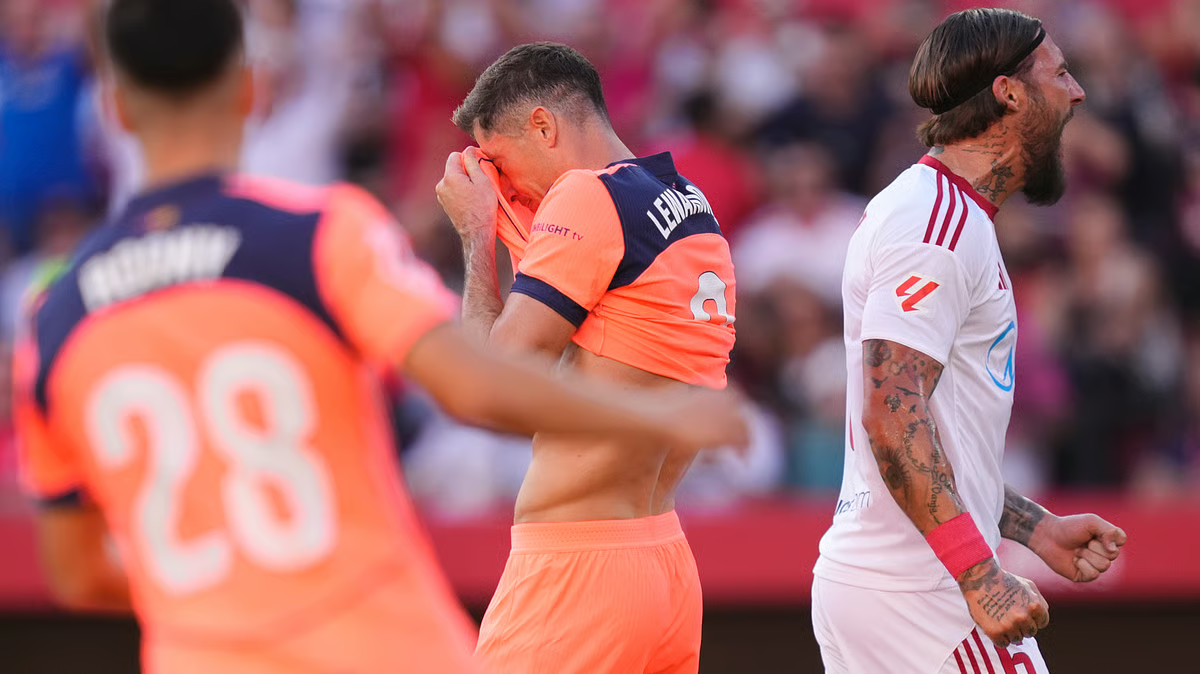
Barcelona pushed hard after the interval and were handed a golden opportunity to equalize in the 76th minute when Alejandro Balde was fouled in the area by Adnan Januzaj. However, Robert Lewandowski squandered the chance, dragging his penalty wide of the post.

Their hopes of a comeback were dashed in the 90th minute when Carmona drilled a low shot through a defender’s legs to make it 3–1. Substitute Akor Adams then capped off Sevilla’s dominant display, tapping in Chidera Ejuke’s cross in stoppage time to seal the 4–1 rout.

“We lacked intensity, we couldn’t get out of our half, and we didn’t know what to do with the ball,” admitted Barcelona midfielder Pedri. “We were never at our best. We need to improve a lot so we can start winning again after the break.”

The victory marked Sevilla’s second consecutive league win. They will resume their La Liga campaign after the international break against Mallorca on October 18, while Barcelona will host Girona on the same day.

Are We Truly Independent?

1

Across social media and digital platforms today, vibrant graphics celebrate our nation’s independence, 65 years since the colonial flag came down, and our own was raised. It marked a moment of triumph, of pride, and of new beginnings. But as we mark another October 1st, a sobering question lingers:

Are we truly independent?

Sixty-five years later, our children are still raised on American, British, and Chinese curricula—an education pipeline that often leads them straight into the arms of foreign nations. Our brightest minds are exported en masse, their potential lost to distant shores.

Our policies, supposedly sovereign, are heavily influenced—if not outright shaped—by Western non-state actors, who serve as consultants embedded deep in our policymaking processes. Whose interests do they really serve?

Our healthcare system is so underfunded and overstretched that those in power routinely bypass it entirely, jetting off to Western hospitals for the kind of care they fail to ensure for the average Nigerian—many of whom may never even see the inside of an airport, let alone fly abroad.

Our economy still leans heavily on foreign exchange. Our universities are underfunded, pushing the elite to send their children abroad while local institutions wither. Our research sector survives largely on donor funding, which comes with policy prescriptions that often undermine our local realities.

We have abandoned our indigenous seeds and embraced patented hybrids and genetically modified organisms—designed not for self-sufficiency but dependency. Our farmers are no longer masters of their fields but consumers in someone else’s supply chain.

We continue to pursue international loans tied to conditions that mandate the adoption of Western ideologies and economic models, often ill-suited for our unique context. Our media landscape remains dominated by Western narratives, echoed by our own journalists, shaping how the world sees us—and how we see ourselves.

We extract our minerals, but the profits go abroad. Our youth remain unemployed, their future mortgaged for resources powering industries they may never work in.

Our technocrats, often foreign-trained, craft policies that curry favor with global institutions rather than confront local needs. Our agricultural systems are increasingly dictated by multinational agribusinesses. We import what we can grow and neglect what we can create. Our middle class is being drained—strangled by inflation, economic insecurity, and the relentless lure of migration.

Are we independent?

We mark our sovereignty every year, but sovereignty is not simply the absence of colonial rulers. It is not the hoisting of a flag or the singing of an anthem.

True independence is the ability to feed ourselves, heal ourselves, educate ourselves, and govern ourselves—on our own terms.*

It is food sovereignty
Policy sovereignty.
Economic sovereignty.
Cultural sovereignty.

Until we achieve these, October 1st will remain a public holiday—not a celebration of true independence, but a reminder of the work still undone.

Elon Musk Becomes World’s First Half-Trillionaire

16

‎Elon Musk, CEO of Tesla, has made history as the first person to surpass a net worth of $500bn (£370.9bn), driven by the sharp rise in the value of Tesla and his other businesses this year.
‎
‎His wealth briefly peaked at $500.1bn on Wednesday afternoon in New York before slipping slightly to just over $499bn later in the day, according to Forbes’ billionaires index.
‎
‎In addition to Tesla, the valuations of his other businesses, including the artificial intelligence startup xAI and rocket company SpaceX, have also risen in recent months.
‎
‎This milestone further strengthens Musk’s position as the world’s richest person, far ahead of his rivals in the global tech industry.
‎
‎Forbes’ billionaire index ranks Oracle founder Larry Ellison as the world’s second-richest person, with an estimated fortune of about $350.7bn.
‎
‎Ellison briefly overtook Musk last month after Oracle’s stock jumped more than 40%, driven by the company’s unexpectedly strong outlook for its cloud infrastructure operations and AI partnerships.
‎
‎Musk’s vast fortune is largely tied to his more than 12% ownership in Tesla, which has seen its stock price climb significantly this year.
‎
‎By the close of trading in New York on Wednesday, Tesla shares were up more than 3.3% and have gained over 20% since the start of the year.
‎
‎The stock’s rise in recent months has been attributed in part to investor optimism over Musk devoting more time to his companies rather than politics.
‎
‎Earlier this year, he faced backlash for his role in the Trump administration’s Department of Government Efficiency (DOGE), an agency tasked with cutting US government spending and eliminating jobs.
‎
‎Musk, who also owns the X social media platform, has been outspoken on topics such as immigration and diversity, equity, and inclusion (DEI) programs.
‎
‎Tesla board chair Robyn Denholm said in September that Musk is now “front and centre” at the company.
‎
‎The board also revealed that Musk could secure a compensation package exceeding $1tn if he achieves a set of ambitious targets over the next decade.
‎
‎To unlock that package, he would need to increase Tesla’s valuation eightfold, sell one million AI-powered robots, deliver an additional 12 million Tesla vehicles, and meet several other benchmarks.
‎
‎Last month, Musk also disclosed that he had purchased about $1bn worth of Tesla stock, which some investors interpreted as a strong show of confidence in the company.
‎
‎Tesla, however, has faced numerous challenges in recent years, including fierce competition from electric vehicle rivals such as China’s BYD.
‎
‎The company is currently transitioning into a broader AI and robotics-focused enterprise.
‎

Top 5 Premier League Club Records That May Never Be Broken

5

The Premier League has delivered countless unforgettable moments from dramatic title races to legendary players lighting up the pitch. Along the way, some clubs have set records so extraordinary that they may stand the test of time.

Built on consistency, brilliance, and dominance, these achievements highlight what happens when teams hit their absolute peak. Here are five records that may never be matched.

  1. Manchester City’s 100-Point Season – The Centurions (2017/18)

In 2017/18, Pep Guardiola’s Manchester City rewrote Premier League history by becoming the first and so far only team to reach the 100-point mark.

Nicknamed the “Centurions,” City dazzled with attacking flair and ruthless efficiency, winning 32 matches and setting a new benchmark for excellence. The closest challengers have been Chelsea with 95 points in 2004/05 and Liverpool with 99 in 2019/20, but Guardiola’s side still stands alone.

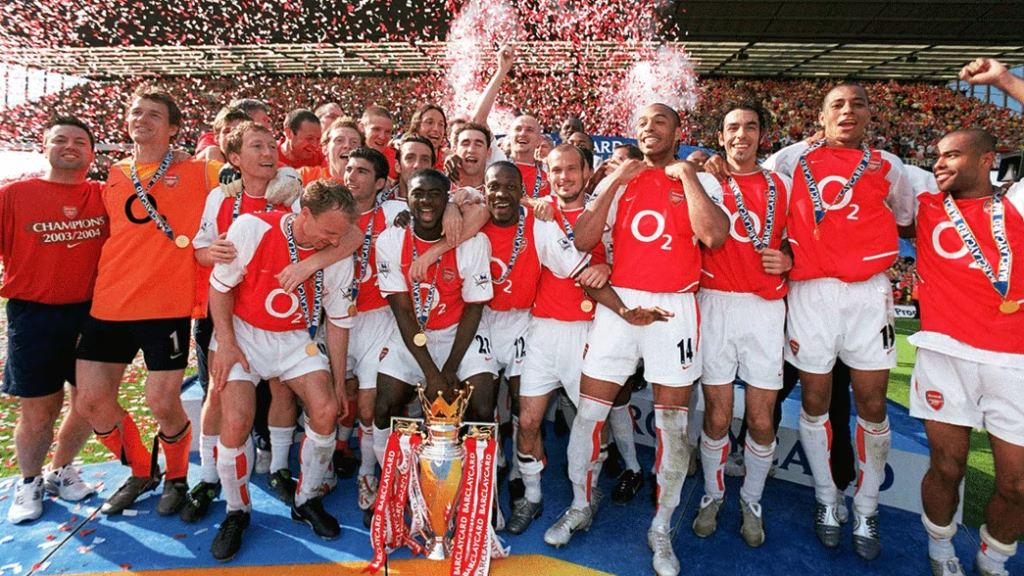
  1. Arsenal’s Unbeaten Season (2003/04)

The “Invincibles” remain one of football’s most iconic sides. Under Arsène Wenger, Arsenal completed the 2003/04 season unbeaten across all 38 league matches — 26 wins and 12 draws, finishing with 90 points.

Their reward was not only the Premier League title but also a one-of-a-kind golden trophy, cementing their place in history. No team has managed to replicate the feat since.

  1. Chelsea’s 86-Game Unbeaten Home Run (2004–2008)

Between March 2004 and October 2008, Stamford Bridge became a fortress. Chelsea went 86 consecutive home league games without defeat, spanning four years and four different managers.

José Mourinho oversaw the bulk of that run, masterminding 60 of those matches. The streak finally ended in October 2008 when Liverpool’s Xabi Alonso struck the decisive goal in a 1–0 win.

  1. Chelsea’s Defensive Wall – Fewest Goals Conceded (2004/05)

The 2004/05 season under Mourinho wasn’t just about winning the title it was about defensive perfection. Chelsea conceded only 15 goals in 38 matches, a record that still stands.

With John Terry and Ricardo Carvalho at the back and Petr Čech in goal, the Blues also kept 25 clean sheets, setting a standard for defensive solidity unlikely to be equalled.

  1. Manchester United’s 14 Straight Clean Sheets (2008/09)

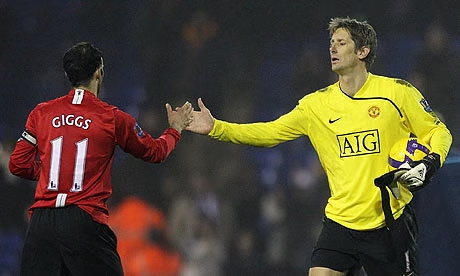
Sir Alex Ferguson’s Manchester United produced a defensive masterclass in the 2008/09 season, going 14 league matches in a row without conceding a goal.

Anchored by Nemanja Vidić, Rio Ferdinand, and goalkeeper Edwin van der Sar who set a then-world record for longest streak without conceding in league football the run remains unmatched in Premier League history.

These records showcase just how high the bar can be set in English football. While future teams may come close, these feats represent some of the league’s most enduring legacies.

Gauff Says More Slam Money Is Crucial For Tennis’ Future

6

Two-time Grand Slam champion Coco Gauff emphasized on Thursday that increasing financial support for players at the four major tournaments is vital for the long-term health of tennis.

Gauff, currently ranked world number three, is among a group of top players campaigning for a greater share of Slam revenues, improved benefits, and a stronger voice in tournament decision-making.

In March, 20 players signed a letter addressed to the heads of the four Grand Slams demanding higher prize money and more involvement in key decisions. Later in the summer, they reinforced their stance with a second letter calling for the creation of a player welfare fund to strengthen retirement and maternity protections. Notably, Novak Djokovic was not among the signatories.

Speaking in Beijing after reaching the China Open semi-finals, Gauff said:
“For the future of our sport and the overall ecosystem, this is really important. Discussions are ongoing behind the scenes, but I don’t know when change will actually happen.”

Players argue that Grand Slams distribute a smaller percentage of revenue to athletes compared to ATP and WTA events, despite generating far greater income. They also point out that while the tours contribute tens of millions annually to player welfare programs, the Slams contribute nothing.

“This isn’t just about increasing the winner’s prize,” Gauff explained. “It’s about ensuring support reaches every level, right down the rankings. We want the majors to invest not only in prize money but also in the wellbeing of players. The 200th or 300th-ranked players are often struggling to make a living.”

Although uncertain whether significant reforms will take place during her career, Gauff said her goal is to leave tennis in a better place:
“I don’t know if it will happen in my playing years, but I want to make sure the sport is stronger for the next generation.”

Man United Seal Deal For Colombian Wonderkid Cristian Orozco

8

Manchester United have completed the signing of 17-year-old Colombian midfielder Cristian Orozco from Fortaleza CEIF.

The deal, confirmed on Thursday by transfer expert Fabrizio Romano, will see Orozco officially join the Red Devils in the summer of 2026 when he turns 18.

According to Romano, all contracts have been cleared by United’s legal team, with the transfer coordinated by the club’s lead scout, Gerardo Guzmán Antonaccio.

Romano wrote on X:
“Manchester United have now sealed and signed a deal to bring in 17-year-old Colombian talent Cristian Orozco. $1m transfer fee from Fortaleza in a deal valid from summer 2026. #MUFC lawyers approved all the contracts, deal coordinated by lead scout Antonaccio.”

Orozco, a defensive midfielder and captain of Colombia’s U-17 national team, has already been tipped as one of the brightest prospects in South American football. Known for his intensity, leadership, and maturity beyond his years, he played a pivotal role in guiding Colombia to the final of the Under-17 South American Championship last year.

The teenager has also featured for Fortaleza in Colombia’s domestic league, further showcasing his potential at senior level.

At Old Trafford, Orozco will become part of a new generation of young talent, joining recent recruits such as Sekou Kone and Chido Obi-Martin, as United continue to invest in the future.

Court Dismisses Suit Challenging Tinubu’s Rivers State Emergency Rule

1

Justice James Omotosho of the Federal High Court in Abuja has dismissed a suit filed against President Bola Tinubu’s proclamation of emergency rule in Rivers State.

The case, brought by Belema Briggs and four others, sought to challenge the legality of the declaration. However, Justice Omotosho ruled that the plaintiffs lacked the legal standing to institute the case, explaining that only the Supreme Court has the jurisdiction to determine such a matter.

He noted that none of the plaintiffs were members of the State Executive Committee, the House of Assembly, or had suffered any specific injury, and that they also lacked the Attorney General’s approval to proceed.

The judge upheld the President’s position, stating that Tinubu’s claim that the emergency was necessary to prevent a breakdown of law and order was “undisputed.” He added that allegations of fundamental rights violations could not stand since the President acted within the framework of the Emergency Rule Order. Omotosho concluded that the case was frivolous and baseless, stressing that the plaintiffs did not obtain the consent of Rivers citizens before filing.

President Tinubu declared the state of emergency in March, suspending Governor Siminalayi Fubara, his deputy, and members of the State House of Assembly. He appointed retired Vice Admiral Ibok-Ete Ibas as Administrator to oversee the state, citing political instability and attacks on oil infrastructure as reasons for the move.

The emergency was lifted on September 17 after the federal government reported restored political cooperation and improved security. Fubara, his deputy, and Assembly members resumed their duties the following day, greeted by jubilant supporters.

US Embassy Assures Passport Services To Continue Despite Shutdown

2

The United States Embassy in Nigeria has reassured Nigerians that visa and passport services will continue despite the partial shutdown of the US government.

The embassy’s statement, released on Wednesday via its official X handle, came amid growing concerns that the shutdown in Washington could disrupt visa processing, student travel plans, and other consular services.

“Due to the lapse in appropriations, this X account will not be updated regularly until full operations resume, with the exception of urgent safety and security information. At this time, scheduled passport and visa transit services in the United States and at U.S. Embassies and Consulates overseas will continue during the lapse in appropriations as the situation permits,” the embassy announced.

It further explained that its social media accounts would only share urgent safety and security information until full government funding is restored.

The shutdown, triggered by a budget standoff between US lawmakers and President Donald Trump over healthcare funding, forced several federal departments and agencies to halt operations. Essential services, including the military, postal services, and social welfare programmes such as Social Security and food stamps, remain unaffected.

The embassy also advised Nigerians to visit travel.state.gov for the latest updates on consular services, including visa appointments and passport processing.

Tinubu To Commission Crude Oil Export Terminal In Rivers State

1

President Bola Tinubu will on October 8 commission the $400m Otakikpo Onshore Crude Oil Export Terminal in Rivers State, marking the first crude export facility built in Nigeria in over 50 years.

Developed by Green Energy International Limited (GEIL), operators of the Otakikpo field in OML 11 at Ikuru town, Andoni Local Government Area, the project is the first wholly indigenous onshore terminal in the country since the Forcados Terminal was commissioned in 1971.

The inauguration is expected to draw key stakeholders, including the Minister of State for Petroleum (Oil), Senator Heineken Lokpobiri, Rivers State Governor, Siminalayi Fubara, and senior industry leaders.

According to GEIL’s Executive Director of Legal and Corporate Services, Olusegun Ilori, the project directly aligns with President Tinubu’s vision to ramp up production and resolve Nigeria’s crude evacuation challenges. “This project is a strategic infrastructure that supports the administration’s commitment to raising output while reducing costs,” Ilori said.

The Otakikpo terminal, with an initial storage capacity of 750,000 barrels expandable to three million and a loading capacity of 360,000 barrels per day, is expected to significantly cut production costs for local producers. Industry experts note it could also unlock crude from more than 40 stranded oil fields that have struggled with evacuation bottlenecks.

Chairman and CEO of GEIL, Professor Anthony Adegbulugbe, hailed the development as a “game-changing national infrastructure,” adding: “What we have achieved here is not just a storage solution, but a pathway for about 40 stranded oil fields to finally contribute to the economy.”

The commissioning highlights the Federal Government’s renewed effort to restore investor confidence in Nigeria’s oil sector, which has grappled with declining production, pipeline vandalism, oil theft, and rising operational costs in recent years.