Home Blog Page 194

Nigerian Students Protest Unpaid Scholarship Allowances Abroad

0

Nigerian students studying overseas under the Federal Government’s Bilateral Education Agreement (BEA) have appealed to President Bola Tinubu to intervene in the prolonged delay of their stipends, saying many of them are facing severe hardship and dangerous living conditions in their host countries.

Dozens of affected scholars and their parents stormed the Federal Ministry of Finance in Abuja on Monday, demanding the immediate release of unpaid allowances. Arriving at the ministry gates around 10am, the protesters carried placards and chanted solidarity songs as they decried what they described as 11 months of government neglect.

The BEA programme supports Nigerian students studying in countries such as Russia, China, Hungary and Morocco. However, the beneficiaries say the situation has worsened since 2023. Their monthly stipend, which was originally $500, was slashed to $220 in 2024—an over 56% reduction—leaving many unable to feed, pay rent or meet basic needs.

The protesters said arrears for September to December 2023 remain unpaid, and that no allowance has been released for 2025, pushing many of the scholars into severe hardship. Their frustration was compounded by the recent death of one of the students, Bashir Malemi, who reportedly died from complications related to tuberculosis. Protesters said Malemi battled poor living conditions before his death and was due to graduate this year.

One of the students, Dalhatu Tijani, said the situation had become unbearable for many scholars who are now stranded abroad and facing embarrassment from landlords and foreign institutions. He explained that they had made several attempts to reach government officials, including the minister of education, the accountant general’s office and the Federal Scholarship Board, but received no solution.

He also noted that motions raised twice in the House of Representatives to address the crisis had not produced any tangible action.

The students are now appealing directly to President Tinubu to step in by ordering the ministries of finance and education, along with other relevant agencies, to clear all outstanding allowances. They also want their stipends restored to the original $500, which they describe as the minimum international standard for scholars studying abroad.

According to them, without urgent intervention, more students could be exposed to life-threatening conditions as they continue to struggle in countries where the cost of living is high and support systems are limited.

Violence Erupts At PDP Secretariat Amid Leadership Clash

0

A violent clash broke out at the Peoples Democratic Party (PDP) national secretariat in Wadata Plaza, Abuja, on Tuesday, November 18, as rival factions fought for control of the party. The confrontation involved the Nyesom Wike-Samuel Anyanwu faction and members loyal to the newly elected national chairman, Kabiru Turaki.

The tension arose after both factions scheduled conflicting National Executive Committee (NEC) meetings. Senator Samuel Anyanwu’s group planned a Board of Trustees (BoT) meeting for 11 a.m. and an NEC session for 2 p.m., while Turaki’s faction set its NEC meeting for 10 a.m. Anyanwu’s supporters arrived early, with a strong security escort by 7 a.m., stationing members at the main gate to block access.

When Governors Seyi Makinde of Oyo State and Bala Mohammed of Bauchi State, along with Turaki, attempted to enter the NEC Hall, a confrontation ensued. Police deployed teargas to disperse the crowd, and the trio was briefly caught in the fumes. Makinde described the tense situation, saying, “We faced strong resistance from supporters at the gate. Police had to use teargas to restore order before we could gain access.”

FCT Minister Nyesom Wike arrived later and stayed in his car for over 30 minutes, observing the standoff. His arrival prompted the gate to be opened, allowing supporters to enter the secretariat.

Addressing reporters, Turaki, flanked by Governors Makinde and Mohammed, said, “Due to some incidents caused by those who are the enemies of progress, the enemies of democracy, we have decided to postpone this meeting till tomorrow, Wednesday, November 19.”

He added, “The PDP remains a peace-loving party committed to restoring harmony within its ranks and across the country.”

He also thanked the police for their protection, noting, “I informed the Commissioner of Police for the FCT that we were coming to hold our inaugural NWC meeting. Some fliers on social media were purporting NEC and BoT notices by people no longer in the party, but the Commissioner ensured our safe entry.”

Later, the police ordered all party members and supporters to vacate the secretariat to restore calm. The incident underscores the ongoing struggle for leadership within the PDP ahead of crucial party activities and the 2027 elections.

‎
‎

UN Security Council Approves Donald Trump’s Gaza Proposal

0

The UN Security Council has formally backed a set of proposals advanced by Donald Trump aimed at establishing long-term stability in Gaza, including the introduction of an international security mission and a potential pathway toward a Palestinian state.

The decision passed with 13 votes in favour, while China and Russia abstained. Speaking after the vote, the US representative, Mike Waltz, said the resolution marked “a new course in the Middle East for Israelis and Palestinians and all the people of the region alike”.

References to eventual Palestinian statehood were included in order to secure broad support from Arab and Muslim-majority nations, which are expected to play a central role in supplying troops for the proposed international stabilisation force (ISF).

Despite this, the Israeli prime minister, Benjamin Netanyahu, reiterated his government’s firm rejection of a Palestinian state shortly before the vote, casting uncertainty over how the approved measures might be implemented on the ground.

In response to the outcome, Hamas dismissed the plan as an externally imposed “international guardianship mechanism” and declared that it had no intention of relinquishing its weapons.

Supporters of the resolution argued that it should immediately open the way for remaining restrictions on humanitarian assistance to be removed, enable the formation of the ISF to take over security responsibilities following any Israeli military exit, and initiate rebuilding efforts — with a potential “pathway to Palestinian self-determination and statehood”.

The provision for Palestinian statehood was added later in negotiations, replacing an earlier draft that lacked such language. Even so, the phrasing remains cautious, noting only that once the Palestinian Authority undergoes reforms and reconstruction has begun, “the conditions may finally be in place for a credible pathway to Palestinian self-determination and statehood.”

This fell short of the explicit commitments sought by Arab, Islamic and some European states. However, many representatives said they were willing to accept the compromise to preserve the current truce and swiftly address the urgent needs of Gaza’s 2.2 million residents.

“The transitional arrangements that we embark on today must be implemented in accordance with international law and respecting Palestinian sovereignty and self-determination,” James Kariuki, the UK chargé d’affaires said.

“We submitted what we considered essential amendments to ensure balance and integrity in the text. Some of those proposals were taken on board,” the Algerian envoy, Amar Bendjama, said.

“Algeria has finally decided to vote in favour of this text, a text that we support its core objective, namely the maintenance of the ceasefire and the creation of conditions enabling the Palestinian people to exercise their immeasurable rights to self-determination and statehood.”

Bendjama also highlighted the importance of the resolution’s annex, saying: “This resolution must be read in its entirety. Its annex is an integral part of it, and all parties must comply with it. It clearly affirms no annexation, no occupation, no forced displacement.”

Although Netanyahu was initially described as having accepted the wording during discussions with Washington, he reversed course after backlash from hardline members of his governing coalition. Over the weekend, he stated: “Our opposition to a Palestinian state on any territory has not changed.”

The resolution represents one of the few coordinated steps by the UN on Gaza after two years of strained diplomacy during which more than 71,000 Palestinians have been killed, alongside accusations of genocide raised by international investigators and rights organisations.

To secure abstentions rather than vetoes from Russia and China, the final text included broad, non-specific formulations that left numerous elements unresolved.

The plan grants overall supervisory authority to a “board of peace” chaired by Trump, though the composition of the board remains unclear. While the board must report to the UN, it is not bound by the organisation’s preferences or by the Palestinian Authority. The resolution also outlines the formation of a Palestinian technocratic committee to manage Gaza’s daily administration, though it is not yet known who might participate.

The ISF mandate empowers the force to disarm militant organisations, including Hamas, yet it remains uncertain whether any nation is prepared to contribute troops for such an undertaking. No country has publicly volunteered forces so far.

Hamas repeated after the vote that it had no intention of surrendering its weapons, raising the possibility of direct confrontation between the ISF and the group.

The reforms required of the Palestinian Authority — a prerequisite for movement toward Palestinian statehood — were also left undefined.

Diplomats from Europe stressed the urgency of identifying the members of the technocratic committee responsible for delivering essential services in Gaza.

Trump hailed the vote on social media as “a moment of true Historic proportion”, saying that “the members of the Board, and many more exciting announcements, will be made in the coming weeks.”

Nigeria Reclaims Two Benin Bronzes Repatriated From US

0

The Federal Government has taken possession of two Benin bronzes returned from the United States, marking another key step in Nigeria’s ongoing efforts to reclaim cultural treasures looted during the 1897 British invasion of the Benin Kingdom.

The Ministry of Arts, Culture, and Creative Economy received a bronze relief plaque and a commemorative head from the Ministry of Foreign Affairs on Monday.
The artefacts were handed back by the Museum of Fine Arts (MFA) in Boston.

Minister of Arts, Culture, Tourism and Creative Economy, Hannatu Musawa, described the development as a historic achievement. She praised the Minister of Foreign Affairs, Yusuf Tuggar, for driving the process, adding that more repatriations are expected.

“This is a historic moment for Nigeria, the ministry, and the good people of the Benin Kingdom. We are still in conversation with several other institutions that hold these artefacts, and soon the process of returning them all to their rightful owners will begin,” she said.

Director-General of the National Commission for Museums and Monuments (NCMM), Olugbile Holloway, thanked all parties who contributed to securing the artefacts.

He noted that the return marks a major milestone in Nigeria’s larger campaign for restitution.
“What we are witnessing today is the return of a huge part of Nigeria’s history. While this occasion is symbolic to Benin, it is also symbolic to Nigeria’s broader restitution struggle,” he stated.

The symbolic handover occurred in the presence of three high chiefs representing the Oba of Benin, His Royal Majesty Omo N’Oba N’edo Uku Akpolokpolo, Oba Ewuare II, according to a statement from the Minister’s Special Adviser, Nneka Anibeze.

Arts Newspapers in the US reported that the MFA in Boston returned the items during a ceremony at Nigeria House in New York in June 2025. MFA Director Matthew Teitelbaum said it was “deeply gratifying” to return the pieces to their rightful owners after 12 years in the museum’s collection.

The Benin bronzes—more than 2,000 brass and bronze artworks—were taken by British forces in 1897 and scattered across museums and private collections around the world.

Nigeria has stepped up diplomatic engagement in recent years to secure their return, signing agreements with institutions in the US, UK, and Europe.

This latest handover follows a 2023 Memorandum of Understanding between Nigeria and the United States focused on repatriating looted artefacts and improving cultural collaboration.

Officials say the development supports President Bola Tinubu’s “Renewed Hope” agenda to restore cultural heritage and promote national identity.

French Energy Giant Accused Of War Crimes Over 2021 Mozambique Massacre

0

A French energy firm is confronting serious accusations of involvement in war crimes — allegations it rejects — over a deadly attack that occurred near its multibillion-dollar gas development in northern Mozambique in 2021.

A human rights organisation has submitted a complaint to French prosecutors, claiming that TotalEnergies was complicit in war crimes that included the torture and execution of numerous civilians allegedly detained by local security forces inside a group of shipping containers located within the company’s compound.

The company has consistently denied any responsibility for actions carried out by government forces or associated security units that were assigned to protect the Afungi peninsula gas complex.

At the time, the project represented the largest foreign investment initiative on the African continent.

The complaint was lodged by the European Center for Constitutional and Human Rights (ECCHR).

“Companies and their executives are not neutral actors when they operate in conflict zones. If they enable or fuel crimes, they might be complicit and should be held accountable,” said Clara Gonzales, the ECCHR’s co-programme director for business and human rights.

The killings took place in Cabo Delgado, a province rich in natural resources, where state security forces were attempting to defeat extremist fighters linked to the Islamic State group — militants known for brutal beheadings and other atrocities.

In March 2021, Islamist fighters stormed the besieged town of Palma, killing or abducting 1,563 civilians who lived near TotalEnergies’ gas installation on the remote Afungi peninsula, according to Alex Perry.

The investigative writer was the first to report on both the scale of the Palma massacre and the subsequent retaliatory killings carried out near the entrance of the Total compound, in a work published in 2024.

Perry referred to the events as the “bloodiest disaster in oil and gas history”.

Civilians who fled to the company’s facilities seeking safety were allegedly accused of collaborating with militants. Men were separated from the wider group and detained inside metal containers. The precise number of those subsequently killed by Mozambican forces guarding the site remains uncertain. Perry documented 97 victims, though he believes the real death toll may be twice that number.

“Most people have never heard about any of this, in part because Total has acknowledged none of it. Today is a victory for truth, and accountability,” Perry said.

The UK government had originally committed to providing financial guarantees for British businesses hoping to participate in what was described as a transformative economic opportunity for Mozambique.

However, after suspending its support following the violence in Palma, the UK is now under pressure from environmental groups to fully abandon the project, who argue that the severity of the allegations against Total should be a decisive “red line” for any financial supporters of its LNG development.

Total, critics say, “continued to demonstrate that it has learned nothing from the past: it just announced the lifting of the force majeure on its gas project, despite the dramatic security and humanitarian situation”, according to Lorette Philippot from Friends of the Earth France.

She urged the UK and Dutch authorities to “refuse to renew their financial support and withdraw from Mozambique LNG”, citing decisions by several French financial institutions to cut ties with the project.

Those who back TotalEnergies’ commitment to proceed with the massive development argue that the venture has the potential to deliver major economic benefits to a region long deprived of investment.

Opponents, however, describe it as a catastrophe in environmental, ethical, and economic terms. They also compare the company’s challenges to a separate controversy involving another major French firm, Lafarge, which is currently facing trial alongside several former executives over accusations that it funded jihadist groups in Syria to keep a cement plant operational.

Wike-Loyal PDP Faction Seizes Control Of National Secretariat

0

The faction of the Peoples Democratic Party (PDP) loyal to the Minister of the Federal Capital Territory, Nyesom Wike, has taken control of the party’s national secretariat, Wadata Plaza, Abuja, ahead of a series of parallel meetings scheduled by rival blocs.

The Taminu Turaki-led National Working Committee (NWC), elected at the controversial Ibadan convention, had planned its inaugural meeting with key party stakeholders for 10 a.m. at the secretariat. Meanwhile, the Abdulrahman Mohammed-led faction had summoned emergency National Executive Committee (NEC) and Board of Trustees (BoT) meetings for 11 a.m. and 2 p.m. at the same venue.

The secretariat, previously under lock and key, was already occupied early in the morning by Abdulrahman Mohammed, who is recognized as factional National Chairman by his bloc. Armed security operatives were deployed across the premises to maintain order as both factions laid claim to the secretariat.

Personnel from the Mobile Police Force, Nigeria Security and Civil Defence Corps, and the Department of State Services positioned themselves at the entrance gates and other strategic points around the secretariat. Patrol vehicles also lined adjoining roads to prevent potential clashes.

Suspended National Secretary, Senator Samuel Anyanwu, had already accessed the premises as accreditation commenced ahead of their faction’s 103rd NEC meeting, which was in progress. The Turaki faction had not yet arrived. Outside the building, anti-Turaki protesters danced and chanted while holding placards with inscriptions such as “No to Turaki” and “Turaki must go.”

Speaking before the BoT meeting, Anyanwu described the heavy security presence as routine, noting that the party routinely invites security agencies to protect members during major gatherings.

He said he had formally notified all security agencies on November 14, 2025, of plans to hold the BoT and NEC meetings, adding that he had also communicated with the electoral commission in line with procedure.

Anyanwu insisted he remains the substantive National Secretary until December 8 and maintained that the Ibadan convention — during which he and others were allegedly suspended — never legally took place.

He argued that no valid communication was sent to the electoral commission regarding the convention and that the event lacked monitoring and supervision, making any decisions from it invalid. He added that two-thirds of the states’ delegates were absent and alleged that individuals “picked by the roadside and given PDP uniforms” were used to fill state delegations.

By 9:45 a.m. on Tuesday, the Wike-backed faction had fully taken over the secretariat. Abdulrahman Mohammed led his bloc into the building with a large contingent of armed police officers. Security personnel took positions along surrounding streets and within the premises.

As of the time of this report, members of the Kabiru-led faction had not yet arrived at the secretariat. National Secretariat Ahead of Parallel Meetings

The faction of the Peoples Democratic Party (PDP) loyal to the Minister of the Federal Capital Territory, Nyesom Wike, has taken control of the party’s national secretariat, Wadata Plaza, Abuja, ahead of a series of parallel meetings scheduled by rival blocs.

The Taminu Turaki-led National Working Committee (NWC), elected at the controversial Ibadan convention, had planned its inaugural meeting with key party stakeholders for 10 a.m. at the secretariat. Meanwhile, the Abdulrahman Mohammed-led faction had summoned emergency National Executive Committee (NEC) and Board of Trustees (BoT) meetings for 11 a.m. and 2 p.m. at the same venue.

The secretariat, previously under lock and key, was already occupied early in the morning by Abdulrahman Mohammed, who is recognized as factional National Chairman by his bloc. Armed security operatives were deployed across the premises to maintain order as both factions laid claim to the secretariat.

Personnel from the Mobile Police Force, Nigeria Security and Civil Defence Corps, and the Department of State Services positioned themselves at the entrance gates and other strategic points around the secretariat. Patrol vehicles also lined adjoining roads to prevent potential clashes.

Suspended National Secretary, Senator Samuel Anyanwu, had already accessed the premises as accreditation commenced ahead of their faction’s 103rd NEC meeting, which was in progress. The Turaki faction had not yet arrived. Outside the building, anti-Turaki protesters danced and chanted while holding placards with inscriptions such as “No to Turaki” and “Turaki must go.”

Speaking before the BoT meeting, Anyanwu described the heavy security presence as routine, noting that the party routinely invites security agencies to protect members during major gatherings.

He said he had formally notified all security agencies on November 14, 2025, of plans to hold the BoT and NEC meetings, adding that he had also communicated with the electoral commission in line with procedure.

Anyanwu insisted he remains the substantive National Secretary until December 8 and maintained that the Ibadan convention — during which he and others were allegedly suspended — never legally took place.

He argued that no valid communication was sent to the electoral commission regarding the convention and that the event lacked monitoring and supervision, making any decisions from it invalid. He added that two-thirds of the states’ delegates were absent and alleged that individuals “picked by the roadside and given PDP uniforms” were used to fill state delegations.

By 9:45 a.m. on Tuesday, the Wike-backed faction had fully taken over the secretariat. Abdulrahman Mohammed led his bloc into the building with a large contingent of armed police officers. Security personnel took positions along surrounding streets and within the premises.

As of the time of this report, members of the Kabiru-led faction had not yet arrived at the secretariat.

Fact Check: Did ISWAP Kill Brigadier General Uba?

0

Reports emerged online claiming that Brigadier M. Uba, Commander of the 25 Task Force Brigade, was kidnapped and killed by the so-called terrorist group, Islamic State West Africa Province (ISWAP) after an ambush along the Damboa–Biu axis of Borno State on Friday, 15 November 2024.

The Nigerian Army quickly dismissed the reports, calling them false. But new statements and images released by ISWAP, supported by independent security sources, have complicated the narrative.

Army Initially Denies Kidnapping Rumours

Following the attack, the Nigerian Army issued a statement confirming that troops “came under sudden and heavy insurgent fire” during a routine patrol near the fringes of the Sambisa Forest.

Army spokesperson Lt. Col. Appolonia Anele rejected the reports of Brigadier Uba’s abduction, describing them as a “fake narrative.”
She confirmed that two soldiers and two CJTF operatives were killed but insisted the brigade commander was safe, having survived the ambush.

ISWAP Releases Statement, Photos Claiming Execution

Contrary to the Army’s position, ISWAP released an Arabic statement through its propaganda outlet, Amaq, claiming it had captured and executed the senior officer.

The terror group published a collage showing Brigadier Uba in his office and another photo purportedly taken after his capture, with visible bloodstains on his camouflage.

In the statement, ISWAP said:
“Islamic State fighters overthrew a senior officer in the Nigerian army after a successful ambush on a military force in Borno…”

It added that the commander was intercepted after fleeing the initial firefight:
“A picture of the brigade commander from inside his office and a picture of him after he was captured by the Islamic State.”

The group also mocked the military’s earlier denial, calling it an “outright lie and a miserable security failure.”

Security Platform PRNigeria Corroborates ISWAP’s Account

PRNigeria, a platform with strong ties to security agencies, reported that the general had initially escaped the ambush with the help of an aerial operation and even contacted his superiors to confirm his safety.

However, the outlet said ISWAP fighters tracked him down after intercepting information about his location:

“Reports of his location compelled the terrorists to track him down, leading to his capture and subsequent summary execution after an interrogation,” the platform reported.

PRNigeria also described the killing as the first time ISWAP would execute an officer of such a high rank, and linked the incident to “insecure military communications” in the region.

Army Silent After ISWAP’s Publication

Despite the new claims and the release of images, the Army has issued no follow-up clarification.
Attempts by journalists to reach the spokesperson were unsuccessful:

“Calls and a message sent to Ms Anele were not responded to at the time of this report.”

Claim Remains Unverified

At this time, the circumstances surrounding Brigadier Uba’s fate remain unverified, as the army insists the commander was never abducted.

The so-called terrorist group ISWAP also claims it captured and executed him and provided images as proof.

Meanwhile, PRNigeria and other security-focused platforms have corroborated ISWAP’s account through independent sources.

At the time of filing this report, there is no updated military statement addressing the new revelations.

While ISWAP’s claims cannot yet be independently authenticated, the army’s earlier position that the commander was “safe” is now strongly in doubt.
The truth remains unclear pending official confirmation.

Germany Dominate to Seal Qualification

0

Germany put in a powerful and ruthless performance as they destroyed Slovakia 6–0 in their final qualifying match, confirming their place at the 2026 World Cup.

From the outset, Germany looked in total control — they poured in four goals before halftime, with Woltemade, Gnabry, and two from Leroy Sané all finding the net. In the second half, the dominance only continued as substitutes Ridle Baku and 19-year-old Assan Ouédraogo added their names to the scoresheet.

Ouédraogo’s goal was especially notable, marking him as the youngest debut scorer for Germany. With this huge win, Germany topped their group and booked direct passage to the finals, while Slovakia, despite the heavy loss, are consigned to the playoff route.

Netherlands Complete Unbeaten Run with Convincing Win

The Netherlands wrapped up their qualifying campaign in style, securing a 4–0 home victory against Lithuania to finish first in their group. They started strong, with Tijjani Reijnders netting the opener in the first half, and then went on to score three rapid goals in the second. A VAR-awarded penalty was converted by Cody Gakpo, before Xavi Simons unleashed a powerful solo strike, and Donyell Malen capped off the rout with a slick counter-attack. Unbeaten throughout the campaign, the Dutch sent a message of intent heading into next year’s finals.

Czechia Ride Rampage to Playoff Spot

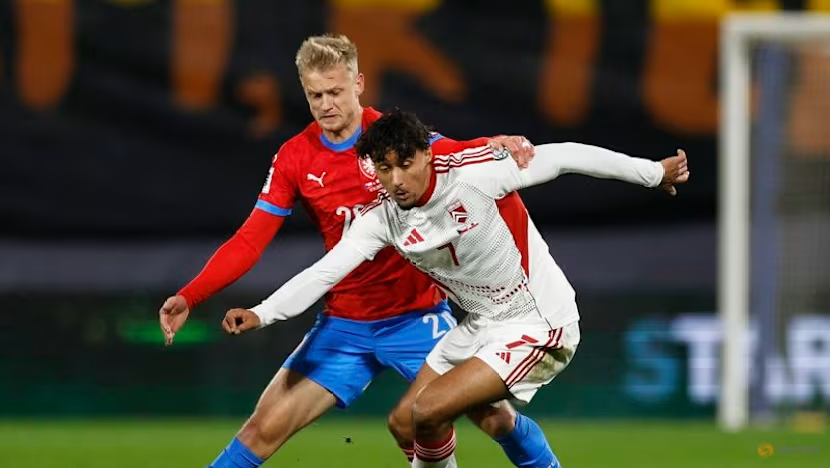
Czechia entertained at home as they dismantled Gibraltar by six goals, stamping their ticket into the playoff stage. The Czechs made their intent clear early on, scoring five times before the break. Doudera, Chory, Coufal, Karabec, and captain Souček all contributed in a dominant first half, while Robin Hranac tucked in a sixth shortly after the restart. Gibraltar never mounted a real threat and failed to register a shot on target, leaving Czechia in firm control as they head into the playoff round.

Croatia Rally from Two Down to Edge Montenegro

In one of the most dramatic matches of the night, Croatia came from behind to clinch a 3–2 away win against Montenegro. The hosts stunned Croatia early, scoring twice in the first 20 minutes. But Croatia responded: Ivan Perišić converted a penalty just before halftime, and Kristijan Jakic levelled matters in the 72nd minute. With the game hanging in the balance, it was Nikola Vlasic who delivered the decisive blow in the dying minutes, netting an 87th-minute winner to secure top spot in their group and guarantee direct qualification, avoiding the playoff.

Poland Holds On in Tense Battle with Malta

Poland secured a hard-fought 3–2 win in Malta to seal their spot in the March playoffs. Robert Lewandowski opened their account with a header, but Malta refused to fold, with Irvin Cardona equalising after a defensive error.

Poland took the lead again through Pawel Wszolek, only for Malta to draw level once more from a VAR-awarded penalty, which Teddy Teuma converted. Just when it seemed destined for a draw, Piotr Zieliński struck a long-range shot late in the match — deflected but effective — to win the game for Poland.

Despite the victory, they finished second in the group and must now navigate the playoff route.

Northern Ireland Finishes on a High, but the Group Outcome Unchanged

Northern Ireland ended their campaign with a narrow 1–0 win over Luxembourg in a match that saw them already eliminated from automatic qualification hopes. Jamie Donley, in only his second competitive start for his country, converted a penalty just before halftime after Christopher Martins committed a foul in the box following a VAR check. While the result gave Northern Ireland a morale boost, it did not affect the overall group standings; their fate for now relies on playoff or other secondary qualification paths.

Implications Moving Forward

The concluding matchday has dramatically clarified Europe’s picture for the 2026 World Cup. Germany and the Netherlands now look ahead confidently as they head into the finals. Meanwhile, teams like Czechia and Poland must now tackle the playoff gauntlet, where one more tough test awaits in March. Croatia’s grit in turning around a two-goal deficit underlines their quality and readiness, while Northern Ireland will regroup and prepare for their next opportunity.

Armed Men Kill Vice Principal, Abduct 25 Girls In Kebbi state

0

Armed assailants stormed the Government Girls Comprehensive Secondary School in Maga, Kebbi State, on Monday, killing a teacher and abducting at least 25 students in one of the most serious school attacks in northern Nigeria in recent months.

Police said the attackers, described as a gang of armed bandits, invaded the school around 4:00 a.m. local time, engaging security personnel in a gunfight before breaching the perimeter fence and seizing students from their hostel. One staff member — Vice Principal Malam Hassan Yakubu Makuku — was shot dead while attempting to protect the girls, and another member of staff sustained injuries and is receiving treatment.

Eyewitnesses reported that a large number of gunmen arrived firing sporadically, creating chaos before leading several students into nearby bushland.

Security agencies have deployed additional police tactical units, soldiers, and vigilante groups to launch a coordinated search-and-rescue operation across surrounding forests and suspected escape routes. Defense Minister Bello Mohammed Matawalle said the government has ordered an urgent response to secure the girls’ safe return.

Nigeria’s Minister of Information, Mohammed Idris, expressed solidarity with families of the abducted students, assuring them that the government is committed to bringing the girls home unharmed.

This abduction is the first major school kidnapping since March 2024, when more than 200 pupils were taken from Kuriga in Kaduna State. Over the past decade, northern Nigeria has faced repeated school attacks carried out by armed groups seeking ransom or leverage in dealings with authorities. While the government has banned ransom payments, the threat of kidnappings remains severe.

Children’s rights organizations say hundreds of students have been kidnapped since Boko Haram’s infamous 2014 abduction of 276 girls from Chibok. Rural schools remain particularly vulnerable, with rights groups warning that abductions often precede further abuses, including forced recruitment and sexual violence.

The attack in Maga has left families devastated as the search for the missing students intensifies.

U.S. Congress To Investigate Religious Violence In Nigeria

0

The U.S. House of Representatives Subcommittee on Africa will hold a high-profile hearing on Thursday, November 20, 2025, to examine President Donald Trump’s decision to reclassify Nigeria as a Country of Particular Concern (CPC) for alleged violations of religious freedom. The hearing comes amid growing international scrutiny of attacks on Christian communities in Nigeria.

At 11:00 a.m. in Room 2172 of the Rayburn House Office Building, the Subcommittee—chaired by Representative Chris Smith (R-NJ)—will convene an open session, available via live webcast. The bipartisan hearing is expected to assess the gravity of the religious persecution in Nigeria and explore possible U.S. policy responses, including sanctions or targeted aid.

Senior U.S. officials and Nigerian faith leaders will testify. On the government side, panelists include Jonathan Pratt, a senior bureau official from the State Department’s Bureau of African Affairs, and Jacob McGee, Deputy Assistant Secretary for the Bureau of Democracy, Human Rights, and Labor. Representing civil society and religious organizations are Nina Shea, Director of the Centre for Religious Freedom; Bishop Wilfred Anagbe of Nigeria’s Makurdi Diocese; and Oge Onubogu from the Center for Strategic & International Studies.

The hearing follows Trump’s October 31 designation of Nigeria as a CPC, citing “severe violations of religious freedom,” particularly the systematic targeting of Christians. Trump has claimed that thousands of Christians are being killed by “radical Islamist” groups, and warned that the United States could suspend aid or even take military action if the Nigerian government fails to protect its Christian population.

“If the Nigerian Government continues to allow the killing of Christians, the USA will immediately stop all aid and assistance … and may very well go into that now-disgraced country, ‘guns-a-blazing,’” Trump declared on November 1, 2025. He added that he had instructed the U.S. “Department of War” to prepare for “possible action” to “wipe out the Islamic terrorists.”

President Bola Tinubu pushed back, rejecting Trump’s remarks as a “misrepresentation of Nigeria’s religious reality.” In a statement on his official social media account, he affirmed that “religious freedom and tolerance have been a core tenet of our collective identity,” adding that Nigeria remains committed to constitutional guarantees of religious liberty.

The U.S. Senate is also weighing a related measure, sponsored by Senator Ted Cruz, that could reinforce consequences for Nigerian officials implicated in religious persecution.

Bishop Anagbe, who is expected to testify, has previously highlighted the threat to Christian communities in Nigeria. At a March 2025 event in the U.K. Parliament, he described how militant Fulani herdsmen and Islamist extremists have attacked Christian villages in Benue State, burned churches, and forced people into internally displaced persons (IDP) camps.

“They follow orders to conquer, kill, and occupy,” he told British lawmakers. “They attack even those who have managed to escape into our IDP camps.”