
Home Blog Page 205

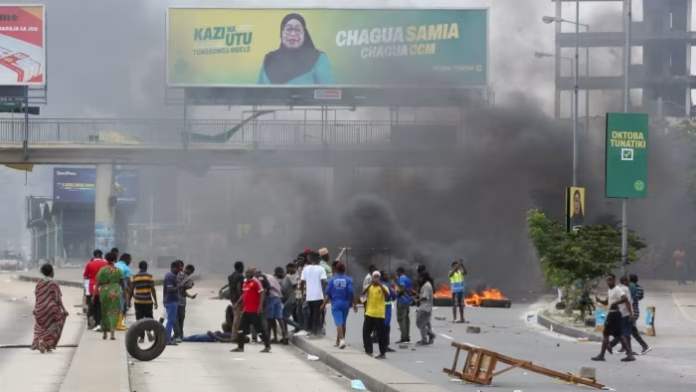
Hundreds Reportedly Killed As Election Protests Escalate Across Tanzania

15

Hundreds of people are feared dead in Tanzania following three days of violent protests triggered by Wednesday’s general election, according to the country’s main opposition party.

A spokesperson for the Chadema party told the AFP news agency that “around 700” people had been killed during clashes with security forces. However, an ongoing nationwide internet shutdown has made it difficult to verify reports or obtain accurate casualty figures.

A diplomatic source in Tanzania said there was credible evidence suggesting that at least 500 people may have lost their lives.

Protests have erupted in several major cities, with many young demonstrators denouncing the election as unfair, after key opposition candidates were barred from running against President Samia Suluhu Hassan.

Widespread unrest despite army warnings

Demonstrations continued on Friday in Dar es Salaam, particularly in the Salasala, Yombo, and Tegetaneighbourhoods, as protesters defied stern warnings from the military.

“Some people went to the streets on 29 October and committed criminal acts. These are criminals and the criminal acts should be stopped immediately,” said Gen Jacob John Mkunda on state TV on Thursday, adding that the army had “controlled the situation.”

Authorities have sought to downplay the scale of the violence, instead extending a nationwide curfew to contain the unrest.

Due to the internet blackout, journalists and human rights groups are struggling to independently verify the reports of fatalities.

Hospitals have reportedly refused to disclose casualty figures. A source at one referral hospital in Dar es Salaam told the BBC that it had been “overwhelmed with casualties” since Thursday and that other hospitals and morgues in the city were also full.

The United Nations has urged Tanzanian security forces to avoid the use of excessive force in responding to the demonstrations.

“We are alarmed by the deaths and injuries that have occurred in the ongoing election-related protests in Tanzania. Reports we have received indicate that at least 10 people were killed.”


Reuters quoted UN human rights spokesperson Seif Magango as saying on Friday that the ambassadors from several foreign embassies have also engaged the Tanzanian government, urging restraint and dialogue in handling the protests.

By late Friday afternoon, the electoral commission had announced results from about 80 of the country’s 272 regions, according to the state broadcaster, TBC.

International observers have reported extremely low voter turnout during the polls held on Wednesday.

President Samia Suluhu Hassan is widely expected to retain power under the Chama Cha Mapinduzi (CCM) party, which has ruled Tanzania since independence in 1961. Official results are expected to be released on Saturday.

Zanzibar election, flight disruptions, and communication blackout

On Zanzibar, the semi-autonomous island that elects its own president, CCM’s Hussein Mwinyi was declared the winner with nearly 80% of the vote. The opposition, however, alleged “massive fraud”, according to the Associated Press (AP).

The protests and internet shutdown have caused significant travel disruptions, leaving tourists stranded at airports across the country.

A Kenyan publicist, Anyiko Owoko, described her ordeal after being trapped in Tanzania for three days due to the communications blackout.

“Internet, shops, petrol stations, email, social media, everything was down. Total disconnect. No international or regional calls in or out. No text messages in or out. There were no Ubers or Bolts available because there was no network,” Owoko posted on Instagram after returning home on Friday via a Kenya Airways flight.

“Many flights were cancelled, and Tanzania’s national airline was grounded. There were so many people stranded at the airport who couldn’t book tickets or reschedule flights because of the connectivity blackout,” she added.

Protesters accuse the government of undermining democracy, citing the detention of key opposition leader Tundu Lissu, who is currently facing treason charges, which he denies. His party boycotted the vote in protest.

Another major opposition figure, Luhaga Mpina of the ACT-Wazalendo party, was disqualified on legal grounds, leaving only 16 minor parties, none with significant popular support to contest the election.

President Samia Suluhu Hassan, who became Tanzania’s first female leader in 2021 following the death of John Magufuli, was initially commended for loosening restrictions on political dissent. However, in recent months, critics say her administration has tightened control, with increased arrests, intimidation, and abductions of political opponents.

NAF Redeploys 25 Senior Officers In Major Leadership Reshuffle

1

This The Nigerian Air Force (NAF) has announced the redeployment of 25 senior officers to key command and staff positions as part of a broad restructuring effort aimed at boosting operational efficiency and aligning with the strategic vision of the newly appointed Chief of the Air Staff, Air Marshal Sunday Aneke.

According to a statement released on Friday by the Director of Public Relations and Information, Air Commodore Ehimen Ejodame, the reorganization seeks to improve decision-making, strengthen coordination across commands, and enhance the service’s readiness to tackle evolving national security challenges.

The latest shake-up saw 19 officers receive new appointments within the Air Force, while six others were posted to various defence and inter-service establishments.

Under the new postings, Air Vice Marshal (AVM) Abubakar Abdullahi becomes Chief of Policy and Plans, while AVM Adeniran Ademuwagun takes over as Commandant of the Air Force Institute of Technology (AFIT), Kaduna. AVM Ibitayo Ajiboye was named Group Managing Director of the NAF Investment Limited Group of Companies.

AVM Precious Amadi is now Chief of Operations, just as AVM Nnamdi Ananaba assumes the role of Chief of Air Intelligence. AVM Ebimobo Ebiowe becomes Superintendent of Standards and Evaluation, and AVM Ahmed Daritakes charge as Chief of Training. The Transformation and Innovation Branch will now be headed by AVM Mohammed Ibrahim.

“In the logistics and engineering domains, AVM Olufemi Ogunsina has been appointed Chief of Aircraft Engineering, and AVM Michael Onyebashi assumes command as Air Officer Commanding, Mobility Command. AVM David Pwajok is now Chief of Communication and Information Systems, while AVM John Ukeh takes charge as Air Provost Marshal.

“Further reinforcing NAF’s administrative and welfare structures, AVM Simon Peter has been appointed Managing Director, NAFIL Housing and Construction Company, while AVM Chidiebere Obiabaka becomes Air Secretary. 

AVM Anthony Martins now serves as Chief of Administration, AVM Abubakar Sule takes over as AOC, Logistics Command, and AVM Abdulrasheed Kotun has been appointed Managing Director, NAF Farms. The new Chief of Civil-Military Relations is AVM Edward Gabkwet, while AVM Osichinaka Ubadike has been named Deputy Commandant, AFIT,” the statement added.

The statement further noted that other senior officers including AVMs Ahmed Bakari, Albert Bot, Idi Sani, Muhammed Suleiman, Jibrin Usman, and Japheht Ekwuribe have been deployed to various defence and inter-service establishments to enhance joint military operations.

The new Air Chief, Air Marshal Sunday Aneke, assumed office on Thursday, and the redeployment exercise followed a day later. His decision to restructure the service’s top hierarchy came just 24 hours after his counterpart in the Nigerian Army also announced a major reorganization of senior commanders.

The second edition of The African Public Square (APS).

2

The APS, which debuted in London in 2023, provides a platform for public debate on Africa’s global agency and regional development issues.

The Abuja edition is featuring discussions on ECOWAS’ achievements, challenges, and the recent withdrawal of three member states, effective January 2025.

International development and public policy experts are expected to present insights on strengthening regional cooperation and promoting a people-centred integration agenda.

Speakers at the event are also highlighting ECOWAS’ milestones, including introducing the ECOWAS Passport and protocols on the free movement of persons, goods, and services.

ln247

‎Military Uncovers N45 Billion In NDDC Accounts Linked To Alleged Coup

11

‎In a deepening investigation into an alleged coup plot against President Bola Tinubu’s administration, the Nigerian military has uncovered a suspicious financial trail involving over ₦45 billion disbursed from the Niger Delta Development Commission (NDDC).
‎
‎The Defence Intelligence Agency (DIA), leading the probe, has linked these funds to politically exposed persons and detained soldiers suspected of orchestrating the conspiracy. Security sources revealed that the discovery has intensified scrutiny on high-level transactions within the commission, raising fears of widespread financial misconduct.
‎
‎The probe gained momentum following the detention of 16 Nigerian Army officers earlier this month, initially tied to a routine exercise but now connected to subversive activities.
‎
‎Investigators, working with the Nigerian Financial Intelligence Unit (NFIU) and the Economic and Financial Crimes Commission (EFCC), traced the funds to a ₦54 billion shoreline protection contract awarded under a previous administration.
‎
‎A portion, estimated at ₦20 billion in mobilization fees, was allegedly diverted to support the plot, with transfers reaching accounts linked to the suspects.
‎
‎At the center of the storm is former Bayelsa State Governor and ex-Minister of State for Petroleum, Timipre Sylva, whose Abuja residence was raided by Army personnel last Saturday. Although Sylva was abroad at the time, his younger brother and a driver were arrested during the operation.
‎
‎Sylva’s camp has vehemently denied any involvement, labeling the allegations as politically motivated attempts to tarnish his reputation amid ongoing rivalries in the Niger Delta.
‎
‎Compounding the tension, NDDC Managing Director Dr. Samuel Ogbuku was arrested by DIA operatives on Wednesday and is currently under interrogation. Sources claim Ogbuku allegedly authorized illicit transfers from the shoreline project, co-sponsoring the coup through these channels.
‎
‎NDDC spokesperson Seledi Thompson-Wakama has declined comment, citing directives to maintain silence, while insiders describe an atmosphere of panic at the commission’s headquarters as executives brace for further summons.
‎
‎The military’s inquiry extends beyond the NDDC, forming part of a broader intelligence operation to track unusual public fund movements.
‎
‎Senior security officials confirmed that interrogations of top NDDC executives focus on the origins, beneficiaries, and utilization of the ₦45 billion, with fears that the probe could expose a network of corruption involving contractors and politicians from both southern and northern Nigeria.
‎
‎The Federal Government has reiterated its commitment to democratic stability, dismissing coup rumors while vowing thorough accountability.
‎
‎As the investigation concludes, findings are set to be submitted to President Tinubu, potentially leading to a General Court Martial and public disclosure of involved parties.
‎
‎This scandal underscores persistent challenges in Nigeria’s public sector, where development funds meant for regional upliftment are allegedly siphoned for destabilizing ends. Stakeholders urge swift reforms to prevent future vulnerabilities, emphasizing the need for transparent oversight in agencies like the NDDC.
‎
‎
‎

Eight dead, Including policeman, In Lagos-Ibadan Expressway Truck Collision

0

‎A devastating multiple-vehicle crash on the Kara Bridge along the Lagos-Ibadan Expressway has claimed at least eight lives, including a police inspector, leaving commuters stranded amid severe gridlock. The incident, which unfolded late Wednesday night into Thursday morning, involved five articulated trucks, one of which was a fuel tanker.
‎
‎Eyewitnesses described a chaotic scene where one truck veered off the road, crashed into the bridge barricade, severed on impact, and plunged into the Kara River below. Two other vehicles collided and burst into flames, while a fourth spilled cartons of biscuits across the highway, exacerbating the blockage inward Mowe.
‎
‎Preliminary investigations by the Lagos State Police Command point to brake failure on one of the trailers as the primary cause, a recurring issue on Nigeria’s busy highways.
‎
‎Commissioner Olanrewaju Ishola, who visited the scene early Thursday, confirmed the tragedy struck the police advance team responding to the initial call.
‎
‎”It’s very unfortunate that we lost one of our police inspectors who came with our advance team to salvage the situation,” Ishola stated, vowing to prosecute those responsible for vehicle maintenance lapses.
‎
‎Rescue operations, involving the Federal Road Safety Corps (FRSC) and LASTMA, have been underway since 5 a.m., with three injured individuals evacuated to nearby hospitals.
‎
‎The crash has triggered a massive traffic backlog stretching from Kara Bridge to Ogunnusi Road and the Berger axis, forcing some motorists to drive against traffic on the Lagos-bound lane.
‎
‎Commercial drivers exploited the chaos, hiking fares on routes like Berger-Oshodi from ₦1,000-1,200 to ₦2,000-2,500, stranding scores of workers and students. A towing van dispatched to separate the wreckage was also struck, complicating efforts.
‎
‎LASTMA urged alternative routes, noting the fire outbreak from the fuel tanker posed additional risks.
‎
‎This accident comes less than 24 hours after a separate truck plunge on the Otedola Bridge, highlighting Nigeria’s persistent road safety crisis driven by poor vehicle upkeep and reckless driving.
‎
‎Ishola warned articulated vehicle operators: “If they are not reckless in their driving habits, we won’t have this kind of accident.”
‎
‎As evacuation continues, authorities emphasize stricter enforcement, calling for mandatory brake checks and driver training to avert future disasters on this vital corridor.

FG Releases ₦2.3 Billion To Clear Lecturers’ Arrears, Averts Strike‎

7

‎The Federal Government has disbursed ₦2.3 billion to public universities nationwide to settle outstanding salary and promotion arrears for academic staff.
‎
‎Education Minister Dr. Tunji Alausa announced the payment on Wednesday, describing it as Batch 8 of the backlog inherited from previous administrations. The move comes amid ongoing dialogues with the Academic Staff Union of Universities (ASUU) to maintain industrial harmony.
‎
‎The release, processed through the Office of the Accountant-General of the Federation, targets unions in federal universities and addresses demands that have fueled tensions for years.
‎
‎Alausa emphasized that the funds underscore President Bola Tinubu’s commitment to improving staff welfare and preventing disruptions in higher education.
‎
‎ASUU had recently suspended a two-week warning strike following interventions by the Nigeria Labour Congress and the National Assembly.
‎
‎The union’s grievances included withheld salaries, promotion delays, and the need for revitalization funds, which have repeatedly led to nationwide shutdowns.
‎
‎In addition to the arrears payment, the government has released funds under the Needs Assessment of Nigerian Universities scheme, with new budgetary provisions to ensure its continuity.
‎
‎This initiative aims to upgrade infrastructure and resources in tertiary institutions, supporting long-term sector growth.
‎
‎Alausa further revealed plans to fully mainstream Earned Academic Allowances (EAA) into university staff salaries starting in 2026. This integration promises prompt and predictable payments, reducing future disputes over allowances.
‎
‎The Minister appealed to lecturers to support reform efforts in the education sector. He assured that all engagements with ASUU and other unions are in good faith, with agreements aligned to realistic budgets to foster stability and progress in Nigeria’s universities.

Tinubu Revokes Over 50 Pardons After Public Outrage

0

‎President Bola Tinubu has revoked presidential pardons for more than 50 high-profile convicts, including murderers, kidnappers, and drug traffickers, following intense public criticism.
‎
‎The revised list, released by presidential spokesman Bayo Onanuga on Wednesday, excludes notorious figures from the initial 175-inmate clemency announced on October 1, Nigeria’s Independence Day. This swift reversal came after nationwide anger over the release of serious offenders.
‎
‎Among those removed is Maryam Sanda, convicted of stabbing her husband to death in 2017, whose death sentence was commuted to 12 years.
‎
‎Other revoked cases involve armed robbers, drug barons, and kidnappers serving lengthy terms. Former Vice President Atiku Abubakar led the backlash, calling the original pardons “an act of shame” that undermined justice and emboldened criminality.
‎
‎Opposition voices and human rights groups joined the outcry. Mallam Bolaji Abdullahi of the African Democratic Congress (ADC) described the move as “a national disgrace” and an abuse of presidential mercy powers.
‎
‎Victims’ families and civil society warned that freeing violent offenders threatened public safety and eroded trust in the judiciary.
‎
‎The Presidency explained that the initial list was compiled by the Ministry of Justice and the Prerogative of Mercy Committee. Justice Minister Lateef Fagbemi confirmed no convict had been released, as the list was under review due to public reaction.
‎
‎Tinubu ordered deletions after consulting the Council of State to address security concerns and victim sensitivities.
‎
‎In a detailed statement, Onanuga noted that some inmates retained partial relief through sentence commutation, but those convicted of grave offences were fully excluded.
‎
‎The 50-plus revoked pardons were formally withdrawn from the Federal Gazette, with affected inmates to serve their original sentences.
‎
‎To prevent future controversies, Tinubu directed the relocation of the Prerogative of Mercy Secretariat to the Ministry of Justice and mandated new guidelines, including compulsory consultation with prosecuting agencies.
‎
‎The revised list has been sent to the Nigerian Correctional Service for implementation, with the President thanking stakeholders for their feedback. The move has been praised as a rare instance of presidential responsiveness, boosting credibility on justice amid rising insecurity.

Israeli Airstrikes In Gaza Leave 104 Dead, Officials Say

10

At least 104 Palestinians lost their lives in a series of Israeli air raids across Gaza on Tuesday night, according to figures released by the territory’s Hamas-controlled health authorities.

The Israeli military said it targeted “dozens of terror targets and terrorists” in retaliation for what it described as violations by Hamas of the US-brokered truce agreement.

Israel’s defence minister accused the militant group of carrying out a deadly attack in Gaza that killed one Israeli soldier and of breaching the terms related to returning the bodies of deceased hostages. Hamas countered the accusation, insisting it had “no connection” to the attack and claiming Israel was attempting to sabotage the truce.

US President Donald Trump stated that “nothing” would threaten the ceasefire but added that Israel had every right to “hit back” when its forces came under attack.

The air raids reportedly struck residential buildings, schools, and homes across Gaza City and Beit Lahia in the north, as well as Bureij, Nuseirat, and Khan Younis further south.

Witnesses in Gaza City said they saw “pillars of fire and smoke” filling the sky as explosions ripped through multiple neighbourhoods.

Health officials in Gaza reported that the attacks killed 104 people, including 46 children and 20 women, while over 250 others sustained injuries.

According to emergency responders, three women and one man were recovered from the debris of the al-Banna family’s home in the Sabra area of southern Gaza City.

In the Bureij refugee camp, five members of the Abu Sharar family were also confirmed dead after their home in the Block 7 district was struck.

At Nasser Hospital in Khan Younis, grieving relatives gathered over the bodies of a mother, Bayan al-Shawaf, and her four children, who were killed in an airstrike that hit a tent sheltering displaced people in al-Mawasi.

“What kind of world is this? Is this the ceasefire?” asked Bayan’s cousin, Umm Mohammed. “They [the children] were sleeping. They were wanting to learn.”

By Wednesday morning, the Israel Defense Forces announced that it had “begun the renewed enforcement of the ceasefire” after conducting air operations on what it called “dozens of terror targets and terrorists,” including over 30 militant commanders.

“The IDF will continue to uphold the ceasefire agreement and will respond firmly to any violation of it,” it added.

A statement from the Israeli Prime Minister’s office confirmed he had ordered “forceful strikes” on Gaza, though it did not give further explanation.

Meanwhile, the defence minister accused Hamas of crossing “a bright red line” after launching an assault on Israeli troops inside Gaza.

“Hamas will pay many times over for attacking the soldiers and for violating the agreement to return the fallen hostages,” Israel Katz warned.

On Wednesday, the military confirmed that one reservist, Master Sergeant Yona Efraim Feldbaum, had died in the incident.

A military source said the attack occurred near Rafah, on the Israeli-controlled side of the “Yellow Line,” the boundary separating IDF-held zones within Gaza under the ceasefire arrangement.

Sgt Feldbaum died after an IDF engineering vehicle working to dismantle a tunnel route came under fire from “terrorists in the area,” the source reported.

“A few minutes later, several anti-tank missiles were fired at another armoured vehicle belonging to the troops in the area. No injuries were reported,” they added.

Hamas reiterated that it had “no connection to the shooting incident in Rafah.”

The group later affirmed its commitment to the truce, accusing Israel of attempting to undermine it through renewed air raids.

US officials downplayed fears of a total breakdown in the ceasefire.

Speaking to reporters aboard Air Force One, President Trump said: “As I understand it, they took out, they killed an Israeli soldier. So the Israelis hit back and they should hit back.”

“Nothing is going to jeopardise” the ceasefire, he said. “You have to understand Hamas is a very small part of peace in the Middle East, and they have to behave.”

Earlier on Tuesday, Israel’s prime minister vowed to take unspecified “steps” against Hamas after the group delivered a coffin containing human remains that did not belong to any of the 13 deceased hostages still held in Gaza.

According to his office, forensic testing confirmed the remains were those of Ofir Tzarfati, an Israeli hostage whose body had already been recovered in late 2023—an act the government described as a “clear violation” of the ceasefire terms.

The IDF also released drone footage allegedly showing Hamas operatives “removing body remains from a structure that had been prepared in advance and burying them nearby” in eastern Gaza City on Monday.

“Shortly afterwards,” the statement continued, the operatives “summoned representatives of the Red Cross and staged a false display of discovering a deceased hostage’s body.”

Hamas dismissed the accusation as “baseless allegations,” accusing Israel of “seeking to fabricate false pretexts in preparation for taking new aggressive steps.”

The International Committee of the Red Cross (ICRC) later denounced what it called the “fake recovery,” saying its personnel were present “at the request of Hamas” and acted “in good faith.”

It added: “The ICRC team at this location were not aware that a deceased person had been placed there prior to their arrival, as seen in the footage – in general, our role as neutral intermediary does not include unearthing of the bodies of the deceased.

“Our team only observed what appeared to be the recovery of remains without prior knowledge of the circumstances leading up to it.

“It is unacceptable that a fake recovery was staged, when so much depends on this agreement being upheld and when so many families are still anxiously awaiting news of their loved ones.”

The ceasefire agreement, facilitated by the US, Egypt, Qatar, and Turkey, forms the initial stage of Trump’s 20-point Gaza peace initiative.

Under the accord, Hamas agreed to return 48 living and deceased hostages within 72 hours after the ceasefire began on October 10.

By October 13, all 20 surviving Israeli hostages had been freed in exchange for 250 Palestinian prisoners and 1,718 detainees from Gaza.

In addition, Israel has transferred the bodies of 195 Palestinians in return for the 13 Israeli hostages’ remains handed over by Hamas, along with the bodies of two foreign nationals—one Thai and one Nepalese.

Of the deceased hostages still in Gaza, eleven are Israeli, one is Tanzanian, and one is Thai.

Hamas negotiator Khalil al-Hayya stated on Saturday that the group was struggling to locate all the bodies because Israeli operations had “altered the terrain of Gaza.” He added that “some of those who buried the bodies have been martyred or no longer remember where they buried them.”

Israel, however, maintains that Hamas is fully aware of the locations of all the remains.

While the agreement appeared to allow flexibility if not all bodies could be returned within the original timeframe, Trump warned Hamas on Saturday that it must deliver those remaining “quickly, or the other countries involved in this great peace will take action.”

All but one of the hostages still unreturned were among the 251 people abducted during Hamas’s assault on southern Israel on October 7, 2023, which left roughly 1,200 people dead.

Israel launched a massive military response in Gaza that has since resulted in the deaths of more than 68,600 people, including over 200 since the ceasefire took effect, according to the territory’s health officials.

FG Signs $400M Steel Plant Deal With China’s Stellar Steel

0

‎The Federal Ministry of Steel Development has entered into a $400 million Joint Strategic Cooperation Agreement with Stellar Steel Company Limited to enhance domestic steel output and lessen Nigeria’s dependence on imported steel goods.
‎
‎Stellar Steel Company Limited is a steel production firm set up to function in Nigeria, supported by significant funding from two Chinese giants, Galaxy Group and RSIN Group, both based in Fuzhou, Fujian Province, China.
‎
‎The pact, inked in Abuja on Tuesday, October 28, 2025, commits Stellar Steel to a $400 million investment for building a state-of-the-art steel facility in Ewekoro, Ogun State.
‎
‎The initiative will unfold in three stages, with the initial phase slated to begin operations by mid-2026.
‎
‎Minister of Steel Development Prince Shuaibu Abubakar Audu represented the Federal Government in signing the deal during a courtesy call by Stellar Steel’s leadership, headed by Mr. Li, President of Inner Galaxy Group, at the Ministry’s Abuja headquarters.
‎
‎In a statement, Audu hailed the alliance as a pivotal step in rejuvenating Nigeria’s steel sector and meeting the Federal Government’s goal of 10 million tonnes of crude steel output per year by 2030.
‎
‎The Minister said that the Federal Ministry of Steel Development will facilitate policy and infrastructure support, including inclusion of Stellar Steel’s logistics projects in the National Infrastructure Plan and access to available fiscal incentives.
‎
‎Highlights of the Cooperation includes; “Development of a localized iron ore supply chain to reduce import dependence and save over $1 billion in foreign exchange annually.
‎
‎“Creation of more than 2,000 direct and 20,000 indirect jobs across the steel value chain. Promotion of green steel production using clean and energy-efficient technologies.
‎
‎Strengthening of Nigeria’s position as a regional steel manufacturing hub in West Africa.”
‎
‎He also stated that in return, Stellar Steel will prioritise local recruitment and training, partnering with Nigerian universities to build technical and managerial expertise in steel production.
‎
‎Prince Shuaibu emphasised that this strategic cooperation marks a new era for Nigeria’s steel industry and demonstrates the government’s commitment to sustainable industrial growth and economic transformation.
‎
‎In his remarks, the leader of the delegation, Mr. Li, assured the Honourable Minister that Stellar Steel Company Limited will respect all agreements reached and will ensure the completion of the project in record time, and assured that all safety standards will be observed.
‎
‎Mr. Li was accompanied during the visit by Mr. You Xiastian, Vice Chairman of RSIN Group, Mr. Jackie Den, Vice President of Inner Galaxy Group, and Mr. Yin, Director of RSIN Group.
‎
‎He recalled that the Honourable Minister of the Steel Department, Prince Shuaibu Abubakar Audu, performed the groundbreaking ceremony of the Steel Plant in Ogun State sometime in April 2025.
‎
‎Speaking at the signing, representatives of both parties emphasised that the partnership would strengthen Nigeria’s industrial base, create jobs, and foster technology transfer in the sector.
‎
‎

‎FIRS Imposes 10% Withholding Tax On Short-Term Securities

0

‎In a bold move to bolster non-oil revenue streams, the Federal Inland Revenue Service (FIRS) has mandated a 10% withholding tax on interest earned from short-term securities, effective immediately.
‎
‎Announced on October 28, 2025, the directive targets banks, stockbrokers, and other financial institutions, requiring them to deduct the tax at the point of interest payment.
‎
‎This policy shift ends long-standing exemptions designed to lure investors into Nigeria’s debt market.Short-term securities affected include treasury bills, commercial papers, bankers’ acceptances, promissory notes, and bills of exchange, which have been popular for their liquidity and high yields amid economic volatility.
‎
‎Previously tax-exempt to deepen domestic investment, these instruments now face the levy under the Companies Income Tax Act and Personal Income Tax Act.
‎
‎However, interest on federal government bonds and Central Bank of Nigeria’s Open Market Operation (OMO) bills remains exempt.
‎
‎FIRS Executive Chairman Zacch Adedeji emphasized compliance in the circular, warning of penalties and interest for non-adherence.
‎
‎”This aligns with our mandate to broaden the tax base and ensure equitable contributions from all sectors,” Adedeji stated.
‎
‎Investors can claim tax credits for withheld amounts unless deemed a final tax, providing some relief for those filing annual returns.The policy arrives as Nigeria grapples with naira depreciation, inflation exceeding 30%, and fiscal pressures from reduced oil revenues.
‎
‎By closing exemption loopholes, the government aims to generate tens of billions of naira annually, according to PwC Nigeria estimates.
‎
‎This supports President Tinubu’s economic reforms, including recent exits from the FATF grey list, to enhance financial credibility and reduce borrowing dependency.
‎
‎Critics, including retail investors and financial analysts, decry the tax as a burden on middle-class savers already squeezed by rising costs.
‎
‎”It erodes net returns on safe, short-term options, potentially driving capital flight or shifts to riskier assets,” noted Dr. Chinedu Agu, a tax consultant in Abuja. Institutional players, reliant on these securities for quick liquidity, fear a dip in market participation.
‎
‎The Nigerian Securities and Exchange Commission (SEC) and Debt Management Office (DMO) have yet to issue formal responses, but early market reactions show slight yield adjustments on upcoming treasury bill auctions. Advocacy groups like the Association of Issuing Houses of Nigeria urge dialogue to mitigate impacts on small investors.
‎
‎As compliance kicks in, the measure tests the balance between revenue needs and investment incentives.Ultimately, this withholding tax underscores Nigeria’s evolving fiscal strategy, prioritizing sustainability over short-term allure.
‎
‎While it may streamline tax collection and align treatments across instruments, success hinges on transparent implementation and investor education. For now, the policy signals a tougher stance on fiscal discipline in Africa’s largest economy.
‎
‎
