Home Blog Page 21

Tinubu Reappoints Buba Marwa As NDLEA Chairman

3

President Bola Tinubu has approved the renewal of Brigadier-General (rtd) Mohammed Buba Marwa’s appointment as Chairman of the National Drug Law Enforcement Agency (NDLEA), extending his tenure for another five years and keeping him in office until 2031.

Marwa, an indigene of Adamawa State, was initially appointed as NDLEA Chairman in January 2021 by former President Muhammadu Buhari. Prior to that role, he served as Chairman of the Presidential Advisory Committee for the Elimination of Drug Abuse from 2018 until December 2020.

His renewed appointment was confirmed in a statement issued on November 14, 2025, by the Special Adviser to the President on Information and Strategy, Bayo Onanuga.

Tinubu commended Marwa’s dedication, stating, “Your reappointment is a vote of confidence in your onerous efforts to rid our country of the menace of drug trafficking and drug abuse. I urge you not to relent in tracking the merchants of hard drugs, out to destroy our people, especially the young ones.”

A former military governor of both Lagos and Borno states, Marwa is a graduate of the Nigerian Military School and the Nigerian Defence Academy (NDA). 

Commissioned as a second lieutenant in 1973, he went on to serve in several key military roles, including Brigade Major of the 23 Armoured Brigade, Aide-de-Camp to the Chief of Army Staff, Lieutenant-General Theophilus Danjuma, and Academic Registrar of the NDA.

Marwa also held diplomatic positions, serving as Deputy Defence Adviser at the Nigerian Embassy in Washington, DC, and later as Defence Adviser to Nigeria’s Permanent Mission to the United Nations.

He holds two advanced degrees: a Master of Public and International Affairs from the University of Pittsburgh (1983–85) and a Master of Public Administration from Harvard University (1985–86).

Under his leadership, the NDLEA has achieved major milestones, including the arrest of 73,000 drug mules and barons and the seizure of over 15 million kilograms of illicit drugs, alongside the rollout of nationwide campaigns aimed at curbing drug abuse.

Ronaldo Red Card Drama Steals The Show As Portugal Stumble In Dublin

0

Cristiano Ronaldo, the face of Portugal’s golden generation, found himself at the centre of controversy at the Aviva Stadium as the Republic of Ireland stunned the visitors 2–0. Ronaldo was initially booked for an elbow on Dara O’Shea, but after a pitch-side VAR review, the yellow was upgraded to a red — his first sending-off in 226 Portugal appearances, leaving Portugal down to ten and swinging momentum firmly in Ireland’s favour.

Manager Roberto Martínez publicly defended his captain, calling the sending-off harsh and arguing the replay exaggerated the contact; he also criticised comments from the Ireland camp that suggested referees were being influenced. Despite the loss, Portugal remains top of Group F, but their margin is thin and Ronaldo’s suspension guarantees he will miss the next qualifier — a blow for a side still hunting certainty ahead of the World Cup.

Ireland took full advantage after the sending-off, converting Portugal’s vulnerability into goals and a disciplined display that closed out a landmark 2–0 victory. The result hands Ireland a huge morale boost while forcing Portugal into a nervy finish to the group phase, with one eye now on damage limitation and squad discipline.

France finishes the job, Mbappé shines as Les Bleus qualify

In Paris, France made absolutely sure of their place at the 2026 World Cup, powering past Ukraine 4–0 with Kylian Mbappé the standout performer. France’s clinical showing sealed qualification and allowed Les Bleus to mark a significant victory on an emotional night for the nation.

England keeps rolling with a professional win over Serbia

England maintained their unbeaten qualifying run with a measured 2–0 victory against Serbia. Head coach Thomas Tuchel praised his squad depth after substitutes helped see the game out, with England delivering another clean, functional performance as they continue to build toward next summer’s tournament.

Norway surge closer — Haaland and Sörloth on target

Norway moved to the brink of qualification with a dominant 4–1 win over Estonia. Erling Haaland and Alexander Sörloth took centre stage as the Scandinavians opened up a healthy gap at the top of Group I, leaving them heavily favoured to clinch a spot in North America.

Hungary edges Armenia in tight finish

Hungary grabbed a narrow 1–0 victory away in Yerevan, a result that keeps them firmly in the battle in their group and tightens the race for playoff positions as the final matchday approaches.

Quick takeaway

Thursday’s qualifiers handed up drama and decisive results: Ronaldo’s red card rewrote Portugal’s immediate narrative and raises suspension questions; France and Norway took big steps toward the World Cup; while England and Hungary kept steady, leaving several groups headed to tense final fixtures.

It’s Nigeria Vs Dr Congo In Winner-Takes-All Play-Off Final For 2026 World Cup Pathway

3

Nigeria and DR Congo will meet in Sunday’s CAF World Cup play-off final in Rabat, with the winners advancing to March’s FIFA Inter-Continental Play-Off and keeping their FIFA World Cup 26™ dream alive. 

Kick-off is 20:00 local time (19:00 GMT) at the Stade Prince Héritier Moulay El Hassan.

Eric Sékou Chelle’s Super Eagles arrive with momentum after a dramatic 4–1 extra-time win over Gabon.

Nigeria were pegged back late in normal time but finished emphatically, as Chidera Ejuke struck early in extra time before Victor Osimhen sealed it with a ruthless brace, adding to Akor Adams’ opener. 

The three-time African champions have now put themselves 90 minutes from the inter-continental shootout that offers Africa’s 10th ticket to 2026.

Opponents DR Congo advanced the hard way, edging Cameroon 1–0 thanks to a stoppage-time finish from captain Chancel Mbemba, who turned in a Cipenga corner after a disciplined defensive display.

Sébastien Desabre’s side kept their shape, relied on Lionel Mpasi’s secure handling, and punished the Indomitable Lions at the death despite André Onana’s earlier saves.

The final sets up an intriguing clash of styles: Nigeria’s direct speed and penalty-box punch, led by Osimhen and supplied by Wilfred Ndidi’s line-breaking passes, against a Leopards unit that has married organisation with timely set-piece threat.

Cedric Bakambu’s experience and Fiston Mayele’s running give DR Congo counters to Nigeria’s high press, while Mbemba’s leadership anchors a back line comfortable absorbing pressure.

With no second chances, detail will decide it: transitions, set-plays, and game management in the Moroccan capital.

The winners move on to the six-team FIFA Inter-Continental Play-Off in March—two spots available for the world stage—while the losers see their route to 2026 close.

Tinubu Applauds Super Eagles’ 4-1 Win Over Gabon

2

President Bola Tinubu has congratulated the Super Eagles following their commanding 4–1 victory over Gabon in the FIFA World Cup Africa qualifiers.

In a statement issued through his Special Adviser on Information and Strategy, Mr. Bayo Onanuga, titled “President Tinubu Celebrates Super Eagles’ 4-1 Victory Over Gabon, Says Nigeria’s March To The World Cup Continues,” the President hailed the team’s performance as a reflection of Nigeria’s resilience and determination to secure a World Cup spot.

“The team showcased courage, precision, and balance—qualities that define the Nigerian spirit,” Tinubu said, emphasizing that football continues to be a unifying force and a source of national pride.

He highlighted that the victory not only boosts national morale but also reinforces Nigeria’s ambition to reach the World Cup finals. The President extended commendations to the players, coaching staff, and the technical and administrative teams for their dedication and hard work.

“This triumph underscores Nigeria’s rich talent pool and the Super Eagles’ commitment to reclaiming their status among Africa’s elite teams,” he added.

Tinubu also praised the fans at home and abroad for their unwavering support, noting that public enthusiasm often plays a decisive role in international competitions.

He urged the team to approach the remaining qualifiers with focus, discipline, and character. “Every match is an opportunity to demonstrate resilience and ambition. Nigerians, both at home and in the diaspora, remain a powerful source of encouragement,” the President said.

Concluding his message, Tinubu charged the Super Eagles to maintain their momentum, saying, “This is the true Nigerian spirit—resilient against all odds. Keep pushing until qualification is secured. Super Eagles, keep soaring. The nation stands firmly with you!”

Osimhen Brace Lifts Nigeria Closer To 2026 World Cup Dream

2

Nigeria’s Super Eagles booked their place in the final round of the 2026 FIFA World Cup African qualifiers after a hard-fought 4–1 victory over Gabon at the Stade Prince Moulay Al Hassan in Rabat.

Despite the emphatic scoreline, the game was far from straightforward. Nigeria were forced into extra time after Mario Lemina’s late equaliser cancelled out Akor Adams’ opener. But a dominant extra-time display, led by Victor Osimhen’s brace and Chidera Ejuke’s well-taken strike, sealed a deserved win for the Super Eagles.

First Half: Missed Chances and Caution

Both teams began cautiously, aware of the stakes. Nigeria dominated early possession but lacked precision in the final third. Osimhen’s glancing header and Iwobi’s curling effort both went narrowly wide, while Gabon goalkeeper Jean-Noël Amonome made several key interventions to keep the scores level.

Gabon, on their part, were disciplined defensively and relied on quick transitions through Pierre-Emerick Aubameyang, who tested Francis Uzoho with a long-range effort midway through the half. The first 45 minutes ended goalless, with tension rising among the Nigerian supporters in the stands.

Second Half: Late Drama

Nigeria finally broke the deadlock in the 78th minute when Akor Adams pounced on a defensive lapse to slot home from close range, sending the Super Eagles’ bench into celebration.

However, the lead didn’t last long. With just a minute of regulation time remaining, Mario Lemina rose highest to head home from a corner, forcing the game into extra time and momentarily silencing the Nigerian fans.

Extra Time: Osimhen Takes Charge

Extra time saw a rejuvenated Nigeria take control of the match. Substitute Chidera Ejuke restored the lead in the 97th minute with a superb solo effort, weaving past two defenders before firing low into the corner.

Then came the Osimhen show, the Galatasaray striker struck twice in quick succession (102’ and 110’) to crush Gabon’s resistance. His first, a precise finish after a sweeping counterattack; his second, a poacher’s effort from inside the box.

Gabon’s energy wilted as Nigeria’s confidence grew, and by the final whistle, the Super Eagles were well in command.

What’s Next

The win sends Nigeria into the final playoff round, where they will face the winner between Cameroon and DR Congo. A win in that fixture would seal their qualification for the 2026 FIFA World Cup in the USA, Canada, and Mexico.

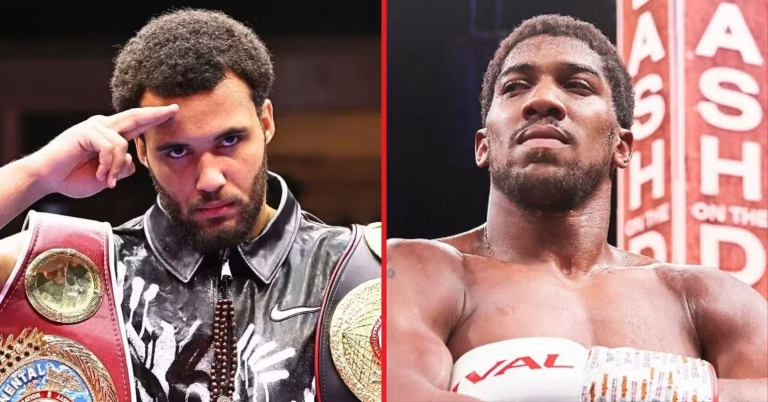
David Haye Backs Itauma Over Joshua In Heavyweight Clash

2

Former world heavyweight champion David Haye has backed British-Nigerian prospect Moses Itauma to beat Anthony Joshua if the pair ever meet in the ring.

Despite the clear difference in age and experience between the two fighters, Haye believes the 20-year-old rising star has what it takes to overcome the 36-year-old former two-time unified world champion.

Joshua, an Olympic gold medallist with 13 world title fights under his belt, has long been a dominant name in heavyweight boxing. In contrast, Itauma has been a professional for less than three years, boasting 13 bouts so far and yet to compete for a recognized title. Still, many boxing enthusiasts and pundits already see him as a future ruler of the division.

Speaking in an interview, Haye, famously nicknamed “The Hayemaker”, was asked whether Itauma could defeat Joshua today.

“Yeah, I think he beats everybody. The only person I’d say has the best chance of stopping him is Usyk,” Haye replied.

Haye, who once dominated the cruiserweight division before moving up to win the WBA heavyweight title, understands the pressure of carrying such high expectations at a young age.

Itauma is set to return to action on January 24 in Manchester, where he will face Jermaine Franklin, the American fighter who went 12 rounds with Joshua three months after Itauma made his professional debut.

As for Joshua, uncertainty surrounds his next move, with no confirmed date for his return after a 14-month hiatus. While a clash with Itauma seems unlikely for now, reports suggest the former champion could instead face YouTuber-turned-boxer Jake Paul, who is seeking a new opponent following the cancellation of his bout with Gervonta Davis.

Nigeria Scraps Mother Tongue Policy: What It Means For Education

2

The Federal Government of Nigeria has officially reversed its 2022 National Language Policy, which had mandated that instruction from Early Childhood Education through Primary Six be delivered in the mother tongue or the language of the immediate community.

At the opening of the “Language in Education International Conference 2025” organised by the British Council in Abuja, the Minister of Education, Dr. Tunji Alausa, announced that English will now serve as the language of instruction from primary through tertiary levels.

He explained that evidence gathered by the ministry showed that students taught mainly in local languages performed poorly in national examinations and lacked essential literacy skills.

The minister described the 2022 policy as one that had “destroyed” the education system in some regions, adding that English will henceforth serve as the unifying language of instruction across all Nigerian schools.

The 2022 policy, initially designed to promote indigenous languages and preserve Nigeria’s rich cultural heritage, recognised more than 600 native languages. However, it faced major hurdles such as lack of trained teachers, inadequate learning materials, and difficulty implementing it in linguistically diverse communities.

Why FG Scrapped The Mother Tongue Policy

The government said the decision to scrap the mother-tongue medium of instruction was based on several critical factors:

Poor Learning Outcomes And Exam Failures

Minister Alausa noted that students taught predominantly in local languages recorded high failure rates in national examinations like WAEC, NECO, and JAMB.

He said, “We have seen a mass failure rate in WAEC, NECO and JAMB in certain geo-political zones of the country, and those are the ones that adopted this mother tongue in an over-subscribed manner.” He described the earlier policy as one that had “literally destroyed education in certain regions.”

Implementation Challenges

Nigeria’s vast linguistic diversity over 500 spoken languages made the policy extremely difficult to implement. Many communities are multilingual, making it nearly impossible to select one language of instruction or provide standard teaching materials and teacher training across the country.

Mismatch Between Instruction And Examination Languages

While the policy encouraged teaching in local languages, all national examinations are conducted in English.

Alausa pointed out that “Exams are conducted in English, but we taught these kids through their mother tongue,” adding that this disconnect left many pupils ill-prepared for assessments or higher education.

Evidence-Based Review And Data Findings

According to the minister, the review conducted by the ministry revealed that the use of mother-tongue instruction from Primary One to Primary Six and in some cases even up to Junior Secondary had not yielded positive educational outcomes. He said the ministry’s findings were “evidence-based, data-driven, and supported by real-life classroom experiences.”

Need For A Unified Language Of Instruction

Alausa concluded that adopting English as the sole medium of instruction would bring uniformity, improve communication standards, and ensure that pupils transition smoothly to higher education without language barriers. He emphasized that the government’s goal was to align language instruction with national assessment and global education standards.

South Sudan’s President Fires Vice-President In Surprise Power Shake-Up

1

South Sudan’s President Salva Kiir has dismissed one of his vice-presidents, Benjamin Bol Mel, a move that has sent shockwaves through the country’s political establishment. 

Bol Mel, widely viewed as a potential successor to Kiir, was stripped of his military rank of general and removed from the National Security Service.

The announcement, made through a presidential decree broadcast on state television, also confirmed the sacking of the central bank governor and the head of the revenue authority both seen as Bol Mel’s close allies. No official reason was provided for the dismissals.

The unexpected move comes amid rising fears of political instability and a potential return to civil war, following the collapse of a fragile power-sharing agreement between Kiir and opposition leader Riek Machar.

Bol Mel, 47, had only been appointed vice-president in February, replacing long-serving politician James Wani Igga. His swift rise to prominence within the ruling Sudan People’s Liberation Movement (SPLM) where he was also elevated to first deputy chairman positioned him as a likely successor to the 74-year-old president.

Analysts believe that Bol Mel’s growing influence within both the party and the military may have contributed to tensions inside the government.

Bol Mel’s ascent to power had already drawn international scrutiny. In 2017, the US Treasury sanctioned him for alleged corruption, describing him as Kiir’s “principal financial advisor.” These sanctions were renewed earlier in 2025. 

However, the South Sudanese presidency rejected the characterization, and Bol Mel himself has never publicly responded to the accusations.

Despite the controversy, Kiir promoted him to the rank of general in the National Security Service, further consolidating his power. His sudden removal, therefore, marks a dramatic reversal of fortunes.

The dismissals have sparked mixed reactions across Juba, the South Sudanese capital.

Observers warn that Bol Mel’s dismissal, coming so soon after Machar’s ouster, could deepen divisions within the ruling party and risk further destabilizing the already fragile nation.

At the time of reporting, President Kiir has not announced replacements for any of the key positions vacated by Bol Mel and his allies.

FG Suspends Planned 15% Import Duty On Petrol

3

The Federal Government has suspended the planned 15 per cent import duty on petrol and diesel, which was earlier scheduled to take effect on November 21, 2025.

The Nigerian Midstream and Downstream Petroleum Regulatory Authority (NMDPRA) announced the development in a statement released on Thursday by its Director, Public Affairs Department, George Ene-Ita, who also advised Nigerians to avoid panic buying.

President Bola Tinubu had, on October 29, approved an import tariff on petrol and diesel, a policy that was expected to raise the landing cost of imported fuel. The approval was conveyed in a letter signed by his Private Secretary, Damilotun Aderemi, following a proposal submitted by the Executive Chairman of the Federal Inland Revenue Service (FIRS), Zacch Adedeji.

The proposal had sought the application of a 15 per cent duty on the cost, insurance, and freight (CIF) value of imported petrol and diesel to align import costs with domestic market realities. It was designed to encourage local refining by making imported fuel more expensive, thereby protecting refineries like Dangote Refinery and other modular plants.

Although the policy aimed to boost local production, experts warned that it could drive up fuel prices and inflation, potentially increasing pump prices by as much as ₦150 per litre.

In an update, however, the NMDPRA confirmed that the government was no longer moving forward with the policy.

“It should also be noted that the implementation of the 15% ad-valorem import duty on imported Premium Motor Spirit and Diesel is no longer in view,” the statement read in part.

The agency also assured the public of sufficient petroleum product supply within the national sufficiency threshold, particularly during this peak demand period.

“There is a robust domestic supply of petroleum products (AGO, PMS, LPG, etc) sourced from both local refineries and importation to ensure timely replenishment of stocks at storage depots and retail stations during this period,” it stated.

“The Authority wishes to use this opportunity to advise against any hoarding, panic buying or non-market reflective escalation of prices of petroleum products. The Authority will continue to closely monitor the supply situation and take appropriate regulatory measures to prevent disruption of supply and distribution of petroleum products across the country, especially during this peak demand period.

“While appreciating the continued efforts of all stakeholders in the midstream and downstream value chain in ensuring a smooth and uninterrupted supply and distribution, the public is hereby assured of NMDPRA’s commitment to guarantee energy security,” the statement added.

US Urges Global Action To Cut Off Weapons To Sudan’s Paramilitary

4

The United States has called for urgent international action to halt the flow of weapons to Sudan’s paramilitary Rapid Support Forces (RSF), following reports of mass killings, rape, and other atrocities in el-Fasher, the capital of North Darfur.

US Secretary of State Marco Rubio, speaking after a G7 Foreign Ministers’ meeting in Canada, condemned the RSF’s actions, describing them as “systematic atrocities” that target civilians, including women and children.

Rubio said, “They’re committing acts of sexual violence and atrocities, just horrifying atrocities, against women, children, innocent civilians of the most horrific kind. And it needs to end immediately. And we’re going to do everything we can to bring it to an end, and we’ve encouraged partner nations to join us in this fight.”

The RSF captured el-Fasher last month after an 18-month siege, gaining control of all major cities in Darfur. Satellite images and witness reports show signs of mass killings, with piles of bodies and blood-stained earth visible from space. 

Non-Arab communities across Darfur are reportedly being systematically targeted in what the US and humanitarian groups describe as genocide. Thousands of civilians are feared dead or missing, while millions have been displaced as the conflict intensifies.

Sudan’s army has accused the United Arab Emirates (UAE) of supplying arms and mercenaries to the RSF through African intermediaries allegations the UAE has repeatedly denied.

While Rubio did not directly call out Abu Dhabi, he hinted at foreign involvement in arming the RSF. “We know who the parties are that are involved [in weapons supply]… That’s why they’re part of the Quad along with other countries involved,” he said.

He further stated that assistance to the RSF “isn’t just coming from some country that’s paying for it, it’s also coming from countries that are allowing their territory to be used to ship it and transport it.”

The Trump administration, in collaboration with the UAE, Egypt, and Saudi Arabia collectively known as the “Quad” has been working toward a peaceful resolution in Sudan. The group previously proposed a three-month humanitarian truce, followed by a transition to civilian rule, but the RSF only agreed to the ceasefire after taking control of el-Fasher.

Despite multiple peace initiatives, fighting has continued, and previous US-backed humanitarian ceasefires have been repeatedly violated.

Amnesty International and UN experts have traced weapons used in Sudan to manufacturers in Serbia, Russia, China, Turkey, Yemen, and the UAE, with smuggling routes often passing through the UAE and Chad into Darfur.

Rubio emphasized the need for a coordinated global response to block the RSF’s access to arms, stating that the group’s dependence on foreign-supplied weapons made international cooperation critical to ending the conflict.

Meanwhile, the G7 joint statement issued after the meeting condemned the escalating violence, warning that the war in Sudan has triggered “the world’s largest humanitarian crisis.”

To date, more than 150,000 people have been killed, and about 12 million displaced, as the two-year civil war between the Sudanese army and RSF continues to devastate the country.