Home Blog Page 210

Will Nnamdi Kanu, IPOB Leader, Be Released Soon?

39

The detained leader of the Indigenous People of Biafra (IPOB), Mazi Nnamdi Kanu, has expressed confidence that he will be granted bail this April after spending four years in custody.

Kanu conveyed this assurance during a visit from the President-General of the Igbo Community Association (ICA) in Abuja, Engr. Ikenna Ellis-Ezenekwe, at the Department of State Services (DSS) facility in Abuja, where he is being held.

Following the visit, Ezenekwe issued a statement confirming that Kanu voiced his disappointment over the absence of strong Igbo leadership advocating for his release and urged renewed efforts to push for the region’s interests.

Ezenekwe noted that he was taken aback by Kanu’s positive demeanor, describing him as upbeat, jovial, and even having gained weight despite his ongoing ordeal.

The statement reads: “Today at the DSS headquarters in Abuja, I had the honor of visiting Nnamdi Kanu, leader of the Indigenous People of Biafra (IPOB). During our discussion, he appeared healthier and more relaxed and reaffirmed his resilience despite his current circumstances.

“He called for a referendum, describing it as a pivotal step towards self-determination, and reiterated his firm belief that he has committed no offense other than urging our people to awake from their slumber.

“He communicated a strong message of self-assurance, noting that he is taking his prescribed medications and remains in good spirits.

“More significantly, he expressed disappointment at the apparent leadership vacuum within the Igbo community—a neglect that has allowed our people’s voice to fade at a critical moment.

“Kanu expressed unwavering confidence in his legal team and his hope for release by the end of April 2025. This resonated as a powerful testament to his dedication and fortitude.”

Ezenekwe emphasized that the meeting served as an important reminder of the ongoing struggle for recognition, justice, and the advancement of Igbo interests in Nigeria.

He urged President Bola Tinubu to facilitate Kanu’s release, arguing that such an action would reflect the president’s dedication to justice.

“In light of today’s (Wednesday’s) encounter, I issue an earnest appeal to President Bola Ahmed Tinubu. I call on him to draw upon the spirit of democracy and commitment to justice that defined his own struggles and to take decisive action in securing the freedom of our brother and hero, Nnamdi Kanu.

“Let this moment serve as a turning point—a renewal of our collective determination to safeguard the rights, dignity, and future of the Igbo people,” he stated

Who is Nnamdi Kanu and Why is He Detained?

Nnamdi Kanu, a British-Nigerian activist born in 1967, founded IPOB in 2012 to advocate for the secession of southeastern Nigeria, a region predominantly inhabited by the Igbo ethnic group, to form an independent state called Biafra.

The movement draws inspiration from the short-lived Republic of Biafra, which fought a civil war against Nigeria from 1967 to 1970, resulting in over a million deaths. Kanu’s rhetoric, often broadcast through Radio Biafra, has called for self-determination, but the Nigerian government views IPOB as a threat to national unity, designating it a terrorist organization in 2017.

Kanu was first arrested in October 2015 on charges of treasonable felony and terrorism. Granted bail in 2017, he fled Nigeria after a military raid on his home, only to resurface in 2021 when he was controversially re-arrested in Kenya and extradited to Nigeria in an operation his supporters and legal team describe as “extraordinary rendition.” Since then, he has been held in solitary confinement by the Department of State Services (DSS) in Abuja, facing a litany of charges, including terrorism and incitement.

What his Release will mean for Nigerians

Nnamdi Kanu’s release would have significant implications for Nigerians. It could be seen as a sign that the justice system is evolving and becoming more responsive to the needs and rights of the people. Many Nigerians might view this development as evidence that long-standing grievances are finally being addressed.

For supporters, his freedom represents a beacon of hope, especially for communities that have felt marginalized or ignored. It could help bridge divisions by sparking broader conversations about fairness, accountability, and national unity. This positive step may encourage the government to consider reforms that ensure all citizens receive just treatment under the law.

Moreover, if Kanu is released on fair legal grounds, it could restore public confidence in the country’s judicial process. Both locally and internationally, this move might serve as a powerful example that even controversial cases can be resolved in a manner that upholds the principles of justice and human rights. In essence, his release may contribute to building a more inclusive and transparent society.

Five Times Nigeria Introduced New Naira Notes

1

The Central Bank of Nigeria (CBN) recently debunked claims that it is set to introduce ₦5,000 and ₦10,000 banknotes, describing the viral reports and accompanying circulars as fake and misleading.

In a post shared via its official X (formerly Twitter) handle on Wednesday, the apex bank stated unequivocally that it has no plans to unveil higher denomination notes and urged the public to disregard the rumor.

“The message circulating about the introduction of ₦5,000 and ₦10,000 banknotes is fake. The CBN has not issued any such statement,” the bank wrote.

The denial comes after a fake circular, which spread rapidly across WhatsApp and social media platforms, claimed that the bank would begin circulating the new notes from May 1, 2025. The forged document falsely asserted that the move was part of efforts to “streamline cash transactions and improve liquidity management.”

The misinformation stoked anxiety among Nigerians still reeling from the effects of the controversial 2022 naira redesign, which caused nationwide cash shortages and disrupted economic activities.

Nigeria’s History of Naira Redesigns

Although the current claim has been dismissed, it has revived public interest in Nigeria’s long-standing history of currency changes. The country has revised or introduced new naira notes at least five times since independence — often sparking national debates and, at times, economic upheaval.

1. 1973 – The Birth of the Naira

Nigeria transitioned from the British pound to its own currency — the naira and kobo — in 1973, under General Yakubu Gowon. It marked a major milestone in asserting economic sovereignty.

2. 1991 – Colour Changes Under Babangida

The military regime of General Ibrahim Babangida changed the colours of ₦5, ₦10, ₦20, and ₦50 notes in what was described as an anti-corruption measure aimed at flushing out hidden cash.

3. 2007 – The Polymer Note Era

Under Governor Charles Soludo, the CBN introduced polymer notes for lower denominations to improve durability. However, by 2012, the policy was discontinued due to concerns about cost and environmental impact.

4. 2014 – Commemorative ₦100 Note

To mark Nigeria’s centenary, a redesigned ₦100 note featuring enhanced security features and a QR code was released under President Goodluck Jonathan.

5. 2022 – Buhari’s Redesign of High-Value Notes

In one of the most disruptive redesign efforts, the CBN introduced new versions of the ₦200, ₦500, and ₦1,000 notes in 2022. The policy aimed to reduce cash in circulation and curb vote-buying, but poor implementation led to widespread hardship and litigation.

With inflation pressures and digital currency trends evolving, speculation about currency changes may not disappear anytime soon. However, the CBN has made it clear that any genuine update regarding Nigeria’s currency will be officially communicated through its verified channels.

The apex bank also urged Nigerians to verify information from credible sources before sharing, especially on matters with economic and financial implications.

JAMB Releases 2025 UTME-Mock Notification Slip for Printing

0

The Joint Admissions and Matriculation Board (JAMB) has announced that the 2025 UTME-Mock Notification Slip is now available for printing. This slip is essential for candidates who registered for the optional *UTME-Mock examination, as it contains critical details such as the *exam date, venue, and time.

In an official statement, JAMB’s Public Communication Advisor, Dr. Fabian Benjamin, urged candidates to print their slips starting from Thursday, April 3, 2025. He emphasized that early printing would allow candidates to make the necessary logistical arrangements to reach their designated exam centers on time.

How to Print the UTME-Mock Slip

Candidates can print their notification slips by following these steps:

  1. Visit www.jamb.gov.ng
  2. Click on “2025 Mock Slip Printing”
  3. Enter your registration number and click on “Print Examination Slip”

Dr. Benjamin also advised candidates to visit their exam centers at least a day before the exam to familiarize themselves with the location and avoid last-minute challenges.

Exam Schedule

  • UTME-Mock Examination Date: Thursday, April 10, 2025
  • Main UTME Examination Start Date: Friday, April 25, 2025

JAMB wished all candidates success in their preparations, reiterating its commitment to conducting a seamless and transparent examination process.

Why Is Lagos Trending? Independence Bridge Closure Sparks Chaos

0

Lagos, Nigeria’s economic engine, is buzzing, this time not for its relentless hustle but for a transport meltdown.

On April 1, 2025, the sudden closure of Independence Bridge, a crucial artery linking Lagos Island to Victoria Island, unleashed gridlock hell on many commuters who ply the route.

Emergency repairs triggered the shutdown, but unmanaged traffic planning left many stranded, businesses crippled, and tempers flaring across the megacity.

Lagosians Cry Out

The closure hit like a sucker punch. By dawn on Tuesday, April 1, traffic choked Ikoyi, Victoria Island, and Lagos Island, with tailbacks snaking for miles.

Social media lit up as furious residents vented their frustration over the lack of notice or decent detours.

With no solid alternative routes, the chaos rippled outward, affecting Third Mainland Bridge and Eko Bridge—already notorious bottlenecks in Lagos’ overstretched road network.

Why Independence Bridge Matters

This isn’t just any bridge. Built in the post-independence boom of the 1960s, Independence Bridge (often tied to the Falomo corridor) is a lifeline for Lagos’ workforce—traders, bankers, and hustlers shuttling between Victoria Island’s skyscrapers and Lagos Island’s markets.

Decades of neglect had left it creaking, with cracked concrete and rusted joints flagged by engineers for years. Yet, action only came when collapse loomed.

What Sparked the Shutdown?

The Federal Ministry of Works cited urgent safety risks. A recent inspection, they say, revealed structural weaknesses too dire to ignore, with crumbling supports and shaky beams, and repairs couldn’t wait. But the abrupt move blindsided everyone.

According to an official from the Ministry of Works who preferred to be anonymous:
“This bridge don dey beg for fix since. It’s part of a bigger push to save Lagos roads, but the rollout? Pure ojoro—no coordination.”

However, Lagosians are not buying the excuse as there was no prior heads-up and no traffic diversion plan.

The city’s history of botched infrastructure projects—like Third Mainland’s endless repairs or Lekki’s flood-trapped roads, only fueled the skepticism.

Government Scrambles: Bridge Reopens

By Thursday April 3, 2025, the backlash forced action as Minister of Works, Senator David Umahi, announced a partial reopening to ease the snarl, bowing to public pressure after just two days of total closure.

The statement from Olukorede Kesha, the Federal Controller of Works in Lagos, was made in an official statement released to the public on April 3, 2025, following the public backlash and pressure regarding the bridge closure. She commented on the efforts being made to balance safety and movement during the ongoing repairs of the Independence Bridge:
“We feel una pain, abeg. We’re working 24/7 to balance safety and movement.”

Repairs will now proceed in phases, with lane-by-lane fixes and night works to minimize disruptions. But the damage to public trust? That will take much longer to repair.

Lagos’ Bigger Problem

This issue also lays bare the city’s transport Achilles’ heel.

Lagos, with its 20 million-plus population, can’t keep lurching from one reactive fix to the next.

Urban planner Bode Falana put it bluntly:
“Megacity wey no plan well na disaster waiting. You can’t just lock a bridge like this without options, where the foresight dey?”

Lagos thrives as Africa’s commercial pulse, but its veins, roads, bridges, ferries are clogged.

The Third Mainland Bridge saga of 2023-2024, with its stop-start closures, showed the same playbook: act late, communicate less, then scramble.

Without proactive maintenance and smart traffic management, productivity bleeds out in exhaust fumes.

What’s Next?

The Independence Bridge drama could be a wake-up call in Lagos’ infrastructure development even as the rains are here.

Rivers APC: Fubara Behind Assembly Bombing

0

The All Progressives Congress (APC) Rivers State Chapter has reaffirmed its stance that suspended Governor Siminalayi Fubara is responsible for the political turmoil currently plaguing the state.

In a recent statement, Tony Okocha, the APC Chairman in Rivers State, asserted that the public revelation by former Rivers State Head of Service, Dr. George Nwaeke, confirms the party’s long-held position. According to Okocha, Dr. Nwaeke’s eye-witness account of the October 29, 2023 bombing of the Rivers State House of Assembly directly implicates Governor Fubara and his associates.

Okocha stated that the testimony has not only validated the APC’s claims but also reinforced the party’s image as the main opposition voice and a credible alternative in the state.

“Dr. Nwaeke’s revelation is a game-changer. It has vindicated us and confirmed beyond doubt that the crisis was orchestrated by Governor Fubara,” Okocha said.

He described the APC as the “voice of the voiceless” and emphasized the growing public support for the party among well-meaning citizens of Rivers State.

The chairman also maintained that the verbal attacks targeted at Dr. Nwaeke following his resignation and subsequent disclosures will not deter him or the APC from speaking the truth and exposing alleged misconduct in the state’s leadership.

Okocha further expressed trust in Nigeria’s security agencies to thoroughly investigate the matter and reveal the full extent of the crisis for the sake of justice and stability.

He reiterated that the APC has consistently pointed fingers at Fubara as the mastermind behind the destruction of the Rivers State House of Assembly, an iconic structure admired across the country.

With the 2027 elections in sight, the APC says it is positioning itself as a credible, transparent, and people-centered alternative ready to take over the leadership of Rivers State.

NNPC Leadership: Why Mele Kyari Was Sacked

In a major shake-up aimed at repositioning Nigeria’s oil industry, President Bola Ahmed Tinubu has removed Mele Kyari as Group Chief Executive Officer (GCEO) of the Nigerian National Petroleum Company Limited (NNPCL) and dissolved its board.

The decision, effective April 2, 2025, marks a decisive effort to improve efficiency, restore investor confidence, and realign the corporation with Nigeria’s ambitious economic and energy goals.

Why Was Mele Kyari Sacked?

Although the presidency has not released an official statement pinpointing the exact reasons for Kyari’s removal, multiple sources and industry analysts cite key factors that likely contributed to his ousting:

Operational Inefficiencies: Under Kyari’s leadership, Nigeria’s crude oil production plummeted below one million barrels per day at its lowest point—far below the OPEC quota. Persistent pipeline vandalism and crude theft exacerbated this crisis, frustrating efforts to stabilize output.

  • Transparency Concerns: The NNPC, despite being commercialized under Kyari, continued to operate in opacity. Allegations of financial mismanagement, discrepancies in oil revenue reporting, and questionable subsidy claims cast doubt on the corporation’s credibility. Investors and policymakers increasingly pushed for reforms.
  • Investor Confidence: Nigeria struggled to attract and retain oil investments due to governance concerns. While NNPC announced billions in new oil sector deals, many remained speculative or stalled. The Tinubu administration’s ambition of building a $1 trillion economy necessitated a leadership change to remove barriers to growth.
  • Refinery Challenges: Despite Kyari’s assurances, Nigeria’s refineries remained largely non-functional, increasing reliance on imported petroleum products. The slow pace of rehabilitations at the Port Harcourt and Warri refineries signaled inefficiency.

In a scathing remark during a televised discussion, legal expert Barrister Felix captured the frustration surrounding Kyari’s tenure:

” “If you look at NNPC, it’s a reflection of Mele Kyari’s administration. Mele Kyari has been working against the progress of Nigeria as long as we can remember. It’s in the interest of Bola Ahmed Tinubu, who wants to make a $1 trillion economy, to remove whoever is standing as a clog in the wheel of progress.”

Energy expert Emmanuel Afimia added:

“The failure of NNPC has a direct bearing on the economic woes Nigeria has.”

Who is Bayo Ojulari, the New NNPC GCEO?

To replace Kyari, President Tinubu appointed Engr. Bashir Bayo Ojulari, a seasoned oil industry executive with over three decades of experience.

Ojulari, an alumnus of Ahmadu Bello University, Zaria, holds a degree in Mechanical Engineering. He started his career at Elf Aquitaine as a process engineer before joining Shell Petroleum Development Company in 1991. Over the years, he worked across Nigeria, Europe, and the Middle East in roles spanning petroleum engineering, asset management, and strategic planning. His tenure as Managing Director of Shell Nigeria Exploration and Production Company (SNEPCo) from 2015 to 2021 saw significant deepwater project developments.

Most recently, Ojulari served as Executive Vice President and Chief Operating Officer of Renaissance Africa Energy Company, leading a $2.4 billion acquisition of Shell Petroleum Development Company of Nigeria (SPDC). His appointment signals a shift towards private-sector expertise and accountability in NNPC’s leadership.

A New Era for NNPC?

The leadership transition at NNPC is not just about personnel changes—it represents a pivotal moment for Nigeria’s oil sector. The Tinubu administration has set bold targets for the industry:

  • Increase oil production to two million barrels per day by 2027 and three million by 2030.
  • Boost gas production to eight billion cubic feet daily by 2027 and ten billion by 2030.
  • Expand NNPC’s crude oil refining capacity to 200,000 barrels per day by 2027 and 500,000 by 2030.

To achieve these, the new NNPC board has been tasked with conducting a strategic portfolio review of joint venture assets, optimizing value, and prioritizing local content development.

Ojulari’s track record suggests he could be the right man for the job. His expertise in upstream and downstream operations, deal structuring, and strategic growth initiatives aligns with the administration’s push for a more commercially viable and transparent NNPC.

What’s Next?

The sacking of Mele Kyari and the appointment of Bayo Ojulari reflect President Tinubu’s commitment to overhauling the oil sector and strengthening Nigeria’s energy independence. The question now is whether Ojulari and the new NNPC leadership can rise to the challenge and deliver tangible results.

With pressing issues like crude oil theft, underperformance of refineries, and the need for increased foreign investment, stakeholders will be watching closely.

Is this the turning point Nigeria’s oil industry has been waiting for? Time will tell.

Sterling Bank Removes Transfer Fees On Online Transactions

0

Sterling Bank has announced the elimination of transfer fees on all local online transactions, making it the first major Nigerian bank to do so. This decision removes the long-standing charges associated with digital banking.

The bank confirmed this policy change on Tuesday through an official press release.

According to the statement, the bank reaffirmed its dedication to customer-focused banking, emphasizing that the zero-transfer-fee policy is real and takes effect immediately.

Obinna Ukachukwu, the bank’s Growth Executive for Consumer and Business Banking, highlighted that the initiative reflects the bank’s core values, ensuring a more inclusive financial system.

“We believe access to your own money shouldn’t come with a penalty. This is more than a financial decision—it’s about redefining banking to put customers first,” he stated.

Under this new policy, Sterling customers will no longer be charged for local transfers made through the bank’s mobile app.

The initiative is expected to ease financial burdens, particularly for individuals and small business owners who rely heavily on digital transactions.

Ukachukwu further stressed that this decision is about more than just competition in the banking industry.

“We’re not yet the biggest bank in Nigeria, but we’ve been the boldest. Sterling fearlessly believes in the future of Nigeria, and this is us backing Nigerians with more than words,” he added.

Who is Bayo Ojulari – The New NNPC Head

On Wednesday, President Bola Ahmed Tinubu appointed Bashir Bayo Ojulari as the new Group Chief Executive Officer (Group CEO) of the Nigerian National Petroleum Company (NNPC) Limited, succeeding Mele Kyari.

This appointment is part of a significant restructuring of the NNPC board, which also led to the removal of Group Chairman Chief Pius Akinyelure and the dismissal of other board members who were appointed alongside him in November 2023.

In an official statement, Bayo Onanuga, Special Adviser to the President on Information and Strategy, confirmed that Ojulari will now assume leadership as the CEO of the national oil company.

What You Need to Know About New NNPC GCEO, Bayo Ojulari

Bayo Ojulari hails from Kwara State in North Central Nigeria and holds a degree in Mechanical Engineering from Ahmadu Bello University, Zaria.

Ojulari is married with children, enjoys spending time at the beach, listens to music, and is currently working on returning to golfing.

Career

Ojulari’s career in the oil and gas sector began at Elf Aquitaine, where he worked as a fresh graduate from September 1989 to October 1991. During his studies in Mechanical Engineering between 1985 and 1989, he became the company’s first Nigerian process engineer.

His professional journey extends beyond Nigeria, having worked in Europe and the Middle East in various roles.

Mr. Ojulari is recognized as an energy expert and describes himself as “a business leader with a proven track record in the global energy sector.”

Over the years, he has taken on various roles in petroleum processing, production engineering, strategic planning, field development, and asset management.

According to his LinkedIn profile, Ojulari spent more than 24 years at global oil giant Shell, ultimately becoming the Managing Director of Shell Nigeria Exploration and Production Company (SNEPCo) in November 2015, a position he held until July 2021.

His LinkedIn profile shows that he first joined Shell in November 1991 as an Associate Production Technologist at Shell Petroleum Development Company (SPDC) after leaving Elf Petroleum Nigeria.

Upon joining Shell, he rose to become a member of the Integrated Studies Team at Shell headquarters in the Netherlands in June 1994, where he worked until October 1995.

Between April 1997 and November 1999, he served as Head of Planning Economics and Budgeting at SPDC Nigeria. Following this, he became the Asset Leader and Head of Production Technologist at Shell in Oman from December 1999 to September 2003.

He later took on the role of Sub-Saharan Africa Regional Planner at Shell headquarters in October 2003, holding this position until December 2004.

From January 2005 to October 2008, he served as Manager of Corporate Planning and Strategy at SPDC Nigeria, while also briefly taking on the role of Asset Production Technologist from November 2006 to March 2007.

At Shell, Ojulari remained in Nigeria from 2008, first becoming the Manager of Asset Development (Onshore and Shallow Water) at SPDC Nigeria, a role he held from October 2008 to October 2010.

He went on to become the Development Director at SPDC Nigeria from January 2010 to October 2015, after which he was promoted to Managing Director of SNEPCo from November 2015 to July 2021.

Following his departure from Shell, he founded BAT Advisory and Energy Company Nigeria Ltd in September 2021 and served as the company’s board chairman. The firm primarily provided consultancy services to businesses in the oil and gas/energy sector.

In January 2024, Ojulari was appointed Executive Vice President and Chief Operating Officer of Renaissance Africa Energy Company, a position he held until his appointment as NNPC’s Group CEO.

He only recently announced his role at Renaissance Africa on LinkedIn, noting:

“It’s been a while since I started my role at Renaissance Africa Energy Company as an Executive Vice President and Chief Operating Officer, but I wanted to share this update with everyone.”

Ojulari joined Renaissance Africa during the company’s acquisition of a Shell asset in Nigeria. As announced by Shell, “Renaissance now controls SPDC’s 30% stake in the SPDC JV, an unincorporated joint venture with the government-owned Nigerian National Petroleum Corporation (55%), Total Exploration and Production Nigeria Ltd (10%), and Agip Energy and Natural Resources (Nigeria) Limited (5%).”

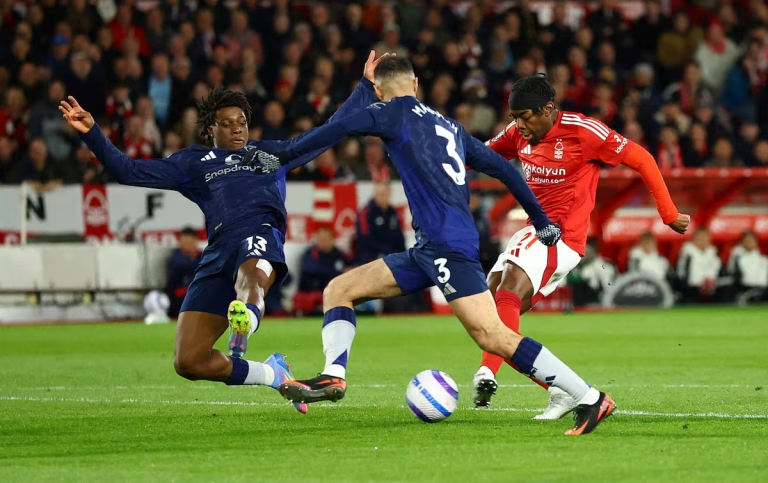
Elanga’s Revenge: Nottingham Forest Stun Manchester United in Historic Win

2

Nottingham Forest achieved a notable 1-0 victory over Manchester United at the City Ground. The decisive moment came from former United player Anthony Elanga, who scored a remarkable solo goal after an 85-meter sprint. This win bolstered Forest’s aspirations for Champions League qualification and marked their first league double over United since the 1991-92 season.

Despite United’s attempts to equalize, including a late effort from Harry Maguire, Forest’s defense held firm. Post-match, Forest’s head coach Nuno Espírito Santo praised his team’s dedication.

Other Football Battles Across Europe

Dunkerque vs. Paris Saint-Germain (PSG)

In the French Cup semifinals, PSG overcame a challenging first half to defeat Dunkerque 4-2, securing their place in the final. Dunkerque, a second-tier team, initially led with goals from Vincent Sasso and Muhannad Yahya Al-Saad within 27 minutes. PSG responded with two goals from Ousmane Dembélé, and additional goals from Marquinhos and Desire Doue. Manager Luis Enrique credited halftime adjustments for the turnaround. PSG will face the winner of Stade de Reims vs. Cannes in the final and are on the verge of clinching their fourth consecutive Ligue 1 title.

Real Madrid vs. Real Sociedad

Real Madrid secured their spot in the Copa del Rey final after a thrilling 4-4 draw against Real Sociedad, advancing with a 5-4 aggregate score. The match was a rollercoaster, with goals from Ander Barrenetxea, Endrick, Mikel Oyarzabal, an own goal by David Alaba, Jude Bellingham, Aurélien Tchouaméni, and a decisive header from Antonio Rüdiger in extra time. This will be Real Madrid’s 41st Copa del Rey final, having won 20 times previously. They will compete for the title on April 26 in Sevilla against the winner of Atlético de Madrid vs. Barcelona.

Arsenal vs. Fulham

Arsenal secured a 2-1 victory over Fulham at the Emirates Stadium. Mikel Merino opened the scoring for Arsenal in the first half. A significant moment occurred when Gabriel suffered a hamstring injury within the opening 20 minutes. Bukayo Saka made a triumphant return, scoring just seven minutes after coming onto the pitch, extending Arsenal’s lead to 2-0. Rodrigo Muniz scored for Fulham during added time, but it served only as a consolation as Arsenal emerged victorious.

Lagos Generates 1,040 Tonnes of Textile Waste Daily — LAWMA

0

The Lagos Waste Management Authority (LAWMA) is ramping up efforts to tackle the 1,040 tonnes of textile waste generated daily in Lagos State as part of its commitment to sustainable waste management.

LAWMA’s Managing Director, Dr. Muyiwa Gbadegesin, made this announcement on Monday in commemoration of International Zero Waste Day, themed “Towards Zero Waste in Fashion and Textiles.”

“Textile waste accounts for approximately 8% of the 13,000 tonnes of daily waste in Lagos. To address this, LAWMA plans to ban textile waste from all state landfills and collaborate with Tejuosho Market in Yaba to collect fabric waste for recycling,” Gbadegesin stated.

As part of the initiative, students at LAWMA Academy are being trained to upcycle textile waste into reusable products, fostering sustainability and economic empowerment.

Gbadegesin reaffirmed LAWMA’s dedication to achieving zero waste in Lagos, aligning with global best practices in waste reduction and resource recovery.

“International Zero Waste Day highlights our collective responsibility to protect the environment. LAWMA is fully committed to implementing waste sorting, recycling, and waste-to-energy initiatives. However, for these efforts to succeed, Lagosians must play an active role in proper waste disposal and environmental sustainability,” he added.

LAWMA’s bold move underscores the growing urgency for sustainable waste management and the need for collaborative efforts in reducing textile pollution across the state.