Home Blog Page 215

2027 Elections: Who Will Control the Future of Nigeria?

4

‎As Nigeria edges toward the 2027 general elections, the contest for the presidency has become more than a political showdown; it is a struggle over policies, lived realities, and the direction of the nation’s future.
‎
‎The ruling All Progressives Congress (APC) is determined to defend its record, while an energized opposition coalition is rallying around promises of relief and reform.
‎
‎For millions of Nigerians, this election is less about personalities and more about who can best address the economic hardship and security challenges defining daily life.
‎‎

Tinubu’s Reform

‎President Bola Tinubu’s administration has pinned its legacy on sweeping economic reforms. The removal of fuel subsidies and the unification of exchange rates were hailed as bold steps toward stability, increasing revenue flows to states and local governments.
‎
‎Yet, the immediate fallout has been harsh: inflation has soared, food prices have climbed, and ordinary citizens are grappling with a shrinking purchasing power.
‎
‎Measures like cash transfers and tax relief have been dismissed by critics as poorly executed, offering little protection to struggling households.
‎
‎The APC insists the pain is temporary and that the foundation for long-term growth is being laid, but voters will ultimately judge whether the sacrifices are worth it.
‎

The Opposition’s Unified Alliance

Sensing opportunity, opposition leaders, including Atiku Abubakar and Peter Obi, have forged an alliance designed to avoid the vote-splitting that weakened them in 2023.
‎
‎Their message is clear: Tinubu’s policies may have boosted government coffers, but they have failed the people. The coalition is promising a shift toward citizen-focused policies — job creation, stronger social welfare systems, and immediate interventions to ease the cost of living.
‎
‎Their challenge is convincing Nigerians that their unity is rooted in genuine reform, not just political convenience.

Next steps

While economic policies dominate the discourse, the issue of security remains a critical concern for voters across the nation.
‎
‎Nigeria continues to face a multifaceted security crisis, from the enduring Boko Haram insurgency and ISWAP activities in the North-East to persistent banditry, kidnappings for ransom in the North-West, and separatist agitations in the South-East.
‎
‎The effectiveness of the current administration’s approach, which has included military operations and the acquisition of new defense hardware, is a central point of contention.
‎
‎The opposition argues that a purely kinetic response is not enough. They propose a multi-pronged strategy that includes strengthening community policing, addressing the root causes of unrest like poverty and unemployment, and engaging in more comprehensive dialogue with stakeholders.
‎
‎The public’s perception of who can best restore peace and stability will be a defining factor in determining the outcome of the election. 
‎
‎
‎

NNPCL Raises Petrol Price To ₦905 Amid Fuel Shortages

5

‎The Nigerian National Petroleum Company Limited (NNPCL) has adjusted the pump price of petrol in Abuja from ₦890 to ₦905 per litre, following recent disruptions in supply caused by a short-lived strike by the Petroleum and Natural Gas Senior Staff Association of Nigeria (PENGASSAN).
‎
‎The price change, which took effect on October 7, coincided with fuel shortages at several filling stations, prompting the return of long queues across the Federal Capital Territory.
‎
‎NNPCL Group Chief Executive Officer, Bayo Ojulari, described the increase as a temporary situation triggered by a two-to-three-day delay in product loading during the labour action.
‎
‎“The disruption created a brief imbalance in supply, but normal operations have resumed. We expect prices to stabilize and revert soon as distribution normalizes,” Ojulari said during a briefing on October 8.
‎
‎A survey of major NNPCL outlets in areas including Wuse, Lugbe, and Gwagwalada confirmed the new price, with attendants dispensing petrol at ₦905 per litre under tight supervision to manage anxious motorists. Meanwhile, some independent marketers raised their prices to as high as ₦945 per litre, citing limited supply.
‎
‎This development marks yet another adjustment in 2025, continuing a pattern of incremental price shifts since Nigeria’s downstream deregulation began in 2023.
‎
‎The recent PENGASSAN strike, which demanded better welfare and safety standards, temporarily halted operations at key depots and refineries, including the Dangote Refinery.
‎
‎The shutdown worsened existing supply constraints, particularly in the north-central region. Though the strike has ended, NNPCL acknowledged residual shortages but assured that emergency import volumes are being mobilized to restore adequate stock levels.
‎
‎The situation unfolds amid fluctuating international oil prices, with Brent crude trading around $79 per barrel on October 8. Earlier in the year, NNPCL and the Dangote Refinery had engaged in brief price competition before market forces aligned their rates.
‎
‎The current episode underscores the ongoing struggle to achieve supply independence despite increased domestic refining capacity.
‎
‎Public transport operators in Abuja have already begun adjusting fares upward by 10–15 percent to cushion the impact of higher fuel costs. NNPCL has appealed to motorists to avoid panic buying, emphasizing that fuel availability will improve within days.
‎
‎Officials from the Nigerian Midstream and Downstream Petroleum Regulatory Authority (NMDPRA) are monitoring compliance across stations to ensure fair distribution and pricing.
‎
‎As of midday on October 8, queues persisted at select fuel outlets, though NNPCL projected full normalization by the weekend. The episode once again highlights the fragility of Nigeria’s fuel supply system, burdened by labour unrest, import reliance, and delayed domestic integration reinforces the need to strengthen local refining capacity to prevent future disruptions.
‎

Trump Urges Jail For Chicago Democratic Leaders As Troops Prepare Deployment

1

U.S. President Donald Trump on Wednesday demanded the imprisonment of Chicago’s Mayor Brandon Johnson and Illinois Governor JB Pritzker, both Democrats, as his administration finalized plans to send military troops into Chicago, America’s third-largest city.

Neither official has been accused of any crime, but both have been outspoken critics of Trump’s intensified immigration enforcement and his decision to deploy National Guard troops to Democratic-led cities.

The president’s call comes just as another of his long-standing political rivals, former FBI Director James Comey, was set to appear in court on criminal charges that many legal analysts have described as weak. While Trump has repeatedly called for the jailing of opponents since 2015, Comey is the first to face prosecution.

On his social media platform, Trump wrote, “Chicago Mayor should be in jail for failing to protect Ice Officers! Governor Pritzker also!” accusing both leaders of obstructing federal immigration efforts.

Earlier in the week, Mayor Johnson signed an executive order establishing an “ICE Free Zone,” which restricts federal immigration officers from operating on city property. Requests for comment from Johnson and Pritzker were not immediately answered.

Meanwhile, hundreds of Texas National Guard members have gathered at a military base near Chicago in preparation for deployment, despite objections from state and local officials. Trump has hinted at plans to send troops to additional cities, saying last week that the deployments could serve as “training grounds” for the armed forces.

The president has already ordered troop deployments to Chicago and Portland, Oregon, following earlier operations in Los Angeles and Washington, D.C. In each instance, he has defied strong pushback from Democratic governors and mayors, who argue that claims of widespread crime and chaos are overstated.

“My goal is very simple. STOP CRIME IN AMERICA!” Trump posted on his platform.

Data from law enforcement agencies show that violent crime has been declining in most U.S. cities since its spike during the COVID-19 pandemic. National Guard troops have so far been primarily used to secure federal facilities rather than engage in street-level law enforcement.

Officials in Chicago and Portland reported that protests against Trump’s immigration policies have remained mostly peaceful and small in scale, contrary to depictions from federal officials.

“What we have going on right now is literally domestic terrorism in Chicago,” said Todd Blanche, Deputy Attorney General, during an appearance on Fox News.

Governor Pritzker has accused Trump of intentionally provoking unrest to justify greater militarization. The Illinois state government has filed a lawsuit to block the deployment, though a federal judge on Monday allowed it to move forward for now. A separate court has halted the planned deployment to Portland.

Trump has also threatened to invoke the Insurrection Act, a rarely used law that allows a president to bypass state and court restrictions on military deployment, a measure last used during the Los Angeles riots in 1992.

Kenya Converts $3.5 Billion In Chinese Loans To Lower Interest Burden

19

Kenya has successfully converted three major railway construction loans from U.S. dollars to Chinese yuan in a bid to reduce its interest expenses, according to the country’s Finance Minister, John Mbadi.

Mbadi announced on Tuesday that the currency conversion, covering loans from China Exim Bank will result in an estimated annual saving of about $215 million. The swap allows the previously dollar-based floating interest rates to be adjusted to yuan-based rates, which are lower.

“It kicks off immediately and it is a saving in our fiscal space,” Mbadi told journalists during a media briefing, though he did not disclose the total amount of debt converted.

The loans, initially valued at $5 billion, were obtained between 2014 and 2015 to finance the construction of Kenya’s standard gauge railway linking the coastal city of Mombasa to Naivasha in the Rift Valley. As of June last year, the outstanding balance on these loans stood at around $3.5 billion, according to data from the finance ministry.

China has yet to issue a public statement regarding the shift to yuan-denominated repayment.

Kenyan authorities explained that the decision was partly driven by the heavy concentration of the nation’s foreign debt in U.S. dollars, which makes the economy vulnerable to exchange rate volatility and higher interest costs. Current estimates show that roughly 68% of Kenya’s external debt is dollar-based.

President William Ruto’s administration has intensified efforts to bring the national debt currently near 70% of the country’s GDP under control. The government is pursuing a revised debt management plan aimed at easing repayment pressures and restructuring loan maturities.

Additionally, Kenya is exploring new financing strategies, including revenue securitisation, to fund critical infrastructure projects such as extending the railway line to the Ugandan border and upgrading Nairobi’s main international airport.

An International Monetary Fund (IMF) delegation is presently in Nairobi to discuss a fresh financial support programme, following the conclusion of the previous one in April.

Mbadi said the negotiations were progressing positively.
“We need the IMF,” he stated. “Yes, our economic conditions have improved but we must not lose sight that we need more concessional loans and they come from multilaterals like the IMF and the World Bank.”

Yoruba Student Groups Rally In Support Of Dangote Refinery

5

A coalition of Yoruba student groups, including members of the National Association of Oduduwa Students (NAOS), the Coalition of Yoruba Students, and the Yoruba Movement, on Tuesday held a peaceful demonstration in support of the Dangote Refinery amid its ongoing dispute with oil unions; PENGASSAN, NUPENG, and the Depot and Petroleum Products Marketers Association of Nigeria (DAPPMAN).

The demonstrators gathered at the Iwo Road Roundabout, along the Ibadan–Lagos Expressway in Oyo State, chanting solidarity songs to express their stance.

They marched through major streets carrying placards bearing messages such as “Don’t Kill Dangote Refinery,” “#StopsabotagingfuelinNigeria,” “#EndPENGASSAN,” “#EndDAPPMAN,” “#DangoteRefineryIsANationalAsset,” and “#StopSabotage,” among others.

Dressed in uniform shirts with the inscription “Don’t Kill Dangote Refinery,” the protesters said their demonstration was meant to alert authorities to what they described as a “coordinated attempt by vested interests” to undermine the refinery’s operations, Nigeria’s largest industrial venture and the biggest single-train refinery in Africa.

NAOS President, Olalere Adetunji, urged President Bola Tinubu and key federal agencies to intervene promptly.

“We want to use this period to appeal to the Federal Government to protect the refinery and ensure that labour and marketers’ actions do not derail Nigeria’s move toward fuel self-sufficiency.”

Security personnel, including police officers and officials of the Federal Road Safety Corps, were deployed to ensure peace and maintain order throughout the march.

FG Sets Up Expanded Negotiation Team For Tertiary Institutions

6

The Federal Government has formally inaugurated the Mahmud Yayale Ahmed–headed Expanded Negotiation Committee for Tertiary Institutions, designed to fast-track talks with both academic and non-academic unions across universities, polytechnics, and colleges of education in the country.

In a statement issued on Tuesday morning by the Director of Press and Public Relations at the Federal Ministry of Education, Boriowo Folasade, “Speaking at the inauguration in Abuja, the Minister of Education, Dr. Tunji Alausa, said the new committee was established to harmonize all negotiation processes under a unified and coordinated framework that ensures institutional continuity and sector-wide inclusiveness.”

He further noted that, unlike previous methods where individual unions were addressed separately, the current arrangement would bring all parties to the table for a consolidated and long-term resolution.

“The membership has been carefully selected to reflect the full spectrum of the education sector, ensuring that no group is left behind,” Dr. Alausa stated.

The Minister revealed that the committee has been equipped with a dedicated secretariat to support its operations and mentioned that the first meeting would hold at 2 p.m. on Tuesday, October 7. He encouraged all unions to show commitment and respond swiftly to the committee’s invitations.

He added that President Bola Tinubu has given his full endorsement to the process, mandating that all discussions be concluded efficiently, equitably, and in an atmosphere of mutual respect.

“President Tinubu’s message is clear, all our children must remain in school. This is the Renewed Hope Agenda in action,” Dr. Alausa said, appreciating the unions for their patience and commitment.

Also speaking, the Minister of Labour and Employment, Mohammed Maigari Dingyadi, applauded the Education Ministry for adopting a collective and consultative approach. He pointed out that genuine and enduring peace within the education sector can only be attained when every relevant stakeholder is part of the conversation.

He urged members of the committee to act as neutral facilitators, emphasizing justice and balance in all deliberations, while stressing that their early participation would aid in seamless execution of final resolutions.

Dingyadi reiterated that President Tinubu remains committed to achieving sustainable industrial harmony through constructive dialogue, engagement, and consistent communication to prevent future disruptions in the academic calendar.

Responding on behalf of the committee, Chairman Alhaji Mahmud Yayale Ahmed thanked the government for the trust placed in them and pledged that the committee would carry out its assignment with accountability, openness, and inclusiveness.

He assured that their focus would go beyond striking deals with unions, extending to practical recommendations that promote enduring stability and progress within the nation’s tertiary institutions.

The Federal Government reaffirmed its resolve to rebuild confidence and restore calm across tertiary institutions through genuine consultation and effective leadership, in alignment with the Renewed Hope Agenda of President Tinubu—an agenda where students stay in school, educators are respected, and educational institutions flourish in unity and peace.

World Teacher’s Day: How Nigerian Teachers Redefine Education Amid Struggles

20

Every year on October 6, the world pauses to celebrate teachers, the backbone of every nation’s development. World Teacher’s Day, established by UNESCO, is more than a ceremonial recognition; it is a moment to reflect on the role of teachers in shaping the future of societies.

In Nigeria, this year’s celebration, which fell on a Sunday, was marked with tributes, messages, and community events across the country. For many teachers, it was a day of reflection rather than rest, a moment to assess how far they have come and how much still needs to be done to improve education. Beneath the public messages of appreciation lies a deeper story of resilience and reinvention that defines today’s Nigerian educator.

The Realities: Between Passion And Pressure

Teaching in Nigeria has always been more than just a profession; it is an act of service. But the realities confronting teachers today test even the most passionate. Many face meagre salaries that barely sustain their households. According to data from education unions, some public-school teachers earn less than ₦50,000 monthly, often with delayed payments stretching for months.

The conditions under which many teachers work remain far from ideal. In rural communities, one teacher may handle multiple subjects across several grade levels, sometimes in makeshift classrooms without chairs or blackboards. Even in urban centres, overcrowded classrooms, sometimes housing over 80 pupils, make personalized learning nearly impossible.

Still, for many Nigerian teachers, quitting is not an option. They see their classrooms not just as workplaces but as spaces where they can change lives, one lesson at a time.

The Struggles: Innovation Amid Scarcity

What stands out most about Nigerian teachers is their ability to innovate even when resources are scarce. In schools without electricity or internet access, teachers have turned to handmade visual aids, storytelling, and peer learning to keep lessons engaging.

During the COVID-19 lockdowns, many teachers recorded lessons with basic phones, shared assignments through WhatsApp, and worked with community volunteers to keep children learning. Others leveraged local radio and community spaces to reach students who had no access to online platforms. These efforts underscore a truth often overlooked: while technology remains a challenge, creativity has become a lifeline for Nigerian education.

Yet such innovation often comes at a personal cost. Many teachers use their own salaries to buy classroom materials, print worksheets, or contribute to school maintenance. Their sacrifices often go unseen but remain the quiet foundation of learning across the country.

The Triumphs

Despite these struggles, there are countless stories of triumph. Teachers across Nigeria continue to produce exceptional students who excel in national examinations and competitions. In several states, educators have been recognized by local governments and NGOs for pioneering creative teaching methods and mentoring young learners in underserved communities.

Some teachers have introduced basic computer literacy classes using personal laptops. Others have created informal reading clubs and after-school programs that nurture confidence and curiosity among students. These everyday successes show that the spirit of teaching in Nigeria is not defined by what is lacking but by what is possible through dedication.

Voices From Social Media: Nigerians Celebrate Their Teachers

Across X (formerly Twitter) and other platforms, World Teachers’ Day inspired a wave of heartfelt posts. Nigerians, including both educators and members of the public, shared gratitude, reflections, and personal stories that highlighted the lasting impact of teaching in the country.

User @lorun_omo wrote, “They equip their students for the challenges ahead. They deserve one billion bear hugs for everything they do daily on and off the clock.”

@jndazhaga celebrated teachers for their everyday impact, saying, “Happy World Teachers’ Day to the incredible educators who shape minds, inspire dreams, and change lives every single day! Your patience, creativity, and dedication don’t go unnoticed. You’re not just teaching lessons; you’re building futures.”

Adding their own voice from within the profession, @DDuguryil shared, “From a young teacher with chalk-dusted hands and big dreams to a professor still chasing that same spark in every classroom. The faces change, the impact remains. Happy World Teachers’ Day to everyone still making a difference.”

In a more reflective tone, @enebome quoted Charles Kuralt, writing, “When we become a really mature, grown-up, wise society, we will put teachers at the center of the community, where they belong. We don’t honor them enough, we don’t pay them enough.”

As the applause for World Teachers’ Day fades, the true measure of celebration lies in how society values its teachers beyond annual speeches and hashtags. Sustainable reform in Nigeria’s education system must start with the people at its heart: teachers.

Improving welfare, providing modern teaching tools, and creating environments that reward innovation are essential to national development.

For now, amid the chalk dust and crowded classrooms, Nigerian teachers continue to redefine education through resilience, creativity, and an unyielding belief in the power of knowledge.

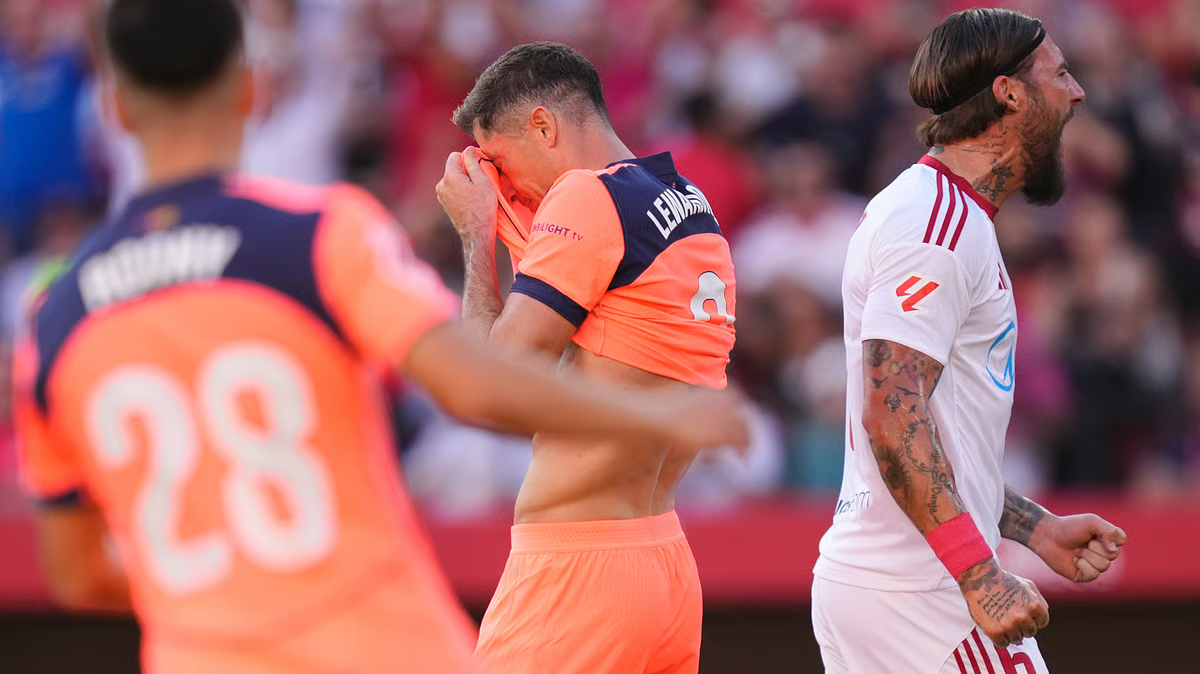
Sevilla Crush Barcelona 4–1 To End Champions’ Unbeaten Run

12

Sevilla delivered a stunning 4–1 victory over Barcelona on Sunday, ending the reigning champions’ unbeaten start to the La Liga season and denying them the chance to reclaim top spot.

The win, Sevilla’s first league triumph over Barcelona since 2015, temporarily lifted them to fourth place with 13 points from eight matches, while Barcelona remained second on 19 points, two behind leaders Real Madrid.

“It’s one of the happiest days of my life. We deserved to win from start to finish,” said José Ángel Carmona, who netted Sevilla’s third goal.

Barcelona began sluggishly, failing to register a shot on target in the opening half hour, while Sevilla pressed high and frequently sought to release Alexis Sánchez with long passes.

The hosts broke the deadlock in the 13th minute when Isaac Romero was brought down by Ronald Araújo inside the box. After a VAR review, the referee pointed to the spot, and Sánchez calmly sent his former Arsenal teammate Wojciech Szczęsny the wrong way to make it 1–0.

Szczęsny prevented further damage in the 27th minute, denying Romero from close range. But the Polish goalkeeper was beaten ten minutes later, when Rubén Vargas sprinted beyond Barcelona’s high defensive line and squared for Romero, who fired home a first-time finish to double Sevilla’s advantage.

Marcus Rashford pulled one back for Barcelona in first-half stoppage time, latching onto Pedri’s lofted pass and smashing a left-footed volley into the roof of the net from a tight angle.

Lewandowski Misses Crucial Penalty

Barcelona pushed hard after the interval and were handed a golden opportunity to equalize in the 76th minute when Alejandro Balde was fouled in the area by Adnan Januzaj. However, Robert Lewandowski squandered the chance, dragging his penalty wide of the post.

Their hopes of a comeback were dashed in the 90th minute when Carmona drilled a low shot through a defender’s legs to make it 3–1. Substitute Akor Adams then capped off Sevilla’s dominant display, tapping in Chidera Ejuke’s cross in stoppage time to seal the 4–1 rout.

“We lacked intensity, we couldn’t get out of our half, and we didn’t know what to do with the ball,” admitted Barcelona midfielder Pedri. “We were never at our best. We need to improve a lot so we can start winning again after the break.”

The victory marked Sevilla’s second consecutive league win. They will resume their La Liga campaign after the international break against Mallorca on October 18, while Barcelona will host Girona on the same day.

Are We Truly Independent?

1

Across social media and digital platforms today, vibrant graphics celebrate our nation’s independence, 65 years since the colonial flag came down, and our own was raised. It marked a moment of triumph, of pride, and of new beginnings. But as we mark another October 1st, a sobering question lingers:

Are we truly independent?

Sixty-five years later, our children are still raised on American, British, and Chinese curricula—an education pipeline that often leads them straight into the arms of foreign nations. Our brightest minds are exported en masse, their potential lost to distant shores.

Our policies, supposedly sovereign, are heavily influenced—if not outright shaped—by Western non-state actors, who serve as consultants embedded deep in our policymaking processes. Whose interests do they really serve?

Our healthcare system is so underfunded and overstretched that those in power routinely bypass it entirely, jetting off to Western hospitals for the kind of care they fail to ensure for the average Nigerian—many of whom may never even see the inside of an airport, let alone fly abroad.

Our economy still leans heavily on foreign exchange. Our universities are underfunded, pushing the elite to send their children abroad while local institutions wither. Our research sector survives largely on donor funding, which comes with policy prescriptions that often undermine our local realities.

We have abandoned our indigenous seeds and embraced patented hybrids and genetically modified organisms—designed not for self-sufficiency but dependency. Our farmers are no longer masters of their fields but consumers in someone else’s supply chain.

We continue to pursue international loans tied to conditions that mandate the adoption of Western ideologies and economic models, often ill-suited for our unique context. Our media landscape remains dominated by Western narratives, echoed by our own journalists, shaping how the world sees us—and how we see ourselves.

We extract our minerals, but the profits go abroad. Our youth remain unemployed, their future mortgaged for resources powering industries they may never work in.

Our technocrats, often foreign-trained, craft policies that curry favor with global institutions rather than confront local needs. Our agricultural systems are increasingly dictated by multinational agribusinesses. We import what we can grow and neglect what we can create. Our middle class is being drained—strangled by inflation, economic insecurity, and the relentless lure of migration.

Are we independent?

We mark our sovereignty every year, but sovereignty is not simply the absence of colonial rulers. It is not the hoisting of a flag or the singing of an anthem.

True independence is the ability to feed ourselves, heal ourselves, educate ourselves, and govern ourselves—on our own terms.*

It is food sovereignty
Policy sovereignty.
Economic sovereignty.
Cultural sovereignty.

Until we achieve these, October 1st will remain a public holiday—not a celebration of true independence, but a reminder of the work still undone.

Elon Musk Becomes World’s First Half-Trillionaire

16

‎Elon Musk, CEO of Tesla, has made history as the first person to surpass a net worth of $500bn (£370.9bn), driven by the sharp rise in the value of Tesla and his other businesses this year.
‎
‎His wealth briefly peaked at $500.1bn on Wednesday afternoon in New York before slipping slightly to just over $499bn later in the day, according to Forbes’ billionaires index.
‎
‎In addition to Tesla, the valuations of his other businesses, including the artificial intelligence startup xAI and rocket company SpaceX, have also risen in recent months.
‎
‎This milestone further strengthens Musk’s position as the world’s richest person, far ahead of his rivals in the global tech industry.
‎
‎Forbes’ billionaire index ranks Oracle founder Larry Ellison as the world’s second-richest person, with an estimated fortune of about $350.7bn.
‎
‎Ellison briefly overtook Musk last month after Oracle’s stock jumped more than 40%, driven by the company’s unexpectedly strong outlook for its cloud infrastructure operations and AI partnerships.
‎
‎Musk’s vast fortune is largely tied to his more than 12% ownership in Tesla, which has seen its stock price climb significantly this year.
‎
‎By the close of trading in New York on Wednesday, Tesla shares were up more than 3.3% and have gained over 20% since the start of the year.
‎
‎The stock’s rise in recent months has been attributed in part to investor optimism over Musk devoting more time to his companies rather than politics.
‎
‎Earlier this year, he faced backlash for his role in the Trump administration’s Department of Government Efficiency (DOGE), an agency tasked with cutting US government spending and eliminating jobs.
‎
‎Musk, who also owns the X social media platform, has been outspoken on topics such as immigration and diversity, equity, and inclusion (DEI) programs.
‎
‎Tesla board chair Robyn Denholm said in September that Musk is now “front and centre” at the company.
‎
‎The board also revealed that Musk could secure a compensation package exceeding $1tn if he achieves a set of ambitious targets over the next decade.
‎
‎To unlock that package, he would need to increase Tesla’s valuation eightfold, sell one million AI-powered robots, deliver an additional 12 million Tesla vehicles, and meet several other benchmarks.
‎
‎Last month, Musk also disclosed that he had purchased about $1bn worth of Tesla stock, which some investors interpreted as a strong show of confidence in the company.
‎
‎Tesla, however, has faced numerous challenges in recent years, including fierce competition from electric vehicle rivals such as China’s BYD.
‎
‎The company is currently transitioning into a broader AI and robotics-focused enterprise.
‎