Home Blog Page 233

France Ends Permanent Troop Presence in Senegal

1

France has officially ended its permanent military presence in Senegal, a symbolic move that marks the closing of a significant chapter in the long and complex relationship between the two countries. On Thursday, France handed over control of its last major military base in Senegal, Camp Geille in Ouakam, Dakar, bringing an end to more than two centuries of French armed presence in the West African nation.

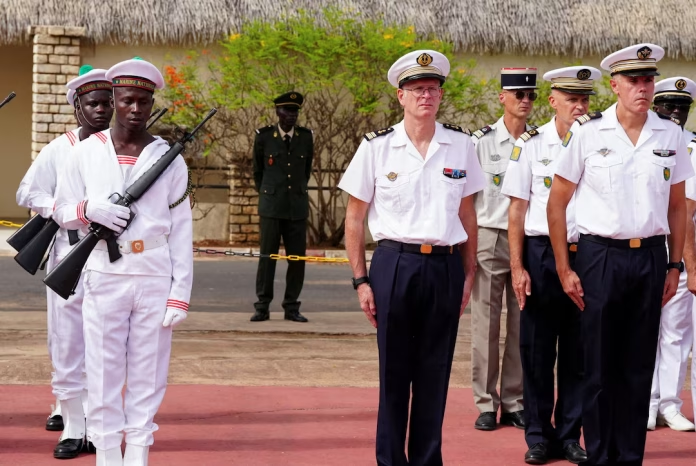
During a ceremonial handover, General Pascal Ianni, commander of French forces in Africa, handed over a ceremonial key to Senegalese officials. As Senegalese troops raised their national flag and the anthem echoed through the base, the moment underscored a peaceful yet powerful assertion of national sovereignty.

“Today’s transfer of Camp Geille marks a new stage in the evolution of the partnership between our two armed forces,” General Ianni said. “It is a response to the Senegalese authorities’ wish to no longer have permanent foreign forces present on their territory.”

The withdrawal comes after Senegalese President Bassirou Diomaye Faye, elected on a platform of reform and sovereignty, declared last year that the continued presence of French military bases was incompatible with Senegal’s full independence. The two governments agreed to a gradual and orderly process, which began in March with the handover of two other French military installations in Dakar.

Unlike the strained exits of French forces from other former colonies—such as Mali, Burkina Faso, and Niger, where new military governments expelled French troops and welcomed Russian security assistance—Senegal’s transition has been relatively smooth and diplomatic. France and Senegal have opted to maintain their military partnership in a revised form that focuses on cooperation rather than control.

General Mbaye Cissé, head of the Senegalese armed forces, affirmed that the end of France’s permanent base would not mean the end of collaboration. “The new agreement will allow Senegal to continue benefiting from training and the exchange of information,” he said. He also wished the departing French troops and their families a safe journey home and acknowledged the historical ties that bind the two nations.

France’s presence in Senegal traces back more than 200 years, beginning during colonial times when Dakar became a central hub for French West Africa. While France officially granted Senegal independence in 1960, its military footprint in the country persisted through strategic bases and bilateral defence agreements—something that has drawn increasing scrutiny from Senegalese citizens and civil society groups over the years.

There are also lingering demands for France to fully acknowledge and investigate historical injustices, including the massacre of African soldiers in 1944. These soldiers, known as “Tirailleurs Sénégalais,” fought for France during World War II but were executed by French forces in Thiaroye after protesting unfair treatment.

As France continues a broader military retreat from the Sahel and West Africa amid growing regional skepticism of foreign influence, the handover of Camp Geille represents more than a logistical shift—it is a statement of changing geopolitical priorities in Francophone Africa. Yet, both sides hope their long and complex history can form the basis of a modern, mutual partnership built on respect, rather than residual colonial dynamics.

Why Japan’s PM Ishiba Refuses To Resign After Election Loss

1

Japan’s Prime Minister, Shigeru Ishiba, has announced that he will remain in office even after his ruling coalition suffered a major setback in the recent upper house election.

The Liberal Democratic Party (LDP), along with its partner Komeito, won a total of 47 seats: three short of the 50 needed to keep control of the 248-member House of Councillors. Although they still hold 122 seats, the loss has led to internal debates about Ishiba’s leadership.

Why Ishiba Says He’s Not Stepping Down

At a press briefing, Ishiba acknowledged the poor election results but emphasized the importance of stability during challenging times. He mentioned that issues like rising prices, trade talks with the United States, and the global political climate cannot wait for internal political changes.

“Although I’m aware of our responsibility for the results, I believe it’s my duty to keep moving forward and listen to the voices of the people,” Ishiba said.

Far-Right Sanseito Party Gains Traction

A surprising twist in the election was the rise of the Sanseito Party, a far-right group that moved from the political fringe to winning 14 seats, in addition to their only existing seat.

Led by Sohei Kamiya, a former teacher and supermarket manager, Sanseito gained support by tapping into public frustration over Japan’s inflation, immigration concerns, and promises of tax cuts and better social welfare.

Kamiya has made controversial statements in the past, including conspiracy theories and strong nationalist rhetoric. However, he defended his “Japanese First” slogan, stating it was about protecting Japanese citizens, not attacking foreigners.

What the People Are Really Worried About

Although Sanseito stirred fears about immigration, polls show that only 7% of Japanese voters see immigration as a top issue. Most citizens are more concerned about the soaring cost of food, especially rice, and Japan’s declining birthrate.

What’s Next for Ishiba and Japanese Politics?

Political experts believe Ishiba may remain in power for now due to a lack of strong alternatives within his party. However, internal party battles and increasing public pressure could challenge his leadership in the coming months.

The election outcome has also opened the door for new voices and ideas in Japan’s political space, with Sanseito’s success marking a shift in how some voters feel about the country’s future.

Japan’s political scene is changing. While Prime Minister Ishiba stays in power for now, growing voter dissatisfaction and the rise of far-right parties like Sanseito suggest that big shifts may be ahead, both for leadership and national policies

Universities That Accept NECO, GCE As Entry Criteria In 2025

3

For many Nigerian students, securing admission into a university is a major milestone. The Senior Secondary Certificate Examination (SSCE), such as the National Examinations Council (NECO) and the General Certificate of Education (GCE), plays a critical role in this journey.

These exams serve as key qualifications for gaining entry into higher institutions in Nigeria and, in some cases, abroad.

In 2025, the good news is that many universities continue to accept NECO and GCE results, either individually or as combined results, to meet their admission requirements. This flexibility is a lifeline for students who may have faced challenges in one exam but excelled in another.

In this article, we’ll explore the latest updates on universities in Nigeria and beyond that accept NECO and GCE as part of their entry criteria for the 2025 academic year, helping you make informed decisions about your educational future.

The National Examinations Council (NECO) conducts the SSCE for both internal (school-based) and external (private) candidates, with the NECO GCE being the external version offered in November/December. Similarly, the GCE, often associated with the West African Senior School Certificate Examination (WASSCE), is another option for private candidates. Both qualifications are widely recognized in Nigeria, and many universities allow students to use them individually or combine them to meet the required five O’level credits, including core subjects like English Language and Mathematics.

Nigerian Universities Accepting NECO And GCE In 2025

Based on the latest information, most Nigerian universities: federal, state, and private, accept NECO and GCE results for admission into various programs. Below are some prominent institutions that have consistently accepted these qualifications, with updates relevant to 2025:

University Of Nigeria, Nsukka (UNN)

UNN, a leading federal university in southeastern Nigeria, accepts NECO, GCE, or a combination of NECO and WASSCE results. With its four campuses in Nsukka, Enugu, Aba, and Ituku-Ozalla, UNN offers a wide range of programs, from Medicine to Arts, and remains a top choice for students with these qualifications.

University Of Ibadan (UI)

As Nigeria’s oldest university, UI continues to accept NECO and GCE results for admission in 2025. Located in Ibadan, Oyo State, UI is known for its prestigious faculties, including Law, Medicine, and Engineering. However, students applying for competitive courses like Medicine may need to confirm if combined results are accepted, as some programs have stricter requirements.

Obafemi Awolowo University (OAU)

OAU, located in Ile-Ife, Osun State, is another federal university that accepts NECO and GCE results. Students can apply with either a single sitting of NECO or GCE or a combination of both to meet the O’level requirements for programs like Dentistry, Engineering, and Social Sciences.

University Of Benin (UNIBEN)

UNIBEN, based in Benin City, Edo State, accepts NECO and GCE results for its undergraduate and diploma programs. The university, known for producing notable alumni, offers flexibility for students combining results to meet admission criteria.

Nnamdi Azikiwe University (UNIZIK)

Located in Anambra State, UNIZIK accepts NECO and GCE results for its diverse academic programs. With campuses in Awka, Nnewi, and Agulu, the university is a popular choice for students in southeastern Nigeria.

University Of Abuja (UNIABUJA)

UNIABUJA, situated in the Federal Capital Territory, accepts NECO and GCE results across its 12 faculties, including Health Sciences and Law. This makes it an accessible option for students in northern Nigeria and beyond.

Other Notable Institutions

Other universities that accept NECO and GCE in 2025 include Ahmadu Bello University (ABU), University of Jos (UNIJOS), Kwara State University (KWASU), Covenant University, and Babcock University. Private universities like Covenant and Babcock are particularly open to NECO and GCE results, provided candidates meet their specific admission criteria.

However, acceptance varies by institution and program. Students are advised to visit the official websites of their chosen universities to confirm specific entry requirements and whether combined results are allowed.

Key Considerations For 2025

Combining Results: Many Nigerian universities allow students to combine NECO and GCE results to meet the minimum requirement of five O’level credits. However, for competitive courses like Medicine or Law, some institutions may prefer a single sitting or have higher grade expectations. Always check the JAMB brochure or the university’s admission portal for clarity.

Verification: International universities often require official transcripts from NECO to verify results. Ensure your results are authentic and accessible through the NECO portal.

Registration Updates: For NECO GCE 2025, registration began on July 7, 2025, and will end on November 18, 2025, with late registration incurring an additional fee of ₦5,000. The exams will run from November 26 to December 13, 2025, and will be computer-based for 16 selected subjects. Candidates should complete their registration via the official NECO portal (www.neco.gov.ng) (www.neco.gov.ng) and ensure biometric capture is done accurately.

Preparatory Programs: For students whose NECO or GCE results fall short, some universities offer foundation or pre-degree programs that may not require O’level results initially but will require them before advancing to degree programs.

In 2025, NECO and GCE remain vital pathways for Nigerian students seeking admission into universities both at home and abroad. Prestigious institutions like UNN, UI, OAU, UNIBEN, and UNIABUJA, among others, continue to accept these qualifications, offering flexibility for students to combine results where necessary.

To make the most of these opportunities, students should research specific university requirements, verify their results, and complete registrations on time.

By staying informed and prepared, you can confidently take the next step toward your academic dreams with your NECO or GCE results in hand. For the latest updates, always check the official websites of NECO, JAMB, or your chosen university.

Germany, EU Partners Move Toward Stricter Asylum Policies

3

Germany’s Interior Minister, Alexander Dobrindt, has joined forces with five fellow European officials to push forward a proposal aimed at reinforcing the European Union’s asylum framework—highlighting a future where deportations to countries like Syria and Afghanistan would be normalized.

The talks took place atop Zugspitze, Germany’s tallest mountain, shortly after Germany implemented a controversial measure in May to deny entry to certain asylum seekers at the border. That move, which authorities claimed was coordinated with neighboring nations, nonetheless sparked heated public debate.

During the gathering, Dobrindt sat down with officials from Austria, France, Poland, Denmark, and the Czech Republic, along with EU Home Affairs Commissioner Magnus Brunner.

Together, they outlined a unified plan for reform, including a push to dismantle legal barriers that currently block rejected asylum seekers from being relocated to safe, non-EU nations for processing. The proposals also support allowing asylum requests to be handled in designated third countries.

“We share the conviction that Europe must act with determination and unity to reduce illegal migration effectively,” stated a joint declaration circulated by the German interior ministry.

According to the same document, deportation to high-risk countries like Syria and Afghanistan should become routine once more. It also suggests applying visa penalties to nations that refuse to cooperate with the EU’s deportation efforts.

This renewed migration stance aligns with recent actions by the German government, which just carried out the deportation of 81 Afghan nationals—its latest move in a more aggressive migration strategy launched in May.

Libyan ICC War Crimes Suspect Apprehended In Germany

2

Authorities in Germany have detained a Libyan national wanted by the International Criminal Court (ICC) over his alleged leadership role in a prison infamous for systematic torture and sexual abuse.

Khaled Mohamed Ali Al Hishri, believed to have served in a commanding position within the Special Deterrence Force during Libya’s civil conflict, was taken into custody on Wednesday, according to officials in Germany.

The ICC confirmed that Al Hishri will remain detained in Germany as domestic legal processes continue.

Prosecutors at the Court allege that Al Hishri is responsible for a range of serious offenses, including murder, sexual violence, and inhumane treatment, between February 2015 and early 2020, when he is said to have held a high-ranking post at Mitiga prison.

The facility, located in western Libya, was one of the country’s largest detention centers. Prosecutors describe it as a site where detainees were crammed into unsanitary conditions, repeatedly subjected to coercive interrogations and acts of torture.

According to the ICC’s account, both male and female prisoners were also victims of sexual abuse, including instances of rape.

The arrest occurs at a particularly sensitive moment for the Court, which is under pressure following political backlash over a recent arrest warrant for Israeli Prime Minister Benjamin Netanyahu concerning alleged offenses related to the conflict in Gaza. The move led to sanctions by the United States and criticism from several of the Court’s European member countries.

Amid these tensions, the ICC is also dealing with internal leadership changes. Chief Prosecutor Karim Khan has temporarily stepped aside due to an ongoing UN-led inquiry into claims of sexual misconduct, which he denies. The prosecution office is currently being led by his two deputies.

In its statement issued Friday, the ICC prosecution office confirmed plans for Al Hishri’s transfer to The Hague and stated that preparations for trial proceedings are underway.

“This development is so needed at a time of unprecedented turmoil in the field of accountability generally and at the ICC specifically,” said Kip Hale, a lawyer involved in documenting Libya-related atrocities.

“Yet, it is most important for the victims of the many atrocity crimes committed at Mitiga prison,” he added.

Earlier this year, another Libyan ICC suspect, Osama Elmasry Njeem, was detained in Italy. However, authorities there later released him back to Libya, citing errors and inconsistencies in the arrest warrant. He too was suspected of involvement in abuses committed at the same prison facility.

Snoop Dogg Joins Swansea City Ownership in Surprise Move

2

In a striking crossover between rap and football, Swansea City have confirmed that legendary American rapper Snoop Dogg has become a co-owner of the Championship club.

The 53-year-old artist, whose real name is Calvin Broadus, joins an increasingly high-profile ownership group that already includes Croatian football icon and former Real Madrid midfielder Luka Modrić, who was announced as an investor in April after signing with AC Milan at age 39.

Snoop Dogg’s involvement had been hinted at last week when he made a surprise appearance on Swansea’s social media platforms, modelling the club’s new home kit for the 2025–26 season. The Welsh side formally announced his investment on Thursday.

His stake comes as part of a wider transformation at the club under American businessmen Brett Cravatt and Jason Cohen, who took over ownership in November 2024. The owners hope that Snoop Dogg’s massive global following—over 100 million across social media—will elevate the club’s visibility and brand appeal as they push for a return to the Premier League, following their relegation in 2018.

“Our aim is to boost revenue and reinvest that into building a competitive squad, within the framework of football’s profit and sustainability regulations,” the ownership group said in a statement. “To borrow a line from Snoop’s catalogue, this is ‘the next episode’ for Swansea City.”

Snoop Dogg expressed pride in joining the club, saying on Swansea’s official website:

“Everyone knows about my love for football, but making this move into club ownership with Swansea City feels truly special. The story of the club and the city resonated with me—it’s a proud, working-class community with an underdog spirit that matches my own. I’m honoured to be part of the journey.”

The club believes that Snoop’s star power and passion for football will play a key role in growing Swansea’s global reach while helping them build a stronger, more competitive team on the pitch.

This move echoes the successful rise of Swansea’s Welsh rivals, Wrexham AFC, whose fortunes have soared since Hollywood actors Ryan Reynolds and Rob McElhenney took over the club in 2020, helping guide them to the Championship.

INEC Extends Voter Registration in Anambra by Three Days Amid High Turnout

2

‎The Independent National Electoral Commission (INEC) has extended the Continuous Voter Registration (CVR) exercise in Anambra State by three days, shifting the deadline from July 17 to July 20, 2025, in response to strong public demand and stakeholder appeals.
‎
‎The announcement, made after INEC’s weekly meeting in Abuja, aims to ensure more eligible voters can participate in the upcoming off-cycle governorship election scheduled for November 8, 2025.
‎
‎INEC’s National Commissioner and Chairman of the Information and Voter Education Committee, Sam Olumekun, disclosed that 96,085 new voters were registered across 326 registration centers in Anambra within nine days, averaging over 10,600 registrations daily.
‎
‎Additionally, 12,595 voters applied for registration transfers within or outside the state, while 7,061 requested updates or replacements for lost or damaged Permanent Voter Cards (PVCs).
‎
‎“The Commission is pleased with the impressive turnout and peaceful conduct of the CVR,” Olumekun said, noting that 58% of new registrants (56,017) are female and 52.48% (50,429) are youths aged 18–34.
‎
‎
‎The extension follows appeals from citizens and groups, including the Ohaneze Ndigbo Youth, who criticized initial logistical challenges, such as inadequate machines and personnel.
‎
‎Former National Human Rights Commission Chairman Chidi Odinkalu also called for an extension, describing the initial process as “an intentional disaster” due to under-resourced registration units.
‎
‎INEC responded by pledging to improve operational efficiency during the extended period.
‎
‎
‎Post-extension, INEC will display the voter register for claims and objections, followed by a data cleanup using the Automated Biometric Identification System (ABIS).
‎
‎A detailed breakdown of registrants by age, gender, occupation, and disability will be published for transparency.
‎
‎The Commission also noted receiving five new applications for political party registration, bringing the total to 134, signaling heightened political activity ahead of 2027.
‎
‎
‎The extension has been widely welcomed, though some residents expressed concerns about accessibility in rural areas. INEC urged eligible voters to seize the opportunity to register, emphasizing its commitment to a credible electoral process.
‎
‎

G20 Leaders Near Agreement On Key Global Issues

1

Finance leaders from the world’s largest economies were on the verge of reaching a shared position on global trade and other pressing matters during their summit on Friday, marking what could be their first unified stance since the election of U.S. President Donald Trump and the onset of tariff tensions.

This meeting comes after a failed attempt to produce a joint statement earlier this year, during a February gathering, which had disappointed the host nation, South Africa.

If a consensus is finalized at the current discussions taking place in Durban, it would mark a significant step forward even though G20 declarations are symbolic and not legally enforceable, and the final language remains to be seen.

“I don’t think it’s a secret. It hasn’t been issued yet, but there’s going to be a communique,” said Raymond Gilpin on Friday.

Another participating official noted cautious hope, saying the group was edging closer to producing a formal communique. That sense of optimism was echoed by multiple delegates.

“We have to see the final text, but I think it’s important that we reached a communique and common language. That’s an improvement from the last G20,” said Dutch Finance Minister Eelco Heinen.

This year, South Africa has focused on advancing a continent-wide agenda under the theme Solidarity, Equality, Sustainability. Key topics have included tackling the high cost of borrowing and mobilizing resources to combat climate-related risks.

Participants worked toward developing unified statements addressing global economic uncertainty and climate financing, while also navigating sensitive discussions surrounding trade policies.

Some officials indicated that the final draft might highlight the value of open markets while avoiding direct criticism of tariff practices, and could refer to “extreme weather events” rather than explicitly using the term “climate change.”

Negotiators reportedly faced difficulty identifying terms acceptable to Washington, particularly given the absence of U.S. Treasury Secretary Scott Bessent, who skipped the two-day gathering.

This was not the first time Bessent was absent he had also missed the February meeting, which saw limited attendance from several other key nations including China, Japan, and Canada, despite the U.S. preparing to take over the rotating G20 presidency later this year.

Though Bessent’s nonattendance posed challenges, insiders noted that the U.S. had still been participating in background conversations on global trade, economic matters, and environmental policy wording.

Tarrif Threats

Finance heads from several major economies, including Brazil, India, China, France, and Russia, did not attend the Durban summit. However, the South African Reserve Bank Governor, Lesetja Kganyago, emphasized that every member country had a presence at the table.

Despite full representation, the weight of U.S. trade policies under Trump loomed large, disrupting international trade norms and affecting global market confidence.

German Finance Minister Lars Klingbeil, speaking during side talks with G7 counterparts, pressed for swift resolution to the global trade standoff.

“What I take home from this is that I hear a lot of countries advocating for free trade and the importance of free trade. It’s under pressure right now. It’s not good for the world,” the Dutch finance minister added.

Mexican Truck Operators Study English Amid New U.S. Language Mandate

1

In response to a new directive from President Donald Trump, truck drivers in Ciudad Juarez, Mexico, have started learning English to align with updated U.S. language regulations for commercial drivers.

Roughly 50 drivers making routine deliveries between Ciudad Juarez and El Paso, Texas, are now participating in weekly English training sessions ranging from four to eight hours. Their employer, Fletes Sotelo, initiated the program to help them meet the language expectations for operating within the U.S.

According to the company’s owner, Manuel Sotelo, the language lessons were launched about a month and a half ago with the intention of helping every driver grasp fundamental English skills. Sotelo also leads the Ciudad Juarez transportation union.

One driver, Jose Murguia, said the language course is a timely initiative in light of recent developments.
“It’s important to know the language, at least in the ways that are necessary for our work, which is to transport goods into El Paso,” he explained.

Although the U.S. had already required drivers to speak English, a previous policy from 2016 advised inspectors not to penalize drivers solely for lacking proficiency. That guidance was revoked by Trump’s executive order in April.

This order followed another declaration made in March, officially designating English as the national language of the United States.

Critics have called the executive mandate unfair, pointing out that the U.S. is home to millions of people who communicate in languages other than English.

Bayelsa Queens Unveil 25-Player Squad for WAFU Qualifiers

3

Reigning Nigeria Women’s Football League (NWFL) champions, Bayelsa Queens, have announced a 25-player squad ahead of the upcoming West Africa Football Union (WAFU) Zone B CAF Women’s Champions League Qualifiers, scheduled to take place in Ivory Coast from August 9 to 24.

Fresh off their triumphant 2024/25 NWFL campaign—capped by a commanding 4-1 victory over Naija Ratels in the final round of the Super Six playoffs—the Prosperity Girls are setting their sights on regional glory. Victory in the WAFU B tournament will guarantee the team a place in the 2025 CAF Women’s Champions League.

Head coach Whyte Ogbonda will be counting on his captain, Blessing Ilivieda, to marshal the defence. She will be joined by defenders Florence Alexander, Jennifer Oliver, Otega Okoko, Semilore Bumi, Amblessed Ogbonnaya, Sefiat Idris, and Chinyere Iheoma.

Between the posts, Bayelsa Queens will rely on the quartet of Monle Omini, Linda Jiwuaku, Agatha Thompson, and Sylvia Echefu.

The midfield will feature Mary Aderemi, Vera Samuel, Dooshima Tarnum, Bankole Sofiat, Chiamaka Ezekwugo, and Kafayat Mafisere.

Tasked with leading the attack are forwards Janet Akekoromowei, Shakirat Moshood, Emem Essien, Lucky Mary, Alaba Olabiyi, Ifeanyi Kindness, and Delight Issac.

In addition to chasing a spot in the CAF Women’s Champions League, Bayelsa Queens will also be aiming for their second regional title, having previously lifted the WAFU B trophy in 2022. The current titleholders are Edo Queens, who defeated Ainonvi FC of Benin Republic 3-0 in the 2024 final.

The winner of this year’s tournament will automatically qualify for the 2025 CAF Women’s Champions League.