
Home Blog Page 237

Nigeria Targets $2.5 Billion Carbon Credit Investment by 2030

0

Nigeria has set a bold target to attract $2.5 billion in high-integrity carbon credit investments by the year 2030, as part of its broader efforts to leverage climate finance and transition to a low-carbon economy.

The announcement was made by the Acting Vice Chancellor of the University of Nigeria, Nsukka (UNN), Professor Oguejiofo T. Ujam, during a stakeholders’ workshop on the voluntary carbon market held in Abuja. He revealed that plans are underway to launch a national carbon registry that will align with the global standards under Article 6 of the Paris Agreement.

Although the full Carbon Market Activation Policy is still awaiting final approval, the country has made significant progress, including the development of regulatory frameworks and the establishment of infrastructure to support carbon trading mechanisms.

Professor Ujam highlighted the two types of carbon markets—voluntary and compliance—emphasizing the need for accurate measurement, transparent reporting, and reliable verification systems to ensure environmental integrity.

Also speaking at the workshop, experts from the University of Nigeria’s Resource and Environmental Policy Research Centre projected that the carbon market could generate more than $2 billion in revenue for Nigeria by 2030. The initiative is expected to open up new economic opportunities, especially in areas such as forestry, agriculture, and renewable energy, while creating thousands of green jobs across the country.

The workshop brought together stakeholders from government agencies, academia, and the private sector to deliberate on how Nigeria can strategically position itself within the global carbon credit economy, in line with its commitments under the Climate Change Act and Energy Transition Plan.

Federal Government Unveils Youth Ambassador Program In Akwa Ibom

0

The Federal Government has officially introduced the Nigerian Youth Academy (NiYA) Ambassador Programme in Akwa Ibom State, a new initiative aimed at boosting youth involvement and strengthening community-level participation in national development.

The launch took place during the opening of the ARISE Youth Skills Week 2025 in Uyo, where the Minister of Youth Development described the programme as a targeted move to bring federal youth initiatives closer to the grassroots. He announced that each local government area will have two youth ambassadors who will promote key Ministry initiatives such as the Bamboo Youth Empowerment Scheme, the Nigerian Youth Academy (NiYA), and the Digital Literacy For All (DL4ALL) project.

Addressing the audience, the Minister encouraged the youth to seize the opportunities available to them. “You are not just tomorrow’s leaders—you are today’s changemakers. Your creativity, drive, and determination can reshape this nation,” he said.

He also commended the Akwa Ibom State Government for hosting the Youth Skills Week, praising its Youth Skills Pitch Challenge as an example other states should follow.

Reflecting on lessons from a recent visit to the United Arab Emirates, the Minister highlighted the importance of building strong support systems to help Nigerian youth convert innovative ideas into viable businesses.

He reiterated the Federal Government’s readiness to partner with state governments to ensure Nigerian youths are well-trained, empowered, and positioned to compete on a global stage.

Speaking on behalf of Governor Umo Eno, the State Commissioner for Youth Development, Dr. Ekerette Ekanem, reaffirmed Akwa Ibom’s commitment to empowering young people by improving their access to innovation and economic opportunities.

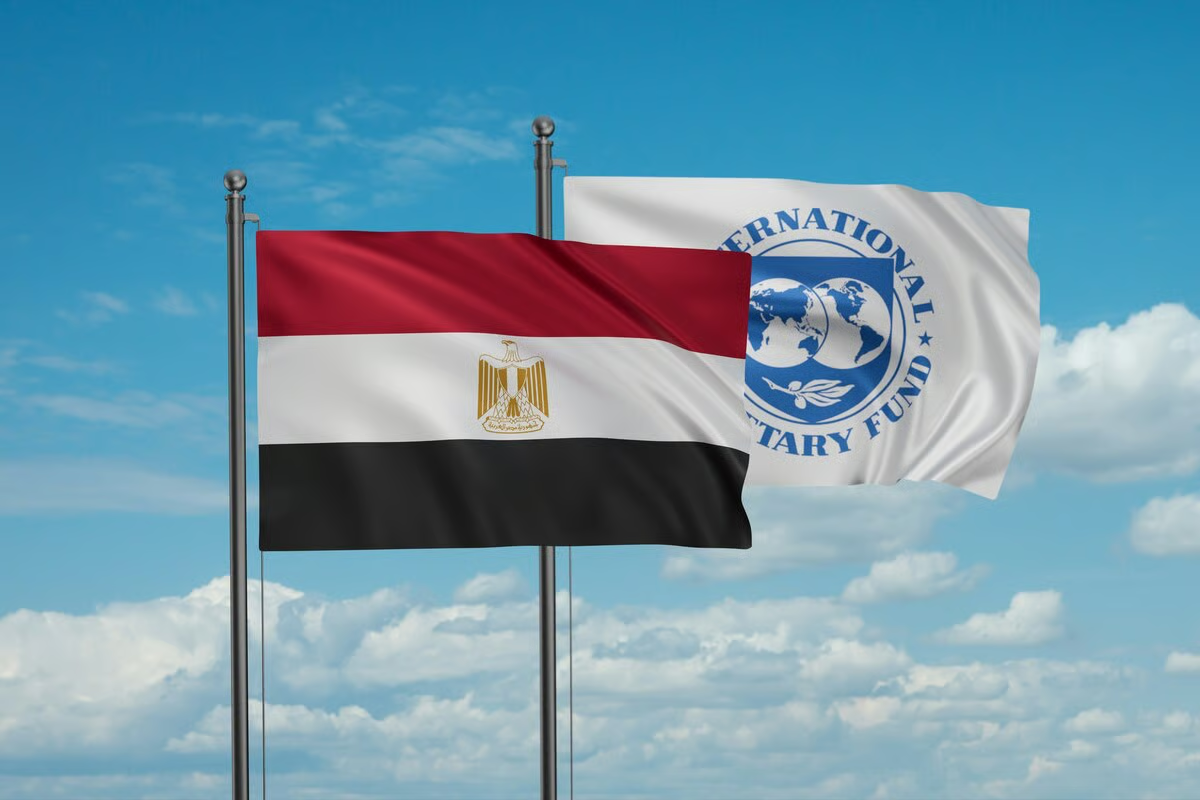
Egypt Set To Conclude IMF Loan Review By October

2

Egypt’s Finance Minister, Ahmed Kouchouk, has expressed confidence in the country’s progress on meeting key benchmarks set by the International Monetary Fund (IMF) as part of its $8 billion loan agreement. Speaking on Wednesday at the London Stock Exchange, Kouchouk said he expects the next IMF review to be finalized between September and October.

The IMF had earlier announced that it would combine the fifth and sixth reviews of Egypt’s loan program. This move aims to give Egyptian authorities additional time to fulfill the economic reform commitments tied to the financial support.
“Both sides are working on the expectation that this should be happening in September or October,” Kouchouk stated. “The IMF is after certain targets—and that’s what’s important.”

A successful review, followed by approval from the IMF’s Executive Board, would unlock the next tranche of funding under the agreement, offering a financial boost to Egypt’s ongoing economic reforms.
In addition to IMF targets, Kouchouk revealed that Egypt plans to complete three to four privatization deals before the end of the current financial year, which began this month. These transactions are a key part of the IMF’s condition to expand the role of the private sector in Egypt’s economy.

Earlier this year, Egypt’s cabinet pledged to list stakes in several military-owned companies via its sovereign wealth fund. This effort is part of a broader commitment to improve transparency, reduce the state’s dominance in key sectors, and attract foreign and domestic investment.

“It will be across a lot of sectors,” said Kouchouk, noting that the government has already shared a “very strategic and visible medium-term plan” with international institutions, including the IMF.

The reform agenda, including subsidy reductions, currency flexibility, and private sector expansion, comes at a time when Egypt is navigating high inflation, a widening budget deficit, and foreign currency shortages.
While challenges remain, the government’s latest statements reflect its intent to meet reform milestones, restore investor confidence, and strengthen the country’s fiscal health.

Trump Proposes New Tariffs On Small Nations, Africa, And The Caribbean

0

U.S. President Donald Trump is pushing forward with a controversial trade agenda that could see new tariffs imposed on imports from smaller nations, including several in Africa and the Caribbean. The proposed tariff, reportedly set at over 10 percent are being framed by the administration as part of an effort to ensure what Trump calls “reciprocal” trade treatment.

The plan marks a significant shift in U.S. trade policy, targeting developing economies that have long benefited from preferential access to the American market. Several countries, including Lesotho, are already bracing for the fallout. The small Southern African nation could face tariffs as high as 50 percent on goods exported to the United States, prompting fears of severe economic disruption.

“These are countries. Many of them, you know, like 200 countries,” Trump said when asked to clarify which nations would be affected. “We’ll probably set one tariff for all of them.”
U.S. Commerce Secretary Howard Lutnick echoed the president’s stance, stating that “the Caribbean countries, African countries there are a lot of them,” and suggesting that applying a single, uniform tariff would be the most efficient approach.

Currently, the proposal is in a three-month consultation period, during which affected countries, trade experts, and international organizations are expected to weigh in. But concerns are already mounting, particularly among nations that rely heavily on exports to the U.S. as a key component of their economic stability.

The World Trade Organization (WTO) has urged the United States to reconsider the plan. WTO Director-General Ngozi Okonjo-Iweala warned that the proposed tariffs could reverse hard-earned economic gains in developing countries and heighten global trade tensions. She specifically called for African nations to be exempt from the duties, citing their vulnerability to external shocks and dependence on U.S. trade for job creation and revenue.

“The livelihoods of millions in these regions are at risk,” Okonjo-Iweala said, adding that such a blanket approach could disrupt supply chains and trigger retaliatory actions.

Several African and Caribbean leaders are reportedly in quiet talks with U.S. officials, hoping to secure exemptions or negotiate alternative arrangements. Trade analysts warn that without flexibility, the tariffs could lead to increased poverty, higher unemployment, and a rollback of development milestones.

As the consultation window progresses, all eyes are on Washington to see whether the administration will revise its approach or press forward with what critics are calling a blunt instrument that could punish some of the world’s most vulnerable economies.

Federal Government Reopens Terrorism Trial Against Nyanya Bombing Suspects

0

The Federal Government has once again presented its case against Aminu Ogwuche and five other individuals accused of carrying out the deadly twin bomb blasts at Nyanya Motor Park in Abuja on April 14, 2014. The explosions left over 70 people dead and many others injured.

During Monday’s hearing before Justice Peter Lifu of the Federal High Court in Abuja, prosecuting counsel David Kasue reminded the court of an earlier directive allowing witness protection. He requested that only legal representatives and accredited media be allowed in the courtroom. However, Justice Lifu declined to bar a group of law students observing from the gallery, explaining that their presence served educational purposes.

The prosecution then introduced its first witness, whose identity was concealed with a mask and hood. Although the defence, led by Nureni Jimoh (SAN), initially challenged the concealment, the testimony was allowed after the witness insisted on anonymity for safety reasons.

Testifying under the guidance of Kasue, the masked witness—who revealed he served in the Department of State Services (DSS) for 23 years—described how the suspects were arrested. He specifically detailed the capture and extradition of the lead suspect, Ogwuche, from Sudan.

He explained that information from the third defendant, Mohammed Ishaq, led to Ogwuche’s identification as a financial supporter of the group. According to the witness, Ogwuche had long been under DSS watch and was previously deported from the UK.

Jimoh objected to the mention of Ogwuche’s deportation, insisting that documentary evidence was needed to support the claim. But the prosecution argued that oral testimony was admissible under Section 7 of the Evidence Act. Justice Lifu postponed ruling on the objection until the case’s conclusion.

Continuing, the witness said Ogwuche was identified by Ishaq as “Aminu,” a man from the Middle Belt who frequently visited a mosque in Utako and developed ties with Boko Haram leader Ahmed Rufai Abubakar, also known as Dr. Tsiga, who remains at large.

The witness also testified that Ishaq claimed he and Tsiga had transported a car loaded with explosives to El Rufai Park and left it there overnight. Ogwuche allegedly later explained his involvement with the sect, stating he believed they were engaged in a divine mission.

The prosecution attempted to submit written statements made by the defendants, but these could not be located due to procedural oversights. Justice Lifu blamed the prosecution for failing to notify the court registrar ahead of time and adjourned the trial until July 24.

The defendants Aminu Ogwuche (also known as Abu Ibrahim or Maiturare), Mohammed Ishaq, Ya’u Saidu (aka Kofar Rama), Anas Isah, and Adamu Yusuf face terrorism charges in connection with the 2014 attack.

Initially overseen by Justice Ahmed Mohammed, the case was reassigned to Justice Lifu following Mohammed’s appointment to the Court of Appeal. The trial has faced multiple delays, mostly due to the prosecution’s repeated absences, drawing warnings from the court that the case could be struck out if the trend continued.

Tara Moore Handed Four-Year Ban After Initial Anti-Doping Ruling

1

British tennis player Tara Moore has been handed a four-year ban after the Court of Arbitration for Sport (CAS) upheld an appeal by the International Tennis Integrity Agency (ITIA), overturning an earlier ruling that had cleared her of an anti-doping rule violation (ADRV).

Moore, formerly Britain’s top-ranked doubles player, was provisionally suspended in June 2022 after testing positive for the anabolic steroids nandrolone and boldenone. She maintained that she had never knowingly ingested any banned substance and argued that the contamination was likely due to consuming tainted meat shortly before the sample was collected.

An independent tribunal initially accepted this explanation, determining there was no fault or negligence on Moore’s part, and she was subsequently cleared. However, the ITIA challenged this ruling, leading to a review by CAS.

Following a reassessment of the legal and scientific evidence, the CAS panel ruled that Moore had failed to prove the detected concentration of nandrolone could have come from contaminated meat. Consequently, they concluded that she had not established the ADRV was unintentional.

“In reviewing the scientific and legal evidence, the majority of the CAS Panel found that the player did not demonstrate that the concentration of nandrolone was consistent with meat contamination,” CAS said in a statement. “The panel concluded that Ms Moore failed to prove the ADRV was unintentional. As such, the ITIA’s appeal is upheld and the original decision is set aside.”

Moore had also filed a cross-appeal, seeking to dismiss the ITIA’s appeal, invalidate the nandrolone finding, or reaffirm that she bore no fault. However, CAS ruled that her cross-appeal was inadmissible.

As a result, the 32-year-old will now serve a four-year period of ineligibility starting from July 15, with credit given for the provisional suspension already served.

Reflecting on the prolonged ordeal, Moore had previously spoken about the emotional toll, stating that her reputation, career ranking, and livelihood had “slowly trickled away” over the 19 months of her initial suspension.

ITIA CEO Karen Moorhouse commented on the ruling, saying, “Our threshold for appealing a first-instance decision is high, and we do not take it lightly. In this case, our independent scientific advisors concluded that the explanation for the high nandrolone levels was insufficient. Today’s CAS ruling supports that conclusion.”

Dangote Unveils Plan For Nigeria’s Deepest Seaport In Ogun

0

Aliko Dangote, President and CEO of the Dangote Group, has launched steps to establish what he calls Nigeria’s largest and deepest seaport at Olokola in Ogun State. The project, a major step in expanding his vast industrial empire, also marks a bold move into maritime logistics.

In an interview with Bloomberg on Monday in Lagos, Dangote confirmed he had submitted the project documents at the end of June. The port is expected to complement his existing operations by easing exports of fertilizer, petrochemicals, and liquefied natural gas (LNG), while improving the importation of equipment and raw materials.

“It’s not that we want to do everything by ourselves, but I believe this will inspire other investors,” he said, emphasizing the potential for the development to stimulate more private sector involvement in Nigeria’s struggling port sector.

Currently, Dangote exports urea and fertilizer using a jetty constructed beside his refinery and fertilizer plant in Lekki, which also handles large equipment deliveries. The proposed Atlantic seaport would lie about 100km from this complex and rival Lagos’ existing port infrastructure, including the Chinese-financed Lekki Deep Sea Port that opened in 2023.

This development also signals Dangote’s return to the Olokola site, where he had originally planned to build his refinery and fertilizer plant before pulling out due to disagreements with local authorities. Those issues appear to have been resolved under the present government.

Four months ago, Dangote had announced plans to re-engage with the Olokola Free Trade Zone, located in Ogun Waterside Local Government Area.

Further expanding his energy ambitions, Dangote also aims to export LNG from Lagos by constructing new pipelines connecting Nigeria’s gas-rich Niger Delta to the coast. Devakumar Edwin, a vice president at the Dangote Group, said this gas export initiative could surpass current output from Nigeria LNG Ltd.—Africa’s largest LNG exporter and a joint venture involving the government, Shell, Eni, and TotalEnergies.

“We know the gas locations. We’ll run a pipeline straight to the coast,” Edwin explained, noting that Dangote’s fertilizer plant already uses Niger Delta gas to make hydrogen for ammonia—essential for fertilizer production.

Meanwhile, the company plans to begin domestic fuel distribution in August using a fleet of 4,000 gas-powered trucks. This move has triggered backlash from groups concerned about a possible monopoly over Nigeria’s downstream oil sector an accusation Dangote has publicly refuted.

Aliko Dangote, whose net worth is estimated at $27.8 billion by Bloomberg, also owns major cement and sugar manufacturing operations across Africa.

Oyo State To Conduct 2025 JSS1 Entrance Examination

2

The Oyo State Government has announced that the 2025 placement examination for admission into Junior Secondary School 1 (JSS1) will hold on Thursday, July 17.

According to the Commissioner for Education, Science and Technology, Hon. Olusegun Olayiwola, the screening exercise will commence at 7:00 a.m. across all designated centres in the state. He urged pupils to arrive early and to come with their own writing materials to ensure a smooth process.

The examination is open to all primary six pupils from public and approved private schools across the state. Principals and heads of screening centres have been directed to make adequate preparations for the conduct of the exam and to ensure that all procedures are followed accordingly.

To ensure transparency and orderliness, officials from the Ministry of Education and the Examination Ethics Committee will monitor the conduct of the exam. Parents and guardians have also been advised not to loiter around the screening centres, as only candidates and authorised personnel will be granted access.

The placement examination is part of the state’s commitment to maintaining standard procedures for admissions into public secondary schools.

Profits Set To Skyrocket Over 350% For Maker Of Viral Labubu Toys

1

The Chinese company behind the widely sought-after Labubu collectibles is forecasting a dramatic increase in profits for the first half of the year.

According to the company, its earnings are expected to climb by no less than 350% during the period, driven by a more than threefold surge in revenue.

Executives say this performance has been largely fueled by the brand’s expanding international popularity, alongside tighter operational cost management.

The Labubu figures—fantastical characters with pointed ears and sharp teeth—have become a global sensation, igniting frenzies in retail stores and long lines of eager fans.

The company gained traction through its use of “blind box” packaging, where the identity of each toy remains hidden until opened. This approach, while highly effective in boosting sales, has attracted scrutiny over concerns it encourages compulsive consumer habits.

First introduced in 2019, the Labubu lineup has catapulted the brand into a leading position in the toy industry. Today, its operations include over 2,000 automated retail machines and physical outlets across various regions.

Since debuting on the Hong Kong Stock Exchange in 2020, the company has experienced a staggering surge in valuation—nearly 600% growth in the last 12 months alone.

In 2024, nearly 40% of the firm’s earnings came from outside mainland China, highlighting its fast-growing global presence.

Stores in multiple countries have been forced to pause Labubu sales due to overwhelming demand and insufficient inventory.

Labubu’s rise has been especially noticeable in the United States, where celebrity fans like Kim Kardashian and Lisa from Blackpink have played a role in boosting its visibility.

Collaborations with iconic global brands—including well-known beverage companies and popular Japanese manga franchises—have also contributed to Labubu’s worldwide appeal.

In June, the toy’s U.S. sales were reportedly 5,000% higher compared to the same month last year, according to industry analysts.

“I’ve not seen anything like this from other toy companies,” M Science senior analyst Vinci Zhang told the BBC.

Zhang also noted that the brand has significant room to grow in the U.S., where it currently runs about 40 stores compared to roughly 400 locations in China.

The surge in demand has also created a lucrative secondary market, with some toys—originally sold for about $10—reselling for hundreds of dollars online.

One life-sized Labubu figurine even fetched $150,000 during a June auction in Beijing.

This surge in popularity has also attracted counterfeiters. Authorities in China confiscated over 46,000 imitation Labubu figures last month as part of a broader effort to suppress the underground market for fakes—commonly called Lafufu dolls.

Two Boys Abducted By Boko Haram In 2019 Reunite With Families

0

The Borno State Police Command has confirmed that two young boys, Ayuba Ishaku and Yakubu Haruna, both aged 13, have been reunited with their families after escaping from Boko Haram captivity four years after their abduction.

According to a statement issued by the police spokesperson, ASP Nahum Daso, the boys were among several women and children kidnapped during a raid on Mandaragrau village in Biu Local Government Area. The abduction occurred on December 29, 2019.

Daso explained that the boys made their escape on the night of July 8, 2025, seizing the opportunity when most of the insurgents had left their camp for an operation. After navigating through the forest and several communities, the boys reached the ITE Divisional Police Headquarters in Maiduguri by July 12, around 5:30 p.m.

During police questioning, the boys recounted that after their abduction, they were relocated to Mangari in the Tumbun Mota area of Baga, Kukawa Local Government Area. While in captivity, they were used as domestic workers and also received training on how to maintain weapons.

Following their arrival at the police station, officers placed the boys in protective custody, where they received care and support. On the orders of the Borno State Commissioner of Police, CP Naziru Abdulmajid, efforts were initiated to trace their families.

One of the family members, Mr. Ishaku Gaji father of Ayuba, was eventually located and confirmed the boys’ abduction during the 2019 attack on their village.

The police commended the bravery of the minors and reiterated their commitment to reuniting victims of insurgency with their loved ones.
