
Home Blog Page 245

Alausa Criticizes Overlapping Roles of University Accreditation Bodies

5

The Minister of Education, Dr. Marufu Tunji Alausa, has criticised the overlapping roles of more than 25 accreditation bodies overseeing Nigerian universities, describing the current system as burdensome, chaotic, and counterproductive.

Speaking during a meeting with professional bodies in Abuja, Alausa highlighted how conflicting requirements, high costs, and logistical challenges have disrupted the effectiveness of Nigeria’s university accreditation process. He raised concerns about universities being forced to fund accreditation visits, stating that accreditation should not become a business that enriches a few individuals while complicating the system. According to him, “If you want to accredit, go and accredit. It’s not the university’s duty to fund your process.”

He maintained that the accreditation of academic programmes remains the statutory responsibility of the National Universities Commission (NUC), and called for a balanced approach that upholds university autonomy while protecting public funds and academic standards.

Alausa traced the increase in accrediting bodies from just seven professional councils five decades ago to more than 25 today. He warned that this proliferation is hindering access and limiting institutional growth. “Access is no longer the major challenge—capacity is. These burdensome requirements are limiting student intake and reducing access,” he said.

He advocated the introduction of a standardised accreditation model featuring a five-year cycle, a two-to-three-day assessment window, and self-funded visits by professional bodies.

Also speaking at the meeting, the Registrar of the Joint Admissions and Matriculation Board (JAMB), Prof. Ishaq Oloyede, supported the call for reform and urged stakeholders to adopt a unified framework that safeguards institutional roles while promoting accountability and quality.

The Executive Secretary of the NUC, Prof. Abdullahi Ribadu, expressed concern over the duplication of accreditation responsibilities, warning that such practices damage the credibility of Nigeria’s higher education system. He called for a harmonised national approach, citing international best practices where professional bodies and universities either collaborate or operate with clearly defined responsibilities.

However, the Registrar and Chief Executive Officer of the Council of Nigerian Mining Engineers and Geoscientists (COMEG), Prof. Zacheus Opafunso, argued that professional bodies play a distinct and essential role in regulating qualifications in their respective fields and should be allowed to continue conducting accreditation exercises.

NELFUND Begins Disbursement Of Upkeep Funds To Students With Updated Bank Accounts

1

The Nigerian Education Loan Fund (NELFUND) has commenced the disbursement of upkeep allowances to student beneficiaries who have successfully updated their bank account details from digital wallet platforms to traditional commercial banks.

This move follows prolonged delays in payment experienced by over 3,600 students who initially registered with digital-only banking services. According to NELFUND, those students have now received their backlog of payments after updating their bank details on the official NELFUND portal.

The agency expressed appreciation for the patience and cooperation of affected students, describing the development as a “significant breakthrough” in efforts to streamline disbursement processes.

Students who are still awaiting payment and are yet to switch from digital wallets are advised to raise a support ticket through the NELFUND portal to request access for updating their account information. Alternatively, such students can report their cases through the IT office of their institution, which will compile and forward them to NELFUND for resolution.

NELFUND reaffirmed its commitment to ensuring that no eligible beneficiary is left behind, adding that the ongoing resolution process is part of a broader strategy to improve transparency, efficiency, and student-centered service delivery.

The agency urged students to engage only through its official communication channels and to assist fellow students who may face difficulties navigating the update process.

For further inquiries, students can contact NELFUND via email at info@nelf.gov.ng or through its verified social media handles:
X (formerly Twitter): @nelfund
Instagram: @nelfund
Facebook & LinkedIn: Nigerian Education Loan Fund – NELFUND

Trump Threatens New 35% Tariff on Canada’s Exports

0

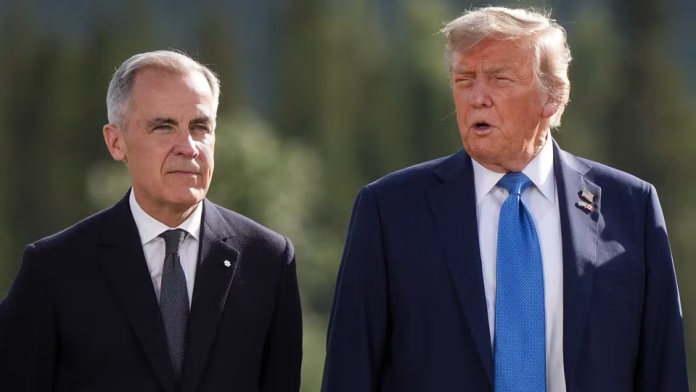
US President Donald Trump has declared plans to enforce a 35% tariff on goods from Canada beginning August 1, despite ongoing last-minute negotiations between both nations on a new trade agreement.

This policy declaration was made public through a letter shared on Trump’s personal social media page, in which he also issued broader warnings about similar tariff hikes—ranging from 15% to 20%—targeting other countries that trade with the United States.

Canadian Prime Minister Mark Carney responded by affirming that his administration remains dedicated to defending Canadian businesses and workers as discussions continue ahead of the self-imposed deadline.

This week alone, Trump has issued over 20 such letters to America’s global trade allies. He has also signaled that Europe will be the next focus of his escalating tariff campaign, with measures expected to be announced shortly.

He has promised that, like Canada, the new trade penalties on other countries will also be activated on August 1.

In addition to this latest warning, Canadian exports are already subject to a 25% general tariff, and previous waves of duties targeting steel, aluminum, and auto imports have already impacted the Canadian economy. However, certain goods still benefit from exemptions due to compliance with an existing North American trade pact.

At this point, it remains uncertain whether the newly announced tariff plans would override protections provided under the Canada-United States-Mexico Agreement (CUSMA).

Trump’s administration has also enacted sweeping tariffs globally, including a 50% duty on aluminum and steel, as well as a 25% import tax on all non-American-manufactured vehicles.

In another move, copper imports are expected to face a 50% tariff next month.

With roughly 75% of Canadian exports heading to the United States—and with Canada being a vital contributor to both the auto and metals sectors—these trade measures are particularly threatening to the nation’s economy.

Trump’s letter emphasized that the 35% duties are in addition to previously imposed tariffs on specific sectors.

“As you are aware, there will be no tariff if Canada, or companies within your country, decide to build or manufacture products within the United States,” Trump stated.

He went on to tie the tariffs to broader concerns, including “Canada’s failure” to prevent fentanyl from reaching American territory, as well as long-standing issues around dairy tariffs and trade imbalances.

“If Canada works with me to stop the flow of Fentanyl, we will, perhaps, consider an adjustment to this letter. These Tariffs may be modified, upward or downward, depending on our relationship with Your Country,” Trump said.

President Trump has in the past pointed fingers at both Canada and Mexico, accusing them of allowing “vast numbers of people to come in and fentanyl to come in” to the US.

In a post on X, Carney stated that Canada had taken significant action to “stop the scourge of fentanyl” and reiterated his country’s commitment to working closely with the US to ensure the safety of communities on both sides of the border.

According to figures from the US Customs and Border Patrol, only a very small fraction—around 0.2%—of fentanyl seizures occur at the border shared with Canada. The overwhelming majority are intercepted along the US-Mexico border.

Earlier in the year, Canada unveiled new funding for border control and appointed a special official to oversee fentanyl-related efforts, responding to rising pressure from Washington.

In recent months, officials from both countries have engaged in extensive dialogue aimed at forging a new bilateral trade and security framework.

During June’s G7 Summit, both leaders publicly reaffirmed their commitment to finalizing a deal within 30 days—setting July 21 as the target date.

Trump’s letter also warned that retaliatory action from Canada could provoke additional duties. Canada, for its part, has already applied some countermeasures and promised further responses if talks break down.

Toward the end of June, Carney repealed a tax targeting large US digital companies after Trump denounced it as a “blatant attack” and threatened to abandon trade discussions altogether.

Carney said the withdrawal of the tax was “part of a bigger negotiation” aimed at securing a broader trade agreement with the United States.

Senate Demands Answers As NNPCL Fails To Account For ₦210 Trillion In Audit Report

1

The Senate Committee on Public Accounts had previously summoned the Group Chief Executive Officer of NNPCL, Bayo Ojulari, to appear on July 10 to answer audit queries regarding the reported ₦210 trillion unaccounted for between 2017 and 2023.

This directive was issued during a session held on June 26, along with a warning that failure to honour the invitation could lead to the issuance of an arrest warrant. After Ojulari failed to appear on the specified date, the committee restated its position, emphasizing that he must show up in person to address the financial discrepancies flagged in the audit report.

Outcome Of The Senate Meeting 

The Senate has stated that the Nigerian National Petroleum Company Limited (NNPCL) has not yet provided a proper account of the ₦210 trillion highlighted in the 2017–2023 audit report issued by the Office of the Auditor-General for the Federation. 

This was revealed on Thursday by the Chairman of the Senate Committee on Public Accounts, Senator Aliyu Wadada, during a continued hearing on the audit report, which reviewed the expenditures of various Ministries, Departments, and Agencies (MDAs), according to the News Agency of Nigeria (NAN).

Wadada clarified that the Senate is not accusing NNPCL of theft but is demanding transparency and accountability regarding the ₦210 trillion flagged in the audit report.

 “The Senate on Thursday clarified that the alleged N210 trillion financial infractions raised against Nigerian National Petroleum Company Limited (NNPCL) in the 2017-2023 audit report had yet to be accounted for by the company,” the source read in part. 

It added that “Wadada maintained that NNPCL did not account for the said fund as raised by the reports, contrary to media reports that the money had been stolen by the company.”

NNPCL’s Group Chief Executive Officer, Bayo Ojulari, was absent at Thursday’s hearing, reportedly because of an OPEC meeting in Vienna. 

However, the committee dismissed a presentation delivered by the company’s Chief Financial Officer, Dapo Segun, stressing that only Ojulari can personally address the audit concerns. Wadada emphasized that the Senate’s demand was not a personal attack but rather a constitutional responsibility to ensure accountability in the use of public resources.

Senator Abdul Ningi, also a member of the Senate Committee, expressed concern over Ojulari’s continued absence from committee hearings since his appointment, despite being notified of the latest invitation prior to the OPEC meeting. 

In a related comment, Senator Adams Oshiomhole cautioned against disregarding the authority of the Senate, asserting that no individual is above the country and that such conduct is unacceptable in public service. He emphasized that the committee’s directive must be taken seriously, warning that further delays could trigger more stringent measures.

The committee has now ordered that NNPCL’s next appearance must be led by its Group CEO, Bayo Ojulari. The exact date for this appearance will be announced soon, and failure to comply could result in the Senate invoking its coercive powers.

Madueke To Arsenal: What The Transfer Means For The Gunners

0

As the summer transfer window heats up, Arsenal are making headlines again, this time, closing in on a bold move for Chelsea winger Noni Madueke. The 23-year-old English talent, known for his pace and trickery, is reportedly nearing a £52 million switch to the Emirates. While the transfer is still pending final confirmations, it has already sparked debate among fans and analysts. Will Madueke be a game-changer or just another squad option?

In another headline-grabbing development, Tottenham Hotspur are set to sign Nottingham Forest captain Morgan Gibbs-White after activating his £60 million release clause, beating potential competition including Arsenal. These two transfer stories are poised to reshape the Premier League landscape and reveal a lot about Arsenal’s strategy going into the 2025/26 season.

Madueke’s Football Journey: From London to Eindhoven and Back

Noni Madueke’s rise began in London, progressing through Crystal Palace’s and Tottenham’s youth setups before making a bold move to PSV Eindhoven in 2018. In the Eredivisie, he quickly made a name for himself with 20 goals and 13 assists across all competitions in just under 80 games. His electric style and confidence on the ball made him one of England’s most exciting prospects abroad.

In January 2023, Chelsea brought him back to England for a reported £30 million. However, despite flashes of brilliance, like a memorable hat-trick against Wolves in 2024, his time at Stamford Bridge has been inconsistent. With just 7 Premier League goals last season, Madueke struggled for game time amid Chelsea’s overstocked attack.

Arsenal’s Tactical Motivation: A New Weapon for Arteta

A direct threat and a depth option

Arsenal manager Mikel Arteta has long sought quality depth on the wings, particularly to ease the load on Bukayo Saka and Gabriel Martinelli. Madueke brings flair, unpredictability, and natural width on either flank qualities that could unlock stubborn defences and add unpredictability to Arsenal’s attack.

Squad rotation and injury cover

Saka, Arsenal’s standout performer, has been overplayed in recent seasons. Madueke’s arrival could finally allow Arteta to rotate effectively without a drop in quality vital for a team competing across four competitions.

What about the competition?

Questions remain: where does Madueke fit in a squad that already includes Saka, Martinelli, Trossard, and Reiss Nelson? Could this spell the end for Nelson or reduce chances for academy stars like Amario Cozier-Duberry? Time will tell.

Chelsea’s Motivation: FFP Pressure and Squad Reshaping

Chelsea’s willingness to let go of Madueke is rooted in financial fair play (FFP) constraints and a need to trim a bloated squad. Selling Madueke likely for a profit would free up wages and ease pressure as they target other positions.

However, critics point to the danger of repeating their infamous error with Mohamed Salah, who was sold early and blossomed elsewhere. Could Madueke follow a similar trajectory under Arteta’s guidance?

What Arsenal Gain, and What They Risk

  • Pros: Dynamic attacker, versatility, Premier League-proven, still young (23).
  • Cons: Injury-prone, inconsistent form, pressure of expectations.

If Madueke settles in and finds rhythm, he could become a bargain in hindsight. But if he underperforms, he risks becoming another expensive squad player in a highly competitive team.

Strategic Implications for Arsenal’s Transfer Window

Arsenal’s pursuit of Madueke suggests a shift in priority perhaps cooling their interest in big-money targets like Eberechi Eze or Viktor Gyökeres. With around £200m budgeted for summer business, Arsenal are choosing to invest in players who can contribute immediately without breaking the bank.

The club has also been linked with midfielders and defenders, but winger depth appears to be a key focus. Whether Madueke will be the only attacking signing remains to be seen.

Morgan Gibbs-White: Spurs Beat Arsenal to Midfield Maestro

In a major development, Arsenal’s North London rivals Tottenham Hotspur have won the race to sign Morgan Gibbs-White, Nottingham Forest’s captain and creative force.

Deal Overview

  • Transfer Fee: £60 million (release clause triggered)
  • Status: Medical scheduled, announcement imminent
  • Age: 25
  • 2024/25 Stats: 7 goals, 8 assists in 34 league matches

Gibbs-White had emerged as a target for several top clubs due to his work rate, leadership, and technical ability. While Arsenal were loosely linked, Spurs moved decisively—securing what could be their most important signing of the summer.

Implications for Arsenal

With Martin Ødegaard, Fabio Vieira, and Emile Smith Rowe already in their ranks, Arsenal may feel less urgency to sign another No.10-type midfielder. However, missing out on Gibbs-White leaves a gap if departures or injuries hit hard.

Noni Madueke’s move to Arsenal could be a calculated masterstroke or a potential misfire, depending on how well he adapts and stays consistent. Arsenal fans have reason to be cautiously optimistic: the winger is talented, hungry, and fits the club’s youthful, high-pressing profile.

As Spurs land Gibbs-White and Chelsea rebuild, the Gunners’ summer business will be judged not just on star power, but how well new signings integrate into Arteta’s finely tuned machine. Madueke may just be the wildcard Arsenal need to unlock the next level.

Presidency Warns Against Fraud In School Feeding Scheme

1

The Presidency has issued a stern warning to criminal elements attempting to exploit the Federal Government’s National School Feeding Programme for fraudulent purposes.

In a formal statement on Tuesday, the Office of the Senior Special Assistant to the President on School Feeding declared that impersonation, forgery, and extortion under the guise of official government engagement will be met with the full force of the law.

“The Presidency will not tolerate any form of criminal exploitation of this national initiative. The misuse of government identity to deceive and defraud contractors is a direct attack on the integrity of the State and will be treated accordingly.”

This warning follows the uncovering of a fraudulent network using forged letterheads of the Presidency to extort funds from unsuspecting contractors under the pretense of awarding feeding contracts for public primary school pupils.

The Presidency affirms that investigations are ongoing and that all individuals involved in this criminal conspiracy will be identified, prosecuted, and held accountable without exception.

Senegal Cancels Akon’s $6 Billion Smart City Project Inspired by Wakanda

0

Senegal has officially canceled the much-publicized $6 billion “Akon City” project, a futuristic smart city envisioned by Senegalese-American artist Akon. The government has reclaimed most of the 136 acres initially allocated for the development, citing persistent delays, lack of progress, and failure to meet financial obligations since the project’s launch in 2020.

Akon City was proposed as a tech-forward metropolis inspired by Marvel’s Wakanda, with plans for renewable energy infrastructure, innovative architecture, and an economy driven by Akon’s cryptocurrency, Akoin. The city was to be constructed in the coastal village of Mbodiène, with its first phase expected to include a hospital and key public facilities by 2023.

Five years later, however, very little progress has been made. Beyond a youth center, basketball court, and an information kiosk, construction has largely stalled.

Serigne Mamadou Mboup, head of SAPCO, the government agency responsible for tourism and coastal development, confirmed the project’s termination in an interview with L’Agence de Presse Sénégalaise, stating, “That project no longer exists.”

According to Bloomberg, the Senegalese government will now pursue a revised tourism project in the same area, supported by private investors and valued at approximately 665 billion CFA francs (about $1.2 billion). Akon will retain only 8 hectares of the original land, which will be integrated into the new plan.

Despite the project’s collapse, officials remain hopeful. The reimagined development is expected to generate as many as 15,000 jobs in its initial phase and stimulate economic growth in the Mbodiène region.

Trump Urges African Leaders to Host U.S. Deportees

0

In a controversial move reflecting his administration’s tough stance on immigration, U.S. President Donald Trump has called on five African leaders to accept deported migrants from the United States, regardless of whether the individuals are citizens of their countries.

During a high-level meeting at the White House on Wednesday, Trump met with the presidents of Liberia, Senegal, Guinea-Bissau, Mauritania, and Gabon to discuss the proposal, according to two sources familiar with the matter.

A U.S. State Department memo, reportedly circulated prior to the meeting, outlined a plan for these African nations to temporarily host third-country nationals deported from the U.S. while their asylum cases are being processed. The document stressed the importance of ensuring the “dignified, safe, and timely” transfer of these individuals.

Although no official statements have been released by the White House or the African governments, a U.S. official revealed that Liberia is preparing to house some of the deportees in Monrovia. However, it is not yet clear if President Joseph Boakai or any of the other African leaders have formally agreed to the request.

This move is part of Trump’s broader immigration strategy aimed at expediting deportations through “safe third country” partnerships, especially in cases where direct repatriation is not immediately possible. Just days before the meeting, eight migrants from Mexico, Cuba, Vietnam, and Sudan were deported to South Sudan following a failed legal attempt to halt their transfer.

During the meeting’s public session, Trump doubled down on his pledge to shift U.S. engagement in Africa from foreign aid to trade, claiming that the U.S. is a “better partner than China.” He also linked immigration enforcement with diplomatic relations, stressing the urgency of visa overstay issues and third-country agreements.

Joining Trump at the meeting were Massad Boulos, his senior adviser on African affairs, and Stephen Miller, known for his influence on the administration’s hardline immigration policies.

2025 FIFA Club World Cup Final Showdown: PSG vs Chelsea

1

The 2025 FIFA Club World Cup final promises a blockbuster clash as Paris Saint-Germain (PSG) and Chelsea FC prepare to battle for global supremacy at the MetLife Stadium in East Rutherford, New Jersey, this Sunday. With the eyes of the footballing world locked in, expectations are sky-high for a dramatic contest between two of Europe’s elite clubs.

But while both sides boast pedigree and star power, PSG enters the final as the dominant force, brimming with form, firepower, and momentum.

PSG: The Team to Beat

PSG’s journey to the final has been nothing short of commanding. The Ligue 1 giants have stormed through the tournament, scoring 16 goals and conceding only once in six games. Their crushing 4-0 semi-final victory over Real Madrid, followed by a clinical 2-0 triumph against Bayern Munich, has cemented their status as clear favorites.

With five clean sheets, Gianluigi Donnarumma guarding the goal with authority, and a midfield orchestrated by Fabian Ruiz, PSG’s balance between attack and defense has been nearly flawless. Bookmakers currently give the Parisians 8/13 odds, suggesting a 61.9% chance of lifting the coveted trophy.

Chelsea: The Resilient Underdogs

While the odds may be stacked against them, Chelsea FC have proven themselves capable of thriving in pressure-cooker moments. Their 2-0 win over South American champions Fluminense in the semi-final showcased a disciplined, tactical side under the guidance of head coach Enzo Maresca.

With promising young talents and experienced leaders, Chelsea will look to defy expectations. But to do so, they’ll need a near-perfect performance, particularly in containing PSG’s transitions and breaking down their watertight defense.

Chelsea enters the final with 4/1 odds, but in football, especially on nights like this, form often meets fate in unpredictable ways.

Tactical Battle: Where the Game Will Be Won

A crucial midfield battle is brewing between PSG’s Fabian Ruiz and Chelsea’s Enzo Fernandez. Ruiz has been instrumental in PSG’s fluid transitions and attacking link-up play, while Fernandez must bring his creativity and composure to the fore to disrupt PSG’s rhythm and carve chances for Chelsea’s forwards.

In goal, Donnarumma’s performances have bordered on world-class, making crucial saves and organizing a disciplined backline. Chelsea’s attacking line, though sharp against Fluminense, will need to reach new levels to find holes in PSG’s near-impenetrable defense.

Predictions: Can Chelsea Pull Off a Shock?

While many analysts tip PSG to clinch the title with ease, not everyone is counting Chelsea out completely.

  • Austin King, a prominent sports analyst, boldly claims: “PSG will kill Chelsea. It’ll not be any different from Inter Milan in the UCL finals.”

Key Factors to Watch:

  • Midfield Control:
    The Fernandez vs. Ruiz duel will shape the pace and control of the game.
  • Defensive Solidity:
    PSG’s defense has been the best in the tournament. Chelsea’s ability to break through this wall could decide their fate.
  • Goalkeeping Brilliance:
    Donnarumma has been a wall for PSG. Chelsea’s keeper will need to match that level if the Blues are to stay in the fight.

Sunday’s clash promises high drama, tactical brilliance, and potentially a few surprises. Will PSG’s golden generation finally lift the Club World Cup, or will Chelsea script a classic underdog triumph?

One thing is certain—the world will be watching.

FIFA Rankings: Super Eagles Drops to 44th Globally

1

The Super Eagles of Nigeria have slipped one spot in the latest FIFA World Rankings, moving from 43rd to 44th globally, according to the update released on Thursday. Despite the slight drop, Nigeria remains the fifth-highest-ranked national team in Africa.

The rankings were updated following over 200 international fixtures, including FIFA World Cup qualifiers and various regional tournaments. Morocco continues to lead African teams at 12th globally, followed by Senegal (18th), Egypt (34th), and Algeria (36th), ahead of Nigeria.

Notably, Nigeria stays ahead of key African rivals such as Ghana and South Africa, ranked 76th and 56th, respectively. Ivory Coast, who had previously surpassed Nigeria in an earlier ranking, have now dropped four places, falling just behind the Super Eagles.

The decline in Nigeria’s position is attributed to a series of mixed results in recent international outings, including friendlies and tournament appearances like the Unity Cup. These performances influenced FIFA’s recalibration of team positions across continents.

On the global stage, Argentina holds firm as the number one team, trailed by Spain, France, England, and Brazil. Senegal climbed into the top 20 after a series of impressive results, marking a significant continental gain.

Elsewhere, Croatia has reclaimed a spot in the top 10, pushing Italy out, while Mexico rose to 13th following their CONCACAF Gold Cup triumph. Costa Rica made the biggest leap internationally, jumping 14 places to 40th after reaching the Gold Cup quarter-finals.

In Africa, Zambia saw a notable improvement, moving up five spots to 83rd. Nigeria’s next chance to improve their ranking will come during the September round of World Cup qualifiers and scheduled friendlies in the lead-up to the 2026 FIFA World Cup.

FIFA will release the next world rankings on 18 September 2025.
