Home Blog Page 260

World Bank Approves $1.5 Billion Loan to Boost South Africa’s Infrastructure

0

The World Bank has approved a $1.5 billion loan to South Africa aimed at overhauling critical infrastructure and accelerating the country’s shift to a low-carbon, sustainable economy, according to the National Treasury. The funding, announced on Monday, comes at a time when aging transport systems, port congestion, and persistent power outages have severely impacted key industries and slowed economic growth in Africa’s most industrialised nation.

“This agreement reinforces the strong and constructive collaboration between the World Bank and the government of South Africa,” the National Treasury said. “This partnership marks a significant step toward addressing South Africa’s pressing economic challenges of low growth and high unemployment.”

The loan is expected to relieve infrastructure bottlenecks, particularly in the freight and energy sectors, paving the way for inclusive economic growth and job creation. South African President Cyril Ramaphosa and his coalition government have committed to tackling corruption and the mismanagement that has plagued state institutions for decades. The government sees infrastructure reform as a pathway to not only economic recovery but also long-term sustainability.

While the Treasury did not provide detailed project breakdowns, it noted that the loan terms include a three-year grace period, which is more favorable than typical commercial financing and will help ease pressure from rising debt-service costs.

In line with its strategic focus, South Africa’s 2025–2026 national budget allocates over R1 trillion across the next three years toward critical infrastructure investment in transport, energy, water, and sanitation with the broader goal of expanding access to basic services and stimulating employment.

However, the country’s economic outlook remains cautious. The Finance Ministry recently revised its GDP growth forecast for 2025 down to 1.4% from a previous estimate of 1.9%, citing global headwinds, persistent logistics constraints, and rising borrowing costs. Finance Minister Enoch Godongwana stated that government debt is projected to stabilise at 77.4% of GDP by the 2025/26 fiscal year.

The World Bank’s support comes amid broader funding challenges, including a significant shortfall in HIV-related aid. Earlier this year, the dismantling of USAID by the Trump administration led to a loss of approximately $436 million in annual support for HIV treatment and prevention in South Africa, threatening healthcare programs and thousands of associated jobs.

Godongwana acknowledged that the government lacks the funds to fully bridge the gap created by the aid cut, which has put pressure on South Africa’s already strained healthcare system particularly in its efforts to support one of the world’s largest populations of people living with HIV.

The World Bank’s loan is expected to serve as a catalyst for economic reform, with hopes that improved infrastructure, especially in energy and logistics, will restore investor confidence and drive sustainable, long-term growth.
State Of The Nation: Finding The Right Leader For Nigeria 

4

As Nigeria faces mounting economic hardship, rising insecurity, and increasing civic unrest, many citizens and critics are questioning whether President Bola Tinubu is providing the leadership the country desperately needs. 

Rather than easing the crisis, some believe his administration has worsened conditions. Calls for accountability grow louder, especially as policies like the fuel subsidy removal and exchange-rate liberalization, though praised in some economic circles, have had painful consequences for everyday Nigerians reducing their purchasing power and slowing down the economy. 

Ironically, the political activism once associated with the South-West during Buhari’s administration has now shifted to the North, where many are demanding better governance under Tinubu’s watch.

Despite the criticism, Tinubu’s presidency has introduced bold reforms aimed at stabilizing the economy and ensuring long-term growth. His administration ended the costly petrol subsidy, unified the exchange rate, and launched tax reforms that improved Nigeria’s revenue-to-GDP ratio. 

To cushion the impact of these changes, the government rolled out social welfare programs, increased wages, and invested in youth empowerment and technical education. 

Furthermore, with a ₦100 billion national agriculture fund and initiatives like dry-season farming and equipment loans, the government aims to secure food supply and reduce reliance on imports. Still, with the stakes so high, many Nigerians are left wondering: are these reforms enough, or is it time to re-evaluate the nation’s leadership once again?

UN Peacekeeper Killed In Central African Republic

0

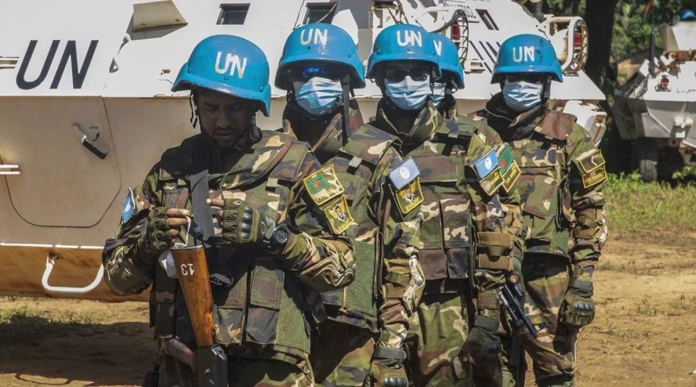
A United Nations peacekeeper from Zambia was killed in the Central African Republic (CAR) during an ambush by suspected Sudanese armed groups, the UN confirmed on Tuesday. The attack occurred on Friday near CAR’s northern border with Sudan, a volatile region increasingly marked by cross-border violence and the presence of armed militias.

According to a statement from the UN peacekeeping mission in CAR (MINUSCA), the incident also left another peacekeeper injured and currently receiving medical treatment. The fallen peacekeeper was a member of the Zambian military contingent serving under MINUSCA, which is tasked with helping to stabilize one of Africa’s most fragile states.

“The members of the Security Council expressed their deep concern over the increasing number of attacks against peacekeepers in the Central African Republic,” said the Office of the Spokesperson for the UN Secretary-General, echoing growing international anxiety over the deteriorating security environment in the region.

Zambia’s Minister of Foreign Affairs also condemned the attack and called for accountability and justice for those responsible.

This marks the third attack on UN peacekeepers in CAR in 2025 alone, underscoring the persistent instability in a country gripped by violence since 2013. The conflict was triggered when mostly Muslim rebels ousted President François Bozizé, sparking waves of inter-communal violence and plunging the nation into prolonged turmoil.

A peace agreement signed in 2019 offered a brief window of hope, but six of the 14 signatory armed groups later pulled out, reigniting tensions and complicating the UN’s peacekeeping mission. Armed groups continue to clash with government forces and each other, frequently targeting international personnel and humanitarian workers.

CAR was also one of the first African nations to formally engage Russia-backed paramilitary forces, who were brought in to support the government and fight insurgent groups. While the presence of these forces was meant to bolster state security, they have been accused of human rights abuses and are believed by some analysts to be fueling further conflict rather than resolving it.

As the UN and regional leaders call for restraint and accountability, Friday’s deadly attack highlights the risks faced by peacekeepers working in high-conflict zones and raises urgent questions about the future of international security efforts in CAR.

Ghana Secures $2.8 Billion Debt Relief Deal

0

Ghana’s Parliament has approved a $2.8 billion debt relief deal with 25 creditor nations, including economic heavyweights such as China, France, the United States, Germany, and the United Kingdom, marking a crucial step in the country’s ongoing efforts to recover from its most severe economic crisis in decades.

The approval, granted late Tuesday, is expected to unlock further disbursements under a $3 billion International Monetary Fund (IMF) bailout programme, which Ghana secured in May 2023. That bailout has since helped stabilise the nation’s economy, which had been reeling from inflation, currency depreciation, and debt distress. The IMF-backed deal also prompted a positive credit rating revision from Fitch.

“The terms of the debt treatment offer a debt service relief of $2.8 billion during the Fund-supported programme period (2023–2026),” a parliamentary report seen by Reuters confirmed. The debt restructuring applies to payments due between December 20, 2022, and December 31, 2026, which will now be capitalised and repaid between 2039 and 2043—giving Ghana over 15 years of breathing space on repayments.

Under the terms agreed with the Official Creditor Committee, interest rates on the restructured debt will range from 1% to 3%, depending on original contract terms. This arrangement provides the Ghanaian treasury with substantial savings, as the rates fall well below current market levels.

“The Committee noted that the debt restructuring was critical in supporting government to restore and sustain macroeconomic stability and debt sustainability,” the report concluded, with lawmakers unanimously recommending approval of the deal.

Ghana, the world’s second-largest cocoa producer, defaulted on most of its external debt in December 2022. Since then, it has been actively engaged in negotiations to restore economic order and win back investor confidence. The memorandum of understanding with bilateral creditors, signed in January 2024, reflects broad international support for Ghana’s reform agenda.

While the parliamentary approval is a key milestone, Ghana is still negotiating with commercial creditors to complete the full debt restructuring process. The outcome of those talks will be crucial in determining the country’s long-term economic recovery trajectory.

With this debt relief, the West African nation takes a significant step toward restoring macroeconomic stability, improving debt sustainability, and creating fiscal space for growth, especially in critical sectors like agriculture, manufacturing, and infrastructure.

Tesla Sales in Europe Continue to Decline

2

Sales of Tesla’s new vehicles in the European market dropped sharply in May — down 27.9% from the same time last year — even as electric vehicle demand across the region surged by over 27%.

Despite growing interest in fully electric cars, Tesla’s updated Model Y hasn’t sparked a turnaround for the company in Europe.

Total vehicle registrations across Europe rose modestly by 1.9% in May, with notable increases coming from hybrid vehicles and models using non-traditional fuel sources, according to recent auto industry data.

This marks the fifth consecutive monthly decline for Tesla in the region. Analysts attribute the trend to consumers increasingly opting for more affordable electric options, particularly from Chinese automakers. Some buyers have also been put off by the public statements of Tesla’s CEO.

Tesla’s presence in the European market has diminished, holding just 1.2% of market share in May—down from 1.8% a year earlier.

The refreshed Model Y was introduced in hopes of renewing interest in Tesla’s lineup as legacy brands and fast-growing competitors from China aggressively expand their EV offerings during a time of rising trade tensions.

Meanwhile, Chinese EV producers continued to gain traction despite newly imposed tariffs, selling over 65,000 units in the region last month. Their overall share of the European market rose to 5.9%, effectively doubling year-on-year. One leading Chinese automaker nearly matched Tesla’s sales in May after overtaking it the previous month.

Across the EU, UK, and EFTA, vehicle sales climbed to 1.11 million units in May, rebounding after a slight decline in April.

Some major car brands recorded growth: a state-owned Chinese firm saw a 22.5% increase in registrations, while a leading German automaker grew 5.6%. In contrast, one prominent Japanese brand saw its sales dip by 23%.

Despite the overall year-to-date dip of 0.6% in EU car sales, electric and hybrid-powered vehicles remain in demand. Registrations of battery-only EVs rose by 26.1%, plug-in hybrids increased by 15%, and hybrids jumped nearly 20%.

Bipartisan Bill Seeks to Ban Chinese AI in U.S. Government Use

0

A group of U.S. lawmakers from both major parties has proposed legislation aimed at preventing federal executive agencies from using artificial intelligence systems developed in China, such as those from DeepSeek.

The proposed legislation, called the “No Adversarial AI Act,” follows intelligence assessments indicating that DeepSeek may be supporting Chinese military and espionage efforts and has reportedly utilized “large volumes” of Nvidia chips.

DeepSeek made waves in the AI sector earlier this year by claiming it had built a system that could rival major U.S. platforms like ChatGPT—at a fraction of the cost. Since those claims, concerns over data protection have led some American institutions and companies to stop using DeepSeek’s technology. The current administration under President Donald Trump has also considered banning the tool on government-owned devices.

The bill—presented in the House by Michigan Republican John Moolenaar and Illinois Democrat Raja Krishnamoorthi—seeks to establish a standing policy that would forbid the adoption of AI models from countries considered U.S. adversaries. The proposal extends beyond China to include Russia, Iran, and North Korea.

Under the new framework, the Federal Acquisition Security Council would be tasked with compiling and maintaining a list of restricted AI systems originating from these nations.

Government departments would be restricted from purchasing or utilizing any AI tools on that list unless granted a specific exemption by Congress or the Office of Management and Budget—for instance, in the case of research needs. There is also a clause allowing for the removal of a technology from the list if it can be demonstrated that it is not under foreign adversarial control or influence.

“The U.S. must draw a hard line: hostile AI systems have no business operating inside our government,” Moolenaar said in a statement. “This legislation creates a permanent firewall to keep adversary AI out of our most sensitive networks – where the cost of compromise is simply too high.”

Additional sponsors of the bill in the House include Representatives Ritchie Torres of New York and Darin LaHood of Illinois. Senators Rick Scott from Florida and Gary Peters from Michigan will champion the legislation in the Senate.

Trump Rejects Report Claiming Iran Strikes Had Minor Effect

0

President Donald Trump and senior officials in his administration have responded strongly to a leaked analysis that claimed recent U.S. airstrikes on Iran caused only minimal disruption to its nuclear operations.

While attending a NATO summit in The Hague on Wednesday, Trump described the operation as having led to the “virtual obliteration” of Iran’s nuclear infrastructure and insisted it had delayed the program “by decades”.

Defense Secretary Pete Hegseth, also present at the summit, downplayed the leaked report’s accuracy, attributing it to an early-stage Pentagon evaluation made with “low confidence” and revealed that federal investigators are now looking into the source of the leak.

Sources familiar with the internal report told officials on Tuesday that the U.S. airstrikes over the weekend did not fully destroy Iran’s enriched uranium supply. They claimed the impact would likely delay Iran’s nuclear activities by only several months — an assertion quickly denied by the administration as “flat-out wrong”.

Details from the classified assessment suggest that although access points to key nuclear sites such as Natanz and Fordo were sealed, the subterranean infrastructure largely remained intact.

Officials briefed on the situation emphasized that the leaked analysis reflected preliminary data and could shift as more intelligence is gathered from the bombed areas.

The Pentagon’s military intelligence division, which compiled the report, specializes in gathering defense-related data and supports combat operations. It operates independently from other agencies, including those focused on civilian intelligence.

The United States has numerous intelligence agencies with varied mandates, which often leads to differing conclusions — such as the ongoing debate over the origins of COVID-19.

Sitting alongside NATO Secretary General Mark Rutte, Trump acknowledged the uncertainties in the intelligence by calling it “very inconclusive”, but then doubled down: “It was very severe, it was [an] obliteration.”

When pressed about the possibility of launching additional strikes if Iran resumed nuclear enrichment, Trump responded: “Sure, but I’m not going to have to worry about that. It’s gone for years.”

He later compared the recent mission to a historic military moment:
“I don’t want to use an example of Hiroshima, I don’t want to use an example of Nagasaki, but that was essentially the same thing – that ended a war,” he said.

During the summit, Trump stood alongside Secretary of State Marco Rubio and Defense Secretary Hegseth. Both echoed his view that the leaked material was misleading.

Hegseth dismissed the claims in the report and said the bombing operation had hit “precisely where they were supposed to”.

He added: “Any assessment that tells you it was something otherwise is speculating with other motives.” He characterised the leak as “completely false”.

Rubio also questioned the accuracy of the report, suggesting its contents had been manipulated before being shared with the public. He criticized those behind the leak as “professional stabbers”.

Preliminary intelligence further suggested that Iran had relocated a portion of its uranium before the strikes.

According to individuals with access to the report, while the entranceways were damaged and some surface-level structures were destroyed, much of the sophisticated enrichment machinery survived.

In intelligence reporting, a “low confidence” label usually points to information that is fragmented, poorly sourced, or subject to significant uncertainty — meaning it should be treated with caution.

By highlighting this classification, Hegseth implied that conclusions drawn from the assessment were tentative and subject to revision.

The U.S. reportedly struck three Iranian nuclear locations — Isfahan, Natanz, and Fordo — using specialized bombs capable of breaching hardened underground targets.

Although it’s not publicly confirmed which specific weapon was deployed, analysts believe the 30,000-pound Massive Ordnance Penetrator (MOP) may have been used, as it’s one of the few capable of damaging Iran’s fortified facilities.

Tehran has consistently maintained that its nuclear activities are civilian in nature.

Following the operation, Gen Dan Caine, chairman of the Joint Chiefs of Staff, addressed the media, noting that time would be needed to assess the full impact on Iran’s nuclear network.

However, he also stated: “All three sites sustained extremely severe damage and destruction.” Satellite photos showed six new craters near two entryways at the Fordo site, along with visible dust and rubble.

Despite this, satellite views have not clearly revealed how deep the damage runs beneath the surface.

Iranian state officials claimed the targeted sites had been vacated well before the strike, minimizing the blow by saying sensitive materials had already been removed.

Officials from both the U.S. and Israel have publicly praised the operation and described it as successful.

Ukraine Expands Diplomatic And Humanitarian Footprint In Africa

0

Ukraine is ramping up its diplomatic and humanitarian presence across Africa in a bold strategy to counterbalance Russia’s long-standing influence on the continent. From opening new embassies to delivering food aid and offering military training, Kyiv is making a calculated push to build partnerships and reshape its image among African nations.

Mauritania, located on Africa’s western tip, has become one of the key stages for this effort. Ukraine recently opened an embassy in the capital, Nouakchott—one of eight new missions launched since Russia’s 2022 invasion. The embassy has already overseen food aid deliveries to Malian refugees at the Mbera camp, West Africa’s largest, which now houses over 250,000 people fleeing Russian-backed forces across the border.

“Ukraine is ready to continue training officers and representatives of the Mauritanian armed forces, to share the technologies and achievements that Ukraine has made,” said Maksym Subkh, Ukraine’s top envoy to Africa. While the Mauritanian government has not publicly commented on the training offer, Ukraine has made it clear that its involvement remains humanitarian in nature, denying any role in covert operations in the Sahel region.

Ukraine’s efforts include a strong humanitarian component, primarily through the EU- and U.S.-funded “Grain from Ukraine” initiative. Nearly 300,000 tonnes of food aid have been delivered across 12 African countries, benefiting over 8 million people. In Mauritania alone, three shipments totaling about 1,400 tonnes of split peas, vegetable oil, and wheat had arrived by the end of 2024, with distribution continuing into 2025. These efforts have been coordinated with the World Food Programme (WFP), which confirmed the aid had reached refugees in Mbera.

“Maintaining its role as one of the guarantors of the world’s food security, Ukraine can prevent Russia from using food supplies as political leverage,” said Roman Sereda, Ukraine’s chargé d’affaires in Nouakchott.

The push into Africa is not without challenges. Ukraine’s Africa strategy, while ambitious, is running on limited resources. Embassies are thinly staffed, often relying on volunteers and diplomatic goodwill from allies. In Mauritania, Viktor Bort, a 29-year-old Ukrainian diplomat, opened the mission solo in May 2024, focusing on building local relationships and coordinating humanitarian efforts. Despite operating without a full security detail at first, Bort quickly became recognized for his drive and diplomacy.

Beyond humanitarian efforts, Ukraine is also seeking to deepen economic and security cooperation. In the Democratic Republic of Congo, Ukraine’s ambassador Vasyl Hamianin said both countries are exploring long-term agriculture and food security partnerships. The Congolese government welcomed Ukraine’s presence “in a spirit of openness and cooperation,” clarifying that it sees no reason to tie Kyiv’s outreach to its conflict with Moscow.

While African nations were initially hesitant to support Ukraine’s position at the United Nations, many are beginning to engage more openly with Kyiv. Ukraine’s President Volodymyr Zelenskyy made a historic visit to South Africa in April, the first by a Ukrainian leader—seeking closer ties on energy, fertiliser, and trade. Still, some analysts argue Ukraine’s strategy lacks coherence. For instance, Kyiv has not yet appointed an ambassador to Ethiopia, a country central to diplomatic engagement with the African Union.

Despite setbacks, such as the downgrade of a planned Ukraine-Africa summit in Kyiv to a virtual format, Kyiv remains focused on strengthening its footprint. The country now has 18 embassies in Africa and plans to open two more, including one in Sudan, where Russia is accused of fuelling both sides of the country’s conflict.

Ukraine’s growing visibility in Africa is part of a wider push to draw historical parallels between its own fight for sovereignty and African countries’ struggles against colonialism. Subkh, the African envoy, said Ukraine is seeking to show that “its fight against Russia has parallels with their own efforts to overcome the legacy of European colonialism.”

While Kyiv cannot match Moscow’s extensive commercial and military networks which include 40 Russian embassies across Africa and new ones on the way it is slowly carving out its own space. Through strategic aid, diplomatic persistence, and efforts to align with African priorities, Ukraine is redefining its role on the continent, one mission at a time.

FIFA Club World Cup: Chelsea Secure Round of 16 Spot

2

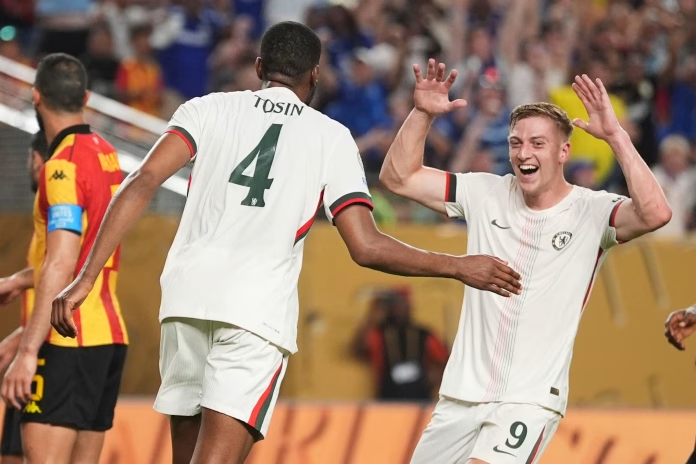
Chelsea’s second string side sealed a place in the Round of 16 at the FIFA Club World Cup with a convincing 3-0 victory over Esperance de Tunis in their final Group D clash on Tuesday. Goals from Tosin Adarabioyo, Liam Delap, and Tyrique George ensured progression for the Blues.

Meanwhile, Group D leaders Flamengo were held to a 1-1 draw by LAFC, finishing on seven points just one ahead of Chelsea. Esperance concluded third with three points, while LAFC finished bottom with a single point.

Chelsea are now set to face Group C winners Benfica on Saturday at the Bank of America Stadium in Charlotte. Flamengo will take on Group C runners up Bayern Munich on Sunday in Miami.

Despite the high stakes, Chelsea manager Enzo Maresca opted to rest several key players, including Cole Palmer and goalkeeper Robert Sánchez. Striker Nicolas Jackson was also unavailable as he continues to serve a two-match suspension following a red card in Chelsea’s previous defeat to Flamengo.

Delap, a £30 million signing from Ipswich Town, came close to scoring in the 20th minute with a header that was cleared off the line. Although Chelsea dominated possession in a quiet first half, their attack lacked sharpness. Delap missed another clear opportunity in the 30th minute, sending a shot wide from close range.

The breakthrough finally arrived in first-half stoppage time when Adarabioyo headed home a precise finish into the bottom left corner. Just moments later, Delap netted his first Chelsea goal, calmly slotting the ball into the far corner after collecting a loose ball inside the box.

Chelsea maintained their dominance throughout the second half, controlling play and defending with composure. The win was capped off in added time as substitute Tyrique George rifled in a third goal from the edge of the area.

Benfica Make History with First Win Over Bayern to Claim Group C Lead

Benfica topped Group C with a 1-0 win over Bayern Munich on Tuesday, securing their first ever victory against the German giants in scorching conditions. Andreas Schjelderup’s early goal proved decisive for the Portuguese side.

With the result, Benfica advance to face Chelsea in the Round of 16. Bayern, who finished second in the group, will now meet Flamengo.

We didn’t perform well in the first half, admitted Bayern manager Vincent Kompany. The heat and pitch conditions disrupted our rhythm. We had chances but didn’t take them, and in football, that often costs you.

Schjelderup scored in the 13th minute, converting Fredrik Aursnes’ low cross after a defensive lapse by Bayern. With qualification already assured, Bayern fielded a rotated squad and lacked urgency in the opening period.

They improved after the break and thought they had equalised when Joshua Kimmich found the net, only for the goal to be ruled out due to Harry Kane being offside in the buildup.

Benfica goalkeeper Anatoliy Trubin delivered a standout performance, making key saves to deny Aleksandar Pavlovic and Leroy Sané. He was deservedly named man of the match.

It was a full team effort against a world-class opponent, said Trubin.The heat was intense, but we stayed focused and finished the job.

Manager Bruno Lage praised his squad’s belief and execution, We came into the game confident, despite our history with Bayern. We played aggressively, created better chances, and finishing first in the group means everything. Everyone was talking about Boca Juniors needing a big win, but they overlooked us we made our statement.

No one thought we could beat Bayern, Lage added, but we believed in our process, and it showed on the pitch.

Kenya Marks Anniversary of Deadly Protests with New Clashes and Gunshot Injuries

0

Fresh violence erupted in Kenya on Wednesday as thousands of citizens took to the streets to mark the one-year anniversary of the 2024 anti-tax protests, which ended in tragedy and ignited ongoing outrage over police brutality. At least 10 people were hospitalised with gunshot wounds during this year’s commemorative rallies, according to a hospital source and a report by Citizen Television.

The protests, held in Nairobi and several other towns across the country, were intended to honour the lives lost during last year’s demonstrations, where over 60 people died, many allegedly at the hands of security forces. The renewed unrest has brought attention once again to Kenya’s growing concerns over human rights violations, police violence, and lack of accountability.

It remains unclear who fired the shots that injured protestors on Wednesday. Kenyan police spokesperson Muchiri Nyaga did not respond to requests for comment, while the Kenyatta National Hospital in Nairobi confirmed it had received 11 patients with gunshot injuries.

The situation in the capital turned tense early in the day, with police deploying tear gas and water cannon to push back crowds attempting to reach the Central Business District the same area that saw the storming of parliament last year on June 25. Roads into the city center were barricaded, and the Communications Authority of Kenya ordered a halt to live broadcasts of the protests, drawing sharp criticism from rights groups and media watchdogs.

Isolated clashes were also reported in Mombasa, Kisii, Kitengela, Matuu, and Nyeri, suggesting the discontent has spread beyond the capital. Despite the heavy police presence, many protesters remained peaceful, including groups that laid wreaths outside parliament in memory of those who died during the 2024 unrest.

This year’s demonstrations were further fueled by the recent death of 31-year-old blogger and teacher, Albert Ojwang, who died in police custody earlier this month. His death has become a symbol of the struggle against police violence, triggering a wave of anger among young Kenyans. On Tuesday, six people, including three police officers, were charged with murder over Ojwang’s killing. All have pleaded not guilty.

“We are fighting for the rights of our fellow youths and Kenyans and the people who died since June 25… we want justice,” said protester Lumumba Harmony, speaking from the heart of the demonstrations in Nairobi.

The mass protests of June 25, 2024, where demonstrators breached barricades and entered parliament under a hail of gunfire marked the most serious crisis of President William Ruto’s administration and drew sharp rebukes from Kenya’s international partners.

Although Ruto later withdrew the controversial tax proposals that sparked last year’s unrest, public frustration remains high, particularly around state violence, unsolved disappearances, and a perceived lack of police reform. As Kenya continues to grapple with these deepening grievances, Wednesday’s scenes serve as a sobering reminder that the wounds of last year have yet to heal and the calls for justice are far from over.