
Home Blog Page 263

Iran’s Response To U.S. Nuclear Strikes Looms

7

The geopolitical tensions between Iran and the United States have escalated sharply following the recent U.S. airstrikes on three Iranian nuclear facilities. The strikes, carried out on Sunday under the directive of President Donald Trump, have triggered widespread international reactions and heightened fears of a broader conflict in the already volatile Middle East region.

While Israel hailed the move as a bold step towards curbing Iran’s nuclear ambitions, Iran has condemned the action as a grave violation of international law and the United Nations Charter. As the world watches closely, Iran’s next move remains uncertain, but its leaders have signaled the possibility of retaliatory measures under the right to self-defense. The ripple effects of this development are also evident in the varied reactions of global and regional leaders.

World Leaders Reaction To The U.S. Action

Israel was swift in praising the U.S. decision. Prime Minister Benjamin Netanyahu described President Trump’s action as a historic and righteous move that would alter the course of global security by denying Iran the ability to possess nuclear weapons.

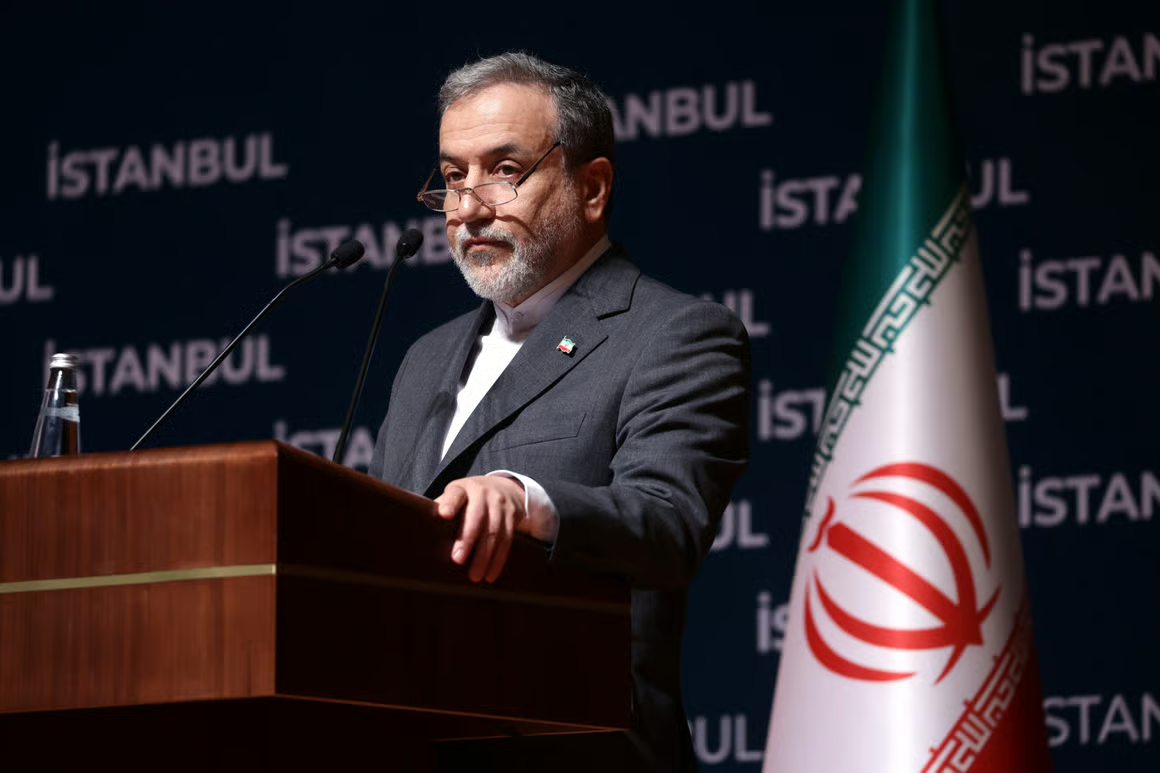
Iran, through its Foreign Minister Abbas Araqchi, vehemently denounced the strikes as illegal and provocative, accusing the U.S. of breaching the Nuclear Non-Proliferation Treaty. Tehran has declared that all options remain on the table to defend its sovereignty and interests.

The United Nations expressed deep concern over the development. Secretary-General Antonio Guterres warned that the strikes mark a dangerous escalation with the potential to destabilize not just the region but global peace and security. He urged all nations to prioritize de-escalation and diplomacy.

The European Union, represented by Commission President Ursula von der Leyen, criticized the use of force, emphasizing that diplomatic avenues had not yet been exhausted. Similar sentiments were echoed by France, which reaffirmed the need for a negotiated solution within the framework of existing international treaties.

Russia’s Dmitry Medvedev mocked the move, suggesting that President Trump’s military action contradicts his image as a peacemaker and further diminishes any prospects of being recognized for peace efforts.

The United Kingdom, through Prime Minister Keir Starmer, acknowledged Iran’s nuclear activities as a significant threat but also called on Tehran to return to the negotiating table to seek a peaceful resolution.

Other global powers, including Japan, Italy, New Zealand, and Australia, emphasized the importance of restraint and diplomacy. They stressed that continued military actions would only worsen the crisis, urging all sides to commit to peaceful dialogue.

Some nations, including Mexico, Venezuela, Cuba, and North Korea, outright condemned the U.S. strikes, labeling them acts of aggression that violate international law and risk plunging the world into deeper instability.

Arab Leaders Reaction To The U.S. Action

Reactions from the Arab world have been largely cautious and focused on the potential consequences of further escalation.

The United Arab Emirates voiced serious concern over the rising tensions, urging both the United States and Iran to halt actions that could destabilize the region further. The UAE called on the United Nations and its Security Council to act decisively in resolving the underlying disputes that threaten regional stability.

Qatar echoed these concerns, warning that the attack could lead to “catastrophic repercussions” if the situation continues to deteriorate. Doha stressed the importance of restraint and immediate diplomatic intervention to prevent a wider conflict.

Other Arab nations, while not issuing detailed public statements, are reportedly engaged in quiet diplomacy aimed at de-escalation, mindful of the impact a broader Iran-U.S. conflict would have on Gulf security, oil markets, and regional alliances.

As the international community reacts, all eyes remain on Tehran’s possible response. Whether Iran chooses a direct military retaliation, covert operations, or diplomatic pushback will shape not only its future with the U.S. but also the stability of the Middle East in the months to come.

Alexander Bublik Overcomes Medvedev To Claim Halle Title

2

Kazakhstan’s Alexander Bublik claimed the Halle Open title on Sunday with a stunning 6-3, 7-6(4) victory over Daniil Medvedev, marking his first-ever win against the Russian and continuing a remarkable resurgence in form.

Bublik had lost all six of his previous matches against the former world No. 1, managing to win just one set across those encounters. But in the Halle final, he delivered a masterclass in grass-court tennis to snap that losing streak and lift the trophy.

Medvedev, who was seeded third, has now suffered defeat in each of his last six ATP Tour-level finals, a worrying trend for the former US Open champion.

Known for his flamboyant shot-making, Bublik displayed a composed and mature performance throughout the final. His confidence was evident after his earlier win over world No. 1 Jannik Sinner in the round of 16, a turning point in a challenging year.

The 27-year-old Kazakh broke Medvedev in the eighth game of the opening set and then held serve with ease, closing out the set during a run of 12 consecutive points.

In the second set, Medvedev earned a set point with Bublik serving at 4-5, but Bublik fended it off with a perfectly executed drop shot from deep behind the baseline. Medvedev took a 4-1 lead in the ensuing tiebreak, but Bublik mounted a spirited comeback to secure the title repeating his championship run in Halle from 2023.

“I’ve had such difficult months since last year’s Wimbledon, all the way until this summer,” Bublik reflected after his win. “I was close to quitting the sport because I wasn’t enjoying it anymore.”

“And now, this is happening quarterfinals at the French Open, winning here in Halle. I have no words.”

On finally defeating Medvedev, Bublik added: “I’ve never beaten Daniil before. He’s such a difficult player for someone with my style. But today, everything just clicked — mentally and physically.”

With the win, Bublik is projected to rise to world No. 30 in Monday’s ATP rankings, a significant leap from being outside the top 75 just a month ago.

Benue Killings: Security Forces Arrest Suspects

0

Following President Bola Ahmed Tinubu’s visit to Benue State on June 18, 2025, to address the Yelwata massacre that killed at least 59 people and displaced over 6,500 in Guma Local Government Area, security forces have made significant progress in apprehending suspects linked to the attack.

On June 22, Benue State Commissioner of Police Emenari Ifeanyi announced the arrest of undisclosed suspects during a press briefing, attributing the breakthrough to Governor Hyacinth Alia’s logistical support and the deployment of tactical teams ordered by Inspector General of Police Kayode Egbetokun.

“The arrest would not have been possible without Governor Alia’s support,” Emenari said, noting that investigations are ongoing to uncover the full network behind the violence attributed to suspected armed herders.

The arrests mark a response to the public outcry and pressure for justice following the June 13 attack, which some local reports claim killed up to 200.

Tinubu’s post-visit directives, including the formation of a peace committee and enhanced security measures, are showing early signs of implementation.

The peace committee, comprising former governors like Senator George Akume, Gabriel Suswam, and Samuel Ortom, alongside traditional rulers such as the Tor Tiv, Professor James Ayatse, and the Och’Idoma, Dr. John Elaigwu, has begun preliminary meetings in Makurdi to outline a framework for sustainable peace.

Sources within the Benue State Government confirm that the committee is engaging non-indigenes and federal officials to address land-grabbing and resource conflicts, a key driver of the violence.

The state government has also initiated steps to allocate land for ranching, as directed by Tinubu, with the Minister of Agriculture and Food Security tasked to oversee implementation, though progress remains slow due to local resistance and logistical challenges.

Security operations have intensified, with additional personnel from the Nigeria Police and military deployed to rural communities like Yelwata.

The National Emergency Management Agency (NEMA) is providing relief to 6,527 displaced persons, including 1,768 females and 657 children, now in camps such as Makurdi International Market.

Blood donation drives, spurred by Tinubu’s appeal, have supported victims at Benue State University Teaching Hospital.

However, critics, including security analyst Daniel Echechofu, argue that more arrests are needed to deter perpetrators, stating, “We know them, and arrests must continue to send a signal.”

Social Democratic Party leader Prince Adewole Adebayo, while acknowledging the arrests, cautioned that without sustained action, the crisis could persist, citing 1,043 deaths in Benue from May 2023 to May 2025.

Despite these efforts, Benue remains tense, with fears of reprisal attacks during the rainy season, a peak period for grazing disputes. Governor Alia’s call for state police and a special intervention fund is under federal review, but no concrete decisions have emerged.

While the arrests and initial steps toward peace-building signal improvement, residents like Mary Iorver, a displaced farmer, remain skeptical, “We want to return to our farms, but we need more than promises.”

As the peace committee prepares for a follow-up meeting in Abuja, hopes linger if these measures will curb the decades-long violence in Benue’s North-Central region.

Rand Weakens As Oil Prices Rise And U.S–Iran Tensions Escalate

1

The South African rand weakened in early trade on Monday, dragged down by a spike in global oil prices and increased geopolitical tension following U.S. military action against Iran over the weekend. By 06:59 GMT, the rand was trading at 18.08 to the dollar, marking a decline of roughly 0.4% from Friday’s close.

The dollar edged higher against a basket of currencies as investors sought safe-haven assets, while oil prices rose by about 1.4%. Market sentiment remains cautious as investors await Iran’s response, amid growing concerns that retaliation could disrupt global oil supply. Analysts fear that a closure of the Strait of Hormuz, a crucial route for about 20% of the world’s crude oil, could further push up prices and weigh on emerging market currencies.

According to Andre Cilliers, Currency Strategist at TreasuryONE, market activity is expected to be largely shaped by global developments in the short term. “Market moves will be driven by geopolitical events,” he said. “Prices are likely to remain fairly volatile in the short term as traders await Iran’s response to the U.S. attacks.”

Locally, attention will turn to economic data scheduled for release later in the week, including the leading business indicator on Tuesday and producer inflation figures on Thursday. These reports will help investors assess the state of South Africa’s economy, which continues to face structural challenges.

South Africa’s benchmark 2035 government bond also saw weakness in early deals, with the yield rising by 2.5 basis points to 10.075%, reflecting increased caution among investors in response to the global uncertainty.

Heavy Russian Air Strike Kills At Least 10 In Kyiv

0

A deadly barrage of missiles and drones launched by Russia has left no fewer than 10 people dead in Kyiv and nearby regions, according to authorities.

Officials confirmed that multiple residential zones across the capital were struck in the early hours of Monday. This marks the second major night-time offensive in just one week, hinting that Moscow may be seeking to escalate tensions as the global spotlight focuses on the US decision to back Israel’s expanding air operations against Iran.

Ukraine’s air force reported that Russia deployed 352 drones and decoys, along with 11 ballistic missiles and five cruise missiles in this latest assault. The country’s air defence systems successfully intercepted or disrupted most of these weapons before they could reach their intended targets.

“Another massive attack on the capital. Possibly, several waves of enemy drones,” Tymur Tkachenko, head of Kyiv’s military administration, said in a statement.

“The Russians’ style is unchanged to hit where there may be people,” Tkachenko said on Telegram. “Residential buildings, exits from shelters – this is the Russian style.”

Emergency responders revealed that the strikes also damaged hospitals, sports facilities, and the entrance to an underground metro station that was being used as a shelter during the attack.

Interior Minister Ihor Klymenko reported on Telegram that at least 10 people were injured and that damage was recorded in six out of Kyiv’s 10 administrative districts.

Several fatalities occurred in Kyiv’s Shevchenkivskyi district, where an entire stairwell of a multi-storey apartment block collapsed.

Several people “were killed in Kyiv’s Shevchenkivskyi district, where the entire entrance of a residential high-rise building was destroyed,” Klymenko said. “There are still people under the rubble.”

A separate drone strike in the Chernihiv region late Sunday resulted in two deaths and left 10 others hurt, including three children, according to local reports.

Another fatality was confirmed in Bila Tserkva, a city located about 85 kilometres southwest of Kyiv, where eight additional people sustained injuries.

President Volodymyr Zelenskyy said preliminary evidence suggests that Russian forces may have employed missiles supplied by North Korea during the Kyiv assault.

He labelled the alliance between Russia, North Korea, and Iran, a country providing drones to Moscow as a “coalition of murderers,” warning that such cooperation could expand the reach of their “terror.”

Russia’s military, however, claimed later on Monday that the overnight attacks were specifically aimed at military-industrial facilities around Kyiv.

Both nations continue to deny purposely attacking civilian populations since the conflict began in February 2022, even though thousands of non-combatants mainly Ukrainians have lost their lives.

Just last week, Kyiv suffered its most lethal air raid yet, with Russian forces reportedly launching hundreds of drones that killed 28 people, injured over 150, and hit nearly 30 locations in waves of strikes.

Ukrainian military chief Oleksandr Syrskii declared that, in response to these increased assaults on the capital, Ukraine would step up its offensive against Russian military sites.

“We will not just sit in defence. Because this brings nothing and eventually leads to the fact that we still retreat, lose people and territories,” he said.

To counter this pressure, Ukraine “will increase the scale and depth” of its operations targeting Russian forces, he added.

According to Ukraine’s air force, Russian troops launched no fewer than 47 drones and fired three missiles across the country overnight Sunday.

Kyiv has accused Moscow of intentionally derailing peace negotiations talks that have been backed by US President Donald Trump in order to prolong its military campaign and claim more land.

NSCDC, NIS, NCoS, And FFS Launch Nationwide Recruitment Initiative

0

The Civil Defence, Correctional, Fire and Immigration Board (CDCFIB) has invited eligible candidates to apply for full-time positions in various paramilitary agencies starting Thursday.

This was announced in a statement by the board’s Secretary, retired Maj.-Gen. Abdulmalik Jubril, on Monday in Abuja.

He encouraged those interested in joining the Nigeria Security and Civil Defence Corps (NSCDC), Nigerian Correctional Service, Nigeria Immigration Service, or Federal Fire Service to submit applications online via the board’s portal: https://recruitment.cdcfib.org.

“Applications should be submitted online within three weeks from the date of this publication and note that the application is absolutely free,” he said.

He stressed that candidates must apply to only one of the four agencies, as submitting multiple applications will lead to automatic disqualification.

He noted that openings are available for Superintendent, Inspectorate, and Assistant cadres.

“For Superintendent of Corrections (CONMESS 09), which is applicable to only NCoS, applicants must be holders of a Bachelor’s Degree (BSc) in medicine and surgery.

“For Assistant Superintendent I (CONPASS 09), applicable to FFS only, applicants must be holders of Degree in Law or a BSc in any of the following: Mechanical, Civil, Chemical, Water or any related field.

“For Assistant Superintendent II (CONPASS 8), applicable to NSCDC, FFS and NIS, applicants must possess a BSc or Higher National Diploma,” Jubril said.

The Secretary added that for the Inspector (CONHESS 06) position, applicants must be registered nurses or midwives, and this role is available only for NCoS, NSCDC, and FFS.

“For Assistant Inspector (CONPASS 06), applicants must be holders of National Diploma or NCE in any related field.

“For Assistant II (CONPASS 04), General duty, applicants must be holders of GVE, Ordinary level, SSCE/NECO or other equivalent with a minimum of five credits in not more than two sittings.

“For Assistant III (general duty), applicants must be holders of GCE, O level, SSCE/NECO or other equivalent with a minimum of four credits in not more than two sittings,” he said.

Jubril further outlined that mandatory requirements for the recruitment include Nigerian citizenship, relevant qualifications, medical fitness, no criminal or financial fraud records, and an age range of 18 to 35, among other criteria.

NNPCL Increased Petrol Prices In Abuja And Lagos

0

Retail stations operated by the Nigerian National Petroleum Company Limited have implemented a price hike for Premium Motor Spirit, commonly referred to as petrol, raising it to N945 per litre in the Federal Capital Territory as of Monday.

In Lagos, the company also revised its pump price for petrol to ₦915 per litre across multiple retail locations, indicating a new upward trend in the downstream segment of the market.

This latest change reflects a fresh increase of N45 in Lagos and N35 in Abuja from their earlier prices of N870 and N910 per litre, respectively.

The adjustment follows closely on the heels of Dangote Petroleum Refinery’s decision to raise its ex-depot petrol price from N825 to N880 per litre, prompting a broader market reaction.

The revised pricing was implemented at various NNPC-owned filling stations, further compounding the financial burden on consumers already dealing with high transportation and living costs.

At the NNPC retail station in the Federal Housing area of Kubwa, Abuja, the new price of N945 per litre was clearly displayed. A similar adjustment was observed at the state-owned mega station along Obasanjo Way.

In Lagos, the updated rate of N915 per litre was reflected at stations located in Igando and along the Badagry Expressway.

The ripple effect was also visible across private retail outlets. MRS filling stations, a strategic partner of the Dangote refinery, raised pump prices to N925 per litre in Lagos, up from N875.

TotalEnergies has adjusted its petrol price to N910 per litre, while other retailers, such as Oluwafemi Arowolo Petroleum in Iba, have raised their prices to N920 per litre.

According to depot sources, key supply hubs in Lagos, including Wosbab, Pinnacle, and NIPCO, have set ex-depot prices for PMS between N920 and N925 per litre as of June 23, attributing the increase to rising upstream costs and global crude oil prices.

Globally, the ongoing tensions between the United States and Iran are unsettling the oil market, with analysts forecasting that crude oil prices could soon surpass $80 per barrel. A recent airstrike, reportedly conducted by US-Israeli forces on Iranian nuclear facilities, has heightened concerns about potential supply disruptions.

Independent marketers have expressed alarm over the trend, cautioning that without prompt intervention, petrol prices could exceed N1,000 per litre in the near future, driven by escalating global oil prices and a depreciating naira.

Olatide Jeremiah, CEO of PetroleumPrice.ng, remarked, “Private depots are likely to increase petrol price to N1,000 in the coming days with the current trend observed in the market. If by tomorrow morning, crude price increases to $80 or exceeds that threshold, Nigerians would pay N1,000 at depots.

“The situation means they will take advantage of Nigerians, but we can only hope that Dangote maintains its current price, that is the only way depot owners won’t jack up the price anyhow. The price surge seen last week was basically because Dangote stopped selling for some days. But it has opened up its portal and is now selling at N880 for two million litres. Dangote remains a major determinant of petrol price.”

The repeated increases are expected to heighten inflationary pressures, placing a heavier burden on commuters, businesses, and households already grappling with the effects of a deregulated yet volatile petroleum market.

South Korea Gets First Civilian Defence Chief In Six Decades

0

In a major shift from military tradition, South Korea’s new president has appointed a civilian to lead the defence ministry the first such move in over 60 years.

President Lee Jae Myung has nominated Ahn Gyu Back, a seasoned liberal lawmaker serving his fifth term, to head the defence ministry. This marks a clear break from the longstanding pattern of selecting former military generals for the post.

Mr Ahn, a member of the ruling Democratic Party, has held roles on the National Assembly’s defence committee and also led a legislative probe into the failed martial law attempt by former president Yoon Suk Yeol.

This nomination follows ongoing trials of key former military officials, such as ex-defence minister Kim Yong Hyun, who are accused of involvement in the controversial martial law enforcement last December.

Although Mr Ahn will undergo a parliamentary confirmation hearing, his approval is largely expected as the Democratic Party holds a strong majority. Moreover, the president does not need formal legislative consent to finalize the appointment. Should the nomination proceed as planned, Ahn would become South Korea’s first civilian defence minister since a military coup in 1961 brought Park Chung Hee to power.

Since that coup, all defence ministers in South Korea have been drawn from military ranks, a pattern that persisted even after democratic reforms in the late 1980s.

“As the first civilian minister of defence in 64 years, he will be responsible for leading and overseeing the transformation of the military after its mobilisation in martial law,” Kang Hoon Sik, the president’s chief of staff, said, referring to Mr Ahn.

President Lee also announced Chung Dong Young, another lawmaker, as his nominee for unification minister, while Cho Hyun, South Korea’s former ambassador to the UN, has been tapped as the next foreign minister. Cho previously served as the key official for North Korea relations from 2004 to 2005.

Kim Young Hoon, a railway worker and past leader of the Korean Confederation of Trade Unions, has been selected as labour minister.

In total, President Lee unveiled 11 cabinet picks on Monday as part of efforts to build his administration. He assumed office earlier this month without the usual transition period after his predecessor, Mr Yoon, was removed from power for violating his constitutional responsibilities by declaring martial law.

Archer Makes Red-ball Comeback To Boost Hopes of England Return

3

Jofra Archer made his long-awaited return to first-class cricket on Sunday, featuring in a County Championship match for the first time in four years. The 30-year-old fast bowler is continuing his comeback from a series of injuries as he aims to earn a place in England’s Test squad.

Archer, who has taken 42 wickets in 13 Test matches, last played for England in the format in February 2021. His career has been plagued by persistent fitness issues, including recurring elbow injuries and back problems that have kept him sidelined for extended periods.

Most recently, Archer suffered a thumb injury that forced him to miss the ODI series against the West Indies just last month.

England selector Luke Wright recently indicated that Archer could be in contention for the second Test against India, scheduled to begin on July 2 in Birmingham. Captain Ben Stokes has expressed confidence in Archer’s commitment to returning to the Test arena.

“He’s been absolutely desperate to put the white shirt back on,” Stokes said ahead of the first Test. “He’s had a really tough time with injuries, but he’s been able to get through a decent amount of white-ball cricket lately. The fact that there’s now a pathway for his red-ball return is a great sign.”

In Sussex’s innings against Durham, Archer batted at number 10 and impressed with a quick 31 runs off 34 balls, helping his side reach 322-9 at stumps on Sunday. He is expected to take the ball when play resumes on Monday.

Kano Explosion Kills Five, Leaves Ten Injured

0

A devastating explosion rocked the Yongxing Steel Company along the Eastern Bypass in Mariri Quarters, Kano State, on Saturday, June 21, 2025, killing five people and injuring ten others. The blast, initially feared to be a terrorist attack, was caused by an unexploded ordnance (UXO) concealed among scrap metals transported from Yobe State, according to the Kano State Police Command.

The incident, which occurred around 11:30 a.m., sparked panic in the community and prompted a swift response from security and emergency services.

Kano State Commissioner of Police, Ibrahim Adamu Bakori, who led first responders to the scene, confirmed the casualties and provided early insights into the cause.

“I received a call that something serious had happened. When I arrived, I found that it was a suspected explosion—possibly a military mortar bomb. Fifteen people were injured, and unfortunately, five died,” Bakori told journalists.

He noted that the explosive material was likely transported by a trailer from Yobe State, but it remains unclear whether the vehicle was operated by military personnel or civilian contractors.

“Preliminary findings suggest the explosive material was being transported by a trailer, but it remains unclear whether the vehicle was carrying military personnel or contractors,” he added.

The police’s Explosive Ordnance Disposal (EOD) and Chemical, Biological, Radiological, and Nuclear (CBRN) units secured the area and recovered nine UXOs from the site, preventing further detonations.

Deputy Police Public Relations Officer, Hussaini Abdullahi, clarified that the explosion resulted from a UXO, not an improvised explosive device (IED) as initially speculated.

“The UXOs had been unknowingly conveyed alongside scrap metals from Yobe State, and one of them accidentally exploded during the process of offloading,” Abdullahi said in a statement.

The explosion occurred while a truck, reportedly loaded with scrap materials from Damaturu, Yobe State, was offloading at the Chinese-owned Yongxing Steel Company.

Ibrahim Udazu, the company’s marketing manager, alerted the police, reporting injuries and requesting immediate intervention. Victims were rushed to Aminu Kano Teaching Hospital, where five succumbed to their injuries, and ten others are receiving treatment.

Bakori stated that it is too early to confirm whether security personnel were among the casualties, emphasizing that a comprehensive investigation is underway.

“We are working diligently to uncover the cause of the explosion and assess the full extent of the damage. More details will be made available as the investigation progresses,” he assured.

Eyewitnesses described a chaotic scene, with thick smoke rising and residents fleeing in fear.

“It was like a war zone. We heard a loud bang, and everyone started running,” said Musa Ibrahim, a nearby shopkeeper.

The incident, though not linked to insurgency, heightened anxiety in Kano, a state with a history of Boko Haram attacks, including a 2024 mosque bombing in Gezawa that killed one and injured 24.

President Bola Ahmed Tinubu, addressing the incident, expressed sympathy for the victims’ families and called for stricter safety protocols.

“Meanwhile, the President has sympathised with the families of those killed or injured by an explosion on Saturday morning in Kano,” said his Special Adviser on Information and Strategy, Bayo Onanuga.

Tinubu tasked relevant authorities with investigating the incident to prevent future tragedies.
The Kano Police urged residents to remain calm and vigilant, providing emergency hotlines (08032419754, 08123821575, 09029292926) for reporting suspicious activities.

“The Command urges residents to go about their lawful businesses without worry,” Abdullahi stated.

The investigation continues to probe how UXOs were transported undetected across state lines, raising concerns about the handling of military ordnance in civilian areas.

This tragedy underscores the need for improved regulation of scrap metal transport and heightened security measures in northern Nigeria, where sporadic explosions remain a challenge despite efforts to curb insurgency.
