Home Blog Page 28

Six Dead After Back-To-Back Typhoons Hit The Philippines

1

At least six lives have been claimed as a powerful typhoon tore through the Philippines, following closely on the heels of another storm that had already killed over 200 people.

“Super typhoon Fung-wong brought floods and landslides, which caused most of the deaths.” Entire regions lost electricity, and the storm eventually weakened to a standard typhoon.

Authorities evacuated over 1.4 million people before the storm made landfall. The system is now moving toward Taiwan, where more than 3,000 residents have been moved to safety.

Fung-wong marks the 21st typhoon to strike the Southeast Asian nation this year, striking at a time when many communities are still struggling to recover from consecutive disasters.

“Fung-wong, known locally as Uwan, slammed into Aurora province on Luzon Sunday night with sustained winds of around 185 km/h (115mph) and gusts of 230km/h.”

Earlier forecasts had warned of “high-risk of life-threatening” storm surges and powerful winds from the “very intense” typhoon.

In Cabanatuan, one of the hardest-hit areas, residents hurried to safeguard furniture and pets on Monday as floodwaters continued to rise, desperate to protect as much as possible.

Although Fung-wong’s winds were not among the strongest on record for the country, the storm unleashed torrential rains that destroyed or damaged roughly 4,100 homes.

“Cabanatuan resident Mercidita Adriano and her family had trimmed trees near their home last week to prepare for the storm.”

When the storm intensified, ten family members crammed into a single room, praying that their home would survive. “Part of their roof was torn off by the heavy rain.”

Many regions remain submerged, although water levels had begun to recede by Tuesday morning.

This disaster follows just days after another typhoon struck the same area, displacing tens of thousands, and comes after a magnitude 6.9 earthquake shook Cebu in September.

While the Philippines regularly experiences natural hazards, experts say this succession of events is “not routine.”

“It is a stark reminder of the escalating climate and seismic risks faced by vulnerable nations. Urgent support is needed to scale up relief efforts, prevent further loss of life and support the country as it recovers from this latest disaster,” it said.

Can Nigeria’s Dropping Inflation Last Through The Festive Season?

4

Nigeria’s inflation rate has been on a steady decline, raising hopes that the worst of the price surge may be easing. The National Bureau of Statistics reports that inflation fell to 18.02% in September 2025 from 20.12% in August, marking the sixth straight month of downward movement. This trend suggests that some of the government’s monetary and fiscal measures are beginning to take effect, offering a bit of relief to households and businesses.

However, the real test lies ahead as the festive season approaches a period traditionally marked by increased spending, higher demand, and potential price pressures. While the easing inflation rate is encouraging, sustaining it will depend on supply stability, market discipline, and continued policy consistency. For now, Nigerians are watching closely to see whether this positive momentum can withstand the holiday rush and carry into the new year.

NAFDAC Prohibits Sale Of Alcoholic Drinks In Sachets And Small Bottles

4

The National Agency for Food and Drug Administration and Control (NAFDAC) has announced a complete ban on the production and sale of alcoholic drinks in sachets and small-volume PET or glass bottles (under 200ml), set to take effect from December 2025.

Manufacturers, distributors, and retailers have been strongly urged to meet the deadline, as no further extensions will be allowed.

This directive comes in response to a resolution by the Nigerian Senate, instructing NAFDAC to implement the ban to protect public health, particularly shielding children, adolescents, and young adults from the harmful effects of alcohol abuse.

Speaking in Abuja, NAFDAC Director-General Prof. Mojisola Adeyeye said the easy availability of high-alcohol-content drinks in small containers has made them cheap, accessible, and easy to hide, fueling addiction, road accidents, domestic violence, school dropouts, and other social ills.

Adeyeye highlighted the wider implications for national security, noting, “Children exposed to alcohol at an early age are more likely to progress to hard drugs. This has long-term consequences on workforce productivity and contributes to social vices such as banditry and kidnapping.”

The DG recalled that in December 2018, NAFDAC, the Federal Ministry of Health, and the Federal Competition and Consumer Protection Commission (FCCPC) signed a five-year Memorandum of Understanding (MoU) with the Association of Food, Beverage, and Tobacco Employers (AFBTE) and the Distillers and Blenders Association of Nigeria (DIBAN) to phase out sachet and small-volume alcohol packaging by January 31, 2024.

The deadline was later extended to December 2025 to give industry operators time to sell off old stock and adjust production lines.

“This ban is not punitive; it is protective. It is aimed at safeguarding the health and future of our children and youth. The decision is rooted in scientific evidence and public health considerations,” Adeyeye said.

The regulation targets only spirit drinks packaged in sachets and bottles under 200ml.

NAFDAC stated it would partner with the Federal Ministry of Health, FCCPC, and the National Orientation Agency (NOA) to run nationwide awareness campaigns on the dangers of alcohol misuse, ensuring that only safe, properly regulated products are available to Nigerians.

Last Friday, the Senate took a firm stance against sachet alcohol, directing NAFDAC to end its production and sale by December 2025.

Lawmakers warned that cheap, high-alcohol drinks sold in sachets and small bottles are harming young Nigerians, driving addiction, violence, and road accidents across the country.

The resolution followed a motion by Senator Asuquo Ekpenyong (Cross River South), who urged the Senate to stop any further delays in enforcing the ban.

Ekpenyong expressed concern that despite repeated commitments, NAFDAC had postponed the phase-out deadline multiple times due to pressure from manufacturers.

He added that any additional extension would “betray public trust” and undermine Nigeria’s responsibility to safeguard public health.

Elena Rybakina Rewrites History With Dominant WTA Finals Triumph

4

Elena Rybakina claimed her first-ever season-ending WTA Finals title in Riyadh, defeating world No. 1 Aryna Sabalenka 6-3, 7-6 (0) in the final. With the victory she became the first player representing Kazakhstan — and indeed the first from Asia — to lift the WTA Finals trophy.

Over the tournament she remained unbeaten, winning all five matches including in the group stage, semifinal and final. Her straight-sets win in the final rounded off a week in which she displayed ruthless serving (eight aces in the final, 13 in that match alone) and clinical baseline aggression. The prize money awarded — US $5.235 million — is the largest ever for a women’s sports event, underscoring the commercial growth of women’s tennis.

Rybakina’s resurgence comes after a challenging 2025 marked by coaching disruptions and questions around form. Her coach, Stefano Vukov, had earlier faced a suspension and her momentum had wobbled. By reclaiming top-level form when it mattered most, she sent a message to the tennis world: she remains among the elite.

Sabalenka, scorer of a landmark season and new record-holder for most prize money earned in a single year on the WTA Tour, remains a formidable force — but her inability to convert dominance into a Finals title adds a new twist to the rivalry. The flawless tiebreak (7-0) in the second set of the final underlined Rybakina’s mental strength under pressure.

The broader implications are significant. The Riyadh event signals the WTA’s aggressive push into new markets, and Rybakina’s triumph in that context amplifies the shift in power structures in women’s tennis. Meanwhile, the controversy around off-court issues — such as her earlier coach suspension and tense relationship with the tour — added a narrative of redemption to the title. She now finishes the season ranked No. 5, with momentum heading into 2026.

Who Was Betty Bayo, Kenya’s Popular Gospel Singer

0

Kenya’s gospel community is mourning the loss of one of its beloved voices, Beatrice Wairimu Mbugua, popularly known as Betty Bayo, who passed away on Monday, November 10, 2025, at the Kenyatta National Hospital in Nairobi.

According to family sources, the 40-year-old gospel minister succumbed to acute leukemia, a form of blood cancer, after a period of treatment. She had reportedly been hospitalized for several days before her passing.

Church leaders, gospel artists, and fans across the country have shared heartfelt tributes in her honor. Bishop Muthee Kiengei described her as “a soul that maximized its full potential in serving God and uplifting others through music.”

President William Ruto also paid tribute, saying her voice “carried hope into the hearts of many and inspired countless believers through her songs.”

As messages of condolence continue to pour in, her colleagues and followers remember her for her humility, deep spirituality, and a ministry that went beyond music to touch lives and strengthen faith.

Early Life

Betty Bayo was born Beatrice Wairimu Mbugua in Banana, Kiambu County, Kenya, as the last-born in a family of eight. She spent part of her childhood in Ol Kalou, Nyandarua County, before her family later returned to Kiambu.

Raised in a humble Christian home, Betty’s journey was marked by perseverance and faith. She once shared in interviews that she dropped out of school in Form Two due to financial challenges and worked as a house help for two years before resuming her education. These early experiences shaped her strong work ethic and faith-centered outlook, which would later become the foundation of her gospel music ministry.

Career

Betty Bayo’s musical journey began in the early 2010s, when she joined Kenya’s vibrant gospel music scene. She rose to prominence with her hit song “Eleventh Hour”, a powerful track about divine intervention that resonated widely with worshippers across the country.

Her music, sung mainly in Agikuyu and Swahili, carried messages of hope, faith, and perseverance, often reflecting the everyday struggles of believers. Other notable songs in her catalogue include “Jemedari,” “Thiiri,” “Udahi,” “Maneno,” “Agocwo,” and “Ndîkerîria.”

Through her soulful voice and relatable lyrics, Betty built a loyal audience and became one of the most respected gospel artists of her generation. Her performances, both in churches and concerts, inspired many to draw closer to God and find strength in worship.

Achievements

Over more than a decade in ministry, Betty Bayo became a household name in Kenya’s gospel industry. Her song “Eleventh Hour” remains one of the most played gospel hits across radio stations and church gatherings.

She received several recognitions for her contribution to gospel music and was often celebrated for using her platform to uplift young, upcoming artists. Her authenticity and unwavering faith earned her admiration within the Christian community, and she was widely respected for maintaining her commitment to spreading the gospel through music.

Family

Betty Bayo was a devoted mother and cherished family woman. She leaves behind two children, who were the center of her life. Family members describe her as a caring, prayerful, and compassionate woman whose faith remained steadfast even during her illness.

Her passing has deeply affected her family, friends, and the broader gospel fraternity, all of whom remember her as a woman who lived her faith daily and shared God’s love through song.

Betty Bayo’s journey on earth may have ended, but her songs, faith, and testimony continue to speak to generations. Her legacy will live on in the hearts of those she inspired through her music and her unshakable belief in God’s goodness, even in the face of life’s greatest trials.

Country Of Particular Concern: Controversies Over Nigeria’s Designation By U.S

3

Tension is rising across Nigeria after U.S. President Donald Trump designates the country a “Country of Particular Concern” over alleged Christian persecution, sparking sharp reactions locally and internationally. Protests erupt in Kano as Islamic groups dismiss the claim of “Christian genocide” and condemn Trump’s threat of possible military action.

The Nigerian government also rejects the allegations, insisting that the nation’s security challenges driven by terrorism, banditry, and communal conflicts, affect people of all faiths and are not the result of state-backed religious persecution.

As the debate widens, ISIS releases a statement admitting attacks on Christians while taunting Trump, adding a new layer to the global conversation. Back home, calls for unity grow stronger, with Muslim and Christian groups holding joint prayers in Birnin Kebbi and northern stakeholders urging Nigerians to resist division and oppose foreign military intervention. Many believe this moment demands a collective stand to protect every community and uphold peace across the country.

US Senate Moves Forward On Bill To End Federal Shutdown

1

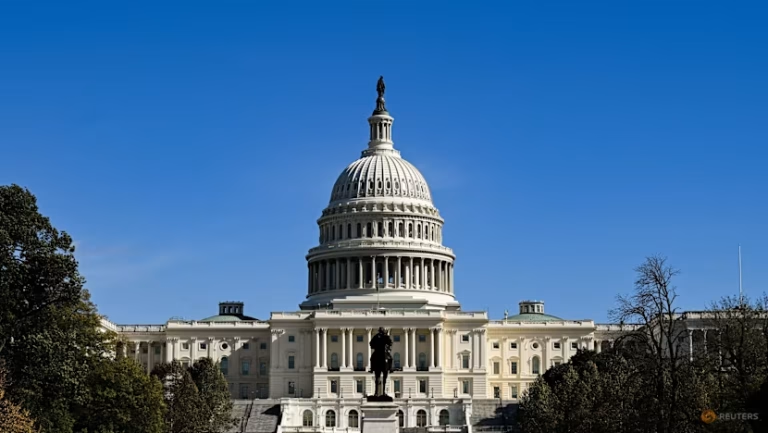
‎The U.S. Senate on Sunday took steps toward passing legislation to reopen the federal government and end the 40-day shutdown that has left federal employees idle, disrupted food assistance, and caused significant air travel delays.

‎In a procedural move, senators advanced a bill previously passed by the House, which will be amended to keep the government funded until January 30 and incorporate three full-year appropriations measures.

‎If the Senate approves the amended version, it will still require approval by the House of Representatives before being sent to President Donald Trump for signing, a process expected to take several days.

‎Under a deal negotiated with several Democrats who defied their party’s leadership, Republicans agreed to hold a December vote on extending Affordable Care Act subsidies. These subsidies, which help low-income Americans afford private health insurance and are set to expire at year’s end, have been a key Democratic demand in the funding standoff.

‎The procedural vote passed 60–40, the exact margin required to overcome a Senate filibuster.

‎“It looks like we’re getting very close to the shutdown ending,” Trump told reporters at the White House before the vote.

‎The bill would prevent federal agencies from terminating employees until January 30 — a victory for federal worker unions and their supporters and temporarily halt Trump’s efforts to reduce the size of the federal workforce.

‎At the beginning of Trump’s second term, about 2.2 million civilians were employed by the federal government, according to official data. Roughly 300,000 workers are projected to exit by year’s end as part of the downsizing initiative.

‎The measure would also guarantee back pay for all federal employees, including military personnel, Border Patrol officers, and air traffic controllers.

‎When the Senate reconvenes on Monday, Republican leaders will seek bipartisan support to bypass standard procedures and expedite the bill’s passage.

‎Otherwise, the chamber would have to spend much of the week completing procedural steps before a final vote, potentially prolonging the shutdown into the next weekend.

‎“It was a good vote tonight,” Senate Majority Leader John Thune told reporters after adjournment on Sunday. “Hopefully, we’ll get an opportunity tomorrow to set up the next votes. Of course, that’s going to take some cooperation and consent.”

‎Sunday’s agreement was brokered by Democratic Senators Maggie Hassan and Jeanne Shaheen of New Hampshire and Independent Senator Angus King of Maine, according to a source familiar with the discussions.

‎“For over a month, I’ve made clear that my priorities are to both reopen government and extend the ACA enhanced premium tax credits. This is our best path toward accomplishing both of these goals,” Shaheen posted on X.

‎Senate Minority Leader Chuck Schumer, the top Democrat in the chamber, voted against the measure.

‎Many Democrats on Capitol Hill reacted with frustration as the deal took shape.

‎“Senator Schumer is no longer effective and should be replaced,” U.S. Representative Ro Khanna wrote on X. “If you can’t lead the fight to stop healthcare premiums from skyrocketing for Americans, what will you fight for?”

‎Sunday marked the 40th day of the shutdown, which has kept federal employees off the job, disrupted food programs and national parks, and strained travel systems amid air traffic control shortages that threaten to upend Thanksgiving travel later this month.

‎Senator Thom Tillis, a Republican from North Carolina, said the worsening effects of the shutdown prompted lawmakers to find common ground.

‎“Temperatures cool, the atmospheric pressure increases outside and all of a sudden it looks like things will come together,” Tillis told reporters.

‎White House economic adviser Kevin Hassett warned on CBS’s “Face the Nation” that if the shutdown continues much longer, economic growth could turn negative in the fourth quarter particularly if air travel remains disrupted during the Thanksgiving season, which falls on November 27 this year.

‎Meanwhile, President Trump on Sunday renewed calls to replace the Affordable Care Act’s insurance subsidies with direct payments to individuals.

‎The subsidies, which helped boost ACA enrollment to 24 million since their introduction in 2021, remain the central issue in the shutdown. Republicans insist the matter should be addressed only after federal funding is reinstated.

‎Trump posted on Truth Social, condemning the subsidies as a “windfall for Health Insurance Companies, and a DISASTER for the American people,” while urging that the money instead go directly to individuals to purchase coverage independently. “I stand ready to work with both Parties to solve this problem once the Government is open,” Trump wrote.

‎Health experts estimate that Americans shopping for 2026 Obamacare plans could see their monthly premiums more than double on average as pandemic-era subsidies expire at the end of the year. The ACA enrollment period runs through January 15, leaving a short window for Congress to act on extending the credits for next year.

Why Nigeria, Others Must Leverage AFCFTA Over Uncertain AGOA

3

Nigeria is the largest economy in Africa, but its low trade-to-GDP ratio and heavy dependence on crude oil show that the country is not fully capitalizing on its economic strength.

This is why the Africa Continental Free Trade Agreement (AfCFTA) becomes critical. With its goal of creating a single African market, AfCFTA presents a major opportunity for Nigeria to diversify exports, expand regional trade, and reduce vulnerability to global price shocks benefits that can only be realized through active engagement.

At the same time, the future of AGOA remains uncertain, and the recent removal of other African countries highlights how unpredictable the arrangement can be. Relying on AGOA alone puts Nigeria at risk, especially with compliance concerns and shifting U.S. policies.

Wike Gives Land Use Defaulters 14 Days To Comply

5

‎The Minister of the Federal Capital Territory (FCT), Nyesom Wike, has given a final 14-day grace period to property owners who breached land use and development regulations in Abuja’s highbrow areas, Asokoro, Maitama, Garki, and Wuse to regularise their titles and pay a N5 million penalty.

‎According to a statement issued on Sunday by the Minister’s Senior Special Assistant on Public Communications and Social Media, Lere Olayinka, the new deadline takes effect from Tuesday, November 11, 2025. It warned that defaulters who fail to comply within the stipulated period would face enforcement action by the FCT Administration.

‎The extension follows the expiration of a previous 30-day window granted to affected allottees after public notices were published between September 8 and 10, 2025.

‎Areas affected by the directive include Gana and Usuma Streets in Maitama; Yakubu Gowon Crescent in Asokoro; Aminu Kano and Adetokunbo Ademola Crescents in Wuse II; as well as Ladoke Akintola Boulevard, Gimbiya Street, and Onitsha Street in Garki II. Others are Ogbomosho Street, Lafia Close, Yola Street, Abriba Close, Danbatta Street, Ringim Close, and Ilorin Street in Garki I.

‎The statement added that Wike approved the issuance of new title documents including Statutory Rights of Occupancy and Certificates of Occupancy with a renewed 99-year term for property owners who meet all requirements.

‎However, the concession excludes titles already revoked for non-development, non-payment of ground rent, or other violations.

‎Findings by The Guardian show that stricter enforcement of land administration policies under Wike has pushed annual revenue from land-related charges in the FCT beyond ₦1 trillion, the highest in the territory’s history.

‎Officials of the Abuja Geographic Information System (AGIS) and the Department of Land Administration attributed the surge to aggressive recovery of unpaid ground rents, new penalties, and higher processing fees for certificates and occupancy rights.

‎A senior FCTA official revealed, “From about ₦40 billion generated last December, land revenue has been climbing steadily. At the current pace, we could hit ₦100 billion monthly by year-end, crossing the ₦1 trillion mark.”

‎Analysts have linked the increase to growing demand for plots, spurred by the administration’s extensive road infrastructure projects across Abuja’s districts and area councils.

‎Ongoing and completed projects include the Kabusa–Takushara and Kabusa–Ketti access roads, the 15km A2 Junction–Pia Road in Kwali, the Kwaita/Yebu Road, and several dual carriageways connecting Dutse, Gwagwalada, and Katampe.

‎However, the reforms have stirred anxiety among over 260,000 landowners and 443 estate developers affected by the minister’s two-year mandatory development policy.

‎Many fear that the stringent deadlines and new fees, including a 21-day payment rule for acceptance and documentation could lead to widespread revocations and reallocation of plots to politically favoured individuals.

‎Real estate developer Shehu Nuhu described the policy as “draconian,” saying it overlooks the prevailing economic hardship.

‎“The policy is not about development but about creating artificial breaches to enable reallocation of land under ministerial discretion,” he said.

‎Nuhu urged President Bola Tinubu to initiate an independent review of the FCT land reform framework and suspend ongoing revocations until broad stakeholder consultations are held.

‎Residents such as Patrick Okoh and Nabel Ikame expressed similar concerns, noting that the cost of obtaining Certificates of Occupancy, ranging from ₦3.5 million to ₦6 million, including advisory fees has become unaffordable for many citizens, particularly civil servants.

‎Wike, however, insists the reforms are designed to curb land speculation, not to dispossess rightful owners.

‎“Anyone who cannot develop a plot in two years is a speculator. Land in Abuja is not for decoration,” he said, adding that the 21-day payment deadline is “reasonable and necessary” to enhance efficiency and boost government revenue.

‎He maintained that he has the legal mandate to enforce the new policy framework, which also includes the regularisation of area council land titles, revised Right of Occupancy conditions, and titling of mass housing projects.

FG Borrowing In 2025 Surges 55.6% Above Target

4

The Federal Government (FG) has borrowed a total of N17.36 trillion from domestic and foreign sources in the first ten months of 2025, exceeding the N10.9 trillion target set in the 2025 Appropriation Act by 55.6%.

The approved borrowing ceiling for the entire fiscal year stands at N13.08 trillion, meaning the government has already surpassed its annual target. Domestic borrowing accounted for N15.8 trillion, while external borrowing reached N1.56 trillion in the first half of the year.

In addition, the FG recently initiated a $2.35 billion (N3.384 trillion) Eurobond issuance, which could push total borrowing to N20.74 trillion, with estimates suggesting a potential year-end borrowing of nearly N23 trillion, about N10 trillion above the original target.

Analysts warn that this persistent overshoot, coupled with weak revenue performance, could deepen Nigeria’s debt challenges, reduce private sector access to credit, and impact business growth, job creation, and the cost of living. The 2025 budget projected expenditures of N54.99 trillion against revenue of N41.91 trillion, leaving a deficit of N13.08 trillion to be financed through borrowing.

Data from the Debt Management Office (DMO) and the Central Bank of Nigeria (CBN) show that domestic borrowing through Treasury Bills reached N11.43 trillion, a 4.6% increase year-on-year while FGN Bonds fell 22% to N4.042 trillion. Borrowing via FGN Savings Bonds rose 5.6% to N40.19 billion, and Sukuk Bond issuance surged to N300 billion from zero the previous year.

Experts caution that this trend reflects ongoing fiscal indiscipline, threatens debt sustainability, undermines IMF-backed consolidation efforts, and could erode investor confidence.