Starting July 1, 2025, France will enforce a smoking ban in outdoor areas frequented by children. The new regulation will prohibit smoking at beaches, parks, bus stops, school entrances, and sports venues.
Health and Family Minister Catherine Vautrin announced the measure on Thursday, May 29. Speaking to Ouest-France newspaper, Vautrin stated, “Tobacco must disappear where there are children. The freedom to smoke ends where children’s right to breathe clean air begins.”
The ban also applies to students smoking in front of schools. Offenders risk a fine of up to €135 ($154).
However, this restriction will not affect France’s renowned outdoor cafe terraces or the use of electronic cigarettes.
Smoking is already prohibited in various public spaces across France, including workplaces, airports, train stations, and playgrounds. Anti-smoking advocates have long pushed for broader smoking restrictions.
According to the World Health Organization (WHO), about 35% of the French population smokes—well above the European average of 25% and the global average of 21%.
Real Madrid have completed the signing of England international Trent Alexander-Arnold from Liverpool on a six-year contract.
The 26-year-old right-back will officially join the Spanish giants on June 1, 2025, with his stay at the Santiago Bernabéu running until June 30, 2031. In an official statement on Friday, the club announced: “Real Madrid C.F. and Liverpool FC have reached an agreement for Trent Alexander-Arnold, who will be part of our team for the next six seasons.”
Alexander-Arnold moves to Madrid following a trophy-laden stint at Liverpool, where he secured nine major honours, including the UEFA Champions League, FIFA Club World Cup, UEFA Super Cup, two Premier League titles, an FA Cup, two EFL Cups, and an FA Community Shield.
A graduate of Liverpool’s youth academy, Alexander-Arnold has spent his entire senior career at Anfield. He debuted for the England national team in 2018 and has represented the Three Lions at the 2018 and 2022 FIFA World Cups, along with UEFA Euro 2024.
Individually, the full-back has earned significant recognition. He was included in the FIFA FIFPro World 11 in 2020, twice named to the UEFA Champions League Team of the Season (2018/19 and 2021/22), and three times in the Premier League Team of the Season (2018/19, 2019/20, and 2021/22). Alexander-Arnold also won the Premier League Young Player of the Season award for 2019/20.
He is set to feature for Real Madrid in the upcoming FIFA Club World Cup, scheduled to begin on June 14 in the United States.
Nigeria’s Flying Eagles will face Saudi Arabia, Colombia, and Norway in Group F of the 2025 FIFA U-20 World Cup.
The tournament, scheduled to take place in Chile from September 27 to October 19, will feature 24 teams competing across four host cities: Santiago, Valparaíso, Rancagua, and Talca. The event is expected to be a vibrant showcase of emerging global football talent.
Host nation Chile headlines Group A alongside New Zealand, Japan, and Egypt. Group B includes South Korea, Ukraine, Paraguay, and Panama, while Group C is being called a “group of death,” featuring youth football heavyweights Brazil, Mexico, Morocco, and Spain.
In Group D, defending champions Argentina will go head-to-head with Italy, Australia, and Cuba. Group E comprises the United States, New Caledonia, France, and South Africa. Nigeria, drawn in Group F, will battle Colombia, Saudi Arabia, and Norway for a place in the knockout rounds.
The tournament format allows the top two teams from each group, along with the four best third-placed teams, to advance to the round of 16.
With a mix of traditional powerhouses and emerging contenders, the 2025 FIFA U-20 World Cup promises to deliver high-stakes drama and a glimpse at the future stars of world football.
Key takeaways from this season’s Premier League campaign, including the rise of the mid-tier clubshighlighting 10 hot topics and tactical lessons from the 2024/25 Premier League campaign:
– Strength of mid-tier clubs marks the end of the “Big Six” era – Idealistic tacticians are on the way out – Forest’s excellent season gives hope to all clubs – 2025/26 title race feels wide open after Liverpool’s low points tally – The classic No 9 is back in fashion – Mid-season manager changes now rarer as “bounce” stops working – Fast transitions make league very entertaining – Individual stars are the difference-makers in “systems” era – Fifth Champions League spot gives league an extra dimension – Promoted clubs are struggling to stay up
The curtain has come down on the 2024/25 Premier League campaign, and a season of change.
Liverpool’s first title in five years, Chelsea and Newcastle booking their returns to the UEFA Champions League, and Nottingham Forest qualifying for Europe were not the only changes.
There were also tactical transformations, shifts in narrative trends, and a more open field than ever before.
Here are 10 things we learned about the Premier League in 2024/25.
1. Strength of mid-tier clubs marks the end of the ‘Big Six’ era
In five of the eight Premier League seasons between 2014 and 2022, the “Big Six” clubs filled every top-six spot in the table.
The “Big Six” refers to the most successful and powerful sides in Premier League football, comprising Arsenal, Chelsea, Liverpool, Manchester City, Manchester United and Tottenham Hotspurs.
In the three years since 2022, not once have those six clubs occupied all of the positions from one to six. In fact, the same number of top-six places have gone to clubs not in the “Big Six” in the last three years as in the previous eight years combined (five).
The historically bad campaigns for both Man Utd and Spurs signal the end of the “Big Six” era, as does Chelsea’s ongoing battle to retain their status alongside the disruptors Newcastle and Aston Villa.
It seems reasonable now to talk about a “Big Eight”, although Brighton & Holves Albion might even challenge that, given they have finished sixth (2022/23) and eighth (2024/25) in two of the last three seasons.
One thing we can say for sure is that a new middle tier of clubs is strong, and capable of permanently upsetting what had looked like a closed shop.
This is partly thanks to the growing financial power of non-“Big Six” clubs compared to those in mainland Europe, leading to first-rate tacticians and UEFA Champions League-standard players arriving at mid-table English teams.
The upshot is a more competitive and unpredictable Premier League, FA Cup, and EFL Cup.
2. Idealistic tacticians are on the way out
It would not be a review of the 2024/25 season without particular focus on what happened to Man Utd and Spurs, who collected only 42 and 38 points respectively in dismal Premier League campaigns.
Premier League
Position
Club
Played
GD
Points
15
Man. Utd
38
-10
42
16
Wolves
38
-15
42
17
Spurs
38
-1
38
18
Leicester
38
-47
25
19
Ipswitch
38
-46
22
20
Southampton
38
-60
12
The one thing they have in common is a manager who clung tight to his ideals; a sign that the Premier League has moved through its phase of tactical dogmatists and into a period of hyper-flexibility.
By the end of the season, Ange Postecoglou had fully let go of his kamikaze attacking football, playing a reactive game throughout the knockout stage of Spur’s Europa League Triumph, while Reuben Amorin also loosened his principles a little – although the 3-4-3 was immovable.
The merits of their respective approaches are up for debate, but what we can say for sure is that, moving forward, disappointing league finishes for both clubs will alter the fashion.
Boardrooms will be more wary of idealists from now on.
Russell Martin, too, will influence a trend away from singular visions. He clung steadfast to a possession-centric philosophy at Southampthon even when the errors piled up, eventually leading to his dismissal in December.
By contrast, few neutrals could define the tactical ideas of Eddie Howe, Unai Emery, Oliver Glasner, Fabian Hurzler or Thomas Frank in a sentence or two.
In a league of ever-increasing wealth, influence, and complexity, teams must be able to draw upon plans from A to Z.
3. Forest’s excellent season gives hope to all clubs
The “Big Six” era is fading, and better still, Forest have shown that every single Premier League club can dream of a transformative season.
They were just one win away from becoming the third club in three seasons – after Newcastle and Villa – to qualify for the Champions League after an absence of at least 20 years.
Despite their final-day defeat to Chelsea, Forest are back in Europe for the first time since 1995/96, and they did it by becoming the first team in Premier League history to double their points tally from one season to the next.
Forest are a good news story for everyone. They have taught us that even teams struggling against relegation one season can find themselves in Europe the next.
4. 2025/26 title race feels wide open after Liverpool’s low points tally
Liverpool’s 84 points is the lowest tally for a Premier League champion since 2015/16 and the third-lowest for a title-winner in the last 20 years, behind Leicester’s 81 and Man Utd’s 80 in 2000/01 and 2010/11 respectively.
Top three
Position
Club
Played
GD
Points
1
Liverpool
38
+45
84
2
Arsenal
38
+35
74
3
Man City
38
+28
71
There is of course an enormous caveat here: Liverpool had the title sewn up with four games to go, four games in which they picked up just two points after heavily rotating their line-up. Had they needed to, Liverpool would surely have hit 90+ points.
But the four-match winless sequence is still instructive. It tells us that Liverpool, who had very few noteworthy injuries this season, cannot depend upon second-choice players to win points.
Anne Slot’s squad depth is not particularly strong, so it suggests next year’s title race will be a good one.
Slot became the fifth manager to win the Premier League title in their debut season. Only one of the previous four was able to retain it in their second campaign – Jose Mourinho, whose first Chelsea team of 2004/05 was epochal.
Man City expect to bounce back, and Arsenal will surely find the striker they need to click back into gear.
Slot needs to hit Mourinho levels of brilliance to stop a more competitive Premier League title race in 2025/26.
5. The classic No 9 is back in fashion
For a while there, the No 9 was on the way out. Roberto Firminoat Liverpool was a prime example of the “false nines” trend and Man City boss Pep Guardiola seemed to believe that striker-less formations were the future.
But in 2024/25, the striker has come roaring back. Chris Wood was a heroic figure at Forest; Alexander Isak was the difference-maker for Newcastle; and Joanne Wissa (19 goals) and Bryan Mbeumo (20) scored 39 times between them for Brentford.
Erling Harland, Ollie Watkins, Jean-Phillip Mateta, Liam Delap, Evanilson, Jorgen Strand Larsen, Raul Jimenez, the list of goalscoring, hold-up-the-ball, strong-in-the-air centre forwards goes on and on.
Interestingly, only the top two teams, Liverpool and Arsenal, haven’t relied on a proper No 9, but while Mohamed Salah’s influence is a genuine anomaly, in Arsenal’s case it only proves the point.
The one thing Mikel Arteta needs is a traditional goalscoring striker.
6. Mid-season manager changes now rarer as ‘bounce’ stops working
The fire-fighter manager is slowly disappearing, and so too is the panic-stricken managerial change in the spring.
Only six clubs changed manager during the 2024/25 season, up slightly from four in 2023/24, but down from 12 in 2022/23.
The overall trend, then, is towards sticking with project managers through thick and thin.
This probably has a lot to do with the relegation battle being so easy to read over the last two years, easing the urge to push the big red button.
But there’s more to it than that. As Premier League managers become head coaches – tacticians and training-ground figures, with teams of people managing finances and transfers above them – there is less desire to throw the dice and pray for a “new manager bounce”.
What’s more, the “bounce” seems to have disappeared. There was no upturn for Southampton, West Ham United, Leicester, or Man Utd after they changed managers this year.
Only Wolverhampton Wonderers and Everton saw a notable change.
7. Fast transitions make league very entertaining
Towards the end of the season, pundits began to talk about football being “too robotic”, suggesting that managers obsessed with systems and structures were diminishing the individualism needed to make the game entertaining.
“Being micro-managed within an inch of our lives, not having any freedom to take a risk to go and try to win a football match is becoming an illness, a disease in the game,” Gary Neville famously said back in April, starting a theme picked up by many others.
In fact, all evidence points to the opposite conclusion.
The Premier League is moving away from slow possession football and towards constant fast transitions, with the majority of goals scored in the few seconds after the ball is turned over.
There are more fast breaks and direct attacks per game than at any other point in Premier League history.
PL fast breaks and direct attacks per 90 minutes
Season
Fast breaks per 90
Direct attacks per 90
2017/18
0.63
3.25
2018/19
1.01
3.31
2019/20
1.22
3.10
2020/21
0.91
2.98
2012/22
1.06
3.22
2022/23
1.19
3.13
2023/24
1.58
3.50
2024/25
2.04
3.50
As a direct consequence, there were 1,115 goals in the Premier League in 2024/25, the second-most in any 38-match season, just behind the record set the year before, in 2023/24.
Players might be “micro-managed” as tactics become more complex, but end-to-end matches that lean into the chaos of hard pressing, constant turnovers, and quick transitions cannot be described as boring.
8. Individual stars are the difference-makers in ‘systems’ era
Then again, maybe things aren’t quite as systematised as they appear.
Salah equalled the Premier League record for goals and assists in a single campaign, picking up pretty much every individual award going on his way to 47 goal involvements and a second Premier League title.
His goals and assists accounted for 54.7 per cent of Liverpool’s total, putting him top of a list that had no fewer than six players contribute at least 40 per cent of their team’s Premier League goals.
Top individual contributions to teams’ goals + assists 24/25
Player
Goals + assists
% of team total
Mohamed Salah
47
54.7%
Jarrod Bowen
21
45.7%
Alexander Isak
29
42.6%
Ollie Watkins
24
41.4%
Bryan Mbeumo
27
40.9%
Bruno Fernandes
18
40.9%
Partly reflecting the return of the traditional No 9, Premier League clubs in 2024/25 were often reliant on one difference-maker; a star player to go against the grain and produce the telling moment.
9. Fifth Champions League spot gives league an extra dimension
This might have been the first time the Premier League received a fifth UEFA Champions League spot, but it seems likely it will become common, giving the table a new dimension in the final straight.
In five of the last 10 Premier League seasons, the gap between fifth and sixth has been a maximum of three points going into the last match of the season. A race to the very end will be seen more and more in years to come.
More importantly, a fifth Champions League spot means an even bigger chance that a non-super-club will qualify, in turning using the financial boon to bridge the gap and widen the competition.
And then there’s the Europa League route. The tweaked format no longer sees Champions League teams drop down into the competition at the knockout stage, making it easier to win.
That opens up the possibility of more Champions League money in the Premier League, as we’ve seen this season with Spurs, further evening up the field.
10. Promoted clubs are struggling to stay up
Unfortunately, for the second consecutive season, the three promoted clubs went straight back down.
Last season, the gap to 17th place and safety was six points. This time it was 13, prompting fears this will become the new normal as established Premier League clubs invest money more wisely than in previous years.
The closest five clubs to the relegation zone – Spurs, Wolves, Man Utd, West Ham and Everton – are all expected to improve over the summer.
All five look considerably stronger than the three clubs coming up from the Championship: Burnley, Leeds United, and Sunderland.
Former D’Tigers captain and Nigeria Basketball Federation (NBBF) board member, Olumide Oyedeji, has expressed deep concern over the slow progress of basketball in Nigeria, blaming it on leadership problems and division within the federation.
Speaking in Abeokuta Oyedeji admitted that the problems in Nigerian basketball have gone on for too long. He took responsibility as a board member but said that without unity, the sport will not grow.
“I take responsibility for the failures,” Oyedeji said. “But this is bigger than me or anyone else. Nigerian basketball is suffering because of a lack of unity.”
Oyedeji, who led Nigeria to its historic AfroBasket victory in 2015, described the current state of the NBBF as harmful to the sport. He called on all parties involved to put basketball first, rather than personal interests.
“We need to stop the fighting. Until we work together, nothing good will come out of this. Basketball must come before politics or personal gain,” he added.
The NBBF has been caught in a leadership crisis for several years. This has led to split camps, cancelled local leagues, lost sponsorship deals, and confusion over Nigeria’s place in international competitions.
Now representing the South West zone on the NBBF board, Oyedeji has also been busy supporting youth basketball. He announced plans to hold age-grade competitions across the region to help rebuild the game from the grassroots.
“We are starting U-13, U-16, and U-17 tournaments. Our goal is to grow the game from the bottom up. That is how to discover and train talent the right way,” he explained.
Oyedeji also called for changes to the NBBF’s constitution, saying it currently favours only a few people. He believes a fairer and more inclusive structure is needed to move the game forward.
“We need a constitution that includes everyone. Basketball belongs to all Nigerians, not just a few,” he said.
The Court of Appeal in Abuja has upheld Monday Okpebholo’s election as Edo State’s governor. A three-member panel, in a unanimous ruling on Thursday, confirmed the prior decision of the Edo State Governorship Election Petition Tribunal, which had validated his win in the 21 September 2024 election.
The Court of Appeal rejected the appeal brought by the Peoples Democratic Party (PDP) and its candidate, Asue Ighodalo, thereby solidifying Mr. Okpebholo’s victory in the contested election.
The Independent National Electoral Commission (INEC) announced Mr. Okpebholo of the All Progressives Congress (APC) as the winner with 291,667 votes, while Mr. Ighodalo took second place with 247,655 votes. Other candidates in the election garnered only a small portion of the votes.
Mr. Ighodalo contested the results at the Edo State Governorship Election Tribunal in Abuja, claiming widespread irregularities, overvoting, malpractices, and violations of the Electoral Act.
The tribunal, in its judgement in April, dismissed his claims as unproven.
Believing strongly in his case, Mr. Ighodalo quickly appealed the tribunal’s verdict at the Court of Appeal.
On Thursday, the Court of Appeal affirmed the tribunal’s ruling, stating that Mr. Ighodalo and his party failed to present enough evidence in support of their case.
The ruling by the Court of Appeal is not the final word in election disputes, as parties dissatisfied with the outcome can further appeal to the Supreme Court, which holds the ultimate authority.
Mr. Okpebholo, a candidate of the All Progressives Congress (APC), participated in the gubernatorial election on 21 September 2024.
Frustrated with the tribunal’s decision, Mr. Ighodalo sought recourse by appealing at the Court of Appeal in Abuja.
Upon receiving the Certified True Copy (CTC) of the tribunal judgement, the PDP Chairman in Edo, Tony Aziegbemi, described it as a miscarriage of justice that ignored facts and rewarded impunity.
On May 29, 2025, President Bola Ahmed Tinubu marked his second year in office with a national broadcast in Abuja. His address, promising that “the worst is over” and “the future is bright,” comes at a time when millions of Nigerians are grappling with severe economic hardship, persistent security threats, and a fragile sense of national stability.
The Economic Landscape: Between Reform and Reality
Since assuming office, President Tinubu’s administration has enacted sweeping economic reforms — the most notable being the removal of the fuel subsidy and the unification of the foreign exchange system. While these measures were intended to boost fiscal stability and attract investment, they have had painful short-term consequences.
Prices of basic goods — rice, bread, fuel — have soared, with inflation reaching nearly 30% earlier this year. Transport fares have more than doubled in many areas, squeezing already strained household budgets. Small businesses are also feeling the pinch, with high borrowing costs and a volatile naira.
President Tinubu acknowledged these hardships in his speech, stating: “I am acutely aware that for many of our people, the economic situation remains challenging. Yet, I assure you that these challenges are temporary and the worst is over.”
Recent economic indicators show some signs of stabilization — inflation has eased slightly to 28%, and GDP growth picked up to 3.5% in the first quarter of 2025. However, for many ordinary Nigerians, the gap between these statistics and daily survival remains wide.
Security: Gains and Lingering Fears
Nigeria’s security challenges are as pressing as ever. Banditry and kidnappings continue in the North West, while attacks on farmers and clashes between herders and communities threaten food security in parts of the North Central. In the South East, separatist tensions fuel violence and economic disruptions.
Tinubu’s administration has ramped up military operations and intelligence efforts. In his speech, he emphasized his government’s commitment to securing every inch of Nigeria: “We shall remain vigilant to end this plague of evil men. Every Nigerian deserves to live without fear.”
Despite these assurances, the situation remains fragile. Many communities still live under a cloud of insecurity, with limited faith in the government’s ability to provide lasting peace.
Infrastructure: Building Blocks of Hope
One of Tinubu’s talking points was infrastructure development — a major pillar of his “Renewed Hope Agenda.” He cited projects like the Lagos-Calabar Coastal Highway, the Abuja-Kaduna-Zaria-Kano Dual Carriageway, and the recently completed Second Niger Bridge access road as signs of progress.
These projects, he argued, are laying the groundwork for long-term growth, creating jobs and improving connectivity. However, critics say their benefits are yet to reach ordinary Nigerians who struggle daily with bad roads, unreliable electricity, and limited access to quality healthcare.
Social Programs: Targeting the Most Vulnerable
To cushion the blow of economic reforms, Tinubu’s government has rolled out several social programs. Free dialysis treatment in selected hospitals, expansion of health insurance to 20 million people, and the launch of the student loan scheme are some of the measures he highlighted.
Yet, many argue these efforts are inadequate or poorly implemented, with significant gaps in coverage and impact. In communities across Nigeria, frustration is growing as safety nets appear too thin to absorb the economic shocks.
Public Sentiment: Hope or Hardship?
As President Tinubu proclaimed that “the worst is over,” reactions have been mixed. For many Nigerians, the daily reality of high prices, job scarcity, and insecurity feels unchanged. Critics question whether the optimism in Tinubu’s speech matches the suffering many endure.
Analysts, however, caution that Tinubu’s reforms — if sustained and supported by targeted social interventions — could indeed lay the foundation for long-term growth. The question remains whether this growth will be inclusive and whether the government can move beyond declarations to concrete relief for those most in need.
President Tinubu’s two-year score card reveals a country at a crossroads — caught between the pain of reforms and the promise of eventual stability. His speech projected a message of hope and resilience, but it also underscored the urgent need for policies that bridge the gap between economic recovery and human well-being.
As Nigeria looks ahead, the true test of Tinubu’s leadership will be whether this “Renewed Hope” agenda can deliver not just macroeconomic gains, but real change for the millions still waiting for relief.
South Africa has surpassed Nigeria as Africa’s leading fuel importer, following the surge in production at Nigeria’s Dangote Petrochemical Refinery, according to a new report by energy consultancy CITAC.
The Dangote refinery, which began large-scale production in early 2024, is reshaping Africa’s fuel supply landscape. With an impressive capacity of 650,000 barrels per day—making it the largest single-train refinery in the world—Dangote’s output has significantly cut Nigeria’s reliance on imported fuel.
Data from CITAC indicates that Nigeria imported 3.1 million metric tonnes of refined petroleum products in Q1 2025. In contrast, South Africa imported 4.2 million tonnes during the same period, marking a significant shift in Africa’s energy market.
“Elitsa Georgieva, Executive Director at CITAC, said, “Nigerian imports are dropping as a result of the continued operation of Dangote. Since early this year, South African imports have consistently been the highest in sub-Saharan Africa. Crude throughput across the region rose by 77.8% year-on-year in 2024, driven largely by Dangote’s operations.”
For decades, Nigeria has relied on imported fuel despite being Africa’s largest crude oil producer. However, the report suggests that Nigeria’s refined fuel imports will decline to 6.4 million tonnes in 2025, less than half of South Africa’s projected 15.5 million tonnes.
The Dangote refinery’s growing output has displaced many traditional fuel imports in West Africa. The report states, “The long-awaited 650,000 barrels-per-day Dangote refinery began operations in January 2024, gradually ramping up production. It has become a major source of petroleum products, disrupting established trade routes.”
While Nigeria’s fuel import dependency declines, South Africa’s need for foreign fuel is intensifying. Since 2020, several of its refineries have shut down due to accidents, ageing infrastructure, and lack of investment. Currently, over 60% of South Africa’s fuel demand is met by imports, according to Transnet SOC Ltd.
The situation worsened in 2022 when Sapref, the country’s largest refinery, was idled. Although the government acquired Sapref in 2023 to restart operations, a relaunch date has yet to be confirmed.
“South Africa’s refining shortfall is attracting foreign traders looking to fill the supply gap,” said an industry insider involved in Shell’s divestment from Sapref.
Analysts believe Nigeria’s reduced reliance on fuel imports could help strengthen the naira, ease pressure on foreign exchange reserves, and narrow trade deficits. Additionally, it could lessen the fiscal burden of subsidising imported fuel.
The Dangote refinery’s impact is also reshaping business models for fuel traders. Swiss-based Mocoh, which had long focused on supplying petrol to Nigeria’s market through deals with the Nigerian National Petroleum Company Limited, has shifted its strategy in response.
“With Dangote now supplying large volumes to the domestic market, we’ve had to pivot quickly,” said Olivier Lassagne, Mocoh’s new CEO. “While we lost most of our petrol trade with NNPC in early 2025, we’re now repositioning for new opportunities.”
Mocoh is now collaborating with Dangote to export surplus fuel to nearby markets like Benin, Cameroon, and Burkina Faso. However, competition is fierce, with Dangote preferring trading giants such as Vitol, BP, and Trafigura for major export deals. Meanwhile, newer players like Atmin, backed by Afreximbank, are also seeking to expand intra-African fuel trade.
“Dangote values flexibility and market pricing—they’re not locking in exclusive partnerships,” Lassagne noted. “We’re positioning ourselves as a nimble regional player in this evolving landscape.”
Professor Muhammad Ali Pate, Nigeria’s Coordinating Minister of Health and Social Welfare, has stated that the Federal Government is actively working to reduce the country’s reliance on foreign pharmaceutical imports.
Experts in the pharmaceutical field have pointed out that Nigeria’s healthcare sector remains highly exposed due to the fact that 70 percent of medicines used in the country are imported.
Nevertheless, the Minister emphasized that President Bola Tinubu’s government is taking deliberate steps to revive and strengthen the domestic pharmaceutical industry, which has suffered years of decline.
In an interview, Professor Pate explained that the President has launched the Presidential Initiative for Unlocking the Healthcare Value Chain (PVAC) to tackle these challenges.
The PVAC initiative is designed to overhaul Nigeria’s healthcare system and position the country as a key global player in health product manufacturing through significant investment and greater private sector involvement.
“For decades, Nigeria has been systematically de-industrialised. We were dependent on imports of the most basic things like generic pharmaceuticals, which we could have produced; yes, we did have some local manufacturers, but they struggled. They struggled because the policy environment was not structured.
“This administration tries to address it head on, and President Bola Ahmed Tinubu initiated an effort to unlock the healthcare value chain, what we call PVAC, with policy reforms, the executive order to reduce the tariffs on raw materials and manufacturing equipment,” the minister said.
He further noted that the “Nigeria First” policy, which is designed to prioritise local content, will help promote the use of locally produced drugs and strengthen the country’s medical industry.
Professor Pate also mentioned that the government’s interventions are beginning to yield results, as private investors are now taking interest in the pharmaceutical sector and setting up manufacturing facilities.
“Recently, we commissioned a manufacturing plant in Sagamu in Ogun state, and several others have now started setting up. One here in Abuja is able to produce 600 million test kits.
“Two years ago, in all of Sub-Saharan Africa, there was no local manufacturer of rapid diagnostic kits, even to tell whether you have malaria or an infection. But now we do have local manufacturers, and that’s just the beginning. There are many more that are in the line because of this direction that this government has taken to produce locally,” he revealed.
He concluded by affirming that the Tinubu’s administration has laid a strong foundation to drive the medical industrialisation of Nigeria.
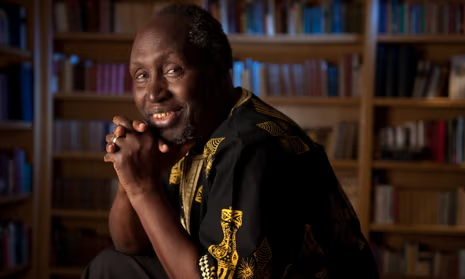
Ngugi wa Thiong’o, the revered Kenyan novelist, playwright, and scholar whose fearless critique of colonialism and post-independence elites reshaped African literature, passed away on Wednesday, May 28, 2025, in Buford, Georgia, at the age of 87.
His death, confirmed by his son Nducu wa Ngugi and his U.S. publisher, The New Press, marks the end of a remarkable six-decade career dedicated to chronicling Kenya’s turbulent journey from colonial subjugation to self-rule and advocating for the use of African languages in literature.
His Early Life
Born James Thiong’o Ngugi on January 5, 1938, in Kamiriithu, near Limuru, Kenya, Ngũgĩ grew up in a large Kikuyu family during the height of British colonial rule. His early life was profoundly shaped by the Mau Mau Uprising (1952–1960), a pivotal rebellion against colonial oppression.
The conflict touched him personally, his half-brother Mwangi was killed as a member of the Kenya Land and Freedom Army, another brother, Gitogo, was fatally shot by British forces due to his deafness preventing him from hearing a command, and his mother was tortured at a local home guard post.
These experiences of loss and resistance became a cornerstone of Ngũgĩ’s literary voice, infusing his work with themes of resilience and defiance.
Early Achievements and Literary Ascent
Ngũgĩ’s intellectual journey began at Alliance High School, an elite institution run by British missionaries, where his family’s sacrifices enabled his education.
He later attended Makerere University in Kampala, Uganda, earning a B.A. in English in 1963. At Makerere, he attended the 1962 African Writers Conference, where he shared manuscripts of his debut novel, Weep Not, Child, with Nigerian author Chinua Achebe. Published in 1964, it became the first major English-language novel by an East African writer, earning critical acclaim for its poignant depiction of the Mau Mau struggle.
His subsequent novels, The River Between (1965) and A Grain of Wheat (1967), solidified his reputation as a leading voice in African literature.
In 1967, Ngũgĩ embraced Fanonist Marxism and began teaching at the University of Nairobi, where he sparked a movement to abolish the English department, advocating for African literature and languages to take center stage.
By 1970, he renounced his colonial name, James, adopting Ngũgĩ wa Thiong’o, and vowed to write primarily in his native Gikuyu, a radical act to reclaim cultural identity.
His 1977 novel Petals of Blood sharply criticized Kenya’s post-independence elite, accusing them of perpetuating colonial inequalities.
Imprisonment and Exile
That same year, his play Ngaahika Ndeenda (I Will Marry When I Want), co-written with Ngũgĩ wa Mirii, provoked the Kenyan government under President Jomo Kenyatta, leading to its shutdown after six weeks and Ngũgĩ’s arrest.
Imprisoned without trial for nearly a year in Kamiti Maximum Security Prison, Ngũgĩ turned adversity into creativity, writing Caitaani Mũtharaba-Inĩ (Devil on the Cross), the first modern novel in Gikuyu, on toilet paper. Released in 1978 after Daniel arap Moi assumed the presidency.
Ngugi faced continued harassment and learned in 1982 of a plot to kill him, prompting a 22-year exile in the UK and later the US. During this period, he held professorships at Yale, New York University, and the University of California, Irvine, where he founded the International Center for Writing & Translation.
Literary Legacy and Awards
Ngũgĩ’s commitment to decolonizing literature extended beyond his fiction. In his seminal 1986 essay collection Decolonising the Mind, he argued that African writers must reject colonial languages like English and French to reclaim cultural authenticity, famously challenging peers like Chinua Achebe for writing in English.
His short story The Upright Revolution: Or Why Humans Walk Upright became the most translated African literary text, available in over 100 languages, surpassing Achebe’s Things Fall Apart.
His extensive body of work includes novels like Matigari (1986), Wizard of the Crow (2006), and The Perfect Nine (2020), as well as plays, memoirs (Detained: A Writer’s Prison Diary, 1981; Dreams in a Time of War, 2010), and children’s books.
Ngũgĩ’s accolades include the 2001 International Nonino Prize, the 2016 Park Kyong-ni Prize, the 2019 Premi Internacional de Catalunya, and the 2022 PEN/Nabokov Award, though the Nobel Prize for Literature, for which he was frequently nominated, eluded him, to the dismay of fans and scholars.
Personal Challenges and Health Struggles
Ngũgĩ’s personal life was complex and not without controversy. Married twice, first to Nyambura, with whom he had six children, and later to Njeeri, with whom he had two, he faced allegations of domestic abuse from his son Mũkoma wa Ngũgĩ in 2024.
Mũkoma claimed Ngũgĩ physically abused Nyambura, who died in 1996, sparking debate about his legacy. Ngũgĩ did not publicly respond to the allegations, which some argued overshadowed his literary contributions.
Health challenges also marked his later years. Diagnosed with prostate cancer in 1995 and given three months to live, Ngũgĩ defied the prognosis. He underwent triple bypass heart surgery in 2019 and battled kidney failure, yet continued writing and teaching until his final days.
Global Tributes and Enduring Impact
Ngũgĩ’s passing has prompted an outpouring of tributes. Kenyan President William Ruto praised his “undeniable patriotism” and “quest for truth,” while Professor Macharia Munene called his work a “true reflection of society.”
On X, South African politician Mbuyiseni Ndlozi mourned him as “Africa’s greatest literary pen” and a “warrior for indigenous African languages.”
Ngũgĩ wa Thiong’o leaves behind a towering legacy as a storyteller, activist, and scholar who challenged the linguistic and cultural vestiges of colonialism. His insistence on the power of African languages continues to inspire writers and readers worldwide, ensuring his voice endures in the global literary canon.
To provide the best experiences, we use technologies like cookies to store and/or access device information. Consenting to these technologies will allow us to process data such as browsing behaviour or unique IDs on this site. Not consenting or withdrawing consent, may adversely affect certain features and functions.
Functional
Always active
The technical storage or access is strictly necessary for the legitimate purpose of enabling the use of a specific service explicitly requested by the subscriber or user, or for the sole purpose of carrying out the transmission of a communication over an electronic communications network.
Preferences
The technical storage or access is necessary for the legitimate purpose of storing preferences that are not requested by the subscriber or user.
Statistics
The technical storage or access that is used exclusively for statistical purposes.The technical storage or access that is used exclusively for anonymous statistical purposes. Without a subpoena, voluntary compliance on the part of your Internet Service Provider, or additional records from a third party, information stored or retrieved for this purpose alone cannot usually be used to identify you.
Marketing
The technical storage or access is required to create user profiles to send advertising, or to track the user on a website or across several websites for similar marketing purposes.