
Home Blog Page 298

Mozambique’s Parliament Passes Landmark Law to Foster Peace and Reconciliation

0

In a historic step toward national reconciliation, Mozambique’s parliament unanimously passed a landmark law on April 2, 2025, aimed at restoring peace through inclusive national dialogue and constitutional reform.

The legislation, a cornerstone of a peace agreement signed on March 5 between President Daniel Chapo and all political parties, seeks to address longstanding political tensions exacerbated by the disputed October 9, 2024, general elections, which sparked protests resulting in approximately 360 deaths over five months.

The new law, titled the Political Commitment for an Inclusive National Dialogue, outlines three primary objectives: restructuring the state to enhance governance, depoliticizing institutions to curb partisan influence, and decentralizing political, economic, and financial power to grant greater regional autonomy.

Key reforms include revisions to presidential authority and the governance framework, as well as pardons for peaceful demonstrators convicted during post-election unrest.

The legislation is seen as a response to calls for electoral integrity and democratic accountability, particularly from opposition leader Venâncio Mondlane, who has contested the 2024 election results.

The passage of the law follows a significant meeting on March 23 between President Chapo and Mondlane, marking a potential breakthrough in easing political hostilities.

The ruling Mozambique Liberation Front (Frelimo), which holds 171 of the 250 parliamentary seats, hailed the law as a “historic opportunity to contribute to Mozambique’s renewal.”

Frelimo representative Feliz Sílvia emphasized its role in fostering trust among political actors and reducing instability.

However, opposition parties expressed cautious optimism. The Democratic Movement of Mozambique (MDM), with eight seats, welcomed the law but criticized the government’s delayed response to electoral fraud concerns.

“It took months of protests and bloodshed before those in power realized democracy cannot be sustained by force,” said MDM leader Fernando Bismarque.

The Optimist Party for the Development of Mozambique (Podemos), holding 43 seats, called the agreement a “turning point” but urged inclusivity, with leader Sebastião Mussanhane stressing that “young people should be political participants, not just electoral tools.”

The Mozambican National Resistance (Renamo), with 28 seats, voiced skepticism, citing a history of unfulfilled political agreements.

The law also includes provisions for justice system reform, such as mechanisms for appointing independent judicial heads, and electoral system changes to enhance transparency.

Human Rights Watch noted that the legislation aims to create platforms for broad societal dialogue, emphasizing the need for diverse representation and accountability for security forces implicated in post-election violence.

Political analysts caution that the law’s success hinges on genuine implementation.

“This is a step toward peace, but it requires commitment from all sides,” said a Maputo-based analyst.

The legislation builds on Mozambique’s history of peace accords, including the 1992 General Peace Agreement and the 2019 Maputo Accord, which ended decades of civil conflict but faced challenges in addressing systemic inequalities.

As Mozambique navigates this critical juncture, the international community is watching closely. The law’s passage signals hope for stability in a nation grappling with political divisions and economic challenges, but its impact will depend on translating promises into tangible reforms.

For now, Mozambicans await the next steps in this delicate process of rebuilding trust and fostering lasting peace.
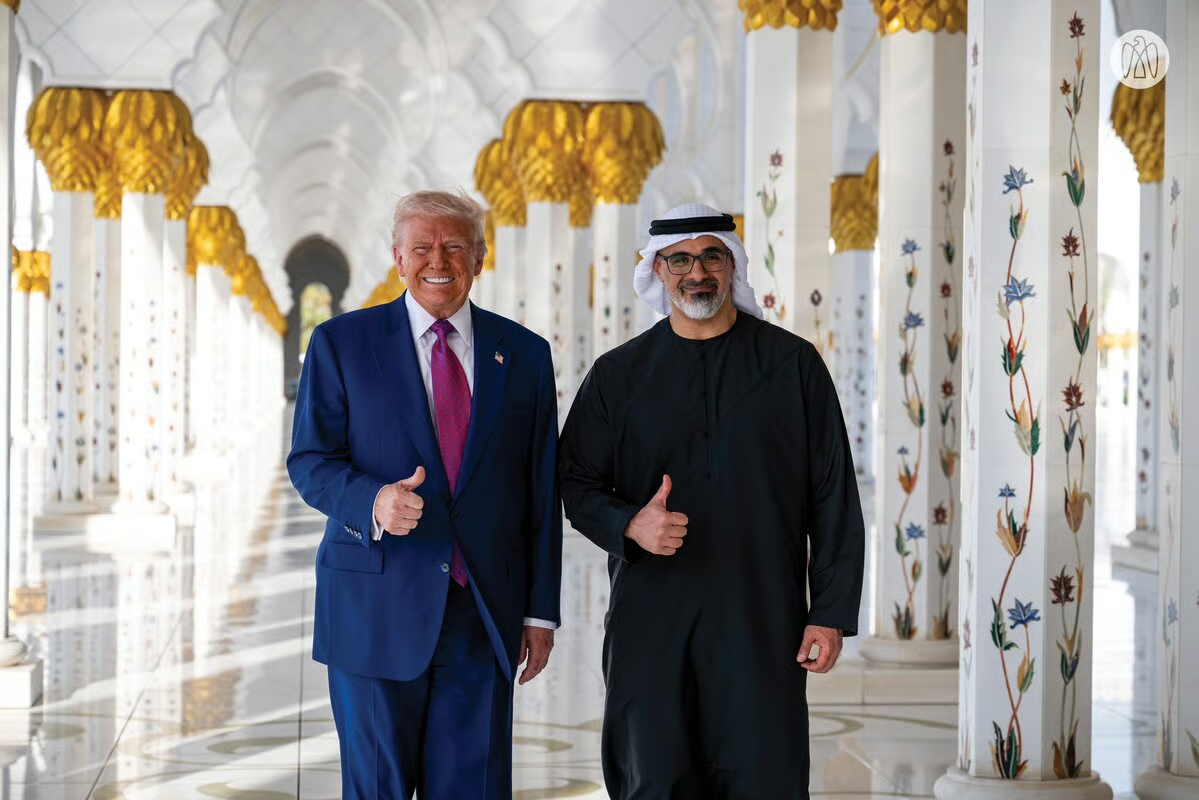
Trump Finalizes AI Semiconductor Deal with UAE as Part of $1.4 Trillion Investment Push

0

President Donald Trump has unveiled a new AI chip agreement with the United Arab Emirates (UAE), forming part of a broader $1.4 trillion initiative aimed at deepening technological cooperation between the two nations.

On Friday, Trump announced a major development in technology and trade relations with the UAE, granting the country access to high-end artificial intelligence (AI) semiconductors produced by American firms.

This announcement follows Trump’s recent visit to Abu Dhabi, where the deal was finalized. It marks a significant step forward both diplomatically and economically. The agreement comes at a time when the UAE is carefully balancing its longstanding relationship with the United States while expanding economic engagement with China, its top trading partner.

This arrangement is seen as a substantial advancement for the UAE’s goal of becoming a prominent force in AI innovation. Trump mentioned that safeguards would be in place to ensure proper handling of the chips, including American oversight of data centers involved.

“We’re making great progress for the $1.4 trillion that UAE has announced it intends to spend in the United States,” Trump said during his concluding stop on a tour of the Gulf region, which included Saudi Arabia and Qatar.

“Yesterday, the two countries agreed to create a path for UAE to buy some of the world’s most advanced AI semiconductors from American companies — a very big contract,” he added.

This deal is expected to contribute billions to both economies and tighten bilateral economic links. It also supports the UAE’s previously declared plan from March to invest $1.4 trillion in various U.S. industries over the next ten years, including energy, AI, and manufacturing.

“This deal will accelerate the UAE’s plans to become a really major player in artificial intelligence,” Trump noted.

The agreement also reflects the Trump administration’s strong belief in U.S. tech supremacy and its willingness to collaborate with global partners on cutting-edge innovations in a secure environment.

China Introduces One-Year Visa-Free Travel

0

China has introduced a new policy that grants citizens from five Latin American countries visa-free access for up to one year, in a bid to deepen regional partnerships.

Effective June 1, nationals from Brazil, Argentina, Chile, Peru, and Uruguay can travel to China without a visa for stays of up to 30 days, according to an announcement made by China’s Foreign Ministry on Thursday. This is part of a one-year trial arrangement.

“We welcome more foreign friends to visit China, to experience the colorful and vibrant China,” Foreign Ministry spokesperson Lin Jian said at a daily briefing.

Earlier this week, Beijing hosted the China-CELAC (Community of Latin American and Caribbean States) Forum, reinforcing its push to build stronger relationships in the region and serve as a strategic counterbalance to U.S. influence.

In recent months, China has relaxed visa policies for several countries — including most European nations, Japan, South Korea, Singapore, and Malaysia — to help stimulate economic recovery following strict pandemic-era restrictions. Additionally, mutual visa-free access between China and Uzbekistan for up to 30 days will begin on the same date, as confirmed by China’s Ministry of Foreign Affairs.

Violent Eruption of Japan’s Sakurajima Volcano Disrupts Flights

0

Mount Sakurajima, a well-known active volcano in Japan, erupted repeatedly on May 15 and 16, launching ash clouds as high as 3,000 meters and leading to the cancellation of 25 flights at Kagoshima Airport.

These cancellations left many travelers stranded, while airlines struggled to accommodate a sharp increase in rebooking and refund demands.

Flight disruptions as ash fills the skies
The volcanic activity, which started early on May 15, released dense ash clouds that drifted toward Kagoshima Airport. As a result, operations were halted from 5 pm.

Several major airlines, such as Japan Airlines (JAL) and Skymark Airlines, were forced to cancel flights connecting Tokyo Haneda, Osaka Itami, and Amami airports. One of JAL’s aircraft had to change course mid-flight to steer clear of the ash.

ANA All Nippon Airways proactively called off some services scheduled for May 16. Meanwhile, airport authorities stated they would monitor runway conditions throughout the night and use sweeping machines if necessary to remove volcanic material.

Passengers Stranded
As planes were grounded, many passengers turned to buses heading to Kagoshima City, causing significant crowding at bus terminals.

Staff at the airport noted an unusually high number of people at help desks, with many tourists frantically searching for accommodation and alternative transportation.

“This level of chaos is something we usually only see during typhoon season,” said an airport employee. “But unlike typhoons, volcanic eruptions are unpredictable, so we couldn’t prepare in advance.”

Extended eruption sparks safety alerts
The third eruption, which began at 10:45 a.m. on May 15, was the strongest and lasted over 12 hours, with loud explosive sounds continuing into the night.

Officials from Kagoshima’s meteorological office cautioned that if the eruptions extended beyond 3 a.m. on May 16, significant ash could fall over the mainland area. They advised motorists to be especially careful.

It’s the first occurrence since November 2019 that Sakurajima has continuously emitted smoke for more than ten hours. The ash plume soared as high as 3,000 meters.

La Liga Champions: How Lamine Yamal Drove Barcelona to Victory

0

Under the guidance of German coach Hansi Flick, FC Barcelona clinched the 2024/25 La Liga title, marking their 28th league championship. The decisive moment came with a 2–0 victory over Espanyol in the Catalan derby, featuring goals from Lamine Yamal and Fermín López. This win was part of an impressive campaign that also saw Barcelona secure the Supercopa de España and the Copa del Rey, achieving a domestic treble. 

Despite facing challenges mid-season, including a dip in form during November, the team demonstrated resilience by embarking on an unbeaten run of over 30 matches. This consistency, combined with pivotal victories in all Clásico matches against Real Madrid, underscored Barcelona’s dominance in Spanish football.

Lamine Yamal: Barcelona’s Teenage Sensation

Born on July 13, 2007, in Esplugues de Llobregat, Spain, Lamine Yamal is a product of Barcelona’s famed La Masia academy. He made his senior debut for the club at just 15 years old in April 2023. Standing at 1.80 meters, Yamal plays as a winger and is known for his exceptional dribbling, vision, and creativity on the field. 

Internationally, Yamal has represented Spain across various youth levels and made his senior debut in 2023, becoming the youngest player to represent and score for the national team at age 16. He played a significant role in Spain’s UEFA Euro 2024 victory, earning the tournament’s Young Player Award. 

His rapid rise has drawn comparisons to Lionel Messi, with Messi himself acknowledging Yamal’s potential, stating, “He has a huge future.”

Lamine Yamal’s Impact and Barcelona’s Future

Yamal’s influence on Barcelona’s attacking dynamics has been profound. His ability to challenge defenders and create opportunities has not only led to personal accolades but also opened up spaces for teammates, enhancing the team’s overall performance. 

However, this reliance has raised concerns about over-dependence. Statistics indicate that Barcelona’s win percentage drops significantly in matches where Yamal is absent, highlighting the need for strategic planning to ensure team resilience.

Looking ahead, Yamal’s commitment to the club is evident. He has expressed a desire to remain with Barcelona long-term, aspiring to become a club legend. 

Lamine Yamal’s emergence signals a promising future for FC Barcelona. His talent, coupled with the team’s recent successes, suggests a new era of potential dominance in both domestic and European competitions. As Yamal continues to develop, his journey will be pivotal in shaping the club’s trajectory in the coming years.

Ceasefire Declared in Tripoli After Deadly Clashes Between Rival Militias

0

After some of the heaviest fighting Tripoli has seen in years, calm returned to the Libyan capital on Wednesday following a government-declared ceasefire. Residents reported a reduction in violence, though no official casualty figures have been released.

The clashes began late Monday night after a prominent militia leader, Abdulghani Kikli—also known as Ghaniwa—was killed. Although the situation briefly stabilized on Tuesday morning, intense fighting resumed overnight, engulfing several districts across the city.

According to the defense ministry, “regular forces, in coordination with relevant security agencies, have begun implementing necessary steps to maintain order,” which includes deploying neutral police units without heavy weaponry around key infrastructure points.

Scenes from the aftermath showed scorched vehicles and buildings riddled with bullet holes. The violence highlighted the fragile state of security in Tripoli, with many fearing a broader conflict could emerge if external factions intervene.

The recent violence appears to have consolidated power under Prime Minister Abdulhamid al-Dbeibah, head of Libya’s internationally recognized Government of National Unity (GNU). Dbeibah, aligned with Turkey, moved swiftly to dismantle irregular militias following Ghaniwa’s death and the defeat of his Stabilisation Support Apparatus (SSA) by the 444 and 111 Brigades—both allied with the prime minister.

One significant holdout remains: the Special Deterrence Force (Rada), the last major Tripoli militia not aligned with Dbeibah. According to The Libyan Observer, intense battles unfolded between Rada and the 444 Brigade on Wednesday.

Fighting also spread to Tripoli’s western outskirts, traditionally an entry point for militias from the town of Zawiya, west of the capital. These developments have raised concerns about the potential for broader escalation beyond the capital.

In reaction to the unrest, Dbeibah ordered the disbandment of all irregular armed groups operating within the city.

The recent turmoil terrified many residents. “It’s terrifying to witness all this intense fighting. I kept my family in one room to stay safe from the shelling,” said a father of three from Dahra. Another resident, Mohanad Juma from Saraj, described brief pauses in gunfire followed by renewed outbreaks: “Each time it stops, we breathe a little easier—but then the shooting starts again.”

The United Nations Support Mission in Libya (UNSMIL) expressed deep concern over the violence in densely populated areas and urged all parties to uphold the ceasefire.

Libya has remained unstable since the 2011 NATO-backed uprising that toppled longtime ruler Muammar Gaddafi. The country has since been divided between rival eastern and western administrations, with Tripoli often at the heart of clashes among competing militias.

Despite the recent fighting, Libya’s major oil infrastructure—located in the southern and eastern regions—has not been impacted. Several oil engineers confirmed to Reuters that production remained steady. However, Sirte Oil Company, a National Oil Corporation (NOC) subsidiary, has suspended land transport to the west, including Tripoli, pending restoration of stability.

Burkina Faso Forces Accused of Mass Civilian Killings in Fulani Areas

0

Human Rights Watch (HRW) has accused Burkina Faso’s military and allied militia of carrying out a massacre that claimed the lives of at least 130 civilians in March, near the western town of Solenzo. The rights group detailed the findings in a report released Monday, attributing the killings to a counterinsurgency operation led by Burkinabè special forces.

The victims were primarily members of the Fulani community—a pastoralist, predominantly Muslim ethnic group that has frequently been accused by the government of supporting Islamist insurgents, a claim strongly rejected by Fulani leaders.

The HRW report links the military operation to widespread displacement and civilian deaths, stating that the massacre followed long-standing patterns of targeting ethnic communities under suspicion of militant affiliations.

Currently, around 40% of Burkina Faso’s territory is believed to be under the control of extremist groups aligned with al-Qaeda and the Islamic State, particularly in the Sahel region. Despite assurances from the ruling military junta to end the insurgency, attacks persist, leaving thousands dead and millions displaced.

Unconfirmed reports over the weekend suggested fresh militant attacks resulting in numerous military and civilian casualties. The BBC has not independently verified these claims, and the Burkina Faso authorities have not issued any statements.

Previously, the Burkinabè government dismissed HRW’s 2023 report—which accused the military of killing 223 villagers—as “baseless,” insisting that any human rights abuse allegations are subject to formal investigation.

In compiling its latest report, HRW says it interviewed eyewitnesses, members of local militias, journalists, and civil society actors. The organization also analyzed video footage circulated on social media, leading to its conclusion that the Burkinabè military was directly responsible for the March killings.

The group further reported that in April, jihadist groups killed at least 100 civilians in retaliatory attacks against communities perceived as aiding government forces.

“Mass killings by state forces, local militias, and Islamist groups constitute war crimes and potentially other atrocity crimes,” HRW said. The organization has called for immediate and thorough investigations and the prosecution of all perpetrators.

The report’s release coincides with junta leader Captain Ibrahim Traoré’s return from a diplomatic visit to Moscow, where he met with Russian President Vladimir Putin to discuss security cooperation in the Sahel. Since seizing power, the military-led government has shifted away from its former colonial partner France and increasingly aligned itself with Russia in its battle against insurgency.

Nigeria to Launch Four Advanced Satellites to Boost Security and Earth Observation

0

The Federal Executive Council has approved the launch of four new satellites aimed at improving Earth observation and strengthening Nigeria’s national security efforts. This announcement was made by Chief Uche Nnaji, the Minister of Innovation, Science, and Technology, during the 22nd National Council on Innovation, Science and Technology (NCIST) held in Abuja from May 12 to May 14. Themed “Research, Develop, Innovate and Commercialise: A Cycle for National Prosperity,” the event underscored the government’s commitment to leveraging innovation for development.

Minister Nnaji explained that the satellite initiative comprises three Earth Observation satellites and one Synthetic Aperture Radar (SAR) satellite. The SAR satellite, in particular, will provide high-resolution imagery in all weather conditions—day or night—offering critical support to military operations and security surveillance.

“With the Renewed Hope Agenda of President Bola Tinubu, Nigeria is actively addressing its challenges. The approval for the launch of these four multi-million-dollar satellites marks a significant leap in our technological capabilities,” Nnaji stated.

He noted that the new technology will help reduce reliance on foreign satellite data, especially for surveillance in high-risk zones like the Sambisa Forest.

On the policy front, Nnaji highlighted the ongoing review of the National Science, Technology and Innovation Policy. He said an inter-ministerial committee is currently working on strategies to establish a National Research and Innovation Fund aimed at bridging the gap between academic research and industrial application.

“As a nation, we can no longer afford the disconnect between research and real-world implementation,” Nnaji emphasized. “Despite our wealth of academic research, much of it remains unused due to a lack of support systems, funding, and industry linkage.”

He expressed hope that the resolutions from the council meeting would trigger a new era where innovation becomes a viable career path and inventions transition seamlessly from concept to commercialization.

Highlighting the importance of collaboration, the minister called on the private sector to invest in research and development (R&D) while urging the government to strengthen regulations that support innovation ecosystems.

He also confirmed that the council’s outcomes would be forwarded to the Federal Executive Council for adoption. The 22nd NCIST meeting, originally slated for 2024, was postponed to 2025 due to unforeseen challenges, but preparations for the 23rd edition are already underway to realign with the regular schedule.

Permanent Secretary Mrs. Esuabana Nko-Asanye described the council as a pivotal platform for fostering collaboration across sectors. She noted that the council received 109 memoranda covering a broad spectrum of national issues—from climate change and unemployment to economic diversification and technological capacity building.

“These submissions present innovative proposals and practical recommendations that will strengthen the role of science, technology, and innovation in driving national development,” she said. “Key focus areas include commercializing indigenous research, enhancing R&D funding, and building innovation capacity in emerging sectors like health, agriculture, energy, and education.”

She added that the depth and diversity of the submissions reflect a growing recognition of the importance of science and technology in Nigeria’s sustainable growth.

In his remarks, Senator George Akume, Secretary to the Government of the Federation, represented by Dr. Morris Mbaeri, stressed the urgency of building a strong innovation ecosystem to ensure sustainable development.

“This cycle of research, development, innovation, and commercialization is vital to solving real-world problems and unlocking long-term prosperity,” Akume noted, calling for stronger collaboration between academia, industry, and government.

Prof. Azikiwe Onwualu, President of the African University of Science and Technology, echoed similar sentiments, urging the government to increase its R&D spending to at least three percent of GDP. He also advocated for more innovation clusters that bring together universities, industries, and startups to drive project implementation.

Nigeria Secures $8 Billion in Oil and Gas Investments

0

The Federal Government of Nigeria has announced a significant milestone in its energy sector—over $8 billion in investments secured within a year for deepwater and gas projects. This surpasses the earlier reported $6.7 billion investment projection for 2024.

Olu Verheijen, Special Adviser to the President on Energy, shared this development at the 2025 Africa CEO Forum held in Abidjan, Côte d’Ivoire. In a speech obtained by our correspondent, Verheijen attributed this achievement to a series of government-led reforms aimed at enhancing investor confidence.

Key reforms include improved fiscal policies, faster project approval processes, clearer regulations, and targeted reforms in the power sector, particularly those that enhance the commercial viability of gas-to-power initiatives.

“In under a year, Nigeria unlocked over $8 billion in Final Investment Decisions (FIDs) for deepwater and gas projects,” Verheijen stated. “This was achieved through bold presidential actions that improved fiscal terms, shortened contracting timelines, and reformed power sector regulations. Investors responded positively—we moved from gridlock to greenlight.”

Recent major FIDs include the Bonga North Deepwater Project and the Ubeta Gas Field, signaling increased investor trust in Nigeria’s energy landscape and regulatory stability.

Despite this progress, the demand for gas infrastructure remains high. Dr. Ogbonnaya Orji, Executive Secretary of the Nigeria Extractive Industry Transparency Initiative, noted that Nigeria needs $20 billion annually over the next decade to meet its gas infrastructure goals.

Verheijen urged African policymakers to adopt a commercially driven mindset rather than relying on emotional appeals to “African capital.” She emphasized that capital is globally opportunistic and seeks competitive, risk-adjusted returns.

“Capital has no passport,” she said. “It is neither African nor foreign—it is rational. Emotional appeals distract from the core issue: competitiveness.”

She cited data showing that Africa attracted $340 billion in upstream investment from 2011–2015, but forecasts suggest a sharp decline to below $130 billion between 2026 and 2030—a trend she described as a “structural decimation.”

To counter this, she called for mutually beneficial partnerships, stable policies, and enhanced project economics. She referenced successful examples of global capital flow to regions like the Permian Basin, Guyana, and Brazil—regions known for strong returns, low emissions, and regulatory clarity.

“If Africa wants a slice of the $500 billion spent annually on upstream projects globally, we must be clear, competitive, and investor-ready,” Verheijen said.

She also called on domestic financial institutions—development banks, pension funds, and sovereign wealth funds—to bridge the financing gap left by retreating international oil companies. She emphasized that African investors have a unique edge in domestic gas, shelf, and onshore operations due to their familiarity with local dynamics.

Highlighting the growing role of African private sector leaders, she referenced the Renaissance Africa Energy Consortium’s acquisition of Shell’s onshore JV and the operational success of the Dangote Refinery as signs of a broader shift toward indigenous control.

She further noted a leap in local ownership, with indigenous equity in Nigeria’s gas sector rising from 69% to 83%, describing it as a “seismic shift in ownership and control.”

However, Verheijen acknowledged the continued importance of international capital, especially as major oil companies shift focus from volume to value—targeting low-cost, low-carbon, de-risked assets.

“Africa must align with this shift,” she said. “We can’t negotiate on capital that hasn’t arrived. Investment must come first, then the returns.”

In conclusion, Verheijen urged African nations to become intentional investment destinations. “We must move from requesting support to designing environments that attract capital,” she said. “When we get it right, capital won’t hesitate—it will chase us. The future of Africa must be built deliberately and unapologetically.”

DSS Drags Pat Utomi To Court Over Shadow Government

0

The Department of State Services (DSS) has filed a lawsuit against Prof. Pat Utomi, a former presidential candidate, at the Federal High Court in Abuja, accusing him of establishing an illegal shadow government.

The suit, marked FHC/ABJ/CS/937/2025, lists Utomi, the 2007 African Democratic Congress presidential candidate, as the sole defendant, alleging that his actions aim to unlawfully challenge the executive authority of President Bola Tinubu.

Utomi recently announced the creation of a 39-member shadow government, claiming it was a response to the alleged mismanagement of governance by the Tinubu-led Federal Government.

While the Federal Government and the All Progressives Congress criticized the initiative, Utomi maintained that his actions were within his constitutional rights.

In the suit filed by its lawyer, Akinlolu Kehinde (SAN), the DSS labeled Utomi’s shadow government as unlawful, asserting that it seeks to incite public discontent against President Tinubu.

The agency argued that Utomi’s creation of a parallel cabinet violates the 1999 Constitution of the Federal Republic of Nigeria.

The DSS alleged that Utomi used public statements, social media, and other platforms to promote his shadow government, positioning it as a challenge to the legitimacy of Tinubu’s democratically elected administration.

According to the DSS, during the inauguration of the ‘shadow cabinet’, Utomi reportedly stated that it includes the Ombudsman and Good Governance portfolio to be led by Dele Farotimi; a Policy Delivery Unit team comprising Oghene Momoh, Cheta Nwanze, Daniel Ikuonobe, Halima Ahmed, David Okonkwo, and Obi Ajuga; as well as a Council of Economic Advisers.

The DSS stated: “Based on the intelligence gathered by the plaintiff, the activities and statements made by the defendant and his associates are capable of misleading segments of the Nigerian public, weakening confidence in the legitimacy of the elected government, and fuelling public disaffection.”

The agency warned that, if not addressed, the shadow government could destabilize Nigeria, provoke political unrest, and jeopardize national security by fostering chaos.

The agency further contended that such a structure risks escalating inter-group tensions and encouraging unlawful actors or separatist movements to establish similar parallel systems, posing a significant threat to national security.

“The plaintiff, in the discharge of its statutory duties, has gathered intelligence confirming that the defendant’s actions pose a clear and present danger to Nigeria’s constitutional democracy,” the DSS stated.

The DSS argued that Utomi’s actions constitute an attempt to mimic or usurp executive powers, violating Sections 1(1), 1(2), and 14(2)(a) of the 1999 Constitution (as amended), which vest governance exclusively in institutions established through democratic elections.

“The Federal Government of Nigeria has made several efforts to engage the defendant to dissuade him from this unconstitutional path, including statements made by the Minister of Information, but the defendant has remained defiant,” the agency noted.

The DSS urged the court to declare Utomi’s shadow government unconstitutional, describing it as a severe assault on the Nigerian Constitution and a threat to the democratically elected government.

“It is in the interest of justice, national security, and the rule of law for this honourable court to declare the existence and operations of the defendant unconstitutional and illegal,” the DSS submitted.

The agency requested that the court rule the “shadow government” or “shadow cabinet” unconstitutional, asserting that it represents an attempt to create a parallel authority not recognized by the 1999 Constitution.

The DSS also sought a judicial affirmation that, under Sections 1(1), 1(2), and 14(2)(a) of the constitution, any governmental structure or authority operating outside constitutional provisions is null and void.

Additionally, the DSS asked for “an order of perpetual injunction restraining the defendant, his agents, and associates from taking any steps towards establishing or operating a ‘shadow government,’ ‘shadow cabinet,’ or any similar entity not recognised by the Constitution.”

The agency supported its claims by citing Section 1(1) of the 1999 Constitution, which establishes the Constitution’s supremacy, Section 1(2), which prohibits unconstitutional governance, and Section 14(2)(a), which affirms the sovereignty of the people.

In an affidavit accompanying the suit, the DSS identified itself as Nigeria’s primary domestic intelligence and security agency, tasked with detecting and preventing internal threats, including subversive activities that could undermine national unity.

The agency emphasized its responsibility to protect the lawful authority of the Federal Republic of Nigeria and its institutions.

The DSS reiterated that Utomi had publicly declared the formation of a shadow government, assigning individuals to various ministerial roles.

A hearing date for the case has yet to be scheduled by the court.
