Home Blog Page 305

Asian Markets Climb Amid Renewed Hopes for US-China Trade Deal

0

Asian stock markets advanced on Thursday as investors grew optimistic about easing trade tensions between the United States and China ahead of high-level negotiations scheduled for the weekend. The rally followed U.S. President Donald Trump’s announcement of an impending “major trade deal,” fueling market speculation and boosting investor sentiment.

Recent calm in global markets has been supported by the hope that Washington will resolve disputes with key trading partners, avoiding further escalation of tariffs that could harm the global economy. This sentiment gained further traction after U.S. and Chinese officials confirmed that top-level talks would take place on Saturday and Sunday in Switzerland. Key attendees include U.S. Treasury Secretary Scott Bessent, Trade Representative Jamieson Greer, and Chinese Vice Premier He Lifeng.

The talks come on the heels of aggressive tariff measures, with the U.S. imposing 145% duties on Chinese goods and China responding with 125% levies of its own. The upcoming meeting is widely seen as a critical opportunity to de-escalate tensions between the world’s two largest economies.

In a separate development, Trump teased a major trade agreement with an unnamed “large, highly respected country,” prompting speculation across trading floors. Reports from the New York Times suggest the country may be the United Kingdom, as the British pound strengthened against the U.S. dollar during early Asian trading.

Positive momentum from Wall Street carried into Asia, with major markets posting gains:

  • Tokyo (Nikkei 225): +0.2% at 36,863.15
  • Hong Kong (Hang Seng): +0.9% at 22,895.17
  • Shanghai (Composite Index): +0.1% at 3,345.57
  • Other gainers: Sydney, Seoul, Wellington, Taipei, Manila, and Jakarta

Despite the market upswing, concerns remain over the broader implications of the U.S. administration’s trade policies. Federal Reserve Chair Jerome Powell warned that prolonged tariff increases could lead to inflation, slower economic growth, and higher unemployment. The Fed maintained its interest rate position, citing increasing uncertainty in the economic outlook.

Powell emphasized that “a great deal of uncertainty” surrounds trade policy and said any significant policy shift—such as a rate cut—would require clear signs of economic weakness. Analysts believe the Fed is unlikely to act until July, as current job market data suggests stable momentum.

Key Currency and Commodity Movements at 02:30 GMT:

  • Euro/Dollar: $1.1317 (up from $1.1301)
  • Pound/Dollar: $1.3347 (up from $1.3286)
  • Dollar/Yen: 143.70 yen (down from 143.89 yen)
  • West Texas Intermediate Crude: +0.3% at $58.26/barrel
  • Brent Crude: +0.3% at $61.27/barrel

Major Global Indexes:

  • New York – Dow Jones: +0.7% at 41,113.97
  • London – FTSE 100: -0.4% at 8,559.33

Investors now turn their focus to the upcoming trade talks and Trump’s promised announcement, both of which could set the tone for global markets in the days ahead.

Senate Passes Tax Reform Bills, Retains 7.5% VAT

0

The Nigerian Senate has passed two key tax reform bills proposed by President Bola Tinubu, marking a major milestone in efforts to restructure the country’s tax administration and fiscal policies.

The approved bills—Nigeria Revenue Service (Establishment) Bill and the Nigeria Tax Administration Bill—were passed on Wednesday, May 7, 2025, after extensive debates and scrutiny. Crucially, the Senate chose to retain the Value Added Tax (VAT) rate at 7.5%, rejecting proposals for a gradual increase to 15% by 2030.

The two remaining tax reform bills—the Nigerian Tax Bill and the Revenue Tax Board Bill—are scheduled for deliberation on Thursday, May 8.

Led by Senator Sani Musa, the Senate Committee on Finance played a pivotal role in refining the bills, incorporating stakeholder feedback to address widespread concerns. Senate President Godswill Akpabio commended the collaborative efforts, highlighting that the reforms reflect broad national consensus.

“These tax laws will optimize revenue collection and benefit all Nigerians, not just a select few,” Akpabio emphasized, dismissing claims of regional bias.

One of the notable components of the reform is the restructuring of the Federal Inland Revenue Service (FIRS) into the Nigeria Revenue Service, granting it broader powers to enhance tax compliance and streamline collection processes.

Additionally, the Senate approved a new VAT revenue-sharing formula:

  • 55% to states
  • 35% to local governments
  • 10% to the federal government

This change aims to deepen fiscal decentralization and give sub-national governments greater control over revenue use.

In a move to protect vulnerable citizens, the reforms exempt essential goods and services—such as food, education, healthcare, and public transportation—from VAT. Businesses are also expected to benefit from VAT credits on assets and production costs, potentially reducing operating expenses and consumer prices by up to 7.5%.

The Presidential Committee on Fiscal Policy and Tax Reforms applauded the Senate’s action, stating that the new framework will simplify Nigeria’s tax system, improve compliance, and foster economic growth by boosting household income and reducing cost-of-living pressures.

However, not all reactions have been positive. While organizations like NACCIMA are withholding comments pending further clarification on the implementation framework, civil society groups and religious bodies have raised concerns.

The Nigerian Supreme Council for Islamic Affairs has requested adjustments to align the reforms with Shariah principles, while critics such as the Movement for Socialist Alternative argue that the bills still favor the wealthy through selective tax exemptions, missing an opportunity to address deep-seated inequality.

As the Senate prepares to consider the final two bills and align them with the House of Representatives’ versions, all eyes are on President Tinubu, whose assent will determine whether these reforms become law.

If signed, the legislation could reshape Nigeria’s tax landscape, improve revenue distribution, and position the country for long-term economic recovery amid current challenges like inflation and fiscal deficits.

2025 UEFA Champions League Final: PSG vs. Inter Milan

0

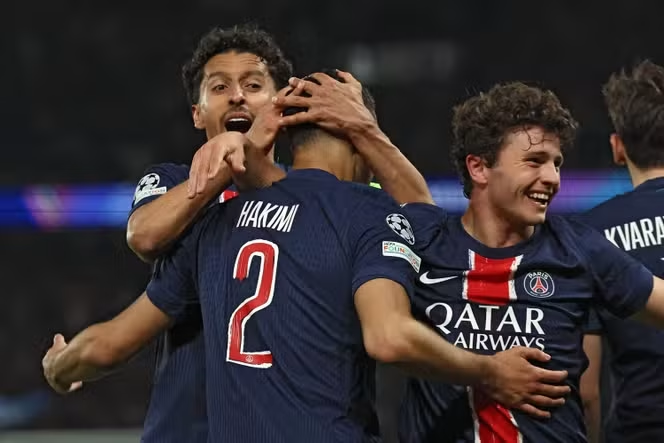
The 2025 UEFA Champions League final promises to be a captivating spectacle as Italian heavyweights Inter Milan square off against French champions Paris Saint-Germain (PSG) in Munich. This clash of two European giants marks the first competitive meeting between these sides, setting the stage for an enthralling battle of tactical wits and individual brilliance.

Team Analysis

Inter Milan

The reigning Serie A champions have crafted a balanced and experienced squad that blends defensive solidity with attacking flair. Central to their success is striker Lautaro Martinez, who has netted nine goals in this year’s Champions League campaign. His sharp movement and finishing ability will be pivotal against PSG’s high defensive line.

In defense, Inter relies on the calm presence of Alessandro Bastoni and the veteran leadership of goalkeeper Yann Sommer. Meanwhile, the attacking versatility of Nicolo Barella and the marauding runs of Federico Dimarco offer Inter multiple routes to unlock PSG’s defense.

Key Strengths:

  • Defensive organization anchored by Bastoni and Sommer.
  • Clinical finishing from Lautaro Martinez.
  • Midfield dynamism led by Barella and Dimarco.

Paris Saint-Germain (PSG)

PSG, underpinned by a new wave of youthful energy, has been dynamic and aggressive throughout the tournament. Young stars like Warren Zaire-Emery and Ousmane Dembele bring pace and unpredictability, while Fabian Ruiz has been a crucial box-to-box link, orchestrating play and helping PSG sustain pressure in the midfield.

PSG’s pressing style and midfield intensity will be key weapons, aiming to disrupt Inter’s buildup play and exploit transitions. However, their conversion in the final third has at times let them down—a factor they must rectify to stand a chance in Munich.

Key Strengths:

  • Energetic pressing and quick transitions.
  • Midfield control led by Ruiz and Zaire-Emery.
  • Pace on the flanks with Dembele.

Who’s Favored?

Inter Milan enters the final as the slight favorite. Their experience in major finals and cohesive tactical structure give them an edge in a high-stakes encounter. They’ve proven themselves capable of grinding out results and seizing key moments in big games—a trait that could prove decisive.

However, PSG’s youthful exuberance and technical quality can’t be underestimated. If they can improve their finishing efficiency and maintain their pressing game, they have the tools to cause an upset.

Key Challenges for PSG

  • Efficiency in front of goal: PSG must convert their chances to trouble Inter’s disciplined defense.
  • Breaking down Inter’s defensive block: Inter’s defensive setup is notoriously hard to breach, so PSG must remain patient and precise.
  • Keeping composure in transitions: Inter’s counters are lethal, and any slip in PSG’s pressing can be punished swiftly.

This final promises to be a tactical chess match between PSG’s energetic pressing and Inter Milan’s balanced, versatile play. Inter’s experience and defensive resilience make them the favorites, but PSG’s youthful flair and midfield power could tilt the scales in their favor if they can rise to the occasion.

Black Smoke Persists: No Pope Elected in Vatican Conclave

6

The Vatican conclave to elect a successor to Pope Francis, who passed away on April 21, 2025, officially began on Wednesday, May 7, but has yet to yield a new pontiff.

At 9:00 p.m. local time (3:00 p.m. EDT) on Wednesday, black smoke emerged from the chimney of the Sistine Chapel, signifying that no candidate among the 133 cardinal electors secured the required two-thirds majority (89 votes).

Earlier that day, the conclave was preceded by a solemn Mass led by Cardinal Giovanni Battista Re, who called for the election of a pope capable of renewing faith and hope. The cardinals entered the Sistine Chapel at 4:15 p.m., taking oaths before the chapel was sealed for voting.

The first vote, traditionally inconclusive, confirmed expectations with black smoke. Yet, the 45,000 faithful gathered in St. Peter’s Square remained hopeful.

On Thursday morning, two additional ballots also failed to elect a pope. At 11:50 a.m., black smoke again poured from the chapel chimney. Voting is set to continue at 4:00 p.m., with more smoke expected at 5:30 p.m. or 7:00 p.m. local time. Approximately 15,000 people continue to gather, watching for the moment when white smoke signals the birth of a new papacy.

This conclave’s voting pace is consistent with previous elections: Pope Francis was chosen after five ballots in 2013, Benedict XVI after four in 2005, and John Paul II after eight in 1978.

Among the leading candidates are Cardinal Pietro Parolin and Cardinal Luis Antonio Tagle, though the diversity of the electors—representing 70 nations—adds to the unpredictability.

The world now awaits the historic “Habemus Papam” announcement, as the conclave continues its solemn duty beneath the iconic frescoes of Michelangelo, with the hopes and prayers of over a billion Catholics resting on the outcome.

EFCC, GTBank, VDM: What Are The Issues

22

Popular Nigerian social media influencer Martins Vincent Otse, better known as VeryDarkMan (VDM), was taken into custody on Friday 2nd May 2025 by the Economic and Financial Crimes Commission (EFCC).

Initial reports indicated that Guaranty Trust Bank (GTB) may have played a role in VDM’s arrest, which followed his public criticism of the bank after claims of unauthorised transactions from his mother’s account.

His arrest has triggered strong reactions online, with many questioning the alleged role of the bank involved in what critics are calling a targeted crackdown.

Why Really Was VDM Arrested?

EFCC spokesperson Dele Oyewale confirmed that the social critic was detained following petitions submitted by unidentified individuals.

“We have some petitions against him that we are working on. He has some issues with us,” said Mr Oyewale.

GTB Reaction

As of press time, Guaranty Trust Bank (GTBank) has not issued any public statement regarding the arrest of Martins Vincent Otse, popularly known as VeryDarkMan (VDM), by the Economic and Financial Crimes Commission (EFCC).

VDM’s Lawyer’s Reaction

VDM’s arrest and confirmation came from activist and lawyer Deji Adeyanju, who shared details in a post on his official Facebook page Friday evening.

According to Adeyanju, VDM was held inside the exit door of the bank for more than five minutes, an action he described as deliberate to allow EFCC officials to carry out the arrest.

“VDM was locked inside the GTB exit door for over 5 mins to enable EFCC arrest him and his friend,” Adeyanju said.

In a later update, Adeyanju explained that a team of lawyers from his firm, led by Marvin_Omorogbe, had met with VDM’s friend, who was also arrested and held at EFCC custody.

“VDM refused to come out of the cell; that he won’t see anyone.

“We have located VDM and are working on getting him out. Our lawyers are now with him,” Adeyanju added.

He further stated, “We will be taking legal actions against GTB for the inhumane treatment meted out to our client.”

Social Media Reactions

The arrest has drawn criticism from netizens, civil society groups, and activists, many of whom are calling for the immediate release of the social commentator.

Political activist Omoyele Sowore, in a Facebook post on Sunday, suggested that the EFCC is now trying to justify VDM’s detention by preparing to bring him before a court on Monday.

“It has been established that the EFCC unlawfully arrested and detained Martins Vincent Otse, aka VDM, as a means to silence him for accusing the agency and its leaders of corruption and malfeasance.

“The EFCC is currently exploring legal avenues to charge him to court, possibly tomorrow, in an attempt to legitimise their actions,” Mr Sowore stated.

Mr Obi in a statement posted on his X page on Sunday described the arrest of VeryDarkMan (VDM) to an abduction, highlighting concerns over the excessive use of force, lack of transparency, and absence of civility during the process.

He cautioned that such methods of arrest could instill fear among citizens and potentially be mimicked by criminals.

He said, “The recent developments in our nation continue to raise serious concerns about our direction as a democracy. The tension in the land aggravated by hardship is needlessly fueled by our attitude to the rule of law and human rights. The arrest of Martin Vincent Otse, popularly known as VeryDarkMan (VDM), though perhaps within the legal rights of security agencies, left many Nigerians unsettled.

“If Nigerians begin to struggle to distinguish between legitimate arrests and unlawful abductions, we will lose a vital layer of national security and accountability. This trend is not new. We must recall that even our esteemed judges, the last line of defence for justice, have suffered similar indignities in recent years. When those who interpret the law are treated with such disregard, it is difficult to expect ordinary citizens to feel protected under the law.”

Cardinals Begin Papal Conclave to Elect New Pope at the Vatican

0

The Catholic Church, with its 1.4 billion members, is now waiting for the election of its next leader a moment that could shape the future of the faith. Catholic cardinals attended a special Mass at St. Peter’s Basilica on Wednesday, May 7, just a few hours before they started the secret vote, known as the conclave, to choose a new pope.

A total of 133 cardinals, who are allowed to vote, walked into the basilica in a formal procession while a choir sang.

The Mass was led by Cardinal Giovanni Battista Re. He opened the ceremony by swinging a censer with incense around the altar and blessing a statue of the Virgin Mary.

After the Mass, the cardinals moved to the Vatican’s Sistine Chapel, where they began the private conclave to elect a successor to Pope Francis, who died last month.

Over 130 Catholic cardinals from around the world are now meeting at the Vatican to begin the conclave. This tradition has been used for centuries to elect a new pope after a papacy ends.

According to the Vatican, 108 of the cardinals are taking part in the conclave for the first time. Only five cardinals voted in the 2005 conclave that elected Pope Benedict XVI: Philippe Barbarin of France, Josip Bozanić of Croatia, Péter Erdő of Hungary, Vinko Pulić of Bosnia, and Peter Turkson of Ghana.

The conclave is taking place behind closed doors in the Sistine Chapel. All cardinals are cut off from the outside world, and no contact is allowed until a new pope is chosen. This rule is meant to protect the fairness and secrecy of the process. Voting will continue until one person receives a two-thirds majority.

“When the choice is made, white smoke will billow from the Apostolic Palace. It is a sign to the world that the Church has a new shepherd,” a Vatican spokesperson said.

Once the white smoke appears, the newly elected pope will step onto the balcony of St. Peter’s Basilica to greet the public. This marks the beginning of his time as pope.

Some experts believe the process will go smoothly, but there is no clear favorite.

“The winner is not a foregone conclusion. Though this conclave is expected to be less divisive than past ones, it’s still wide open,” said a senior Vatican analyst.

Pilot Error, Equipment Failure Blamed for Crash That Killed Herbert Wigwe – U.S. Report

0

The deadly helicopter crash that killed Access Holdings CEO Herbert Wigwe, his wife Doreen, their son Chizi, and former Nigerian Exchange Group Chairman Abimbola Ogunbanjo resulted from pilot error and defective equipment, as detailed in a final report issued by the United States National Transportation Safety Board (NTSB) on May 7, 2025.

The incident took place on February 9, 2024, near the California-Nevada border. The NTSB determined that the pilot persisted with visual flight rules (VFR) despite worsening weather conditions that necessitated instrument flight procedures. This choice caused the pilot to suffer spatial disorientation, leading to a loss of control and the helicopter’s impact with the ground.

The report also pointed out major deficiencies in the helicopter operator’s safety management. Investigators noted that the company failed to properly manage safety procedures, including flight risk evaluations, maintenance records, and adherence to aviation regulations.

A key piece of equipment, the helicopter’s radar altimeter, was inoperative during the flight. The pilot had previously flagged issues with this device to the company’s maintenance director. Despite unsuccessful attempts to fix it, both the pilot and the maintenance director chose to proceed with the flight, knowing the equipment was faulty.

Additionally, after collecting the charter passengers, there was no documented communication between the pilot and the company’s flight follower about the defective equipment or the current weather conditions. The NTSB stressed that these lapses played a significant role in the tragic incident.

All six individuals aboard the helicopter, registered as N130CZ, perished in the crash. The NTSB’s conclusions highlight the vital need for rigorous compliance with flight safety standards and proper equipment maintenance to avoid such disasters.

At Least 26 Killed in Overnight Indian Airstrikes on Pakistan

0

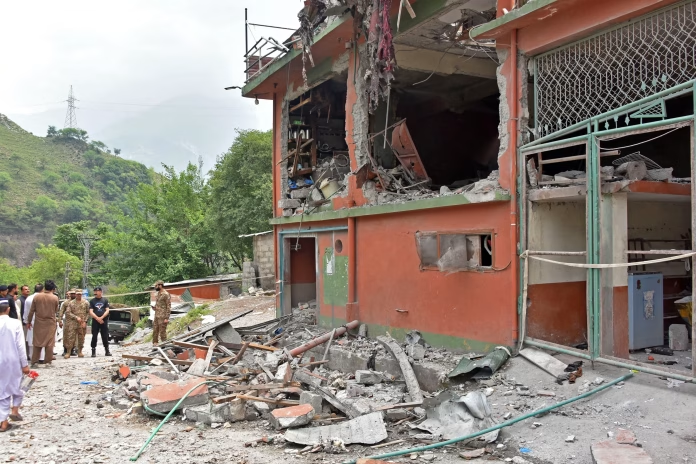
Indian air raids carried out overnight have resulted in the deaths of at least 26 individuals and left many others wounded across Pakistan, according to military sources in the country.

Describing the offensive as a “blatant act of aggression,” the Pakistani armed forces condemned the operation. An Indian official, however, offered a contrasting narrative, labeling the move as “measured, non-escalatory, proportionate and responsible.”

The aerial attack, which follows a missile strike from Tuesday, has further intensified hostilities. India continues to hold Pakistan accountable for an April attack in the disputed Kashmir territory—a charge Islamabad firmly denies. That earlier incident, known as the Pahalgam attack, had left 26 people dead in the Indian-administered portion of Kashmir.

In response to Tuesday’s escalation, Pakistani officials had vowed retaliation “from the air and ground.” Reaffirming that stance on Wednesday, they stated Pakistan “reserves the right to respond, in self-defense, at a time, place, and manner of its choosing.” Following a session of the National Security Committee, a government statement emphasized that “the Armed Forces of Pakistan have duly been authorized to undertake corresponding actions in this regard.”

India’s military later acknowledged the latest strikes in a statement that read its actions were “responding appropriately in a calibrated manner.”

Indian Foreign Secretary Vikram Misri defended the overnight operations as precautionary, arguing that Islamabad had not sufficiently acted against “terrorist infrastructure on its territory or on territory under its control.”

According to two Indian defense sources, the strikes targeted nine different sites and lasted roughly 25 minutes. The officials asserted that the objectives were hit and warned that India is ready to respond to “Pakistani misadventures” that could “escalate the situation.”

Pakistan claimed that the strikes affected multiple areas within its territory, not limited to Pakistan-administered Kashmir. It further alleged that a hydroelectric facility in the region was among the targets.

Military spokesperson Lt. Gen. Ahmed Sharif Chaudhry stated during a press briefing that 46 individuals were injured during the airstrikes. Meanwhile, Pakistan’s Ministry of Foreign Affairs said India’s lead diplomat in Islamabad had been summoned in protest.

Calling the strike a breach of its territorial rights, the Ministry remarked, “The Indian side was warned that such reckless behavior poses a serious threat to regional peace and stability.”

The U.S. Mission in Pakistan released an alert on Wednesday, saying officials were “aware of reports of military strikes by India into Pakistan.”

“This remains an evolving situation, and we are closely monitoring developments,” the message read, noting that a “Do Not Travel” warning remains for areas near the India-Pakistan border “due to terrorism and the potential for armed conflict.”

“We advise U.S. citizens to depart areas of active conflict if they can safely do so, or to shelter in place,” the alert continued.

FG Launches Overhaul of NYSC Scheme, Introduces Teachers and Medical Corps for National Development

0

The Federal Government has initiated a comprehensive reform of the National Youth Service Corps (NYSC) with the inauguration of a committee tasked with overhauling the scheme. The goal is to make NYSC more impactful, relevant to current realities, and aligned with the nation’s development needs.

This move follows growing concerns over the safety of corps members, substandard facilities, and questions about whether the scheme remains effective in today’s socio-economic landscape. The committee was officially inaugurated in Abuja on Tuesday with representatives from government, civil society, and the private sector present.

Speaking at the inauguration, the Minister of Youth Development, Ayodele Olawande, acknowledged the significance of NYSC since its inception in 1973 in fostering national unity and youth development.

He said, “The issues of corps members’ safety, infrastructural challenges, and the broader question of the scheme’s relevance in an increasingly dynamic socio-economic environment are among the key concerns. However, these challenges also present opportunities that require urgent, visionary, and determined action.”

Olawande noted that the committee would thoroughly examine NYSC operations and recommend changes to enhance its safety, creativity, and overall impact.

“The outcome of this review must align with broader national development objectives, positioning the NYSC as a strategic tool for youth empowerment and nation-building,” he added.

The committee is expected to review current policies, engage with stakeholders nationwide, propose legislative and operational reforms, and recommend improved funding and monitoring mechanisms. Their findings and suggestions will be presented to the minister within a set timeframe.

Meanwhile, the Minister of Education, Maruf Tunji Alausa, revealed that the government also plans to launch a Teachers’ Corps and a Medical Corps to address critical gaps in education and healthcare, especially in rural areas.

Alausa said, “The Teachers’ Corps would help bridge educational gaps and create a pathway to government employment, while the Medical Corps would strengthen healthcare delivery in underserved areas, addressing critical issues such as maternal and child health.”

Also speaking at the event, the Special Adviser to the President on Policy and Coordination, Hadiza Usman, highlighted the importance of improving technical and vocational skills among Nigerian youth.

“Such alignment would empower young people to make meaningful, long-term contributions to their communities and to the nation as a whole,” Usman stated.

Tinubu Hosts Delta Governor and APC Leaders Amid Emerging Political Realignments

0

President Bola Tinubu welcomed Delta State Governor Sheriff Oborevwori and several governors from the All Progressives Congress (APC) to the Presidential Villa on Monday, as conversations around party loyalty and future elections gain momentum.

Governor Oborevwori’s attendance was particularly notable, as it follows his recent switch from the Peoples Democratic Party (PDP) to the APC—a move that caught many political observers off guard.

This visit represents his first formal interaction with President Tinubu since his defection. Also swept up in the political shift were former Delta Governor Dr. Ifeanyi Okowa, who ran as the PDP’s vice-presidential candidate in 2019 and 2023, Deputy Governor Monday Onyeme, and other notable PDP figures from Delta State.

Oborevwori arrived at the Villa at around 3:45 p.m., with APC Governors Biodun Oyebanji (Ekiti), Uba Sani (Kaduna), and Abdullahi Sule (Nasarawa) arriving shortly after.

The gathering was held privately within the president’s office and lasted for more than two hours.

Governor Oborevwori did not address the press following the session, leading to widespread speculation over the nature of the discussions and any potential political deals made.

While specifics remain unclear, insiders suggest the meeting is part of the Tinubu administration’s strategic plan to boost APC’s presence in the South-South—a region traditionally dominated by the PDP. This push is believed to be linked to early preparations for the 2027 presidential race.