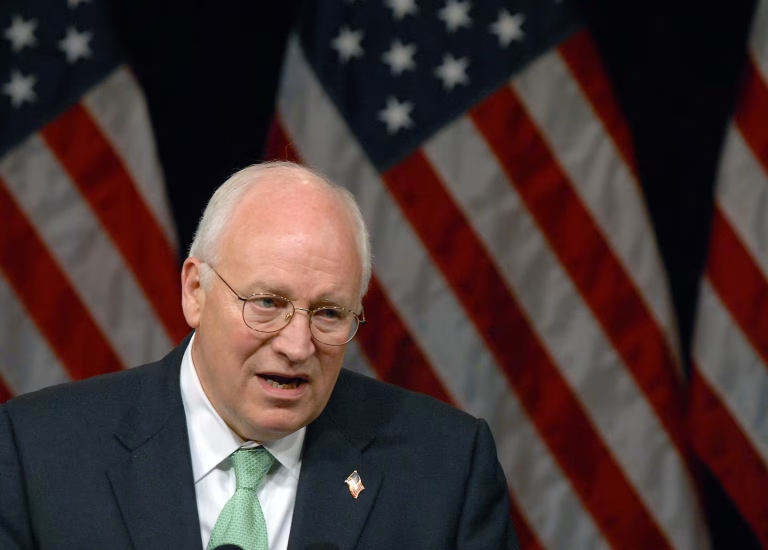
Dick Cheney, who served as the 46th vice president of the United States, has passed away at the age of 84, according to a statement from his family cited by U.S. outlets on Tuesday.
Cheney, who held the position under President George W. Bush from 2001 to 2009, “died due to complications of pneumonia and cardiac and vascular disease,” his family said.
“For decades, Dick Cheney served our nation, including as White House Chief of Staff, Wyoming’s Congressman, Secretary of Defense, and Vice President of the United States,” the family’s statement read.
Regarded as one of the most influential vice presidents in U.S. history, Cheney was often portrayed as a strategic power broker who exercised immense influence behind the scenes.
Born on January 30, 1941, in Lincoln, Nebraska, Cheney spent most of his childhood in Wyoming, the state he would later represent in Congress.
He initially attended Yale University but left before completing his studies, later earning a political science degree from the University of Wyoming.
A committed Republican, Cheney began his political career in earnest in 1978, when he won Wyoming’s lone seat in the House of Representatives, a position he would hold for ten years.
In 1989, President George H.W. Bush appointed him as secretary of defense, where Cheney oversaw U.S. military operations during the 1990–91 Gulf War, a campaign that expelled Iraqi forces from Kuwait.
During his tenure as vice president, Cheney advanced a staunchly neo-conservative agenda and assumed an unusually prominent role in shaping national security and foreign policy decisions.
He was considered a key advocate for the U.S. invasion of Iraq following the September 11, 2001, terrorist attacks, promoting the now-discredited assertion that Saddam Hussein possessed weapons of mass destruction, a claim that became central to the case for the 2003 war.
A viral story recently claimed that an AI-generated “Minister of Albania” was pregnant with 83 children and while the story was completely false, millions across social media believed it. Some panicked, others laughed or celebrated, but few paused to question its biological impossibility.
This incident wasn’t about Albania or artificial intelligence; it was about us, our growing struggle with digital literacy in an age where misinformation spreads faster than truth. When we share sensational stories without verifying them, we expose a dangerous gap in our collective judgment.
The “AI Minister” story is a reminder of how easily false information can take over the internet. The real issue isn’t the technology, it’s our instinct to share before we think. Every click, share, or repost gives life to misinformation.
As AI continues to blur the lines between truth and fiction, we must become more cautious and discerning, pausing to question what we see before spreading it. The health of our democracy, and the strength of our society, depend on how wisely we handle the flood of information that reaches our screens every day.
Chad’s government has sealed its border with Nigeria after President Donald Trump’s recent warning triggered regional security concerns.
Over the weekend, President Trump alleged that Christians in Nigeria have long been subjected to genocide and criticized the Nigerian government for failing to prosecute terrorists or end the ongoing violence.
Security and counterinsurgency analyst Zagazola Makama revealed on his verified X account that “military sources in N’Djamena confirmed on Monday that President Mahamat Idriss Déby Itno ordered a complete military lockdown along the Nigerian border after intelligence suggested that terrorist elements from northern Nigeria were preparing to flee into Chadian territory.”
He added that “according to the sources, the Chadian army has been placed on full alert, with troops and armoured vehicles deployed across key border corridors linking the two countries.”
The Chadian leader reportedly stated that “no armed group or foreign force will be allowed to enter Chadian soil under any disguise.”
This development follows mounting regional unease and speculation regarding potential U.S. military maneuvers in West Africa.
Security observers described Chad’s border closure as a strategic step to safeguard its national security and prevent infiltration by militant factions taking advantage of regional unrest.
The Lagos State Police Command has declared activist and former presidential candidate Omoyele Sowore wanted for allegedly planning to incite public unrest and obstruct major roads in the state.
The State Commissioner of Police, Olohundare Jimoh, announced this on Monday during a press briefing held at the Iyana-Oworo section of the Third Mainland Bridge.
Jimoh said Sowore, who leads the “Take It Back Movement,” ignored repeated warnings from the police against mobilising protests over the recent demolition of houses in the Oworonshoki area.
“We are closing in on Sowore and others involved in coordinating activities intended to disrupt public peace. Sowore should surrender at the nearest police station or face arrest wherever he is found,” he said.
The police commissioner warned that anyone attempting to cause disturbances or block public roads would “face the full weight of the law.”
According to Jimoh, intelligence reports revealed that Sowore and his associates were allegedly planning simultaneous demonstrations at strategic locations, including the Third Mainland Bridge, Lekki Tollgate, and Freedom Park.
Describing the plan as “criminal,” the commissioner said such actions could trigger severe traffic disruptions and endanger lives.
“It is only someone who needs examination that would attempt to block such a vital route used by thousands daily,” he added.
Jimoh disclosed that 13 suspects connected to the planned protest had already been arrested, while Sowore was reportedly on the run. He confirmed that investigations were ongoing to identify the sponsors and collaborators behind the movement.
The police have since deployed officers across major highways and bridges, setting up temporary roadblocks and diversions to prevent possible demonstrations.
“The Third Mainland Bridge was not designed to hold stationary weight. Any gathering on it could pose structural risks,” Jimoh stated.
Addressing the controversy surrounding recent demolitions in Oworonshoki, Jimoh insisted that residents whose properties were affected had been compensated.
“The government compensated those affected, and the media witnessed it. There is no justification to provoke a crisis under the guise of protest,” he said.
He urged Lagos residents to go about their normal activities without fear, assuring that security agencies were “fully in control of the situation.”
“We are not sleeping. We will apprehend, investigate, and prosecute anyone attempting to undermine public safety in Lagos,” the commissioner declared.
Jimoh reaffirmed the police command’s commitment to enforcing the law “without fear or favour,” stressing that freedom of expression must not translate into a public nuisance or threat to life.
Earlier reports shows that Sowore had threatened to lead a protest against the demolition of houses in Oworonshoki, following growing public outrage over the incident.
He made the threat shortly after being granted bail in Abuja, alongside Nnamdi Kanu’s Special Counsel, Aloy Ejimakor, Kanu’s younger brother, Prince Emmanuel Kanu, and other activists.
Commissioner Jimoh, however, warned Sowore against mobilising any demonstrations, saying the police had made massive security deployments across Lagos to prevent public disorder.
He reiterated that the command would not tolerate any attempt to block major roads or disrupt the peace in the state.
Bayelsa State Governor, Senator Douye Diri, today completed his long-anticipated defection from the Peoples Democratic Party (PDP) to the All Progressives Congress (APC) at a colourful rally held at the Samson Siasia Sports Complex. Flanked by Vice President Kashim Shettima, APC National Chairman Nentawe Yilwatda, and no fewer than five APC governors, Diri received the party flag amid thunderous applause from thousands of supporters who painted Yenagoa green-white-green. “I took this decision on behalf of every Bayelsan,” Diri declared from the podium. “Somebody had to step forward so that our state is no longer sidelined when federal projects, oil blocks, and NDDC contracts are shared. Today, Bayelsa is fully at the centre.” He revealed that he quietly resigned from the PDP on October 15 after weeks of shuttle diplomacy between Abuja and Yenagoa, adding that 19 state assembly members, two senators, and over 80 per cent of his cabinet crossed the carpet with him. Shettima, who handed Diri the broom symbol, hailed the move as “the final piece in the South-South jigsaw.” With Delta’s Sheriff Oborevwori (who flew in for the event), Akwa Ibom’s Umo Eno, and now Diri in the APC fold, only Rivers State’s Siminalayi Fubara remains under the PDP umbrella in the oil-rich region. “President Tinubu’s Renewed Hope now has an Ijaw face,” Shettima quipped, triggering wild cheers. Yet the jubilation masked brewing tension at Government House. Deputy Governor Lawrence Ewhrudjakpo, a staunch PDP loyalist and protégé of ex-Governor Seriake Dickson, boycotted the ceremony. Sources confirmed that 21 of the 24 assembly members have signed an impeachment notice against him for “gross disloyalty.” Ewhrudjakpo has already filed suit at the Federal High Court, Abuja, to restrain the Speaker, the Chief Judge, and security agencies from removing him. Former APC publicity scribe Yekini Nabena fired an early shot, tweeting that Diri “arrived empty-handed” and warning against sidelining Bayelsa APC founding fathers like Timipre Sylva and Heineken Lokpobiri. Minister Lokpobiri, present on the dais, countered by praising Diri’s “bridge-building spirit” and promising more federal appointments for Bayelsans. The defection ceremony concluded at 6:45 p.m. with the national anthem. Governor Diri and Vice President Shettima left the Samson Siasia Stadium under tight security. Government House, Yenagoa, will fly the APC flag from tomorrow. Bayelsa now joins Delta and Akwa Ibom as APC-controlled states in the Niger Delta. The political map of the South-South has been redrawn.
The Maldives has introduced a groundbreaking law prohibiting anyone born on or after 1 January 2007 from smoking tobacco, making it the first nation in the world to establish a permanent generational smoking ban.
The country’s health ministry announced on Saturday that individuals from this age group will not be permitted to smoke, purchase, or sell tobacco products anywhere within the island nation.
The ban, the ministry said, “reflects the government’s strong commitment to protecting young people from the harms of tobacco.”
Ahmed Afaal, vice chair of the archipelago’s tobacco control board, said that last year’s comprehensive ban on vaping had been “a good step towards a generation of tobacco-free citizens.”
According to the health ministry, the new policy “applies to all forms of tobacco, and retailers are required to verify age prior to sale,” emphasizing that the measure aligns with the Maldives’ commitments under the World Health Organization Framework Convention on Tobacco Control.
The WHO describes the convention as one that “provides a global response to a global problem – namely, the tobacco epidemic.”
Afaal noted that the earlier ban on vaping played a crucial role in protecting young people, explaining that “these new stylish gadgets are tactics of the industry to approach the younger generations to uptake addictive processes, which definitely harms their health.”
Under last year’s regulations, it became illegal to import, sell, possess, or use e-cigarettes and vaping devices in the Maldives, regardless of a person’s age.
Tourists visiting the island nation will also be subject to the same restrictions, but Afaal dismissed concerns that the ban could harm tourism.
“People don’t come to the Maldives because they’re able to smoke. They come for the beaches, they come for the sea, they come for the sun, and they come for the fresh air,” he said.
Citing tourism statistics, Afaal added that there had been no cancellations linked to the ban, noting that visitor numbers had actually increased over the past year.
“We’re projecting more than 2m [tourists] in the next year,” he said.
New Zealand had previously planned to enact a similar generational smoking ban but abandoned the effort in 2023 following a change in government — a decision many health advocates and Māori communities, who face some of the highest smoking rates, described as a setback.
In the United Kingdom, former Prime Minister Rishi Sunak proposed a comparable law to prohibit smoking among individuals born in or after 2009. The updated version of that bill, now introduced by the current administration, has passed through the Commons and is undergoing review in the House of Lords, approaching final approval.
The Presidency has dismissed a report suggesting that President Bola Tinubu is scheduled to visit the United States on Tuesday for a meeting with U.S. Vice President J.D. Vance.
The clarification was issued on Monday by Temitope Ajayi, Senior Special Assistant to the President on Media and Publicity, who described the report as false, misleading, and speculative.
In a post shared via his official X handle, Ajayi said the story had fuelled unnecessary public debate and “uninformed commentaries.”
“There’s a Sahara Reporters story that President Tinubu is going to the U.S. on Tuesday to see U.S. Vice President J.D. Vance. That story is not true. I can see that the fake news by Sahara has become the basis for some uninformed commentaries since yesterday. If President Tinubu is going to the White House, he won’t be going to see a Vice President,” he wrote.
Ajayi clarified that if the President were to visit the White House, he would be meeting with President Donald Trump, not the Vice President.
The denial follows reports that Tinubu was planning a visit to Washington for what some described as “top-level diplomatic engagements.” The speculation intensified amid global attention on claims of Christian persecution in Nigeria and a controversial statement by U.S.
President Donald Trump, who threatened possible military action.
In a post on his Truth Social account on Saturday, Trump said the U.S. might “go in guns blazing” if the Nigerian government failed to address alleged attacks on Christians.
“If the Nigerian Government continues to allow the killing of Christians, the USA will immediately stop all aid and assistance to Nigeria, and may very well go into that now disgraced country, ‘guns-a-blazing,’ to completely wipe out the Islamic terrorists who are committing these horrible atrocities.
I am hereby instructing our Department of War to prepare for possible action. If we attack, it will be fast, vicious, and sweet, just like the terrorist thugs attack our cherished Christians,” he wrote.
In response to the growing controversy, President Tinubu dismissed allegations of a “Christian genocide” in Nigeria, reaffirming that the nation remains a democracy committed to religious liberty and equality.
In an official statement shared via his X handle, the President said:
“Nigeria stands firmly as a democracy governed by constitutional guarantees of religious liberty.”
He added:
“Since 2023, our administration has maintained an open and active engagement with Christian and Muslim leaders alike and continues to address security challenges which affect citizens across faiths and regions.”
Tinubu also rejected external portrayals of Nigeria as a religiously intolerant nation, describing such claims as inaccurateand unreflective of the country’s diversity and commitment to peaceful coexistence.
“The characterisation of Nigeria as religiously intolerant does not reflect our national reality, nor does it take into consideration the consistent and sincere efforts of the government to safeguard freedom of religion and beliefs for all Nigerians,” Tinubu stated.
Reaffirming the nation’s values, the President said:
“Religious freedom and tolerance have been a core tenet of our collective identity and shall always remain so. Nigeria opposes religious persecution and does not encourage it.”
He further pledged continued collaboration with the United States and other international partners to protect religious communities and promote mutual understanding.
“Nigeria is a country with constitutional guarantees to protect citizens of all faiths. Our administration is committed to working with the United States government and the international community to deepen understanding and cooperation on the protection of communities of all faiths,” Tinubu affirmed.
The arrest of the former chief legal officer of Israel’s military has intensified a growing political crisis sparked by a leaked video that allegedly depicts Israeli soldiers brutally mistreating a Palestinian detainee.
Maj Gen Yifat Tomer-Yerushalmi, who stepped down as the Military Advocate General of the Israel Defense Forces (IDF) last week, announced that she “took full responsibility for the leak.”
On Sunday, the situation grew more alarming after reports surfaced that she had gone missing, prompting a police search that lasted several hours along a beach north of Tel Aviv.
Authorities later confirmed she was found “alive and well,” though she was subsequently detained for questioning.
Public outrage and political tension surrounding the leaked footage continue to intensify.
The video, first made public in August 2024, reportedly shows reserve soldiers at the Sde Teiman military base in southern Israel isolating a Palestinian detainee before surrounding him with shields and allegedly assaulting him, including stabbing him in the rectum with a sharp instrument.
The victim required medical treatment for severe injuries following the incident.
Five reservists were later charged with aggravated abuse and causing serious bodily harm. They have denied any wrongdoing, and their identities have not been disclosed.
On Sunday, four of the accused appeared outside the Supreme Court in Jerusalem wearing black balaclavas, alongside their defense attorneys, who called for their trial to be dismissed.
One of the lawyers argued that his clients had been subjected to “a faulty, biased and completely cooked-up legal process.”
A formal investigation into the video leak began last week, and Gen Tomer-Yerushalmi was suspended during the inquiry.
By Friday, the defense minister announced that she would not be reinstated to her former position.
Shortly afterward, she tendered her resignation.
In her letter, she accepted “full responsibility for any material that was released to the media from the unit.”
“I approved the release of material to the media in an attempt to counter false propaganda against the army’s law enforcement authorities,” she said.
This was widely seen as a reference to claims by right-wing figures who alleged that the abuse accusations were fabricated.
She also stated: “It is our duty to investigate whenever there is reasonable suspicion of acts of violence against a detainee.”
Following her resignation, the defense minister strongly criticized her actions, declaring, “Anyone who spreads blood libels against IDF troops is unfit to wear the army’s uniform.”
Prime Minister Benjamin Netanyahu later reinforced those remarks, describing the Sde Teiman case as “perhaps the most severe public relations attack that the State of Israel has experienced since its establishment.”
Only hours after his statement, news broke that Gen Tomer-Yerushalmi was missing, raising concerns that the political controversy might have taken a tragic turn.
After an extensive search operation, police confirmed she had been found “safe and in good health” in Herzliya.
Later that night, a police spokesperson revealed that two individuals had been taken into custody on suspicion of “leaking and other serious criminal offences.”
Reports identified the two as Gen Tomer-Yerushalmi and former chief military prosecutor Col Matan Solomosh.
The Sde Teiman case has become a symbol of the deep ideological rift dividing Israel’s political spectrum.
Conservatives have denounced the video’s release as a betrayal of national loyalty and an attack on the military’s reputation.
When military police arrived at the base in July 2024 to question 11 reservists, far-right demonstrators — including several lawmakers from the ruling coalition — stormed the compound in protest.
Progressive voices, however, view Gen Tomer-Yerushalmi’s authorization of the video’s release as an act of integrity consistent with her legal duty.
To them, the footage serves as crucial proof supporting claims of systemic abuse of Palestinian detainees following the Hamas-led 7 October 2023 attacks.
A UN inquiry released in October 2023 concluded that thousands of detainees, including both children and adults from Gaza, had been “subjected to widespread and systematic abuse, physical and psychological violence, and sexual and gender-based violence amounting to the war crime and crime against humanity of torture and the war crime of rape and other forms of sexual violence.”
Israel’s authorities dismissed those allegations, insisting they were “fully committed to international legal standards” and asserting that thorough investigations had been conducted into every reported case.
President Bola Tinubu is preparing for high-level diplomatic engagement with United States President Donald Trump “in the coming days” to address explosive allegations of a “Christian genocide” in Nigeria, the Presidency announced on Sunday. The meeting potentially at the State House in Abuja or the White House in Washington, aims to clear the air on terrorist attacks that Trump claims target Christians exclusively, while Nigeria insists they affect citizens of all faiths. Daniel Bwala, Tinubu’s Special Adviser on Policy Communication, broke the news on X, stressing the two leaders’ “shared interest in the fight against insurgency.” Bwala highlighted Trump’s earlier approval of arms sales to Nigeria, which he said Tinubu has “adequately utilised… with massive results to show.” Any differences over the religious dimension of the violence, Bwala added, “would be discussed and resolved” face-to-face. The announcement follows Trump’s Friday redesignation of Nigeria as a “Country of Particular Concern” (CPC) and his threat of military airstrikes or troop deployment if Abuja fails to halt alleged systematic killings of Christians. Tinubu swiftly rejected the label, insisting Nigeria’s constitution guarantees religious freedom and that insecurity cuts across faiths. A senior Presidency source told SaharaReporters late Sunday that a standalone Washington visit originally floated for November 4 has been shelved. Instead, Tinubu now eyes a sideline encounter with Trump at the G20 Summit in Durban, South Africa, on November 20—provided Trump attends. “Conversations are ongoing, but a bilateral White House sit-down is not yet locked,” the source said. Presidential spokesman Bayo Onanuga dismissed weekend rumours that Tinubu would meet U.S. Vice President J.D. Vance, calling them “fabricated.” He reiterated that any White House trip would involve Trump himself. Meanwhile, former Jigawa Governor Sule Lamido urged Tinubu to convene all living ex-leaders for a national security summit before any foreign trip. On X, Nigerians are divided. Hashtags #TinubuTrump and #TrumpNigeria trend with memes mocking a possible snub, while others praise Tinubu for “standing tall.” One viral post quipped: “From White House to G20 sidelines still better than Zoom.” Security analysts warn that failure to de-escalate could trigger U.S. sanctions or aid cuts, further straining Nigeria’s counter-terrorism efforts. As troops intensify patrols in the North-East and diplomatic phones ring off the hook, one thing is clear: the next 17 days will decide whether Africa’s most populous nation faces its sternest foreign-policy test since the Boko Haram surge or emerges with a stronger U.S. partnership. For now, the world watches two strong-willed leaders circle each other, with Nigeria’s sovereignty hanging in the balance.
I am following with deep interest the ongoing debates that are erupting over Donald J. Trump’s designation of Nigeria as a Country of Particular Concern (CPC) for religious freedom violations.
Many Nigerians, including analysts I respect, are rushing to interpret that decision through the narrow lens of Western imperialism or anti-Islam bias. Others are dismissing it as another of Trump’s theatrics; a foreign leader speaking loudly to his conservative Christian base.
But, as someone who is studying policy, governance, and environmental security, and as a Nigerian who loves his country deeply, I am insisting that President Trump is not after Nigeria. He is after China. And Nigeria, whether we are realising it or not, is standing today as one of the hidden battlegrounds in the long-running strategic rivalry between the United States and China.
Trump’s Silence on China and His Sudden Shift to Nigeria
What is capturing my attention is how Trump is behaving immediately after his meeting with the Chinese President in Tokyo just a few days ago. He said nothing too detailed about the content of the meeting. Instead, he is stepping out and talking about Nigeria — about the mass killings of Christians, the destruction of rural communities, and the rise of religiously-motivated violence in the Middle Belt.
To a casual observer, that shift looks random. But in the language of global diplomacy, it is a signal. You don’t move from Tokyo to Nigeria in one breath unless there is a linking thread. Trump’s intelligence briefings are showing that Nigeria’s crisis is being tied to Chinese economic interests. That is what many of us are failing to see.
China’s Deep Hand in Nigeria’s Bloody Mining Economy
We are not deceiving ourselves when we say Nigeria is sitting on gold. Real gold. And not just gold — we are sitting on columbite, tantalite, lithium, and other rare earth minerals that are vital to modern technology: electric cars, smartphones, satellites, even weapons. Whoever is controlling the supply of these resources is controlling the future of global power.
China is dominating global rare-earth production and refining, but as its domestic reserves are depleting, it is expanding into Africa — and Nigeria, with a weak regulatory system and persistent insecurity, is looking like a prime target.
Across Zamfara, Niger, Nasarawa, Plateau, Benue, and Taraba states, illegal mining is exploding. Beneath the surface of that chaos is a powerful network of Chinese-backed miners, local collaborators, and militia protection rackets. In some communities, entire villages are being emptied out by attacks so that the land is being “freed up” for mining.
A visit to some communities in Benue, Plateau, and Nasarawa, where the soil is carrying visible scars of reckless excavation. Locals are speaking of strange foreigners arriving at night and trucks loaded with ore moving under military escort. These are not fairy tales; they are the daily reality of a nation losing its wealth to foreign hands under the cover of terror.
Terrorism as a Tool for Resource Control
We often view terrorism in Nigeria as purely ideological, a religious war, or a clash of civilizations. But when we look closely, we are seeing that terrorism is becoming a deliberate tool for resource control.
Groups that label themselves as herders, bandits, or insurgents are aligning with illegal miners. They are attacking Christian farming communities, killing or displacing the inhabitants, and leaving behind ungoverned zones/spaces ready for exploitation. Chinese middlemen and local cartels are moving in to dig, extract, and export. The minerals are leaving Nigeria illegally, ending up in Dubai, Hong Kong or Shanghai — enriching foreign economies while Nigeria bleeds.
When Trump is talking about Christian persecution in Nigeria, many people are thinking he is pandering to faith-based voters. But he is also responding to strategic intelligence. His government is discovering that China is using Nigeria’s instability as a shield for illegal extraction — and that thousands of Christian lives are not being lost randomly, but as collateral damage in a global economic war.
The Buahri Waterways Bill — China’s Trojan Horse
We are remembering how, under President Buhari, the Water Resources Bill was being pushed. Nigerians from every corner resisted it and rightly so. On the surface, the bill seemed like an administrative reform to bring all inland waterways and adjoining lands under federal control. But beneath that surface was something far more sinister.
Those waterways; rivers, streams, and wetlands are not just water routes; they are mineral corridors. Many of Nigeria’s richest alluvial gold and rare earth deposits are located along these river systems. By centralising control of the lands, the bill if pass was paving the way for foreign interests, especially Chinese-linked companies to gain access through federal licences, bypassing state governments and local communities.
I believe Chinese advisers and investors were quietly lobbying for that bill. They were seeing it as a legal shortcut to Nigeria’s mineral heartlands. Fortunately, Nigerians resisted it fiercely. But the attempt itself exposed how deeply Chinese mining ambitions are penetrating our policymaking corridors.
Trump’s Intelligence Briefing and the Bigger Picture
Now imagine Trump sitting in the Oval Office, reviewing a classified intelligence briefing ahead of his meeting with the Chinese President. The report might read:
“China is funding illegal mining operations in Nigeria through proxies. Minerals are being smuggled to China. Terrorist groups are clearing Christian farming zones to open mining fields. Nigeria’s government is aware but failing to act.”
If I put myself in Trump’s shoes — a man obsessed with America First, economic nationalism, and confronting Chinese influence, I see why he is doing what he is doing.
That explains why after his meeting with the Chinese President he is saying nothing about the trade war or Huawei. Instead, he is focusing on Nigeria. He is not only expressing moral outrage, he is sending a geostrategic message to Beijing and Abuja alike: “We see what you’re doing in Nigeria, and we are watching.”
The CPC designation thus becomes a diplomatic weapon; not just to defend religious freedom, but to pressure Nigeria’s leadership to confront internal terrorism, regulate its mining sector, and cut off China’s exploitation routes. It is also telling China that the U.S. will not silently allow Africa’s mineral corridors to slip into Beijing’s hands.
The Blood of the Poor, the Gold of the Powerful
As a development professional, I am telling ourselves that underdevelopment is not accidental. It is a system maintained for the benefit of those who profit from chaos. The violence ravaging Nigeria’s north and middle belt follows an economic logic. It is driving farmers away from ancestral lands, weakening resistance, and clearing the field for predatory extraction.
In many of these regions, the victims are overwhelmingly Christian farmers. Their lands sit on mineral deposits. Their displacement often labelled as “herder-farmer clashes” is enabling illegal mining. Every truckload of gold leaving Zamfara or Niger without record is carrying stolen wealth plus the blood of innocent people.
When Trump is referring to “Christian genocide,” it may sound dramatic to some. But to me it is truthful. He is naming what the rest of the world is refusing to name: a systematic campaign of dispossession combining religion, resource greed, and geopolitics.
Nigeria at the Crossroads of Global Power Politics
Nigeria is now standing at a dangerous crossroads. On one side is China — aggressive, patient, and comfortable operating in the shadows. On the other side is the United States — loud, moralistic, and determined not to lose strategic ground. Both are seeing our country as strategic: China for minerals; America for influence.
For Beijing, Nigeria is a silent goldmine. For Washington, Nigeria is a partner slipping away. And for Nigerians like us, we are caught in the middle — a proud nation being turned into a chessboard for foreign powers.
The truth is uncomfortable: our leaders allowed it. Through negligence or complicity, they permit foreign powers to profit from our insecurity. Every village burned in Benue or Plateau, every displaced farmer in Nasarawa, every illegal mining pit in Niger is part of the same global script — the conversion of African lives into raw material for foreign profit.
What Trump’s Move is Actually Signalling
Trump’s move is not hostile toward us. It is a wake-up call. He is using America’s legal and diplomatic tools, like the CPC designation, to jolt our leadership into action. He is highlighting the shootings in Plateau, Benue, and Southern Kaduna not just out of empathy, but because those regions sit atop mineral deposits that feed China’s industrial machine.
When he says “The persecution of Christians must stop,” he is also meaning “Nigeria must stop enriching our biggest rival through the corridors of instability.” His message, though blunt, aligns with what every patriotic Nigerian should demand: a state that protects its people, its land, and its resources.
Nigeria Must Wake Up
Nigeria cannot continue to live in denial. We must stop pretending our insecurity is purely domestic. It is not. It is being sponsored, exploited, and sustained by global powers who see profit in our pain.
We must press for urgent reforms — a national mining framework that shuts down illegal foreign operators; a security architecture that protects communities; and leadership that understands that when a Nigerian village falls, the nation’s sovereignty is being stripped.
We must draw the connections from the blood on our farmlands to the gold in Chinese vaults. From Christian families fleeing in the Middle Belt to the wealth fueling Asian factories. From the failed waterways bill to the shadowy corridors of global mining diplomacy.
Conclusion
President Trump is not after Nigeria. He is after China and Nigeria is just one of the theatres where this global confrontation is playing out. His warnings about Christian killings and religious freedom carry more than moral weight; they are linked to strategic intelligence.
As a Nigerian, I accept his message not as an insult, but as a challenge, a reminder that sovereignty lies not only in our flag, but in how we protect our people, our land, and our resources.
If we fail to act, the silent war between the United States and China will keep being waged on our soil, not with tanks or missiles, but with shovels, mineral flows, and human suffering.
It is time for Nigeria to wake up.
Written by Anngu Orngu. Anngu Orngu writes from Koti-Yogh, Ute, Vandeikya Local Government Area of Benue State.
To provide the best experiences, we use technologies like cookies to store and/or access device information. Consenting to these technologies will allow us to process data such as browsing behaviour or unique IDs on this site. Not consenting or withdrawing consent, may adversely affect certain features and functions.
Functional
Always active
The technical storage or access is strictly necessary for the legitimate purpose of enabling the use of a specific service explicitly requested by the subscriber or user, or for the sole purpose of carrying out the transmission of a communication over an electronic communications network.
Preferences
The technical storage or access is necessary for the legitimate purpose of storing preferences that are not requested by the subscriber or user.
Statistics
The technical storage or access that is used exclusively for statistical purposes.The technical storage or access that is used exclusively for anonymous statistical purposes. Without a subpoena, voluntary compliance on the part of your Internet Service Provider, or additional records from a third party, information stored or retrieved for this purpose alone cannot usually be used to identify you.
Marketing
The technical storage or access is required to create user profiles to send advertising, or to track the user on a website or across several websites for similar marketing purposes.