
Home Blog Page 330

More Than a Boxer: The Incredible Journey of George Foreman

1

George Foreman’s journey is one of grit, redemption, and reinvention. From his rise as a feared heavyweight champion to his unexpected return to the ring and later success as a businessman, his life is filled with inspiring lessons.

Humble Beginnings: A Rough Start in Texas

Born on January 10, 1949, in Marshall, Texas, George Foreman grew up in Houston’s Fifth Ward, a rough neighborhood known for crime and poverty. As a teenager, he was a school dropout, constantly in trouble and engaging in street fights. His life took a turn when he joined the Job Corps, a government program that helped troubled youth develop skills and find purpose. It was there that he discovered boxing, and under the guidance of trainer Doc Broadus, his raw power was transformed into a disciplined craft.

The Rise of a Boxing Titan

Foreman’s natural talent and aggressive style quickly propelled him through the amateur ranks. In 1968, he won a gold medal at the Olympics in Mexico City, a victory that put him on the global stage. Turning professional soon after, he dominated his opponents with an unmatched combination of power and intimidation. His knockout streak made him one of the most feared fighters of his era, and in 1973, he faced heavyweight champion Joe Frazier. In a stunning display of force, Foreman knocked Frazier down six times in two rounds to claim the undisputed heavyweight title. The world had a new boxing king.

The First Reign: A Fearsome Champion

As champion, Foreman seemed unstoppable, defending his title with brutal knockouts. His punches carried an almost mythical reputation, with opponents rarely making it past the early rounds. Then came the legendary 1974 fight against Muhammad Ali, known as the “Rumble in the Jungle.” Foreman, the overwhelming favorite, dominated the early rounds, but Ali’s rope-a-dope strategy wore him down. In the eighth round, Foreman was exhausted, and Ali knocked him out, handing him his first professional defeat. The loss crushed Foreman, shaking his confidence and altering the course of his career.

The Fall and Spiritual Awakening

After the Ali loss, Foreman struggled to reclaim his dominance. In 1977, after losing a fight to Jimmy Young, he experienced what he described as a near-death vision in the locker room. Believing he had seen the afterlife, Foreman renounced boxing and devoted himself to Christianity. He became a preacher, founded a church, and spent the next decade helping troubled youth. The once-intimidating boxer had found peace, seemingly leaving his fighting days behind for good.

The Unbelievable Comeback: From Preacher to Champion Again

In 1987, at the age of 38, Foreman shocked the world by announcing his return to boxing. Many dismissed it as a publicity stunt, believing he was too old and out of shape to compete. But Foreman proved them wrong. He slowly climbed the ranks, using experience and power rather than speed and aggression. At 42, he fought Evander Holyfield for the heavyweight title, losing a hard-fought match but earning widespread respect. Then, in 1994, the impossible happened—at 45 years old, he knocked out Michael Moorer to reclaim the heavyweight championship. The world watched in awe as he stood in the ring, the oldest heavyweight champion in history, proving that comebacks are real and second chances exist.

The Birth of a Business Empire
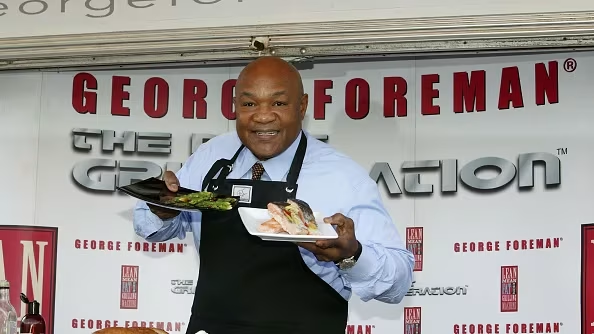
Foreman’s legend didn’t stop in the ring. After retiring, he reinvented himself as a businessman. He lent his name to the George Foreman Grill, a product that became a household sensation. Initially hesitant, he eventually embraced the brand, and his charismatic personality helped sell over 100 million units worldwide. The success of the grill made him even wealthier than his boxing career ever did. His business acumen and ability to connect with audiences turned him into one of the most successful athlete-entrepreneurs in history.

Legacy and Impact

George Foreman’s life is a story of resilience, faith, and reinvention. He influenced generations of fighters with his power and determination, but his greatest lesson goes beyond the ring—showing the world that it’s never too late to change, to come back, and to succeed in a whole new way. Today, Foreman remains an icon, a living testament to perseverance, proving that champions aren’t just made in the ring, but in life itself.

Nigeria’s 2-0 Win Over Rwanda: Lessons Learnt

12

In their 2-0 victory against Rwanda, Nigeria’s Super Eagles, under new coach Eric Chelle, learned the importance of clinical finishing and set-piece execution, while Rwanda highlighted the need for improved defensive organization and composure in tight matches. 

Key Lessons Learned:

For Nigeria:

Clinical Finishing: The Super Eagles’ victory underscored the importance of converting chances, with Osimhen’s two goals being crucial in securing the win.

Set-Piece Strength: Nigeria demonstrated improved attacking prowess from set-pieces, with the first goal coming from a set-piece situation.

Midfield Structure: The match exposed vulnerabilities in Nigeria’s midfield, with Ndidi’s errors and Chukwueze’s absence on the right highlighting areas for improvement.

Tactical Flexibility: The team’s decision to sit deep after taking the lead invited unnecessary pressure, a tactical flaw that needs addressing.

For Rwanda:

Defensive Lapses: Rwanda’s early concession from a set-piece highlighted the need for better aerial defending and overall defensive organization.

Attacking Precision: While Rwanda grew into the game, their failure to convert late chances exposed a lack of composure and the need for a more clinical approach in attack.

Tactical Adaptability: Amrouche’s late tactical shift showed promise, but Rwanda needs to find a better balance between defensive resilience and attacking intent. 

It had been 1,224 days since the Super Eagles last won a World Cup qualifying match and twenty years since Nigeria defeated Rwanda in Kigali.

Since Nigeria beat Liberia 2-0 on 13 November 2021 in a FIFA World Cup Group C qualifier for Qatar 2022 at the Stade Ibn Botouta, Tangiers in Morocco, the Super Eagles have not won any World Cup qualifying match.

The win at the Amahoro Stadium is Nigeria’s first in three at the stadium, and the first away defeat of Rwanda away from home.

The win also marks their first since the 2026 World Cup qualifying series began which pit Nigeria on a recovery path in the World Cup campaign.

They have passed through difficulties in the past when it appeared that World Cup tickets had slipped off their claws. The dramatic turn-around changed the narratives.

Flashback to the World Cup 2002, the first and only one so far co-hosted. Defeats by Liberia in Monrovia and that of Sierra Leone in Freetown turned World Cup qualification into a Greek puzzle

A George Weah-inspired Librera were coasting towards what would have been the country’s first World Cup appearance. The Super Eagles picked up the challenge. Even, without their captain, Sunday Oliseh, the team made mincemeat of their hosts, Sudan, pummelling them 4-0 in Omdurman


World Cup Qualifier: Chelle Praises Players, Focuses On Zimbabwe Clash

0

After a convincing victory in Kigali, Super Eagles head coach Eric Chelle has turned his attention to their next World Cup qualifier against Zimbabwe.

Nigeria secured a 2-0 win over Rwanda in their Matchday 5 encounter at the Amahoro Stadium.

Speaking at the post-match press conference, Chelle commended his players for their resilience and emphasized the need to prepare for the upcoming game.

“It was a tough match. Rwanda has a strong team, but I’m proud of my players’ performance. We worked hard despite having only two full training sessions. In the second half, we controlled the game well—great effort from the team.”

“I’m happy with the system we implemented. We experimented with two different setups, but there’s still room for improvement. This was just the first game, and now we shift focus to the next challenge,” he added.

The Super Eagles will aim to maintain their strong form when they host Zimbabwe in Uyo next week.

2023 African Player of the Year, Victor Osimhen, was the standout performer as Nigeria Super Eagles secured a crucial 2-0 victory over Rwanda in a 2026 FIFA World Cup qualifier on match day five.

Heading into the encounter at the Stade Amahoro in Kigali, the Super Eagles were desperate for a win to revive their fading qualification hopes. And it was Osimhen who rose to the occasion, scoring both goals to hand Nigeria all three points and leaving Rwanda just one point above the Eagles on the log.

The Galatasaray striker opened the scoring in the 11th minute, expertly finishing off a delightful free-kick delivery from Ademola Lookman. He doubled Nigeria’s advantage just before half-time, chipping the Rwandan goalkeeper in the 45th minute to net his 25th international goal.

Osimhen’s first-half brace was enough to seal the victory, as Nigeria saw out the second half with a disciplined performance. The result takes the Super Eagles to six points in Group C, reigniting their hopes of qualifying for the 2026 FIFA World Cup.

This victory also marks a winning start for new head coach Eric Chelle, who took charge of the team earlier this year. Nigeria will now look to build on this result when they host Zimbabwe in Uyo on Tuesday, March 25, in their matchday six qualifier.

FIFA World Cup 2026: How African Teams Will Qualify

0

The Confederation of Africa Football (CAF) placed participating teams into nine groups.

All the group winners will progress to the tournament itself, with the four best-ranked runners-up contesting an African playoff to determine which of the quartet will advance to represent the continent in the inter-confederation playoffs

Nigeria’s Super Eagles resurrected their 2026 FIFA World Cup campaign with a well-deserved win over Rwanda in Kigali.

Two goals from Victor Osimhen in the 10th minute and in the third minute of added time in the first half sealed the three points and moved the Super Eagles to six points from five matches.

This good fortune also saw other leading teams in Group C drop points. Benin were held 2-2 by Zimbabwe on Thursday, while South Africa moved to the top of the group with a 2-0 win over Lesotho.

First Half

Nigeria dominated from the start, but the game began dramatically, as Osimhen was injured in the first minute and required immediate medical attention. Despite the setback, Nigeria pressed on, and in the fifth minute, Ademola Lookman had a chance to shoot but was robbed of the ball, conceding a free kick to the opposition.

In the 10th minute, Moses Simon was fouled just outside the box, earning Nigeria a free kick. Lookman stepped up to take it, and Osimhen, showing resilience after his early injury, scored, marking his 24th goal in 40 appearances. Nigeria’s high press made the Rwandans uncomfortable, and the Eagles continued dominating.

In the 12th minute, a dangerous cross from Osimhen nearly resulted in an own goal by Ange Mutzinsi, adding to the pressure. Nigeria kept pushing, and in the 14th minute, Ekong had a chance to score from a corner kick but headed the ball high, missing a golden opportunity. A minute later, another foul by the physical Rwandan side saw Ola Aina fouled, and another free kick was awarded. Ekong once again had a chance but headed wide from an open goal, unmarked and frustrated.

The 16th minute brought a cooling break, allowing both teams to regroup. Play resumed, and in the 23rd minute, Simon was denied by a brilliant save from the Rwandan goalkeeper. Osimhen headed wide from the resulting corner kick. In the 28th minute, Moses’ cross was turned out for a corner.

A substitution in the 37th minute saw Samuel Gueulette replaced by Gilbert Mugisha, who quickly tested Nigeria’s goalkeeper Nwabali with a long-range shot. Lookman and Osimhen combined beautifully in the box shortly after, but the ball slipped away from Lookman, denying another scoring opportunity.

In the 43rd minute, Aina conceded a corner kick because of a lack of communication with his teammates, giving Rwanda a rare chance. Three minutes were added to the first half, during which the Rwandans improved slightly, but Nigeria remained in control.

Just before halftime, Osimhen struck again, this time on a breakaway. With a delightful chip over the goalkeeper, he scored Nigeria’s second goal, capping off a dominant first half for his team.

Second half

The second half was all about restoring pride for the Amavubi in front of the home crowd led by President Paul Kagame.

Nigeria continued to assert its dominance. In the 46th minute, Osimhen was fouled, resulting in a free kick for Nigeria and a yellow card for Rwanda’s captain, Djihad Bizimana, for the challenge. Shortly after, in the 47th minute, Simon attempted a shot from the edge of the box but sent it wide, missing the target.

The game grew more physical, and in the 49th minute, Ndidi was shown a yellow card for a foul on Rwanda’s No. 4. Nigeria kept pushing forward, and in the 50th minute, Bright Osayi-Samuel had a go at goal, but his shot was saved by the goalkeeper, leading to a corner kick for Nigeria. Ekong’s defensive header conceded a corner kick to Rwanda, giving them a rare opportunity to build an attack in the 51st minute.

Bruno Onyemaechi and Raphael Onyedika came on for Samuel Chukwueze and Ola Aina in the 58th minute as Coach Eric Chelle strengthened his midfield. Advantage played in the 75th minute, but Osimhen blazed over after a run by Osayi-Samuel. Tolu Arokodare made his debut in the 78th minute, replacing Osimhen. Alhassan Yusuf also came on for Osayi-Samuel.

Rwanda continued to push forward as Nigeria tried to contain the action by possessing the ball. Five minutes were added, but the Eagles defended stoutly to take all three points and a clean sheet.

The Eagles will travel to Uyo, where Nigeria hosts Zimbabwe on Tuesday, seeking another three points to take them towards the top of Group C.

South Africa Defeats Lesotho 2-0, Go Top of Group C

0

South Africa go top of the CAF qualification Group C in the 2026 FIFA World Cup qualifiers after their victory over Lesotho Bafana Bafana ensured they claimed all three points in the encounter even though the first half ended goalless After five games each, Hugo Broos’ side have 10 points, two lead ahead of Benin, while Rwanda are third with 7 points and Nigeria fourth with 6.

South Africa have taken themselves top of the CAF qualification Group C in the 2026 FIFA World Cup qualifiers following a 2-0 victory over Lesotho.

After a goalless first half, the Peter Mokaba Stadium came to life on the hour mark as Relebohile Mofokeng struck to send the home fans into the wilds. Jayden Adams made it 2-0 just four minutes later to ensure Bafana Bafana cement their place at the top spot.

South Africa defeated Lesotho to go top of Group C. Photo: PHILL MAGAKOE. Source: Getty Images Following the victory, South Africa take themselves top of the group with 10 points from five matches.

Benin are second with 8 points after Gernot Rohr’s side were forced to a 2-2 draw by Zimbabwe on Thursday. Rwanda are third with 7 points after five matches as well, while the Super Eagles of Nigeria are fourth with 6 points.

Action returns to the group on Tuesday, March 25 and all matches will be played simultaneously, as per Vavel. The Super Eagles of Nigeria will welcome the Warriors of Zimbabwe to the Godswill Akpabio International Stadium in Uyo and will hope to register another victory to take themselves to 9 points. Group leaders South Africa travel to Abidjan where they take on the Cheetahs of Benin at the Houphouet Boigny Stadium.

The Amavubi of Rwanda welcome Lesotho to the Amahoro Stadium at the same time as the battle for the 2026 FIFA World Cup continues.

Why The Protest In Turkey?

0

The recent arrest of Istanbul’s Mayor, Ekrem İmamoğlu, has ignited widespread protests across Turkey, reflecting deep-seated concerns about the nation’s democratic processes and escalating political tensions.

What happened

The mayor, Ekrem İmamoğlu, rose to prominence as a member of the Republican People’s Party (CHP), Turkey’s main opposition party.

In 2019, he achieved a landmark victory by winning the Istanbul mayoral election, defeating a candidate from President Recep Tayyip Erdoğan’s party. This win was particularly significant, as it marked the first time in decades that the ruling party lost control of Turkey’s largest city. İmamoğlu’s success positioned him as a formidable challenger to Erdoğan’s long-standing rule.

On March 19, 2025, İmamoğlu was detained by Turkish authorities on charges including corruption, extortion, bribery, money laundering, and alleged ties to terrorist organizations, specifically the Kurdistan Workers’ Party (PKK).

Alongside him, over 100 individuals, including political and business figures, were also arrested. The government asserts that these actions are part of a legitimate legal investigation.

The arrests have sparked widespread protests across Turkey, with demonstrators perceiving İmamoğlu’s detention as a politically motivated move aimed at sidelining a key rival ahead of upcoming elections.

Opposition leaders, such as CHP’s Özgür Özel, have labeled the arrests a “coup” against democracy and have called for continuous peaceful demonstrations until İmamoğlu and others are released.

These protests have erupted in major cities, including Istanbul, Ankara, and İzmir, leading to clashes with police forces.

Responding to the protests, President Erdoğan accused his political opponents of theatrics for participating in a second night of demonstrations.

> “They have lost the balance so much that they are in a state to attack our police, hurl threats at judges and prosecutors,” he said.

Opposition’s take

Addressing a crowd of demonstrators outside Istanbul’s city hall, Özgür Özel, the leader of İmamoğlu’s CHP party, accused the government of attempting a “coup” and insisted that people had the right to protest.

However, government officials have criticized the opposition for calling for demonstrations.

“Gathering and marching in protest are fundamental rights. But calling people to the streets over an ongoing legal investigation is illegal and unacceptable,” Justice Minister Yılmaz Tunç wrote online.”

Authorities have also widened bans on demonstrations, further escalating tensions between the government and opposition supporters.

Despite the crackdown, the CHP plans to proceed with its internal vote to select a presidential candidate, with İmamoğlu as the sole contender. Party leaders assert that any attempt to bar him from running would only strengthen their determination and support. They have also indicated plans for peaceful demonstrations to protest what they see as unjust actions by the government.

As the situation unfolds, Turkey faces a critical juncture in its political landscape, with potentially significant implications for its democratic processes and the upcoming elections.

Africa’s Time to Shine: Can the Continent Break New Ground in the 2026 World Cup?

0

As the 2026 FIFA World Cup draws closer, excitement is building across Africa. With a record nine guaranteed spots—and a possible tenth team through the intercontinental playoffs—this marks a historic moment for African football. The continent has long been a breeding ground for extraordinary talent, but the ultimate goal remains unachieved: an African nation winning the World Cup.

Could 2026 finally be Africa’s breakthrough year?

Africa’s World Cup Evolution: A Legacy of Near Misses

For decades, African teams have captivated the world with their skill, flair, and resilience. From Cameroon’s legendary quarterfinal run in Italia ’90 to Senegal’s stunning debut in 2002 and Morocco’s historic semifinal finish in 2022, the continent has produced moments of brilliance. Yet, no African team has lifted the World Cup trophy.

The upcoming tournament, co-hosted by the U.S., Canada, and Mexico, presents an unprecedented opportunity. With more African teams in the mix, the odds of a deep run are higher than ever.

Contenders to Watch: Who Will Carry Africa’s Hopes?

The road to qualification has been fierce, with several powerhouses leading the charge. As of now, Morocco, Nigeria, and South Africa are seen as the continent’s strongest contenders.

Other teams making waves in the qualifiers include Ivory Coast, Mozambique, Tunisia, and Madagascar, each showcasing the hunger and tactical discipline needed to compete on the world stage.

Predicted African Teams to Qualify for the 2026 World Cup

  1. Morocco
  2. Nigeria
  3. South Africa
  4. Ivory Coast
  5. Mozambique
  6. Tunisia
  7. Madagascar
  8. Ghana
  9. Senegal

A potential tenth African team could emerge through the intercontinental playoffs, further strengthening the continent’s presence.

How Far Can African Teams Go in 2026?

Football analysts believe African nations have a strong chance of reaching the quarterfinals. Some even predict a historic semifinal run, especially for Morocco, which stunned the world in Qatar 2022 by becoming the first African team to reach the last four.

Here’s how Africa’s representatives could fare in 2026:

  • Quarterfinals: Morocco, Nigeria, South Africa
  • Round of 16: Ivory Coast, Mozambique, Tunisia
  • Group Stage: Madagascar, Ghana, Senegal

A Golden Opportunity for Africa

With an expanded tournament format, a new generation of African superstars, and increased representation, the stage is set for Africa to leave a lasting mark on the 2026 FIFA World Cup.

Will this finally be the year an African team shatters the glass ceiling and lifts the trophy? The world will be watching.

When Will NYSC’s New N77,000 Monthly Allowance Be Paid? This Is What We Know

0

In the 2025 budget proposal presented by President Bola Tinubu to the National Assembly in December 2024, the Federal Government allocated N430.7bn to the National Youth Service Corp, Nysc, marking the highest budgetary allocation for the agency in the past five years.

Of this amount, N372.9bn (86.5 percent) is designated for corps members’ allowances, to which a Corp member will receive a N77, 000 monthly allowance.

However, despite the announcement made in September 2024, the Federal Government is yet to implement the payment five months later.

After the failure to roll out the payments in February, Caroline Embu, the acting Director of Press and Public Relations, clarified that the NYSC is still awaiting the necessary cash backing.
“The cash backing is still being awaited,” Embu stated in a brief response.

The Director-General of the National Youth Service Corps (NYSC), Brigadier General Olakunle Nafiu, has now officially announced that corps members across the country will begin receiving a new monthly allowance of Seventy-Seven Thousand Naira (N77,000) starting from March 2025.

This announcement was made public through a statement from the Acting Director, Information and Public Relations, Caroline Embu, which was provided to journalists.

Brigadier General Nafiu assured corps members that both the NYSC management and the Federal Government are fully committed to their welfare.

He emphasized that the well-being of corps members continues to be a top priority.

“With effect from March, you are going to receive the sum of Seventy-Seven Thousand Naira as your monthly allowance.”

The National Youth Service Corps may allocate as much as N307.6bn for the mobilisation and payment of allowances to corps members. This figure reflects the increase in the monthly allowance, which has been raised from N33,000 to N77,000, as announced by the NYSC in a statement issued in September 2024. The rise followed the signing of the new minimum wage bill into law in May 2024.

Typically, the NYSC mobilises between 1,200 and 1,500 corps members for orientation exercises across camps in the 36 states and the Federal Capital Territory. These mobilisations occur in three batches each year A, B, and C.

This results in an average of 55,500 corps members per batch, which means that the total number of corps members mobilised in a year amounts to 333,000. With each corps member now receiving N77,000, the total payment for one batch totals N25.64bn. Over the course of the year, the total allocated for corps members’ allowances reaches N307.6bn.

Full-Time HND Graduates Cleared for NYSC Mobilization – Education Minister

0

The Minister of Education, Dr. Morufu Olatunji Alausa, has confirmed that only full-time Higher National Diploma (HND) graduates are eligible for mobilization into the National Youth Service Corps (NYSC) program.

This resolution follows discussions between the Ministry of Education and the Director-General of NYSC in Abuja, addressing the long-standing concerns about HND graduate mobilization.

According to Boriowo Folasade, Director of Press & Public Relations at the Federal Ministry of Education, this development marks a significant breakthrough for full-time HND graduates, who were previously excluded from the NYSC program. However, part-time HND graduates remain ineligible for mobilization.

To facilitate a seamless mobilization process, the National Board for Technical Education (NBTE) has been instructed to collate data on eligible HND graduates. A circular has also been sent to all Polytechnic Rectors, directing them to upload graduate details to the newly created HND admission portal.

Dr. Alausa emphasized that the portal will serve as the official database for full-time HND graduates, ensuring proper documentation and addressing previous issues with admission records.

The Minister urged all eligible HND graduates to proceed with their mobilization, reaffirming the government’s commitment to equity, fairness, and inclusivity in Nigeria’s education system. He reiterated that this decision ensures all qualified graduates can contribute to national development through the NYSC scheme.

Dangote Refinery Rejects Naira—What It Means for Fuel Prices

0

The Nigerian fuel market is bracing for potential disruptions following the Dangote Refinery’s decision to suspend the sale of fuel in Naira. This move, aimed at addressing forex challenges, could have far-reaching effects on petrol prices, inflation, and the value of the Naira.

Why Dangote Refinery Stopped Selling Fuel in Naira

The Dangote Refinery, a $19 billion facility expected to transform Nigeria’s fuel supply chain, recently announced that it would no longer sell fuel in the local currency. The decision comes as the refinery struggles with sourcing crude oil, which is priced in dollars, amid Nigeria’s forex crisis.

Previously, the refinery had attempted to secure crude from local suppliers, but most preferred to be paid in foreign currency. With the Naira’s instability, continuing sales in the local currency became financially unsustainable for the refinery.

Expected Petrol Price Hike

The shift to dollar-based transactions will likely lead to:

  • Higher Landing Costs: Fuel importers and distributors will have to source forex at high rates, increasing the cost of refined petroleum.
  • Rising Pump Prices: With higher wholesale fuel prices, petrol stations will pass the cost to consumers, leading to a possible surge in pump prices nationwide.
  • Increased Inflation: Higher fuel prices will push up transportation and production costs, affecting the prices of goods and services.

Nigerians, who are already struggling with economic hardship, may soon experience another wave of price hikes.

How This Affects the Value of the Naira

The suspension of fuel sales in Naira is another blow to the currency, which has been struggling against the U.S. dollar. Here’s why:

  • Increased Demand for Dollars: Fuel importers and businesses will need more dollars to pay for petrol, putting additional pressure on the already scarce forex reserves.
  • Weaker Purchasing Power: A higher exchange rate means it costs more to import goods, further devaluing the Naira.
  • Reduced Confidence in the Naira: If businesses increasingly prefer foreign currency transactions, it weakens trust in the local currency and worsens depreciation.

The Central Bank of Nigeria (CBN) may have to intervene to stabilize the forex market, but without a sustainable fuel policy, the Naira remains vulnerable.

As uncertainty looms, all eyes are on policymakers to see how they navigate this crisis. One thing is clear—if no intervention happens, Nigerians should prepare for another fuel price hike and further pressure on the economy.

This is a developing situation, and its impact on Nigeria’s economic landscape will be closely watched. Will the government step in, or will market forces dictate the next phase of Nigeria’s fuel crisis? Only time will tell.
