Home Blog Page 344

Telecom Price Hike: “Internet Access Has Become A Luxury For Many”…

0

In a move that has sent ripples through Nigeria’s telecommunications landscape, MTN Nigeria has increased the price of its data offerings and one data bundle prominent among Nigerians is the 15GB weekly data plan which has now been jacked up from ₦2,000 to ₦6,000. This 200% hike has ignited widespread reactions, with many expressing shock and frustration over the sudden surge in data costs.

This price adjustment aligns with the 50% tariff increase approved by the Nigerian Communications Commission (NCC) in January 2025. But while the NCC’s directive was for a 50% increase, MTN’s implementation has resulted in a 200% increase for the 15GB plan, leading to public outcry.

What are Nigerians saying?

Nigerians have taken to social media platforms to voice their displeasure. Many users have expressed concerns about the affordability of data, especially for students and small businesses that rely heavily on internet access.

On X,one user by the name Chidinma Felix remarked, “Internet access has become a luxury for many”.

Another user named Khan on X remarked, “ I think it’s high time we boycotted MTN. Their network is terrible, and their data plans are a rip-off. The 15GB package doesn’t even last three days”.

Ayothezillian took to his Instagram to say “Living in Nigeria now is getting tougher, some crazy inflation”

Kadibeautycraft on Facebook said “The annoying thing is that ,they make Internet expensive in Africa but very cheap in some countries like Italy and Cambodia. Can our leaders wakeup for goodness sake”.

Adakunwachineme on Instagram remarked “Why blame MTN when all cost of production went up astronomically”.

Mukhtar Usman on X said “There is no way for the average Nigerian to grow in this country, tell me how do one save in all of these”.

A t about 11.50am on Wednesday 12th of February, LN247 did a scan of the available data plan on MTN and discovered that the 15GB bundle is now no longer available on its platform. But what’s the justification, and where does this leave small businesses and students who rely on affordable data?

Impact on other network providers

The significant increase in MTN’s data prices raises questions about the pricing strategies of other network providers in Nigeria. Although they are yet to adjust their prices, Airtel, Glo, and 9mobile may face pressure to adjust their tariffs in response to MTN’s move. However, such decisions will depend on various factors, including their operational costs, market competition, and regulatory guidelines.

Regulatory and Government Response

Meanwhile, the House of Representatives has called for the suspension of the tariff hike until service quality improves. They have urged the Minister of Communications, Innovation, and Digital Economy, Dr. Bosun Tijani, and the NCC to halt the impending hike in telecommunications tariffs arguing that it places an undue burden on Nigerians, especially students and small businesses.

Lawmakers are urging the Nigerian Communications Commission (NCC) and the Ministry of Communications and Digital Economy to reconsider the increase. Mounting pressure from consumer rights groups and labor unions, protests are expected unless the government steps in to address the concerns.

As the situation unfolds, subscribers are closely monitoring the actions of other network providers. It is expected that competition will lead to more affordable data plans, ensuring that internet access remains accessible to all Nigerians.

In the meantime, users are exploring alternative options and expressing their concerns through various channels, advocating for more reasonable pricing in the telecommunications sector.


Real Madrid’s Never-Say-Die Spirit vs. Manchester City’s Familiar Struggles

0

Real Madrid’s Galacticos once again proved their resilience, while Manchester City fell victim to familiar mistakes. Jude Bellingham’s stoppage-time goal sealed a dramatic 3-2 comeback win for Madrid in their Champions League first-leg clash at the Etihad.

With just minutes left on the clock, Madrid overturned a 2-1 deficit, punishing City for their late-game defensive lapses—an issue that has plagued them throughout the competition.

The Final Moments: Bellingham’s Heroics

Trailing 2-1 in the 80th minute, Madrid found inspiration from Brahim Diaz, who leveled the score. But it was Bellingham who delivered the final blow in stoppage time, sliding in to convert Vinicius Junior’s lobbed pass.

The moment revived memories of Madrid’s dramatic 2022 semifinal win over City, when Rodrygo struck twice in stoppage time to force extra time, leading to Madrid’s eventual triumph.

“We need to see games out better, that’s for sure,” admitted City defender John Stones.

City’s Late-Game Woes Continue

Manchester City’s inability to close out games remains a significant problem. Guardiola’s side has now conceded seven goals in the last 15 minutes of Champions League matches this season.

“It’s not the first time, unfortunately, it happened many times,” Guardiola said. “In the moment, I’m not able to give something to (provide) composure to the team, to manage these situations.”

The defeat also ended City’s impressive 35-game unbeaten home record in the Champions League, dating back to 2018.

Haaland Shines, But Madrid Strikes Back

City started strong, with Erling Haaland scoring twice, once in each half. Madrid had earlier come close, with Vinicius Junior hitting the bar and Ferland Mendy denied by a goal-line block.

Madrid’s equalizer came in bizarre fashion, with Kylian Mbappe’s miskicked volley wrongfooting Ederson and looping into the net. Moments later, Mbappe hit the post, before City restored their lead through a Haaland penalty after Dani Ceballos fouled Phil Foden.

But Madrid wasn’t finished. Former City academy player Brahim Diaz scored Madrid’s second, setting the stage for Bellingham’s dramatic winner.

Bellingham’s Reaction: Respect for City

Despite Madrid’s triumph, Bellingham acknowledged City’s quality.

“I don’t care what form City are in—they are still an unbelievable team and so difficult to play against,” he said. “We finally took one of our many chances and made it count.”

Other Champions League Highlights: PSG, Juventus & Dortmund Dominate

PSG Takes Control with Dembélé’s Brilliance

Paris Saint-Germain inched closer to the knockout stage with a 3-0 victory over Brest, led by Ousmane Dembélé’s double. The forward extended his stunning scoring streak to 10 consecutive games, netting 18 goals in that period.

Dembélé was instrumental, winning a penalty that Vitinha converted before adding two goals of his own. With a dominant first-leg win, PSG is well on course to progress.

Juventus Secures Late Victory

A dramatic 82nd-minute winner from Samuel Mbangula handed Juventus a 2-1 victory over PSV Eindhoven. The 21-year-old Belgian pounced on a spilled save, marking his first Champions League goal.

Weston McKennie had earlier put Juventus ahead with a stunning strike, while veteran Ivan Perisic equalized for PSV.

Dortmund Cruises Past Sporting Lisbon

Borussia Dortmund’s 3-0 win over Sporting Lisbon put them on track for the next round. Serhou Guirassy scored his 10th UCL goal of the season, also assisting Pascal Gross.

Karim Adeyemi wrapped up the win with a breakaway goal in the 82nd minute, securing a dominant result for Dortmund.

What’s Next? Second-Leg Showdowns Await

The second leg at the Bernabéu will determine whether City can recover from another painful Madrid comeback or if the Spanish giants will once again prove their Champions League dominance.

With PSG, Juventus, and Dortmund also in commanding positions, the next round of fixtures promises even more drama on the road to UCL glory.

Why Keystone Bank Is Now Fully Owned by the Federal Government of Nigeria

0

Keystone Bank Limited officially announced on Tuesday that it is now entirely owned by the Federal Government of Nigeria, following the dissolution of its previous shareholder, Sigma Golf Nigeria Limited, by the court. This decision comes after the Lagos State Special Offences Court, sitting in Ikeja, Lagos, delivered a judgment on February 11, 2025, in a case brought by the Economic and Financial Crimes Commission (EFCC).

The court convicted Sigma Golf and ordered the winding up of the company due to its involvement in an alleged N20 billion fraudulent diversion case. The case also involved the former Managing Director of the Asset Management Corporation of Nigeria (AMCON), Ahmed Kuru, and Sigma Golf. The EFCC accused Sigma Golf of illegally using AMCON funds through Heritage Bank to acquire shares in Keystone Bank.

Court Proceedings and Judgment

During the proceedings, Kuru pleaded not guilty to the charges, while Sigma Golf’s Chairman, Umaru Modibbo, admitted guilt. A plea bargain was reached between Sigma Golf and the EFCC, which resulted the trial judge, Justice Rahman Oshodi to order the ownership transfer and the forfeiture of 6.3 billion units of ordinary shares held by Sigma Golf in Keystone Bank to the Federal Government at a nominal rate of one naira per share.

The plea bargain agreement states that, following Sigma Golf’s conviction, all of its rights and interests in the bank’s shares would be transferred to the Federal Government. In exchange, Modibbo and Sigma Golf agreed to cooperate fully with the EFCC in future investigations related to the case.

On February 11, 2025, the court confirmed the forfeiture, marking the end of Sigma Golf’s ownership in Keystone Bank. This decision has significant implications for the bank’s future, as it is now under full control of the Federal Government.

Keystone Bank’s Response

Keystone Bank expressed its confidence in the new development, acknowledging that it represents a major milestone in its journey. The bank emphasized that this change will contribute to its stability and create a foundation for a successful recapitalization process.

The Central Bank of Nigeria (CBN) had previously dissolved the bank’s Board and Management in January 2024 due to corporate governance breaches and appointed new leadership. With this court ruling, Keystone Bank is now fully positioned for sustained growth and strengthened partnerships, reinforcing its resilience and commitment to fulfilling all regulatory requirements.

Keystone Bank assured its customers that the institution remains financially strong, healthy, and secure, continuing to provide exceptional value and ensuring a smooth transition into its next phase of development.

UK To Block Undocumented Migrants from Gaining Citizenship

0

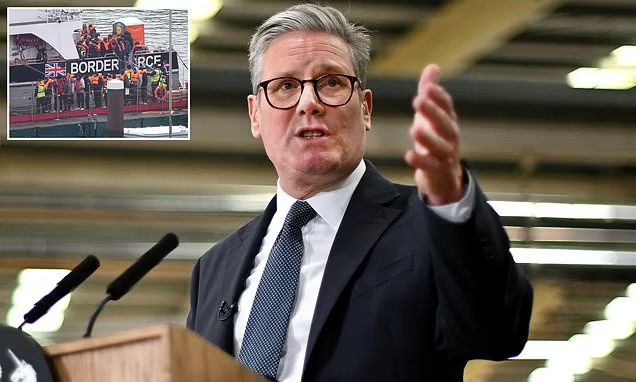
On Wednesday, the British government announced that it would be tightening immigration rules, making it nearly impossible for undocumented migrants arriving via small boats to later obtain UK citizenship. According to the new guidance, migrants arriving by sea or hidden in vehicles will typically be denied citizenship.

“This guidance further strengthens measures to make it clear that anyone who enters the UK illegally, including small boat arrivals, faces having a British citizenship application refused,” said a Home Office spokesperson.

Prime Minister Keir Starmer’s Labour government is facing increasing pressure to reduce migration following the success of Nigel Farage’s Reform UK party, which garnered nearly four million votes during the last general election—an unprecedented achievement for a far-right party.

However, the changes have sparked criticism from some Labour MPs. “If we give someone refugee status, it can’t be right to then refuse them a route to become a British citizen,” said lawmaker Stella Creasy on X, adding that the policy would result in individuals being “forever second class.”

Free Movement, an immigration law blog, warned that the new rules could “block a large number of refugees from naturalising as British citizens, effective immediately,” describing the updated guidance as “incredibly spiteful and damaging to integration.”

This move follows ongoing debates among MPs about the government’s new Border Security, Asylum, and Immigration Bill, which seeks to grant law enforcement officials “counter-terror style powers” to break up criminal gangs involved in smuggling irregular migrants across the English Channel.

Both legal and undocumented immigration are major political issues, with both reaching historically high levels. The July 2024 election, which brought Starmer to power, saw these topics dominate discussions. Upon taking office, Starmer immediately scrapped the controversial deportation plan to Rwanda proposed by his predecessor, Rishi Sunak. Instead, he vowed to “smash the gangs” responsible for the rising migrant numbers.

Provisional figures from the interior ministry revealed that 36,816 people crossed the Channel between England and France in 2024, marking a 25% increase from 2023’s 29,437.

Dangote Refinery Cuts Diesel Price by 5%, Offering Relief to Nigerians

0

Dangote Petroleum Refinery & Petrochemicals has reduced the price of its diesel by 5%, lowering the gantry price to N1,020 per litre from N1,075 per litre, with the goal of positively impacting Nigerian consumers.

Since beginning diesel production in January 2024, the refinery has decreased the price more than three times, dropping from an initial N1,700 per litre to the current rate. This price reduction has provided much-needed relief to both manufacturers and consumers.

The latest N55 per litre reduction comes after Development Economist and Public Policy Analyst, Prof. Ken Ife, revealed that Dangote Petroleum Refinery absorbed over N10 billion in losses to maintain a uniform petrol price during the holiday season. He also praised the refinery for setting a new standard in Nigeria’s energy sector, which has created significant opportunities for export revenue.

In a discussion on Arise TV, Prof. Ife explained that for many years, the equalisation fund was responsible for handling price differentials and transportation costs across the country. However, he pointed out that the fund currently owes over N80 billion to marketers.

“What has actually happened is that the president has shifted the subsidy burden away from the public purse and onto the private sector. The equalisation fund, which was meant to cover the price differential and transportation costs, plays a crucial role. If petroleum is to be sold across the country at a set price, then transportation costs must be accounted for to ensure this is possible. That’s the purpose of equalisation. However, the equalisation fund is reported to owe around N80 billion to the marketers, and this issue is still under discussion.

“During the Christmas season, which is traditionally the most challenging period, we often face shortages of petroleum, petrol hoarding, and arbitrary price hikes, all of which impact the cost of food. In response, during this last yuletide, the Dangote Group made the decision to absorb the costs. They equalised the price themselves, at a cost of over N10 billion. In doing so, they effectively absorbed the subsidy,” he stated.

Prof. Ife also highlighted that the Dangote Refinery is helping Nigeria transition away from its reliance on Premium Motor Spirit (PMS) towards a more diversified range of petroleum-based exports.

With international companies like BP and Saudi Aramco purchasing refined products from Nigeria, he believes the country is quickly becoming a significant player in the global petroleum market. Prof. Ife expressed optimism about Nigeria’s progress toward petroleum self-sufficiency, while also positioning itself as an energy export powerhouse

How Nigerians Are Reacting to CBN’s ATM Withdrawal Directives

0

The recent directives from the Central Bank of Nigeria (CBN) regarding ATM withdrawals have once again sparked debates among Nigerians, many of whom are already burdened by multiple banking policies that seem to tighten access to their own money.

While the CBN has maintained that these policies are aimed at financial stability and digital adoption, the everyday Nigerian sees them as yet another inconvenience in a system that is becoming increasingly expensive to navigate.

Nigerians Reactions to CBN’s New ATM Withdrawal Charges

The Central Bank of Nigeria’s (CBN) recent directive to eliminate the three free monthly ATM withdrawals from other banks’ machines has ignited a wave of reactions across social media platforms. Under this new policy, effective from March 1, 2025, customers will incur a ₦100 fee for every ₦20,000 withdrawn from another bank’s ATM.

On X (formerly Twitter), users have expressed their dissatisfaction and concern over the additional financial burden. One user lamented, “Nigerians are getting poorer, yet APC politicians are desperate to enrich themselves. Welcome to ‘change.’ ATM withdrawal fees are now ₦100.”

Another user highlighted the inconvenience of existing withdrawal limits, stating, “They should also increase/remove the limit they placed on ATM withdrawals. Nobody is going to spend hours in a queue just to withdraw only 5k.”

On Facebook, discussions have been equally fervent. A post by Daily Times Nigeria detailed the new charges, noting that while withdrawals from a customer’s own bank’s ATM will remain free, using another bank’s ATM will now attract a ₦100 fee per ₦20,000 withdrawn.

The CBN has justified this policy change by citing rising operational costs and the need to enhance ATM efficiency. However, many Nigerians feel that this move further restricts their access to cash and imposes additional financial strain, especially in a challenging economic climate.

But this is not the first time the CBN has introduced such controversial policies. A quick look at recent history shows a pattern of monetary decisions that, rather than offering relief, have only added to the financial strain of individuals and businesses.

A Brief History of ATM Charges in Nigeria

Nigerians have long had a complicated relationship with ATM charges. Before 2017, banks were allowed to charge N65 after the third withdrawal from another bank’s ATM within a month. However, due to public backlash, this charge was reduced to N35 in December 2019. Despite this minor relief, the burden of transaction fees has only increased over time.

Then came the cashless policy drive, which introduced additional costs such as:

  • Cash deposit and withdrawal limits: Transactions above a certain threshold attracted extra charges.
  • Stamp duty fees: A N50 charge on transactions of N10,000 and above.
  • Transfer fees: Charges for moving funds between accounts, even within the same bank.

Each of these policies has sparked frustration, especially as electronic banking alternatives—though encouraged—often come with their own hidden costs, such as network failures and increased service charges.

Current CBN Directives: A Step Forward or Backward?

The latest directive on ATM withdrawals appears to be another push toward limiting cash transactions and promoting digital banking. However, rather than embrace the move, many Nigerians see it as another way to restrict access to physical cash while banks continue to charge various fees for digital transactions.

For example, with unreliable POS transactions, failed transfers, and frequent system downtimes, cash remains a safer option for many. This is particularly true for small businesses and rural dwellers, where digital adoption is slow and financial inclusion remains a work in progress.

Are Nigerians Suffering from Policy Fatigue?

Over time, policies like these have left citizens questioning whether the financial system is designed for their benefit or simply as a revenue-generating machine for banks and regulators. The constant introduction of new charges, coupled with economic pressures like inflation and high fuel prices, has fueled what can best be described as policy fatigue.

Many Nigerians now feel that they are being taxed at every turn—whether through fuel subsidies removal, electricity tariff hikes, or endless banking deductions. As one Lagos-based trader put it:

“Even to collect my own money, they want to charge me. What kind of system is this?”

The government and CBN argue that these policies are necessary for economic stability, but public perception is quite different. For many, it feels like a constant cycle of paying more for less access.

At the end of the day, trust in the banking system can only grow when people feel that policies serve their interests, not just those of financial institutions. Until then, the frustration surrounding each new CBN directive will only deepen, as Nigerians continue to ask: At what cost are these policies truly serving us?

Lagos Government Announces Traffic Diversions for 2025 City Marathon

0

As the city prepares for this year’s Lagos City Marathon, the Lagos State Government has announced a comprehensive traffic diversion plan to ensure smooth movement across the city.

Taking place on Saturday, February 15, 2025, the marathon will run from 5:00 am to 1:00 pm, leading to significant changes in traffic flow throughout the day.

The Commissioner for Transportation, Oluwaseun Osiyemi, released a statement on Tuesday, detailing the race’s route. The marathon will begin at the National Stadium in Surulere and cover several major roads, including Ikorodu Road, Anthony (Bertola), and Gbagada.

Participants will cross the Third Mainland Bridge, head towards Lagos Island, and pass through critical streets such as Dolphin Road, Alfred Rewane Road, and Falomo Roundabout.

The race will then move along Bourdillon Road, cross the Lekki-Ikoyi Link Bridge, and continue to Admiralty Way and Ozumba Mbadiwe Avenue before concluding at Ahmadu Bello Way, Eko Atlantic.

In response to the changes, the government has outlined alternative routes to ensure smooth commuting throughout the day.

“Motorists from the Lagos-Ibadan Expressway (Mowe and nearby areas) should take the Ojota Slip Road, connect Ikorodu Road, and continue through Funsho Williams Avenue to Eko Bridge,” the government advised.

“The Third Mainland Bridge will remain closed to traffic heading towards Lagos Island but will be accessible to motorists travelling to the Mainland,” it added.

For those traveling from Lagos Island to the Mainland, alternative routes such as Apongbon Bridge, Eko Bridge, and Costain Roundabout are available, or they can use the route through Victoria Island and Independence Bridge.

Osiyemi reassured residents that traffic management personnel would be stationed at key locations to ease congestion and minimize disruptions.

Is Lagos Habitable for Young Professionals?

0

Lagos, Nigeria’s commercial capital, has long been a city of contrasts. It is the land of endless opportunities and the place where dreams are made—or crushed. The city’s fast-paced lifestyle, expensive living costs, and harsh working conditions make it a tough terrain, especially for young professionals trying to build a future.

In 2024, Lagos was ranked as one of the worst cities to live in globally. But beyond the statistics, what does life in Lagos actually feel like for a young person earning a modest income? Is Lagos still the city of hope, or has it become a survival game?

The Cost of Survival: Transportation and Living Expenses

For a young professional earning ₦100,000 monthly, surviving in Lagos is nothing short of a balancing act. Rent, transportation, food, and utilities all compete for a slice of their limited paycheck.

  • Rent: In Lagos, where landlords demand at least a year’s rent upfront, housing is a major financial burden. A decent self-contained apartment in a central location costs at least ₦800,000 per year—far beyond what most young professionals can afford. This forces many to live in distant, cheaper areas like Ikorodu, Mowe, or Badagry, where rent is lower but transportation costs are crushing.
  • Transportation: The cost of commuting is a daily struggle. A one-way bus trip from the mainland to the island can cost between ₦1,000 and ₦2,500. Multiply that by 20 working days, and that’s nearly half of a ₦100,000 salary gone—just on getting to work. The alternative? Enduring long, overcrowded bus rides, leaving home at 4 AM to beat traffic, or trekking long distances when fares become unbearable.
  • Food & Utilities: With inflation driving up food prices, even a simple meal of rice and beans costs nearly ₦1,500 at a roadside canteen. Electricity bills and internet subscriptions add to the financial strain, leaving little to no room for savings or personal growth.

A breakdown of expenses for a young Lagosian earning ₦100,000 might look like this:

  • Rent (Shared Apartment on Outskirts) – ₦30,000
  • Transportation (Buses, Keke, or Bike) – ₦30,000
  • Food & Feeding – ₦25,000
  • Utilities & Data – ₦10,000
  • Miscellaneous (Emergencies, Social Life, Savings?) – ₦5,000

With no room for savings or personal growth, many are stuck in a cycle of survival rather than progress.

The Pressure to Survive: When Desperation Leads to Despair

With living costs skyrocketing and wages stagnant, many young professionals find themselves backed into a corner. Some take on multiple side gigs, working late into the night, barely getting enough sleep. Others, overwhelmed by financial pressure, turn to alternative means of survival—fraud, prostitution, or shady business deals.

Cybercrime, commonly called “Yahoo Yahoo,” has become an escape route for some young Lagosians who see no way out of their financial struggles. Likewise, the rise of transactional relationships, where young women exchange companionship for financial stability, shows how economic hardship pushes people into morally complex decisions.

Social media constantly glorifies luxury lifestyles, fueling the illusion that hard work alone is not enough. A young graduate working in a bank might earn ₦120,000 monthly, while another person flaunts millions online from questionable sources. The pressure is intense, and without strong moral grounding, some give in to shortcuts.

For many, the dream of “making it” in Lagos turns into an exhausting, soul-crushing reality where survival trumps ambition.

What is the Government Doing?

The Lagos State Government has acknowledged the city’s housing crisis and rising cost of living. Policies like the Lagos Rent-to-Own Scheme were introduced to help young professionals access affordable housing, but the impact has been minimal. The demand for affordable homes far outweighs supply, and bureaucratic bottlenecks make it difficult for the average Lagosian to benefit from these initiatives.

On transportation, the government launched the Blue Line Rail Project and expanded BRT (Bus Rapid Transit) services to ease commuting stress. However, the reality remains that public transport is still unreliable, expensive, and unsafe.

Until concrete steps are taken to address the root causes—high inflation, low wages, and exploitative housing policies—Lagos will remain a difficult place for young professionals to thrive.

The Harsh Reality of Lagos Living

Lagos is a city of dreams, but only for those who can afford it. While opportunities exist, they come at a heavy cost—one that many young professionals are struggling to pay.

The question remains: Is Lagos still habitable for young professionals, or has it become a city that only rewards the privileged? Until the government prioritizes affordable housing, fair wages, and better infrastructure, the Lagos dream will remain just that—a dream.

Google Maps Renames Gulf of Mexico to Gulf of America

0

Google Maps has updated the name of the Gulf of Mexico to the Gulf of America for U.S. users, following an executive order from former President Donald Trump. This decision has sparked a debate, with Google confirming that the change is based on information from official government sources.

“For users in the U.S., the body of water is now labeled ‘Gulf of America.’ Users in Mexico will continue to see ‘Gulf of Mexico,’ while users elsewhere will see both names,” Google said in a statement on Monday.

The name change is part of a broader initiative by the Trump administration to reinstate historical U.S. names. The same executive order also called for Alaska’s highest peak, Denali, to be renamed Mount McKinley. The name “Mount McKinley” had been used until 2015, when President Obama renamed it to honor Alaska’s Indigenous heritage. As of Tuesday, the mountain’s name on Google Maps remains unchanged.

The executive order referred to the renaming as a way to celebrate “American greatness,” criticizing the 2015 change as an insult to President William McKinley’s legacy, and highlighting his contributions to tariffs and the defense of U.S. values.

The Federal Aviation Administration (FAA) and the U.S. Coast Guard have already begun updating official documents and charts to reflect the new names. “We are currently revising our data to incorporate the name change from Gulf of Mexico to Gulf of America,” the FAA said in a statement.

The decision has led to mixed reactions, with some seeing it as a patriotic move, while others question the necessity of renaming landmarks with deep historical and cultural significance.

Nigeria to engage US over visa drop box suspension

0

The Federal Government of Nigeria has committed to diplomatic discussions with US authorities to address the recent suspension of the drop box service for visa renewals.

Chairman of the House of Representatives Committee on Foreign Affairs, Oluwole Oke, disclosed this while speaking during an interview.

“I am currently in the US and will take up this matter. After my meetings in New York, I will head to Washington to discuss the issue with our chargé d’affaires and explore possible solutions,” Oke stated.

He downplayed concerns over the suspension, noting that Nigeria does not offer a similar drop box service for Americans renewing their Nigerian visas.

“This is not a major issue. The US has the right to discontinue the drop box option for Nigerians. In diplomacy, the principle of reciprocity applies,” he explained.

Oke highlighted that, before President Bola Ahmed Tinubu assumed office, the US granted Nigerians two-year visas, whereas Nigeria issued US citizens only one-year visas. The US later extended its visa validity to five years, while Nigeria continued with one-year visas. However, Tinubu directed the Minister of Interior to implement a five-year visa policy for Americans to ensure parity.

“The decision to remove the drop box service is entirely theirs. I contacted the Minister of Foreign Affairs to confirm if any official communication had been received from the US, and he confirmed that no formal notification had been issued,” Oke added.

He expressed confidence that the US would reconsider some of its policies, emphasizing Nigeria’s significance on the global stage.

“Nigeria is a key player in global affairs, and no nation can afford to ignore us. We remain a strategic partner, and the world is watching,” he said.

The drop box service previously allowed certain visa applicants, particularly those with a recent US travel history, to renew their visas without attending in-person interviews. However, over the weekend, reports emerged that the US had discontinued the service in Nigeria, requiring all visitor visa applicants to undergo face-to-face interviews for renewals.