The Federal Government is scrambling to avert a possible blackout across the country as electricity generation companies (GenCos) threaten to down tools over an outstanding debt of about ₦4 trillion.
Investigations revealed that the GenCos are owed over ₦2 trillion in legacy debts and about ₦1.97 trillion for the year 2024 alone. This comes as the Federal Government has also failed to settle ₦450 billion owed to power distribution companies (DisCos) as part of the electricity subsidy for 2024.
The Executive Secretary of the Association of Power Generation Companies, Dr. Joy Ogaji, said GenCos are under immense pressure due to the financial shortfall. She warned that the sustainability of power generation is at risk if the debts remain unpaid.
Minister of Power, Adebayo Adelabu, acknowledged that the subsidy burden is becoming unsustainable and emphasized the need for a more targeted subsidy model. He also noted that poor investment by DisCos in network infrastructure has affected the shift of consumers to cost-reflective tariffs, worsening the situation.
The GenCos have made several demands, including the immediate implementation of a debt repayment plan and the provision of a payment security mechanism backed by international financial institutions. They are also asking the government to ensure full settlement of their invoices and cover obligations in the recent MYTO Supplementary Order and the Distribution Reimbursement Obligation.
Stakeholders warn that if these issues are not urgently addressed, Nigeria could be plunged into a major electricity crisis, with widespread blackouts and grid instability.
On April 8, 2025, Judge Beryl Howell of the U.S. District Court for the District of Columbia instructed the Federal Bureau of Investigation (FBI) and the Drug Enforcement Administration (DEA) to release records tied to a 1990s drug probe involving President Bola Ahmed Tinubu.
This decision followed a lawsuit filed in June 2023 by American transparency advocate Aaron Greenspan under the Freedom of Information Act (FOIA). The lawsuit challenged the agencies’ use of the “Glomar response,” a legal stance that permits them to neither confirm nor deny the existence of certain records.
Judge Howell ruled that invoking the Glomar response was “neither logical nor plausible,” especially as Tinubu’s link to the case had already been acknowledged.
Consequently, the court directed the FBI and DEA to remove redactions and make the documents public. A joint status report from the agencies is expected by May 2, 2025.
What is the Drug-Related Allegations all about
Recently released documents from the United States District Court for the Northern District of Illinois have revealed more details about Bola Tinubu’s past encounters with U.S. authorities regarding allegations of drug trafficking and money laundering.
As a former governor of Lagos State and the All Progressives Congress (APC) presidential candidate, Tinubu faced persistent scrutiny over his alleged involvement in a drug case in Chicago in the early 1990s.
Though the controversy has resurfaced periodically since the mid-2000s, Tinubu has consistently chosen not to address it publicly. Instead, he highlights his professional background in accounting, consultancy, and support for democratic governance.
According to his official declaration to Nigeria’s electoral commission, INEC, he claimed he has never been convicted of any crime.
His supporters often downplay the case, referring to it as an old matter with little relevance to present-day Nigerian politics due to its foreign and historic context.
However, many Nigerians continue to demand full disclosure from him, especially since court records indicate that he forfeited “$460,000 to U.S. authorities in 1993” as part of a case settlement.
The 56-page document released by the Chicago court does not introduce significantly new information but supports details previously reported in the media.
Public curiosity intensified after a report published on July 13 by journalist David Hundeyin in West Africa Weekly, which revisited the longstanding drug allegations.
Court-certified documents dated August 10 linked Tinubu, alongside individuals identified as “K.O. Tinubu and Alhaji Mogati,” to the laundering of drug-related funds via Heritage Bank and Citibank.
It’s still unclear if “Alhaji Mogati” was a clerical mistake for “Alhaja Abibatu Mogaji,” Tinubu’s late foster mother, who passed away in 2013.
In July 1993, the U.S. government moved to seize funds believed to be proceeds from narcotics. A resolution was reached allowing the Tinubu family to retain funds in Heritage Bank, while “$460,000 held in Citibank” was forfeited.
The case was officially dismissed “with prejudice” by a U.S. federal judge on September 21, 1993, ruling out the possibility of it being reopened in the United States. However, it’s uncertain if Nigerian authorities could initiate a new case based on the same allegations.
Public Reactions
The ruling has sparked widespread conversations online and offline:
Investigative journalist David Hundeyin shared his reaction on X (formerly Twitter), stating: “I’ve dreamt of this day since 2022, and it’s a shame that I can’t do this with my @DavidHundeyin account.
But long story short, Aaron Greenspan and I have won our FOIA lawsuit against the @FBI, @DEAHQ, @StateDept and @TheJusticeDept regarding @official Abates heroin trafficking records.
THE UNREDACTED FILES WILL BE RELEASED!”
I've dreamt of this day since 2022, and it's a shame that I can't do this with my @DavidHundeyin account.
Another X user, @iremide, questioned the legitimacy of the funds involved: “Omo forfeiting $460,000 in 1993 for that matter! Which legit work can give such a huge profit?”
Omo forfeiting $460,000 in 1993 for that matter! Which legit work can give such a huge profit?
Reacting to the U.S. court’s directive, the presidency issued a statement through Bayo Onanuga, a media aide to President Tinubu, emphasizing that the ruling does not imply wrongdoing on the president’s part.
According to Onanuga, the relevant FBI and DEA reports “have been in the public domain for over 30 years” and do not implicate the Nigerian president. He also mentioned that legal experts are currently reviewing the judgment.
“Journalists have sought the presidency’s reaction to the ruling last Tuesday by a Washington DC judge ordering the US FBI and DEA to release reports connected with President Bola Ahmed Tinubu,” the statement reads.
“Our response is as follows. There is nothing new to be revealed. The report by Agent Moss of the FBI and the DEA report have been in the public space for more than 30 years. The reports did not indict the Nigerian leader. The lawyers are examining the ruling.”
Potential Implications for Nigeria’s Political Landscape
Should any new details emerge from the unredacted files, it could lead to political unrest in Nigeria. Questions may surface about the authenticity of President Tinubu’s mandate, potentially triggering investigations or demands for accountability within the country.
Although impeachment is legally possible, pursuing it would depend on political factors and the disposition of the National Assembly.
The opposition might use the situation to challenge the administration’s legitimacy. At the same time, civil society organizations and the media may ramp up calls for greater transparency.
Internationally, Nigeria’s reputation could suffer, particularly in discussions centered on governance, ethics, and anti-corruption standards.
Conclusively, how this matter evolves will largely depend on the responses of political leaders, institutions, and the Nigerian populace.
In southern Mauritania’s town of Sélibaby, Christians are gripped by fear following a violent protest on April 7, in which demonstrators, reportedly incited by Muslim leaders, desecrated the grave of a Christian man, exhumed his body, and dragged it through the streets before reburying it miles away.
Authorities had approved the protest, which advocacy group Middle East Concern (MEC) said was organized by Muslims opposed to the presence of Christians in the area.
“Christians in Sélibaby have grave concerns for their safety and lives as the incitement of hate against them by prominent religious and community leaders continues,” a MEC press statement read.
According to MEC, an Islamist mob stormed a cemetery, broke the tombstone of a deceased Christian, exhumed the body, and dragged it through the streets before transporting it to a distant village for reburial.
“Tensions eased by evening, but social media posts describing Christians as infidels and apostates, urging ‘action’ against them, intensified the following day,” MEC stated. “They called for a total ostracism of Christians. Some of the leaders have been warned by their clans and relatives, not to contact them. The situation remains volatile.”
The day after the demonstration, authorities fired local security leaders after an investigation. However, rights advocates say the move is not enough. Human rights defender Cheikh Mkhaitir criticized the government’s handling of the situation.
“He is reburied 30 kilometers from the city, far from a normal cemetery,” Mkhaitir said, according to Jubilee Campaign. “Mauritania is a country that is very dangerous for non-Muslims, even for the deceased.”
Mkhaitir, who was once sentenced to death for “apostasy” in 2014 and later released due to international pressure, emphasized the need for global accountability.
“The countries that still practice laws of apostasy and blasphemy in spite of the U.N. conventions that they signed would not continue to violate the conventions unless they were sure that all those agreements and conventions are on paper only,” he said. “And, they will continue to be on paper only, and people will continue to suffer in prisons and even the gallows, unless some real mechanism pushes these countries to adhere to the conventions they have signed, irrespective of the country’s status in international economics.”
Jubilee Campaign confirmed the spread of disturbing videos of the desecration on social media and on CRIDEM, Mauritania’s primary French-language news portal. The footage showed several perpetrators dragging the body while a crowd filmed the act.
According to Jubilee Campaign, Mauritania still has the death penalty for apostasy and blasphemy, though a moratorium is in place. “It has not stopped them from sentencing Cheikh to death in 2014 and continues to use the law to threaten Christian converts and other non-Muslims with silence and eradication,” the group said.
“Mauritania’s repeated cosmetic adjustments after pressure are evidence that the country desires acceptance on the world stage.”
Despite international trade partnerships and recent meetings with NATO on security cooperation, Jubilee Campaign says these diplomatic moves are not enough.
“The recent action in Sélibaby is a pressing example that piecemeal solutions are not enough,” the organization stated. “The death penalty for apostasy and blasphemy needs to be repealed completely for the recognition of the rights and protection of Christians, non-Muslims and all the citizens of Mauritania. Otherwise, we will return to another Sélibaby, another youth robbed of six years of his life and even an extrajudicial execution.
Temporary security and trade deals are not worth the suffering of generations.”
Mauritania’s laws are a blend of French civil code and Islamic sharia law. The 2018 amendment to Article 306 of its penal code states: “Any Muslim who explicitly apostatizes from Islam, or who says or does something that would require or include that, or who renounces what he knows to be required by the religion, shall be imprisoned for three days, during which time he will be asked to repent. If he does not repent, he will be sentenced to death for blasphemy, and his property will be transferred to the treasury of the Muslims.”
The U.S. State Department’s 2022 religious freedom report noted public calls for stronger enforcement of sharia law and highlighted severe restrictions on non-Islamic religious practices.
“The law prohibits apostasy and blasphemy,” the report states. “The criminal code mandates a death sentence for any Muslim convicted of apostasy or blasphemy, but the government has never applied capital punishment for apostasy or blasphemy.”
Faith-based NGOs are barred from proselytizing or promoting any religion other than Islam, and religious gatherings—even in private homes—require prior government approval.
“Authorized churches were able to conduct services within their premises but could not proselytize,” the report adds. “An unofficial government requirement restricted non-Islamic worship to the few recognized Christian churches.”
In late 2023, a video of a baptism in Sélibaby sparked outrage among Muslims, leading to the arrest of up to 18 Christians and their family members. By December 18, they had been released.
Open Doors ranked Mauritania 23rd on its 2025 World Watch List of countries where it is most difficult to be a Christian.
Gabon’s interior minister announced that Brice Oligui Nguema, who seized power in a coup in August 2023, won the presidential election held on Saturday with 90.35% of the vote, based on provisional results released Sunday.
This landslide victory further consolidates Nguema’s grip on leadership, 19 months after the military ousted the Bongo family, ending their five-decade reign over the oil-rich Central African nation of 2.5 million people.
In the eight-candidate race, Nguema’s primary challenger was Alain Claude Bilie By Nze, a former prime minister under ousted President Ali Bongo. According to the results, Nze secured just 3.02% of the votes.
Nguema, seen wearing a baseball cap bearing his “We Build Together” campaign slogan, positioned himself as a reformist ready to take on corruption linked to the previous regime.
He promised to reduce Gabon’s heavy dependence on oil and boost sectors like agriculture, tourism, and industry. Currently, about one-third of Gabon’s population lives below the poverty line.
The voter turnout stood at 70.40%, a significant increase from the 56.65% recorded in the August 2023 election that preceded the coup.
That earlier election had declared Bongo the winner of a third term, but widespread allegations of fraud surrounded the outcome. The military took control shortly after the results were made public.
With $3 billion in outstanding international bonds, global investors have been closely monitoring Gabon’s political trajectory to gauge whether the country would regain democratic legitimacy through transparent elections.
“Prolonged political uncertainty and fears of extended military rule have constrained Gabon’s economic growth, exacerbating the country’s budget deficit and debt levels,” said Mucahid Durmaz, senior Africa analyst at risk intelligence firm Verisk Maplecroft.
“A democratically elected government with a clear mandate will be better positioned to engage with multilateral partners and to pursue fiscal reforms and debt restructuring, which are essential to establishing macroeconomic stability.”
The World Bank reported that Gabon’s economy grew by 2.9% in 2024, up from 2.4% the previous year, driven by increased infrastructure projects and a rise in production of oil, manganese, and timber.
Nguema’s win earns him a seven-year term, renewable once, as per the new constitution ratified in November.
Although he vowed to break from the legacy of the Bongo regime, which faced criticism for concentrating the country’s oil wealth among elites, Nguema has ties to the previous government. He formerly served as an aide-de-camp to Omar Bongo, Ali Bongo’s father, who ruled Gabon for over 40 years until his death in 2009.
Algeria has given 12 French officials a 48-hour deadline to leave the country, as confirmed by the French foreign minister.
This move is widely seen as a response to the recent arrest of three Algerian nationals in France.
“I am asking Algerian authorities to abandon these expulsion measures… if the decision to send back our officials is maintained, we will have no other choice but to respond immediately,” said Foreign Minister Jean-Noel Barrot.
A diplomatic source noted that among those asked to leave are members of the French interior ministry.
The diplomatic fallout follows the indictment of three Algerians, including a consular official, by French prosecutors on Friday. They are suspected of being involved in the April 2024 abduction of Algerian influencer Amir Boukhors in a suburb of Paris.
Boukhors, known online as “Amir DZ,” is a prominent critic of the Algerian government. He has more than a million followers on TikTok and was granted political asylum in France in 2023.
The Algerian government is calling for Boukhors’ extradition to face legal charges and has issued nine international arrest warrants accusing him of fraud and terrorism.
This development adds to the strain on an already delicate relationship. For years, the dynamic between Paris and Algiers has been marked by complexity, despite various diplomatic efforts to foster improved ties.
On Monday, South African President Cyril Ramaphosa named former deputy finance minister Mcebisi Jonas as a special envoy to the United States.
Jonas, who currently serves as the independent non-executive chairman of MTN Group, a major telecommunications company, will maintain his role at MTN while undertaking his new diplomatic responsibilities.
“Jonas is entrusted with the responsibility to advance South Africa’s diplomatic, trade and bilateral priorities. He will lead negotiations, foster strategic partnerships and engage with U.S. government officials and private-sector leaders to promote our nation’s interests,” said a statement from President Ramaphosa’s office.
The appointment comes at a time when relations between South Africa and the United States have worsened since President Donald Trump returned to office in January.
The U.S. has slashed financial aid to South Africa, citing concerns over its land reform agenda and its legal case against Israel at the International Court of Justice. Additionally, Washington expelled South Africa’s ambassador last month.
Jonas previously held the position of deputy finance minister from 2014 to 2017. He gained recognition for speaking out against corruption and played a key role in the judicial inquiry that examined graft and undue influence during former President Jacob Zuma’s administration.
During the inquiry, Jonas testified that the Gupta brothers known associates of Zuma offered him the finance minister post and a large sum of money. Both Zuma and the Guptas have denied any wrongdoing.
Sony, the renowned Japanese electronics company, has announced that it is increasing prices for select PlayStation 5 models in several international markets—excluding the United States—due to “challenging” global economic conditions.
The company told AFP on Monday that the PS5 Digital Edition, which comes without a disc drive, will see a price rise of over 10 percent in Europe, the UK, and Australia.
In a blog post shared on Sunday, Sony said the “tough decision” to raise prices was influenced by ongoing economic difficulties, including high inflation rates and unstable exchange rates.
The announcement comes as global markets continue to feel the impact of U.S. President Donald Trump’s shifting tariffs, which have sparked a trade war with China and fueled fears of a wider economic downturn.
The blog post also noted that New Zealand will face a price increase for the PS5 Digital Edition.
In addition, Sony revealed that the price of the standard PS5, which includes a Blu-ray disc drive, will increase in both Australia and New Zealand.
Although no specific pricing was disclosed, the company stated that some price adjustments will also take place in the Middle East and Africa.
On a positive note for gamers, Sony announced that the recommended price for the standalone PS5 disc drive will be reduced.
All new pricing changes are set to take effect starting Monday. The company confirmed that the pricing for the premium, high-performance PS5 Pro launched in November will remain unchanged.
Originally released in 2020, the PlayStation 5 saw a boost with the PS5 Pro version, which includes upgrades that improve game speed and visual quality.
In Europe, the PS5 Digital Edition will now retail for 499.99 euros ($570.04), while in the UK, it will be priced at 429.99 pounds ($566.53).
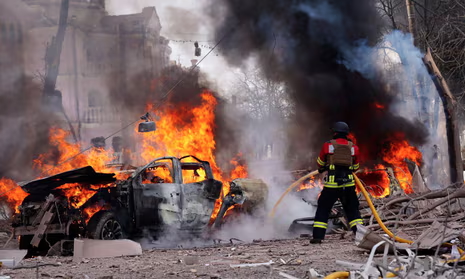
Russian missiles hit the center of Sumy, a city in northeastern Ukraine, while people gathered to celebrate Palm Sunday. At least 34 people died in what became the second major attack in just over a week to kill civilians in Ukraine.
According to the State Emergency Service of Ukraine, the dead included two children. Around 117 people got injured, including 15 children.
Officials said the two ballistic missiles hit at about 10:15 a.m. local time. Photos from the scene showed rows of black body bags along the road. More bodies were wrapped in foil blankets among the wreckage.
Ukrainian officials stated that 20 buildings were damaged. This included four educational institutions, several cafes, shops, and five apartment buildings. Ten cars and trams were also hit.
BBC Ukrainian reported that the university’s congress center, often used for children’s classes, was among the damaged sites. Local residents said the center was an “educational hub for the entire city” and “very actively rented out for various courses, clubs, and master classes”.
Officials in Sumy also said that the missiles had cluster munitions, which can kill randomly over large areas. The blasts caused burning vehicles and bent trees, where many of the deaths seemed to happen.
President Volodymyr Zelenskyy called for a strong international reaction to the attack. It happened while U.S. President Donald Trump continued his efforts to end the war.
“Russia wants exactly this kind of terror and is dragging out this war. Without pressure on the aggressor, peace is impossible,” he said.
Zelenskyy said one of the injured was a baby born this year. He added that medics were doing “everything they can” to save lives. “The strike hit right in the heart of the city on Palm Sunday,” he said in his evening video address. “Only completely deranged scum can do something like this taking the lives of ordinary people,” he added.
He also posted on social media that the first missile hit buildings at a city university, while the second exploded above street level. Andriy Yermak, the head of the Ukrainian president’s office, said the strike used cluster munitions to try to kill as many people as possible. The Associated Press could not confirm this claim.
World leaders also condemned the attack. French President Emmanuel Macron said it damaged U.S.-led efforts to bring peace. “Everyone knows: This war was initiated by Russia alone. And today, it is clear that Russia alone chooses to continue it with blatant disregard for human lives, international law and the diplomatic efforts” of Mr. Trump, Macron said.
UK Prime Minister Sir Keir Starmer called the attack “horrific”. He said, “President Zelensky has shown his commitment to peace, President Putin must now agree to a full and immediate ceasefire without conditions as Ukraine has done.”
Macron and Starmer are working together on a “coalition of the willing” to help carry out any peace deal in Ukraine.
The attack happened shortly after U.S. envoy Steve Witkoff met with Russian President Vladimir Putin in St. Petersburg on Friday. The Kremlin said the meeting went on for over four hours and focused on “aspects of a Ukrainian settlement”. Russian envoy Kirill Dmitriev called it “productive” — it was Witkoff’s third meeting with Putin this year.
U.S. Secretary of State Marco Rubio gave his condolences to the victims of the “horrifying Russian missile attack on Sumy.” He said, “This is a tragic reminder of why President Trump and his Administration are putting so much time and effort into trying to end this war and achieve a just and durable peace.”
The Plateau State Government has strongly condemned another unprovoked attack by gunmen on Zike and Kimakpa communities in Kwall District, Miango, located in Bassa Local Government Area of the state.
Speaking with Walkyes Kwakfut, our correspondent over the phone, Rt. Hon. Joyce Ramnap, the Commissioner for Information and Communication, stated that the attack is one too many and its reoccurrence pose a serious threat to the lives and livelihoods of the state’s peace-loving residents.
“It is sad that in less than two weeks after our people were killed in Bokkos local government, this sad incident is reoccurring in another community in Bassa local government” she said.
She described the attack as another attempt to disrupt the peace gradually returning to the state.
She termed the attacks as “provocative” and urged the affected communities and the entire state to remain calm and stay vigilant.
The Commissioner reaffirmed the Mutfwang administration’s commitment to taking firm action against any individual or group found responsible for targeting innocent citizens.
She also discouraged any form of reprisal and urged security agencies to pursue and bring the perpetrators of these dastardly acts to justice
On April 13, 2025, Newcastle United delivered a commanding 4–1 victory over Manchester United at St. James’ Park, marking a significant moment in both clubs’ seasons.
Match Overview
Despite the absence of manager Eddie Howe due to illness, Newcastle, under assistant Jason Tindall, showcased a cohesive and dynamic performance. Sandro Tonali opened the scoring with a sharp volley, and although Alejandro Garnacho briefly equalized for Manchester United, Newcastle regained control with two goals from Harvey Barnes and a final strike from Bruno Guimarães, capitalizing on a goalkeeping error.
Tactical and Player Insights
Manchester United, managed by Ruben Amorim, fielded a rotated squad, prioritizing their upcoming Europa League fixture. This decision, coupled with defensive vulnerabilities, contributed to their downfall. Debutant goalkeeper Altay Bayındır struggled, notably in the buildup to Newcastle’s fourth goal.
Newcastle’s midfield, led by Tonali and Guimarães, dominated proceedings, while Barnes’ attacking prowess was evident in his two goals. The team’s depth and adaptability were on full display, reinforcing their credentials for a top-four finish.
Implications
This result propelled Newcastle into fourth place, bolstering their Champions League aspirations. Conversely, Manchester United’s 14th league loss equaled their worst Premier League season record, intensifying scrutiny on Amorim’s tactical approach and squad management.
With a crucial Europa League match against Lyon on the horizon, Manchester United faces mounting pressure to salvage their season.
To provide the best experiences, we use technologies like cookies to store and/or access device information. Consenting to these technologies will allow us to process data such as browsing behaviour or unique IDs on this site. Not consenting or withdrawing consent, may adversely affect certain features and functions.
Functional
Always active
The technical storage or access is strictly necessary for the legitimate purpose of enabling the use of a specific service explicitly requested by the subscriber or user, or for the sole purpose of carrying out the transmission of a communication over an electronic communications network.
Preferences
The technical storage or access is necessary for the legitimate purpose of storing preferences that are not requested by the subscriber or user.
Statistics
The technical storage or access that is used exclusively for statistical purposes.The technical storage or access that is used exclusively for anonymous statistical purposes. Without a subpoena, voluntary compliance on the part of your Internet Service Provider, or additional records from a third party, information stored or retrieved for this purpose alone cannot usually be used to identify you.
Marketing
The technical storage or access is required to create user profiles to send advertising, or to track the user on a website or across several websites for similar marketing purposes.