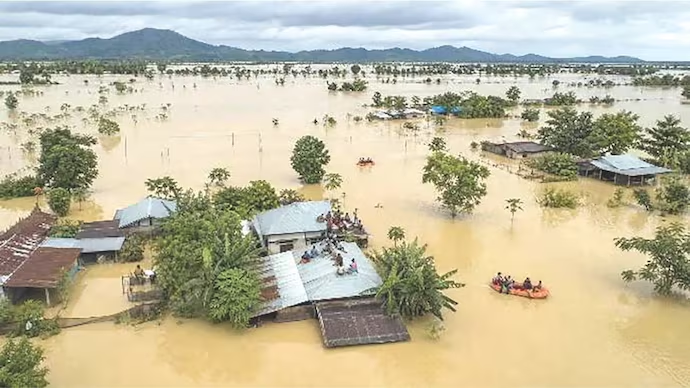
Flooding across India’s northeastern region has claimed nearly 100 lives, with villages buried under mud and thousands of residents displaced following one of Assam’s worst flood disasters in recent years, according to updated official figures released on Friday.
Authorities said at least 97 people have died in Assam, while nearly 170,000 residents have been affected by the disaster. Thousands of families have been forced to leave their homes and seek refuge in temporary relief camps as overflowing rivers continue to inundate communities and farmland.
The floods have also submerged more than 14,000 hectares of agricultural land, covering an area estimated to be almost one and a half times the size of Paris.
An AFP journalist who visited Sivasagar, one of the worst-hit districts, reported scenes of widespread devastation, with homes partially submerged, trees uprooted, and vehicles trapped beneath thick layers of mud.
Assam Chief Minister Himanta Biswa Sarma shared a heartbreaking video on Friday showing him comforting the parents of a 13-year-old boy who lost his life while attempting to rescue his pet dog from the floodwaters.
“No parent should ever have to bid farewell to their child,” he wrote.
India’s Health Minister J.P. Nadda, who toured the affected areas on Thursday, described the destruction as overwhelming and warned that recovery would take considerable time.
“The scale of the devastation is so huge that it will take time” for normal life to resume, he said.
“Village after village has been submerged,” he told reporters.
Flooding is a recurring challenge in Assam during the June-to-September monsoon season, as the Brahmaputra River, India’s largest river, and its numerous tributaries frequently overflow after heavy rainfall.
However, experts have warned that the disasters are becoming increasingly severe due to the combined effects of climate change and poorly planned urban and environmental development.
Residents and local officials have also blamed illegal coal mining in neighbouring Nagaland, arguing that mining activities have worsened flooding in areas that were not previously considered flood-prone.
Chief Minister Sarma said he intends to raise the matter with the Federal Government in New Delhi.
Climate advocacy organisation Climate Trends noted that the worsening flood situation in Assam reflects a combination of environmental and human factors.
According to the group, the increasing severity of floods is “driven by the interaction of global warming, changing river dynamics and growing human exposure, making them more frequent, more complex and more costly.”
Victims abducted during the deadly attack on Woro Community in Kaiama Local Government Area of Kwara Statehave arrived in Ilorin following their rescue after spending several months in captivity.
The rescued victims reached the Kwara State capital late on Thursday after regaining their freedom through sustained military offensives and coordinated operations by Nigerian security agencies.
They were transported from Niger State to Ilorin, where they were received at the Nigerian Army’s 2 Division, Sobi Barracks.
The victims were later moved to a secure, undisclosed location where they spent the night.
Some of the rescued victims were taken to hospital for immediate medical attention due to the physical and emotional effects of their prolonged captivity.
The victims were among residents kidnapped when heavily armed attackers stormed Woro earlier this year, killing scores of villagers and taking many others into nearby forests.
The attack sparked nationwide concern and prompted intensified military and security operations aimed at locating and rescuing those held by the abductors.
The rescued victims are expected to be formally presented to Kwara State Governor AbdulRahman AbdulRazaq, who has maintained close engagement with security agencies throughout efforts to secure their release.
Authorities are also expected to complete the verification of the rescued victims while ensuring they receive adequate medical care, psychological support, and other welfare assistance to aid their recovery after months in captivity.
Woro Attack
Armed terrorists attacked Woro Community in February, killing more than 150 people and abducting scores of residents.
“President Bola Ahmed Tinubu warmly welcomes the successful rescue of 308 Nigerian citizens who were abducted in different attacks in Niger and Kwara states,” presidential spokesman Bayo Onanuga said.
He disclosed that 163 victims were rescued from Woro, while 145 others were freed in Niger State.
According to the Presidency, the victims were rescued from the Kainji Lake National Park Forest, where they had been held by their captors.
The vast forests and game reserves stretching across parts of Nigeria have increasingly become safe havens for criminal gangs and armed groups responsible for mass abductions and violent attacks.
Onanuga described the operation as “the largest rescue operation ever carried out” in a single day, noting that it involved the National Counter-Terrorism Centre (NCTC), the Nigerian Armed Forces, the Department of State Services (DSS), and the Nigeria Police Force.
Investigations into the February attack revealed that the terrorists had earlier sent a message to Woro residents announcing plans to visit the community to preach. After no one reportedly attended, the attackers returned in what residents described as a brutal retaliatory assault.
The assailants set homes ablaze, destroyed property, killed more than 165 residents, and abducted many others, according to eyewitnesses, although local authorities released lower casualty figures.
Initial reports estimated that 176 residents were kidnapped, though Kwara State Police later stated that the figure had not been officially verified.
The attack left large sections of Woro reduced to rubble and ashes, forcing many survivors to flee the community.
President Bola Tinubu condemned the incident at the time, describing it as a “beastly attack.” He ordered the deployment of an army battalion to the affected area and attributed the assault to Boko Haram, although the name is often broadly used to describe jihadist groups operating in the region.
The attack came only months after the Al-Qaeda-linked Group for the Support of Islam and Muslims (JNIM) claimed responsibility for its first-ever attack on Nigerian territory in the same state, close to Woro.
The Nigeria Labour Congress (NLC) has declared that the current ₦70,000 national minimum wage is no longer sufficient to meet the needs of Nigerian workers, citing soaring inflation, rising living costs, and worsening economic conditions as reasons for an immediate wage review.
The call was made on Friday during the Nigeria Rights of Workers Summit 2026 held in Birnin Kebbi, Kebbi State, where labour leaders, government officials, employers, civil society organisations, and representatives of the National Industrial Court gathered to mark 88 years of organised trade unionism in Nigeria.
The summit, themed “The Rights of Workers: Decent Work and a Just Economy in Nigeria,” focused on the welfare of Nigerian workers and the state of labour rights, with participants expressing concerns over declining purchasing power, unsafe working conditions, job insecurity, workplace discrimination, and the protection of workers in the informal and non-traditional employment sectors.
Representing NLC President Joe Ajaero, the Congress’ Deputy President, Adewale Adeyanju (Amba), said the country’s current economic realities have made the existing minimum wage inadequate.
“The current ₦70,000 minimum wage can no longer adequately respond to the realities confronting Nigerian workers, particularly with the rising cost of living,” Adeyanju said.
He noted that the lifespan of the current wage arrangement had expired, making it necessary for organised labour to begin fresh negotiations with the Federal and State Governments. He urged authorities to approve a new minimum wage that reflects present-day economic realities and protects workers from the impact of inflation.
Convener of the summit and Executive Director of Call a Lawyer, Ekpa Stanley, said the event was designed not only to celebrate the history of organised labour in Nigeria but also to assess progress made and identify practical solutions to improve workers’ welfare.
“This summit is not only about celebrating 88 years of trade unionism; it is also an opportunity to reflect on what has been achieved, the challenges that remain, and what must be done to guarantee decent work for Nigerian workers,” he said.
Former NLC President Ayuba Wabba stressed that improving workers’ welfare should go beyond salary increases.
According to him, decent work also requires the protection of workers’ rights, adequate social security, and constructive engagement between government, employers, and organised labour.
“Decent work is not only about wages. It is also about workers’ rights, social protection and meaningful social dialogue between workers, employers and government,” Wabba said.
He urged policymakers to adopt measures that would protect workers’ dignity, strengthen job security, and expand social protection programmes to cushion the impact of current economic challenges.
Kebbi State Governor Nasir Idris assured workers that his administration would fully implement any new national minimum wage approved by the Federal Government.
The governor also pledged to advocate for improved workers’ remuneration during discussions at the Nigeria Governors’ Forum.
“Whatever is agreed upon at the national level on the minimum wage, Kebbi State will implement it,” Idris said.
Participants at the summit also called for stricter enforcement of labour laws, safer workplaces, stronger protection against discrimination, and greater attention to workers in the informal sector.
They maintained that the 88th anniversary of organised trade unionism should serve as an opportunity to renew commitment to protecting workers’ rights and ensuring that collective bargaining results in meaningful improvements in the living and working conditions of Nigerian workers.
More than 300 people abducted in separate attacks across Nigeria have been rescued, in what the presidency is calling the largest single-day security operation of its kind. The rescue took place in Kainji Lake National Park in Niger State and involved a joint effort by the military, police, intelligence services and the National Counter-Terrorism Centre.
Among those freed were 163 people taken during a February assault on the Woro community in Kwara State, an attack that killed scores of residents, along with 145 others abducted in Niger State. It remains unclear whether any suspects were captured during the operation. The rescued victims are receiving medical treatment at a military facility ahead of being reunited with their families.
Presidential spokesman Bayo Onanuga said President Bola Tinubu welcomed the rescue of 308 citizens, calling it the largest such operation ever conducted in a single day. Tinubu pointed to the outcome as evidence of stronger coordination among the country’s security agencies.
The Woro attack was carried out by armed jihadists seeking to force residents to reject Nigeria’s government and constitution in favour of their own rule. Amnesty International reported that many victims were found bound at the hands and feet, with some killed by gunfire and others by knife. Nigerian authorities have attributed the attack to Boko Haram, though the group has not commented publicly.
The rescue follows the recent release of 44 students and teachers who were freed after more than 50 days in captivity following a school abduction in Oyo State, the result of a month-long security operation. The wave of kidnappings, spreading into north-central and southern Nigeria, has heightened concerns that insecurity is expanding beyond the country’s usual conflict areas.
The Nigerian film industry has been thrown into mourning following the death of popular Nollywood actress Temitope Osoba, who died at the age of 40 after battling breast cancer.
Her passing comes less than a year after she made an emotional return to acting, having publicly celebrated her recovery and encouraged others facing similar health challenges.
News of her death was confirmed on Wednesday by fellow Nollywood actor Alesh Sanni, who shared the heartbreaking announcement on Instagram.
“Couldn’t sleep since last night, it’s well. Rest in peace my dearest sister, Temitope Osoba. We had amazing time and good memories together, till we meet again. I really dunno what to say mehn, gosh,” he wrote.
Osoba’s courage throughout her cancer journey inspired thousands of Nigerians. By openly sharing her diagnosis, surgeries and recovery, she became a voice of hope for many breast cancer patients.
Her death has once again highlighted the importance of awareness, early detection and regular screening for one of the world’s most common cancers.
What Is Breast Cancer?
Breast cancer is a disease in which abnormal cells in the breast grow uncontrollably, forming a tumour. If left untreated, these cancerous cells can spread to nearby tissues, lymph nodes and other parts of the body, including the lungs, liver, bones and brain.
Although breast cancer is most commonly diagnosed in women, men can also develop the disease because everyone is born with some breast tissue.
According to global health experts, breast cancer remains the most frequently diagnosed cancer among women worldwide. However, advances in screening, early diagnosis and treatment have significantly improved survival rates over the years.
There are several forms of breast cancer, including:
Invasive ductal carcinoma (IDC), the most common type
Invasive lobular carcinoma (ILC)
Ductal carcinoma in situ (DCIS)
Triple-negative breast cancer
HER2-positive breast cancer
Inflammatory breast cancer
Paget’s disease of the breast
Male breast cancer
Healthcare professionals classify breast cancer into different stages depending on the size of the tumour and whether it has spread beyond the breast.
What Causes Breast Cancer?
Medical experts say there is no single cause of breast cancer. Instead, it develops when breast cells undergo genetic mutations that cause them to grow and multiply abnormally. Several factors are known to increase a person’s risk of developing the disease, including:
Increasing age, particularly after age 50
Being female, although men can also be affected
Family history of breast or ovarian cancer
Inherited genetic mutations, especially BRCA1 and BRCA2
Previous radiation exposure to the chest
Hormone replacement therapy (HRT) for prolonged periods
Obesity, particularly after menopause
Alcohol consumption
Smoking
Early onset of menstruation or late menopause
Having dense breast tissue
Not having children or having a first pregnancy later in life, which may slightly increase risk in some women
It is important to note that many people diagnosed with breast cancer have none of these risk factors, while others with several risk factors may never develop the disease.
Signs And Symptoms Of Breast Cancer
Breast cancer does not always produce symptoms in its early stages, making regular screening extremely important.
Common warning signs include:
A new lump or thickening in the breast or underarm
Changes in the size or shape of the breast
Persistent breast pain in one area
Swelling of part or all of the breast
Skin dimpling, often described as resembling an orange peel
Redness or unusual darkening of the breast skin
A nipple that suddenly turns inward
Unusual nipple discharge, especially if bloody
Peeling, crusting or scaling of the nipple or surrounding skin
Swollen lymph nodes around the collarbone or underarm
Doctors advise that anyone who notices unusual breast changes should seek medical evaluation immediately rather than waiting for their next routine screening.
How Can Breast Cancer Be Prevented?
While breast cancer cannot always be prevented, experts say adopting healthy lifestyle habits and undergoing regular screening can significantly reduce the risk or improve the chances of early detection.
Recommended preventive measures include:
Perform regular breast self-examinations to become familiar with normal breast changes.
Attend recommended breast screening appointments, including mammograms where appropriate.
Report any unusual lump or breast change to a healthcare professional promptly.
Maintain a healthy body weight.
Engage in regular physical activity.
Eat a balanced diet rich in fruits, vegetables and whole grains.
Limit alcohol consumption.
Avoid smoking.
Discuss the risks and benefits of hormone replacement therapy with a healthcare provider before long-term use.
Individuals with a strong family history of breast cancer should consider genetic counselling and, where appropriate, genetic testing.
Health professionals emphasise that early diagnosis remains one of the most effective ways to improve survival outcomes, as treatment is generally more successful when breast cancer is detected before it spreads.
Conclusion
Temitope Osoba’s passing is a painful reminder that breast cancer remains a serious public health challenge despite advances in medical treatment. Her openness about her diagnosis, surgeries and recovery inspired countless people to take their health more seriously and encouraged conversations about early detection.
While not every case of breast cancer can be prevented, recognising the warning signs, attending regular screenings and seeking prompt medical attention can save lives.
As friends, colleagues and fans continue to mourn the actress, her story also serves as a lasting call for greater awareness, education and support for those living with breast cancer.
The Democratic Republic of Congo has banned exports of copper and cobalt concentrate, according to a government order reviewed by Reuters, marking the latest push to force mineral processing within the country and capture more value from its natural resources. News of the ban sent benchmark three-month copper prices on the London Metal Exchange up as much as 1.8% to $14,369.50 a metric ton, its highest level since late January.
Congo, the world’s leading cobalt producer and a major copper supplier, is aiming to build up domestic refining capacity rather than export raw materials. The order, signed on June 29 by the mines, foreign trade and economy ministers, states plainly that concentrate exports are prohibited. It took effect immediately, though one-year waivers may be issued under undefined “strategic circumstances.” The order also establishes a new tax framework, with a three-month transition period, covering economically significant mining by-products.
Officials said the ban is meant to push mining companies toward exporting higher-value processed minerals rather than raw concentrate. Congo has taken similar action before, imposing comparable bans in 2013, 2019 and 2023, each time allowing exemptions where domestic smelting capacity fell short. This latest order replaces the 2023 rules entirely with a broader framework governing mineral exports and by-product taxation.
Most of Congo’s copper already leaves the country as refined metal rather than raw concentrate: in the first quarter of 2026, it exported roughly 697,000 tons of copper cathodes compared with about 54,000 tons of copper concentrate. It also shipped nearly 52,000 tons of cobalt hydroxide over the same period.
Mining analyst Christian-Geraud Neema said the ban is unlikely to hit most operators hard, since the majority of Congo’s copper and cobalt is already processed domestically. He noted the Kamoa-Kakula venture, jointly owned by Ivanhoe Mines, China’s Zijin Mining and the Congolese government could feel the greatest impact, as it still exports some concentrate under prior exemptions. Ivanhoe, Zijin and Congo’s chamber of mines had not responded to requests for comment.
The new tax rules apply broadly, including a 55% valuation coefficient for trace and ultra-trace minerals recovered during refining, with royalties charged in addition to those on primary minerals.
Uganda is mourning David Owori, one of its most prominent footballers, who died at 27 after being attacked by suspected robbers near his home in Kampala. Police say the SC Villa captain was assaulted after he resisted attempts to steal his phone and other belongings, an incident that has reignited public anger over rising violent crime in the capital.
Owori led SC Villa, the Uganda Premier League’s most successful club, playing as both a right-back and midfielder, and also earned caps for the national team, the Cranes. The club said it had lost more than a player, describing him as a leader, brother and friend.
According to witnesses, a group of attackers struck Owori with paving stones outside his home in the Makindye suburb on Tuesday night before robbing him and fleeing, leaving him unconscious. SC Villa spokesperson Asan Kasingye said the footballer was ambushed as he approached his residence and suffered life-threatening injuries before being rushed for treatment. He was first taken to a nearby clinic, then transferred to a private hospital, where he died on Wednesday.
Police spokesperson Rachael Kawala said investigators were following leads to track down the attackers and confirmed the scene had been processed for evidence.
Tributes have poured in from across Uganda’s football community and political establishment for Owori, known affectionately as “Colgate.” The Federation of Uganda Football Associations called him a leader and inspiration both on and off the pitch, while the Cranes said the country had lost a star who carried the nation’s hopes. Parliament observed a minute’s silence in his honour on Wednesday and urged a swift investigation.
Owori rejoined SC Villa in 2023 after a two-year spell in Europe and was among the squad’s longest-serving players at the time of his death. He was instrumental in the club’s 2024 title win, its first in 20 years and a record 17th overall, and had recently signed a contract extension through January 2027. He also featured in Uganda’s 2021 Africa Cup of Nations qualifying campaign and was seen as a likely future contender for national team selection.
His death has fuelled outrage on social media, with Ugandans demanding tougher action on crime. It comes weeks after rugby international Sydney Gongodyo was also killed in a mob attack in Kampala.
The Nigeria Police Force has announced the deployment of 15,000 police personnel to provide security during the August 15 Osun State governorship election, with a stern warning that anyone attempting to disrupt the electoral process will face the full weight of the law.
The Commissioner of Police assigned to oversee security for the election, Samuel Etaifo, disclosed this on Wednesday in Osogbo, the Osun State capital, while addressing journalists after a meeting with police personnel deployed for the exercise.
Etaifo explained that the security deployment comprises conventional police officers as well as specialised units, including the Police Mobile Force (PMF), medical teams, dog section and other specialist operatives.
He also revealed that the election security operation would be supervised by a Deputy Inspector General of Police (DIG) and an Assistant Inspector General of Police (AIG).
“As I speak with you, the total number of officers that will come for this election, we should be expecting nothing less than 15,000.
“This includes conventional policemen, specialists, dog section, medical, PMF. The DIG and AIG in charge of this operation are coming.
“I will be the CP in charge of the election. That is why the IGP has deployed me here. We are supposed to arrive here about four or five days before the election, but because of the heightened tension, the IGP said I should come, being the junior officer,” Etaifo said.
According to the police commissioner, additional officers had already been deployed to Osun State following reports of rising political tension and isolated incidents of violence ahead of the governorship poll.
He urged all officers participating in the operation to conduct themselves professionally, maintain neutrality and strictly adhere to the provisions of the law throughout the election period.
Etaifo stressed that no individual, regardless of political affiliation or social status, would be allowed to undermine the conduct of a free, fair and credible election.
He warned that anyone arrested for violating electoral laws during the election would be transferred to Abuja for investigation and possible prosecution.
“Arrested violators of electoral laws will be moved straight to Abuja.
“Anyone arrested here in Osun during the course or after the election will be taken to Abuja. This election is a Federal Government election, so anybody arrested will be taken to Abuja. That’s the order,” the CP said.
The Osun governorship election is scheduled for August 15, with voters expected to elect the state’s next governor.
A total of 14 candidates will contest the election, including the incumbent governor, Ademola Adeleke, who is seeking another term in office.
The Nigeria Police Force has assured residents that adequate security measures have been put in place to ensure a peaceful electoral process and urged citizens to remain law-abiding while exercising their civic responsibility.
The Federal Government has assured Nigerian public servants that payment of outstanding wage awards will commence before the middle of August, as efforts to clear pending workers’ entitlements enter the final stage.
The assurance was conveyed in a statement issued on Wednesday in Abuja by Efe Ovuakporie, Head of Information and Public Relations at the Federal Ministry of Finance.
According to the statement, the Minister of Finance and Coordinating Minister of the Economy, Taiwo Oyedele, gave the assurance during a meeting with labour leaders led by the National President of the Joint Public Service Negotiating Council (JPSNC), Trade Side, Kabiru Minjibir.
During the meeting, Oyedele stated that the Federal Government had already begun addressing several labour-related concerns before receiving the council’s formal submissions.
He reaffirmed the commitment of the President Bola Tinubu administration to honouring agreements reached with Nigerian workers through continuous dialogue and constructive engagement.
“The objective is to build confidence by ensuring the government honours every commitment made,” he said.
The minister disclosed that the process for releasing the outstanding wage awards had reached its final phase and expressed optimism that eligible workers would begin receiving the payments before mid-August.
He also directed the relevant government agencies and officials to immediately review the council’s submissions and accelerate action on all outstanding labour matters.
Oyedele acknowledged concerns raised by labour representatives over delays in implementing previous agreements and pledged that the government would prioritise transparency, regular consultations and timely execution of approved commitments.
In addition to the wage awards, the Federal Government assured workers that outstanding promotion arrears are currently being processed in accordance with approved administrative procedures.
The Permanent Secretary of the Federal Ministry of Finance, Raymond Omachi, reiterated the ministry’s commitment to maintaining stronger collaboration with organised labour, assuring workers that approved financial entitlements would be processed without unnecessary delays.
Similarly, the Permanent Secretary for Special Duties, Mohammed Danjuma, revealed that significant progress had been made in addressing workers’ outstanding benefits.
According to him, Batch Seven promotion arrears, which were previously omitted, are now being processed alongside Batch Nine promotion arrears.
Danjuma further explained that the government is working closely with the relevant agencies to resolve issues relating to peculiar allowances and other outstanding labour-related concerns affecting public servants.
Also speaking at the meeting, the Director of Cash Management, Christiana Osho, confirmed that reconciliation of the outstanding wage award had been completed and that payment was now awaiting final release.
She stated that the process had reached its concluding stage and would soon be implemented.
Earlier, the JPSNC President, Kabiru Minjibir, urged the Federal Government to urgently resolve all pending labour issues affecting public servants across the country.
Among the unresolved matters highlighted by the labour leader were outstanding wage awards, promotion arrears, salary relativity for health workers and payment of peculiar allowances.
He stressed that prompt implementation of the government’s commitments would help strengthen industrial harmony, improve workers’ morale and boost public servants’ confidence in the administration’s commitment to their welfare.
The African Democratic Congress (ADC) has questioned the independence of the Economic and Financial Crimes Commission (EFCC) following President Bola Tinubu’s directive ordering the anti-graft agency to reverse the freezing of the Osun State Government’s bank accounts.
The opposition party said the President’s intervention, as well as his reference to an alleged court order that authorised the account freeze, has sparked fresh concerns about the operational autonomy of the commission.
President Tinubu had, on Thursday, instructed the EFCC to immediately return to court to vacate the order freezing the state government’s accounts, describing the timing of the action—just days before the August 15 Osun governorship election as inappropriate.
The President explained that although the EFCC was carrying out its statutory responsibilities, he felt “deeply embarrassed” because actions taken by federal agencies are often attributed to the Presidency and could create the impression of federal interference in the electoral process.
Before the presidential directive, the EFCC had defended its decision to freeze the accounts, stating that it was investigating the alleged diversion of Ecology Funds, Intervention Funds, and Federal Account Allocation Committee (FAAC) allocations belonging to the Osun State Government.
The commission maintained that suspicious financial transactions uncovered during the investigation justified the restriction, insisting the move was a routine preventive measure and not politically motivated.
EFCC Director of Public Affairs, Wilson Uwujaren, had also noted that similar restrictions were placed on Edo State’saccounts ahead of the 2024 governorship election.
Reacting in a statement on Thursday, ADC National Publicity Secretary, Bolaji Abdullahi, said while the party welcomed President Tinubu’s directive, his explanation had raised more questions than it answered.
“What we find most curious about the statement is the President’s repeated reference to an alleged court order authorising the freezing of the Osun State Government’s accounts,” Abdullahi said.
He argued that throughout the controversy, the EFCC consistently defended its action based on its statutory powers and preventive mandate without publicly stating that it had secured judicial approval.
“In all of its public statements on this matter, the EFCC never once claimed that it had obtained a court order. The commission consistently defended its actions on the basis of its statutory powers and what it described as its ‘preventive mandate’.
“At no point did it inform Nigerians that a court had authorised its actions. The obvious question, therefore, is: where did the President obtain the information that a court order existed? If such an order exists, why was it never mentioned by the EFCC in its statement while defending one of the most controversial actions it has taken in recent times?
“If no such order exists, why would the President introduce one into the public narrative? It is either the President was misinformed or he had chosen to misrepresent the facts. Either possibility is deeply disturbing,” he stated.
The ADC further argued that the President’s admission that he instructed the EFCC to withdraw the matter from court contradicts repeated assurances that anti-corruption agencies operate independently of the executive arm of government.
“The President also insists that he does not interfere in the operational activities of anti-corruption agencies, yet in the same statement he publicly announces that he has directed the EFCC to approach the court, vacate the alleged order, and discontinue its case.
“If the President possesses the authority to direct the EFCC to withdraw from court proceedings because the political consequences may affect an election, then it follows that he possesses the authority to direct the commission in other operational matters as well.
“The net implication is that the carefully cultivated argument that these agencies operate entirely independently collapses under the weight of the President’s own statement,” Abdullahi added.
To provide the best experiences, we use technologies like cookies to store and/or access device information. Consenting to these technologies will allow us to process data such as browsing behaviour or unique IDs on this site. Not consenting or withdrawing consent, may adversely affect certain features and functions.
Functional
Always active
The technical storage or access is strictly necessary for the legitimate purpose of enabling the use of a specific service explicitly requested by the subscriber or user, or for the sole purpose of carrying out the transmission of a communication over an electronic communications network.
Preferences
The technical storage or access is necessary for the legitimate purpose of storing preferences that are not requested by the subscriber or user.
Statistics
The technical storage or access that is used exclusively for statistical purposes.The technical storage or access that is used exclusively for anonymous statistical purposes. Without a subpoena, voluntary compliance on the part of your Internet Service Provider, or additional records from a third party, information stored or retrieved for this purpose alone cannot usually be used to identify you.
Marketing
The technical storage or access is required to create user profiles to send advertising, or to track the user on a website or across several websites for similar marketing purposes.