Home Blog Page 44

Who Was Raila Odinga? Kenya’s Former Prime Minister

9

Former Kenyan Prime Minister Raila Odinga passed away at the age of 80 while receiving medical treatment in India.

His death comes after weeks of speculation about his health. Indian outlets reported that he suffered a cardiac arrest in Kochi, was rushed to the hospital, but unfortunately, could not be saved.

Who Was Ralia Odinga

Born on January 7, 1945, Raila Amolo Odinga was a Kenyan politician and statesman who served as the Prime Minister of Kenya from 2008 to 2013. He represented the Langata Constituency in Parliament from 1992 to 2013 and later served as leader of the opposition from 2013 onward.

A member of the Luo ethnic group, Odinga hailed from Bondo in Siaya County, located in western Kenya, near the shores of Lake Victoria.

He came from one of Kenya’s most influential political families. His father, Jaramogi Oginga Odinga, was the country’s first Vice President after independence in 1963.

Odinga ran unsuccessfully for the presidency five times in 1997, 2007, 2013, 2017, and 2022 often alleging electoral malpractice.

He was known for his resilience, reformist agenda, and ability to connect deeply with ordinary Kenyans despite his elite background.

He was married to Ida Odinga since 1973, and their union was blessed with four children, including Rosemary and Winnie Odinga, both of whom have followed in their father’s footsteps in public service and activism.

Early Life & Education

Odinga studied in East Germany, where he obtained an engineering degree from Otto von Guericke University, Magdeburg.

After returning to Kenya, he entered public life and began advocating for democratic reforms.
During the regime of President Daniel arap Moi, Odinga spent several years in detention from 1982 to 1988 and again between 1989 and 1991 for his involvement in pro-democracy movements and alleged association with the failed 1982 coup attempt.

These detentions earned him the title of Kenya’s longest-serving political prisoner.

Political Career

Raila Odinga’s political career spanned more than four decades. He was instrumental in Kenya’s transition from one-party rule to multiparty democracy in the early 1990s and played a major role in the constitutional reforms that led to the adoption of Kenya’s 2010 Constitution.

His influence grew during the 2007 post-election crisis, when his disputed loss to Mwai Kibaki triggered one of Kenya’s worst waves of political violence, leaving over 1,200 people dead and 600,000 displaced.

The crisis was resolved after Kofi Annan brokered a power-sharing deal, resulting in a coalition government with Odinga as Prime Minister.

In 2017, Odinga’s legal challenge to President Uhuru Kenyatta’s victory led to a historic Supreme Court annulment of the election results, a first in Africa though he boycotted the subsequent rerun, demanding electoral reforms.

After losing again in 2022, Odinga agreed to join President William Ruto in a “broad-based government” designed to promote national unity and stability following widespread protests and political unrest.

Speech At ICAD 2025 With LN247

At the International Conference on Africa’s Democracy (ICAD) in July, 2025, held at the NAF Conference Centre in Abuja, Nigeria, Odinga delivered what would be one of his final public addresses.

Speaking on the theme “Building a Governance System That Works in Africa for Africans,” he stated:
“Africa trades more with the external world than with itself.”

He spoke with LN247, emphasizing the need for Afrocentric governance, economic integration, and reduced dependency on foreign powers, saying:

“We must reimagine governance in a way that breaks structural dependency and empowers our people to trade, innovate, and thrive together.”

The two-day conference explored topics such as democratic consolidation, economic sovereignty, and continental collaboration.

Legacy

Raila Odinga’s death leaves a considerable void in Kenya’s political landscape.

He was known as “Baba” (Father), “Agwambo”, and “Tinga”, nicknames that speak to both reverence and his ability to mobilize grassroots support.

He is remembered as a champion of democratic freedoms, human rights, and constitutional reform, and one of Kenya’s longest-serving political detainees.

As Kenya moves toward its 2027 elections, many wonder whether any living leader can unify opposition forces with the same influence and vision as Odinga. His legacy will continue to shape political discourse across Kenya and Africa for years to come.

Reactions To His Death

Across Africa, political leaders, activists, and citizens have paid tribute to Odinga’s towering legacy.

Kenya’s former Chief Justice and presidential candidate, David Maraga, said he was “shocked” by the news, describing Odinga as:
“A patriot, a pan-Africanist, a democrat, and a leader who made significant contributions to democracy in Kenya and in Africa. Kenya has lost one of its most formidable leaders who shaped the trajectory of our beloved country. Africa has lost a leading voice in pushing for peace, security, and development. The world has lost a great leader.”

Ethiopian Prime Minister Abiy Ahmed also expressed condolences, writing:
“On behalf of the Government of Ethiopia, I extend my sincere condolences on the passing of former Kenyan Prime Minister Raila Odinga. May he Rest In Peace.”

At Least 16 Dead In Bangladesh Garment Factory Blaze, Toll Expected to Rise

9

A devastating fire at a garment factory in Dhaka, Bangladesh, has claimed the lives of at least 16 people, with officials warning that the number of victims could increase as rescue efforts continue.

Authorities reported that sixteen bodies have so far been recovered and will be handed over to families after DNA testing, as the remains were badly burned and difficult to identify.

Crowds of grieving relatives gathered outside the four-storey factory in the Mirpur district on Tuesday, anxiously waiting for news of loved ones who were still unaccounted for.

The blaze erupted around midday and was brought under control after about three hours, according to the fire service. However, a nearby chemical storage facility continued to burn late into the night.

Major fires remain a recurring tragedy in Bangladesh, often linked to weak enforcement of safety measures and poor building conditions. Hundreds of lives have been lost in similar incidents across the country in recent years.

By 9:00 p.m. local time on Tuesday, officials confirmed that firefighters were still working to fully extinguish the flames at the chemical warehouse next to the factory. Investigators have not yet determined which of the two buildings caught fire first.

Eyewitnesses said the warehouse contained bleaching powder, plastic materials, and hydrogen peroxide — all highly flammable substances that can intensify fires and release toxic fumes when burned.

According to the fire service, most of the victims likely succumbed to poisonous gas inhalation, made worse by the fact that the roof exit was locked at the time of the incident.
Fire service director Mohammad Tajul Islam Chowdhury said the victims probably died “instantly” after inhaling “highly toxic gas.”

Police and military personnel are currently searching for the owners of both the garment factory and the chemical warehouse, while authorities have launched a probe to determine if the warehouse had been operating legally.

Officials revealed that the warehouse lacked both a fire safety clearance and an operating licence. Reports also confirmed that it had no official occupancy permit.

Outside the smouldering buildings, heartbroken families held photographs of their missing relatives. Among them was a father desperately searching for his daughter, Farzana Akhter.
“When I heard about the fire, I came running. But I still haven’t found her… I just want my daughter back,” he said tearfully.

Bangladesh has a grim record of industrial disasters. In 2021, a fire at a food and beverage factory killed at least 52 people, later found to have been operating illegally without proper fire exits.
In 2019, a fast-moving blaze swept through an old part of Dhaka, leaving 78 people dead.

The country’s deadliest industrial tragedy occurred in 2013, when the eight-storey Rana Plaza building, which housed several garment factories, collapsed due to structural defects, killing more than 1,100 people.

NAFDAC Clarifies List of 101 Withdrawn Drugs and Their Current Status

38

The National Agency for Food and Drug Administration and Control (NAFDAC) has clarified the regulatory status of 101 withdrawn drugs in Nigeria, explaining the reasons behind each classification and reassuring the public of its commitment to drug safety and quality.

In a statement released on its official X (formerly Twitter) handle on Tuesday, the agency said the clarification was issued to help Nigerians and industry stakeholders understand the implications of the different categories under which these products were listed.

According to NAFDAC, the terms “withdrawn,” “suspended,” and “cancelled” represent distinct regulatory decisions made to ensure that only safe and compliant medicines remain in circulation.

Under its explanation, “withdrawn” refers to drugs whose registration was voluntarily discontinued by the manufacturer or marketing authorisation holder, often for commercial or market reasons, and not necessarily due to safety concerns.

Meanwhile, “suspended” denotes a temporary halt in registration pending compliance with regulatory standards, while “cancelled” applies to products whose approvals have been fully revoked — usually due to safety issues, poor quality, or non-compliance with manufacturing practices.

The agency stated that the publication of such lists aligns with global best practices, aimed at curbing counterfeiting and ensuring that delisted products do not re-enter the market.

NAFDAC provided examples across various categories, including antimalarials, antimicrobials, diabetes medicines, eye drops, and injectables.

Among the affected products are Artemether/Lumefantrine 40mg/240mg Tablets and ASAQ (Artesunate Amodiaquine Winthrop) Tablets, both voluntarily withdrawn by Healthline Limited and Sanofi Aventis Nigeria Ltd, respectively, for commercial reasons.

Other delisted medicines include Flagyl Suspension and Tablets (400mg), which are no longer approved for manufacture or sale, and Norditropin Growth Hormone Injectables, which were removed following a regulatory review.

In the diabetes category, Januvia and Janumet were withdrawn from the market, while Amaryl M Tablets and Amaryl M SR were voluntarily withdrawn by Sanofi Aventis Nigeria Ltd.

Reaffirming its mandate, NAFDAC said,
“NAFDAC remains committed to safeguarding the health of Nigerians through continuous post-market surveillance and regulatory enforcement to ensure that only safe, quality, and efficacious products are available to the public.”

FCCPC Supports CBN’s 48-Hour Refund Policy

1

‎The Federal Competition and Consumer Protection Commission (FCCPC) has welcomed the Central Bank of Nigeria’s (CBN) draft guidelines requiring all banks to refund customers for failed Automated Teller Machine (ATM) transactions within 48 hours.

‎To make the policy effective, the FCCPC said it would work with the CBN to establish systems for monitoring compliance and ensuring timely redress when banks fail to meet the 48-hour deadline.

‎Director, Corporate Affairs of the commission, Ondaje Ijagwu, stated in Abuja yesterday that the draft guidelines follow the FCCPC’s Consumer Complaints Data Report published in September 2025.

‎According to him, the report, which covered the period from March to August 2025, showed that the banking and fintech sectors accounted for the highest number of complaints nationwide, over 3,000 cases in banking alone, with about N10 billion recovered for customers across 30 sectors.

‎The findings highlighted recurring issues such as failed transactions, unauthorised deductions, and delayed refunds, all of which the CBN draft guidelines seek to address.

‎He added that the Executive Vice Chairman and Chief Executive Officer of the FCCPC, Tunji Bello, described the proposal as “a timely and long-awaited correction to a persistent consumer challenge.” He also noted that, even at the draft stage, it demonstrated stronger alignment between regulatory agencies committed to consumer protection.

N’Assembly Sets November 2026 For Presidential, Governorship Elections

1

‎In a potentially landmark move to fundamentally reshape Nigeria’s democratic process, the National Assembly has proposed a significant acceleration of the electoral calendar, moving the next presidential and governorship elections forward by six months to November 2026.

‎This core amendment, contained in the draft Electoral Act (Amendment) Bill 2025, is primarily driven by the goal of ensuring that all election litigations are definitively concluded before the traditional May 29, 2027, swearing-in date, thereby ending the chaos of leaders governing under a cloud of legal uncertainty.

‎The legislative shift is stipulated under the proposed Section 4(7), which mandates that elections for the President and state Governors shall be held “not later than 185 days before the expiration of the term of office.” Applying this timeframe to the May 29, 2027, handover date points directly to late November 2026.

‎Chairman of the House Committee on Electoral Matters, Hon. Adebayo Balogun, emphasized that the adjustment is specifically designed to guarantee that all election litigations are dispensed with before the swearing-in of winners.

‎To facilitate this, the bill proposes sweeping judicial reforms, including shortening tribunal judgment deadlines to 90 days (from 180) and appellate court appeals to 60 days.

‎Beyond the calendar changes, the draft legislation introduces a comprehensive overhaul of the voting machinery, emphasizing technology and transparency.

‎The amendment to Section 60(5) now mandates the compulsory electronic transmission of results from polling units, a reform that received broad support from INEC and civil society groups.

‎Other innovations include a provision for early voting for Nigerians on electoral duty (security personnel, INEC staff, etc.), non-compulsory use of the Permanent Voter Card (PVC) with approved alternatives, and stiff penalties for electoral offenses, such as the distribution of unstamped ballot papers.

‎While the overall vision for cleaner, swifter polls garnered significant praise, the speed of the calendar change sparked controversy.

‎Opposition parties argued that the shift constitutes a “hoodwink” that hands incumbents an unfair advantage, warning that November 2026 is “too early” for opposition parties.

‎However, proponents maintain that the changes are essential for reducing electoral tension and promoting smoother transitions of power. If adopted and harmonized with constitutional amendments, this legislative package will usher in Nigeria’s earliest general elections in modern history, compelling all political actors to redraw their strategies and potentially strengthening the foundation of Nigeria’s democracy.

Tinubu Mourns Veteran Labour Activist Abiodun Aremu

1

President Bola Tinubu has expressed deep sorrow over the death of veteran labour leader and human rights advocate, Comrade Abiodun Aremu, describing him as a fearless champion of workers’ rights and social justice.

Aremu reportedly died on Sunday evening, October 12, 2025, after being hit by a speeding vehicle in Ota, Ogun State, while crossing the road near his home. He was rushed to a nearby hospital but was pronounced dead shortly after.

According to a statement released on Monday by the President’s Special Adviser on Information and Strategy, Bayo Onanuga, Tinubu extended his condolences to Aremu’s family, friends, and the wider labour and civil society community.

He praised the late activist for dedicating his life to improving the welfare of Nigerian workers, saying Aremu remained consistent in his pursuit of fairness, equity, and dignity for all.

The President also commiserated with the Nigeria Labour Congress (NLC), the Academic Staff Union of Universities (ASUU), and other civil society groups, noting that Aremu was “a reliable partner in the struggle for a just and prosperous nation.”

“Aremu was a teacher, an organiser, and a conscience of the people. He inspired generations with his unwavering integrity, patriotism, and commitment to justice,” Tinubu said.

He described Aremu’s passing as a great loss to the nation, hailing him as a selfless and courageous patriot who stood firm in defence of the oppressed.

The 65-year-old activist will be laid to rest on Thursday, October 23, 2025, at his residence, No. 30 Kabiru Fatoye Street, opposite Alaka Field, Ijako Sugar Bus Stop, along Ifo Road on the Lagos–Abeokuta Expressway.

President Tinubu prayed for the peaceful repose of his soul and for divine comfort for his family and loved ones.

Trump Considers Supplying Tomahawk Missiles To Ukraine

1

US President Donald Trump says he may authorise the delivery of long-range Tomahawk cruise missiles to Ukraine, a move that could heighten already tense relations between Washington and Moscow.

Speaking to reporters aboard Air Force One on Sunday, Trump said he was “considering it,” when asked about sending Tomahawks to Kyiv, adding, “We’ll see… I may.” He described such a decision as “a new step of aggression” in the ongoing Russia–Ukraine war.

The comment followed a weekend phone call between Trump and Ukrainian President Volodymyr Zelensky, who urged the United States to strengthen Ukraine’s long-range strike capabilities against Russian forces.

Moscow has previously cautioned the US against transferring long-range missiles to Kyiv, warning it would provoke a major escalation in the conflict and further strain diplomatic ties.

Tomahawk missiles can travel up to 2,500 kilometres (1,500 miles), making it possible for Ukraine to reach Moscow and other targets deep inside Russian territory.

Trump’s position on Russia has become more hardline in recent months as his administration grows impatient with President Vladimir Putin’s resistance to reaching a ceasefire deal.

“I might tell them [Russia] that if the war isn’t settled, we may very well send Tomahawks to Kyiv. Do they want them heading their way? I don’t think so,” Trump said.

Kremlin spokesman Dmitry Peskov described Trump’s comments as “deeply concerning,” warning that global tensions were “intensifying from every side.”

He also pointed out that Russia would not be able to determine whether any Tomahawks launched toward its territory were nuclear-armed. “What should Russia think? How should we respond?” he asked.

Former Russian President Dmitry Medvedev echoed Peskov’s remarks in a post on Monday, warning that the delivery of the missiles “could end badly for everyone — and especially for Trump himself.”

Medvedev, who has adopted a more aggressive tone in recent years, has clashed with Trump in the past. Their previous exchanges on social media prompted the US president to order two nuclear submarines closer to Russian waters in August.

Ukraine has long requested long-range weapons since Russia launched its full-scale invasion in 2022. During recent discussions, Trump and Zelensky also reviewed ways to strengthen Ukraine’s air defence and strike capacity.

Russia has intensified its missile and drone attacks on Ukraine’s energy facilities in recent weeks, causing widespread blackouts as winter approaches.

Last month, Trump’s special envoy to Ukraine, Keith Kellogg, hinted that the president had already approved strikes inside Russian territory, telling Fox News that “there are no sanctuaries” in the ongoing conflict.

Who is Maria Corina Machado, 2025 Nobel Peace Prize Winner

4

The Norwegian hub Nobel Committee has announced Venezuelan opposition leader Maria Corina Machado as the winner of the 2025 Nobel Peace Prize, recognizing her unyielding advocacy for democracy and peaceful political reform in Venezuela.

Machado, widely regarded as the “Iron Lady of Venezuela,” was honored for her “tireless work promoting democratic rights for the people of Venezuela and for her struggle to achieve a just and peaceful transition from dictatorship to democracy.”

Announcing the award in Oslo, Committee Chair Jørgen Watne Frydnes described Machado as “a brave and committed champion of peace” who continues to “keep the flame of democracy burning amidst growing darkness.” Despite being barred from political office and currently in hiding due to threats from President Nicolás Maduro’s government, Machado’s resolve to stand for freedom and democratic values has made her a global symbol of peaceful resistance.

Who is Maria Corina Machado?

Born on October 7, 1967, in Caracas, Maria Corina Machado is an industrial engineer, economist, mother of three, and one of Venezuela’s most prominent opposition figures. She leads the Vente Venezuela party, a liberal movement that campaigns for democratic governance, free markets, and social welfare programs targeting the nation’s poor.

Machado’s political journey began in 2002 when she co-founded Súmate, a civil organization formed to promote civic participation and electoral transparency during the deeply polarized years under former president Hugo Chávez. That same year, she led a recall referendum campaign against Chávez’s presidency, an act that earned her charges of treason and death threats, forcing her family to temporarily leave the country.

Undeterred, Machado became one of the most vocal critics of the Maduro administration, pushing for democratic transition and accountability. In 2023, she won the Venezuelan opposition’s presidential primary with overwhelming support, but her candidacy was blocked by a Supreme Court ruling that upheld a ban preventing her from holding public office.

Following the 2024 disputed presidential election, in which Maduro claimed victory amid allegations of electoral fraud, Machado went into hiding inside Venezuela, continuing her activism despite mounting threats and arrests of her allies.

What Is the Nobel Peace Prize About?

Established through the will of Alfred Nobel in 1895, the Nobel Peace Prize is one of the world’s most prestigious honors, awarded annually to individuals or organizations that have made exceptional contributions toward peace, democracy, and the advancement of human rights.

The award recognizes those who have “done the most or the best work for fraternity between nations, the abolition or reduction of standing armies, and for the holding and promotion of peace congresses.”

Over the decades, the Nobel Peace Prize has celebrated global icons who have stood firm in the face of oppression: leaders, activists, and advocates who have chosen dialogue and resilience over violence and fear. Maria Corina Machado joins this historic lineage as the 20th woman and one of few Latin Americans to receive the distinction since its inception in 1901.

The Nobel Committee’s Remarks on Machado

In its official statement, the Norwegian Nobel Committee praised Machado as a “courageous defender of freedom and democracy,” highlighting her steadfastness in the face of persecution and her commitment to peaceful change.

The committee emphasized that despite living in hiding and facing threats to her life, Machado “has remained in her country, a choice that has inspired millions.” It reaffirmed that she meets “all three criteria stated in Alfred Nobel’s will” by promoting unity within Venezuela’s opposition, resisting the militarization of society, and persistently advocating for non-violent democratic transition.

Committee Chair Frydnes noted that the decision to honor Machado was also symbolic; a message to the world that “democracy is a precondition for peace” at a time when authoritarian regimes are gaining ground.

Similarly, Nina Græger, Director of the Peace Research Institute Oslo (PRIO), described the award as “a prize for democracy,” commending Machado’s courage to defend freedom “with ballots, not bullets.”

Maria Corina Machado’s Nobel Peace Prize win represents more than personal recognition; it is a global affirmation of courage, endurance, and faith in democracy. Her unwavering stand against authoritarian rule and her determination to inspire peaceful reform have made her a beacon of hope for millions in Venezuela and beyond.

Cameroon’s Election Winner Issa Tchiroma, Calls On Biya To Accept Defeat

5

Opposition figure Issa Tchiroma on Monday night proclaimed himself winner of Cameroon’s October 12 presidential election, urging incumbent President Paul Biya to concede and “honour the truth of the ballot box.”

“Our victory is clear. It must be respected,” Tchiroma said in an address streamed live on his Facebook page from Garoua, his hometown in northern Cameroon. “The people have chosen. And this choice must be respected.”

At 76, Tchiroma — once a government spokesperson and minister of employment — distanced himself from Biya earlier this year and launched an independent campaign that attracted massive rallies and backing from several opposition alliances and civil society groups.

Biya, aged 92, who has ruled Cameroon for over four decades, is bidding for an eighth term in office. Despite his dominance over state institutions and a divided opposition, his continued hold on power has been increasingly questioned amid widespread frustration over economic hardship and persistent insecurity.

Tchiroma commended citizens for what he described as their courage to stand firm at polling centres despite threats and delays.
“I also thank candidates who have already sent me their congratulations and recognised the will of the people,” Tchiroma said.
“We have placed the regime before its responsibilities: either it shows greatness by accepting the truth of the ballot box, or it chooses to plunge the country into turmoil that will leave an indelible scar in the heart of our nation,” he warned.

The authorities have yet to issue any official statement in response to Tchiroma’s announcement.
Meanwhile, Minister of Territorial Administration Paul Atanga Nji cautioned days earlier that the independent release of results would amount to “high treason,” stressing that only the Constitutional Council is empowered to declare the final outcome.

Cameroon’s electoral regulations allow preliminary results to be posted at polling units, but the ultimate figures must receive validation from the Constitutional Council, which has until October 26 to make the official declaration.

Tchiroma revealed plans to soon publish a detailed breakdown of votes gathered from results displayed at polling centres across the country.
“This victory is not that of one man, nor of one party. It is the victory of a people,” he said.
He also appealed to the military, security operatives, and state officials to remain committed to the “republic, not the regime.”

Cameroon operates a single-round presidential system in which the candidate with the highest number of votes emerges victorious. Over 8 million citizens were registered to participate in the recent election.

China Arrests Dozens of Underground Church Pastors In Religious Crackdown

3

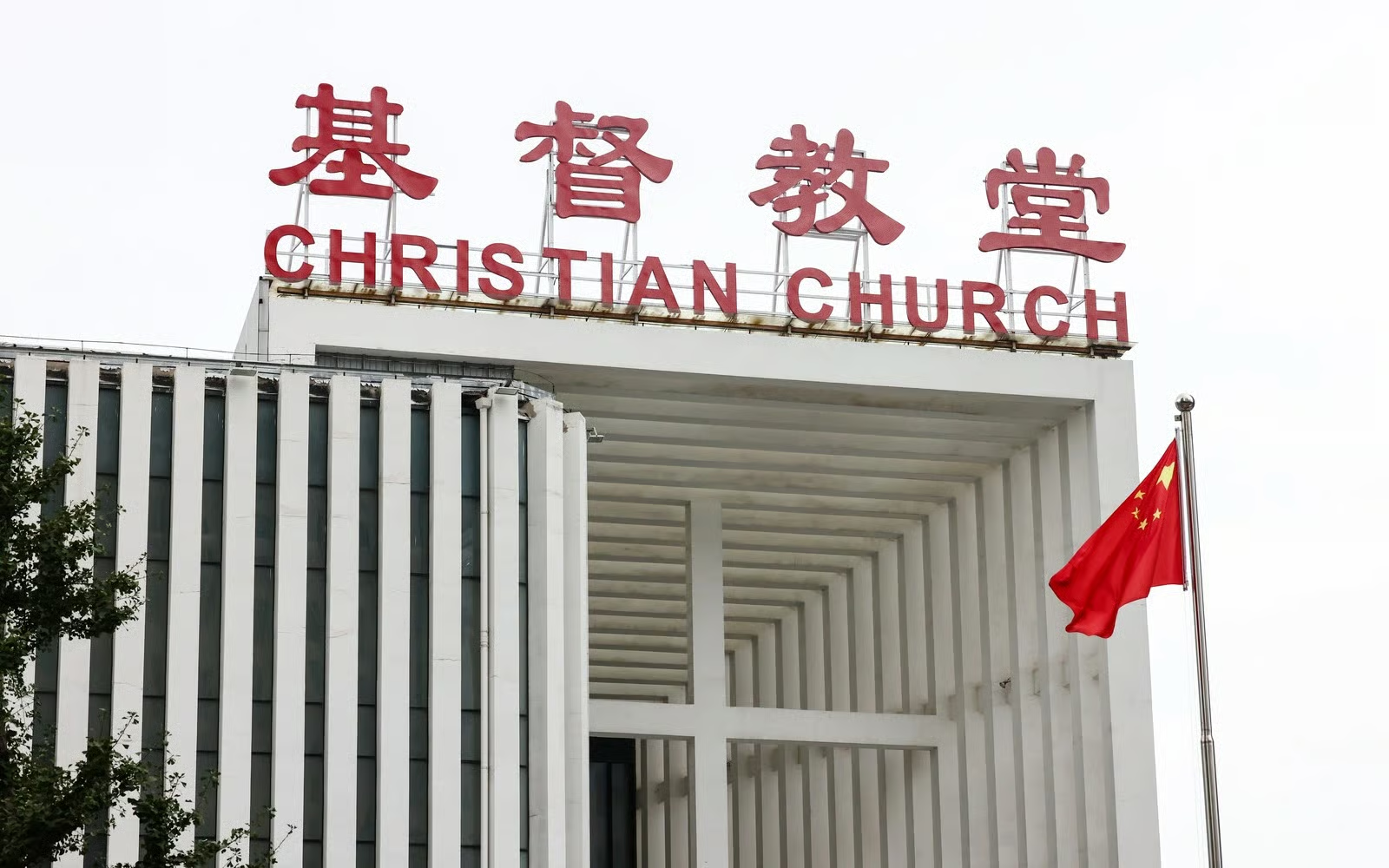
Authorities in China have detained several pastors linked to one of the country’s largest unregistered Christian congregations, marking the most extensive suppression of underground churches since 2018, according to family members and church representatives.

The arrests occurred over the weekend, coinciding with heightened China–U.S. tensions following Beijing’s recent decision to expand controls on rare earth exports. The detentions have sparked international outrage, with U.S. Secretary of State Marco Rubio urging the immediate release of the pastors.

Among those taken into custody was Pastor Jin Mingri, the 56-year-old founder of Zion Church, a prominent unofficial “house church” not recognised by the state. He was arrested at his residence in Beihai, a city in southern China, on Friday evening, according to his daughter, Grace Jin, and a church spokesperson, Sean Long.
“What just happened is part of a new wave of religious persecution this year,” Long said, noting that security forces had questioned over 150 church members in recent months and increased surveillance at Sunday gatherings.

Speaking from the United States, Long said that around the same period, nearly 30 church leaders and members were detained nationwide, though five have since been released. Roughly 20 others remain in custody.

Jin is currently being held at the Beihai City No. 2 Detention Centre on charges of “illegal use of information networks,” according to an official notice shared by Long. The offence carries a possible prison sentence of up to seven years. Supporters fear the pastors could face additional accusations related to sharing religious content online.
“He’s been hospitalised in the past for diabetes. We’re worried since he requires medication,” Grace Jin said. “I’ve also been notified that lawyers are not allowed to meet the pastors, so that is very concerning to us.”

The arrests come in the wake of new regulations from China’s national religious affairs authority that prohibit unauthorised online preaching and “foreign collusion.” Last month, President Xi Jinping pledged to “implement strict law enforcement” and further advance the “Sinicisation” of religion — the process of aligning faith practices with Communist Party ideology.

Official statistics indicate that China has over 44 million Christians worshipping in state-approved churches, most of whom are Protestants. However, estimates suggest that tens of millions more attend unregistered “house churches” operating independently of state control.

Zion Church, which reportedly has about 5,000 regular followers spread across nearly 50 cities, expanded rapidly during the COVID-19 pandemic through online sermons and small group worship, Long explained. Founded by Jin — who is also known by his Christian name, Ezra — in 2007 after leaving an official Protestant church, the congregation has long been under scrutiny.

A graduate of Peking University, Jin embraced Christianity following the 1989 Tiananmen Square crackdown. Authorities closed Zion Church’s main building in Beijing in 2018 during a wave of raids on major underground congregations. Earlier this year, 11 of its pastors were also briefly detained.

According to Grace Jin, her father has faced travel restrictions since 2018, preventing him from visiting his wife and three children, who now live in the United States. “I think he had always known that there was a possibility he would be imprisoned,” she said.

Last month, police intercepted and forcibly returned Jin to Beihai while he was in Shanghai, according to Grace Jin and Bob Fu, founder of the Christian advocacy group ChinaAid.
“The key underlying reason is that Zion Church has grown explosively into a well-organised network in recent years, which of course must scare the Communist Party leadership,” Fu stated.