Home Blog Page 48

Madagascar President Appoints Army General As New Prime Minister

1

Madagascar’s President Andry Rajoelina has appointed army General Ruphin Fortunat Zafisambo as the country’s new Prime Minister, following the dissolution of the government amid growing public unrest over persistent electricity and water shortages.

Zafisambo succeeds former Prime Minister Christian Ntsay, who was dismissed as part of a broader government shake-up. Before his appointment, the general served as Director of the Military Cabinet in the Prime Minister’s Office.

Before making the announcement, Rajoelina stated that the nation needed a “prime minister capable of restoring order and the people’s trust.” He emphasized that the new premier’s foremost task would be to stabilize power and water supply across the country.

Earlier on Monday, thousands of demonstrators took to the streets of Antananarivo and other cities, marking the third consecutive week of anti-government protests. The demonstrations have intensified since Rajoelina dismissed his cabinet last week, with many now calling for his resignation.

Security forces in the capital reportedly used tear gas to disperse crowds, many of whom were university students voicing frustrations over poor governance and economic hardship. The protests drawing inspiration from recent “Gen Z” movements in Kenya and Nepal represent the largest wave of dissent seen in Madagascar in recent years, highlighting growing anger over deepening poverty and allegations of corruption.

Television footage on Monday showed clashes between police and demonstrators in several regions, including the southern city of Toliara and the northern city of Diego Suarez.

Despite its rich natural resources and agricultural potential, Madagascar remains one of the world’s poorest nations. Economic indicators show that the country’s income per capita has fallen by about 45% since its independence in 1960.

The United Nations reported that at least 22 people were killed and over 100 injured during the initial days of the unrest, figures the government has denied.

In a speech last Friday, President Rajoelina expressed willingness to engage with citizens’ grievances but dismissed calls for his resignation. Over the weekend, a spokesperson for his office said the protest movement was being “exploited by political actors who are seeking to destabilise the country,” adding that “President Rajoelina remains committed to dialogue, to accelerating solutions that improve people’s daily lives.”

The presidency also announced that Rajoelina held discussions with several civil society groups on Saturday, although details of the meeting were not disclosed. However, some organisations stated they declined the invitation, citing concerns that authorities had not guaranteed protesters’ safety or the release of those arrested during demonstrations.

Yoruba Student Groups Rally In Support Of Dangote Refinery

5

A coalition of Yoruba student groups, including members of the National Association of Oduduwa Students (NAOS), the Coalition of Yoruba Students, and the Yoruba Movement, on Tuesday held a peaceful demonstration in support of the Dangote Refinery amid its ongoing dispute with oil unions; PENGASSAN, NUPENG, and the Depot and Petroleum Products Marketers Association of Nigeria (DAPPMAN).

The demonstrators gathered at the Iwo Road Roundabout, along the Ibadan–Lagos Expressway in Oyo State, chanting solidarity songs to express their stance.

They marched through major streets carrying placards bearing messages such as “Don’t Kill Dangote Refinery,” “#StopsabotagingfuelinNigeria,” “#EndPENGASSAN,” “#EndDAPPMAN,” “#DangoteRefineryIsANationalAsset,” and “#StopSabotage,” among others.

Dressed in uniform shirts with the inscription “Don’t Kill Dangote Refinery,” the protesters said their demonstration was meant to alert authorities to what they described as a “coordinated attempt by vested interests” to undermine the refinery’s operations, Nigeria’s largest industrial venture and the biggest single-train refinery in Africa.

NAOS President, Olalere Adetunji, urged President Bola Tinubu and key federal agencies to intervene promptly.

“We want to use this period to appeal to the Federal Government to protect the refinery and ensure that labour and marketers’ actions do not derail Nigeria’s move toward fuel self-sufficiency.”

Security personnel, including police officers and officials of the Federal Road Safety Corps, were deployed to ensure peace and maintain order throughout the march.

FG Sets Up Expanded Negotiation Team For Tertiary Institutions

6

The Federal Government has formally inaugurated the Mahmud Yayale Ahmed–headed Expanded Negotiation Committee for Tertiary Institutions, designed to fast-track talks with both academic and non-academic unions across universities, polytechnics, and colleges of education in the country.

In a statement issued on Tuesday morning by the Director of Press and Public Relations at the Federal Ministry of Education, Boriowo Folasade, “Speaking at the inauguration in Abuja, the Minister of Education, Dr. Tunji Alausa, said the new committee was established to harmonize all negotiation processes under a unified and coordinated framework that ensures institutional continuity and sector-wide inclusiveness.”

He further noted that, unlike previous methods where individual unions were addressed separately, the current arrangement would bring all parties to the table for a consolidated and long-term resolution.

“The membership has been carefully selected to reflect the full spectrum of the education sector, ensuring that no group is left behind,” Dr. Alausa stated.

The Minister revealed that the committee has been equipped with a dedicated secretariat to support its operations and mentioned that the first meeting would hold at 2 p.m. on Tuesday, October 7. He encouraged all unions to show commitment and respond swiftly to the committee’s invitations.

He added that President Bola Tinubu has given his full endorsement to the process, mandating that all discussions be concluded efficiently, equitably, and in an atmosphere of mutual respect.

“President Tinubu’s message is clear, all our children must remain in school. This is the Renewed Hope Agenda in action,” Dr. Alausa said, appreciating the unions for their patience and commitment.

Also speaking, the Minister of Labour and Employment, Mohammed Maigari Dingyadi, applauded the Education Ministry for adopting a collective and consultative approach. He pointed out that genuine and enduring peace within the education sector can only be attained when every relevant stakeholder is part of the conversation.

He urged members of the committee to act as neutral facilitators, emphasizing justice and balance in all deliberations, while stressing that their early participation would aid in seamless execution of final resolutions.

Dingyadi reiterated that President Tinubu remains committed to achieving sustainable industrial harmony through constructive dialogue, engagement, and consistent communication to prevent future disruptions in the academic calendar.

Responding on behalf of the committee, Chairman Alhaji Mahmud Yayale Ahmed thanked the government for the trust placed in them and pledged that the committee would carry out its assignment with accountability, openness, and inclusiveness.

He assured that their focus would go beyond striking deals with unions, extending to practical recommendations that promote enduring stability and progress within the nation’s tertiary institutions.

The Federal Government reaffirmed its resolve to rebuild confidence and restore calm across tertiary institutions through genuine consultation and effective leadership, in alignment with the Renewed Hope Agenda of President Tinubu—an agenda where students stay in school, educators are respected, and educational institutions flourish in unity and peace.

World Teacher’s Day: How Nigerian Teachers Redefine Education Amid Struggles

20

Every year on October 6, the world pauses to celebrate teachers, the backbone of every nation’s development. World Teacher’s Day, established by UNESCO, is more than a ceremonial recognition; it is a moment to reflect on the role of teachers in shaping the future of societies.

In Nigeria, this year’s celebration, which fell on a Sunday, was marked with tributes, messages, and community events across the country. For many teachers, it was a day of reflection rather than rest, a moment to assess how far they have come and how much still needs to be done to improve education. Beneath the public messages of appreciation lies a deeper story of resilience and reinvention that defines today’s Nigerian educator.

The Realities: Between Passion And Pressure

Teaching in Nigeria has always been more than just a profession; it is an act of service. But the realities confronting teachers today test even the most passionate. Many face meagre salaries that barely sustain their households. According to data from education unions, some public-school teachers earn less than ₦50,000 monthly, often with delayed payments stretching for months.

The conditions under which many teachers work remain far from ideal. In rural communities, one teacher may handle multiple subjects across several grade levels, sometimes in makeshift classrooms without chairs or blackboards. Even in urban centres, overcrowded classrooms, sometimes housing over 80 pupils, make personalized learning nearly impossible.

Still, for many Nigerian teachers, quitting is not an option. They see their classrooms not just as workplaces but as spaces where they can change lives, one lesson at a time.

The Struggles: Innovation Amid Scarcity

What stands out most about Nigerian teachers is their ability to innovate even when resources are scarce. In schools without electricity or internet access, teachers have turned to handmade visual aids, storytelling, and peer learning to keep lessons engaging.

During the COVID-19 lockdowns, many teachers recorded lessons with basic phones, shared assignments through WhatsApp, and worked with community volunteers to keep children learning. Others leveraged local radio and community spaces to reach students who had no access to online platforms. These efforts underscore a truth often overlooked: while technology remains a challenge, creativity has become a lifeline for Nigerian education.

Yet such innovation often comes at a personal cost. Many teachers use their own salaries to buy classroom materials, print worksheets, or contribute to school maintenance. Their sacrifices often go unseen but remain the quiet foundation of learning across the country.

The Triumphs

Despite these struggles, there are countless stories of triumph. Teachers across Nigeria continue to produce exceptional students who excel in national examinations and competitions. In several states, educators have been recognized by local governments and NGOs for pioneering creative teaching methods and mentoring young learners in underserved communities.

Some teachers have introduced basic computer literacy classes using personal laptops. Others have created informal reading clubs and after-school programs that nurture confidence and curiosity among students. These everyday successes show that the spirit of teaching in Nigeria is not defined by what is lacking but by what is possible through dedication.

Voices From Social Media: Nigerians Celebrate Their Teachers

Across X (formerly Twitter) and other platforms, World Teachers’ Day inspired a wave of heartfelt posts. Nigerians, including both educators and members of the public, shared gratitude, reflections, and personal stories that highlighted the lasting impact of teaching in the country.

User @lorun_omo wrote, “They equip their students for the challenges ahead. They deserve one billion bear hugs for everything they do daily on and off the clock.”

@jndazhaga celebrated teachers for their everyday impact, saying, “Happy World Teachers’ Day to the incredible educators who shape minds, inspire dreams, and change lives every single day! Your patience, creativity, and dedication don’t go unnoticed. You’re not just teaching lessons; you’re building futures.”

Adding their own voice from within the profession, @DDuguryil shared, “From a young teacher with chalk-dusted hands and big dreams to a professor still chasing that same spark in every classroom. The faces change, the impact remains. Happy World Teachers’ Day to everyone still making a difference.”

In a more reflective tone, @enebome quoted Charles Kuralt, writing, “When we become a really mature, grown-up, wise society, we will put teachers at the center of the community, where they belong. We don’t honor them enough, we don’t pay them enough.”

As the applause for World Teachers’ Day fades, the true measure of celebration lies in how society values its teachers beyond annual speeches and hashtags. Sustainable reform in Nigeria’s education system must start with the people at its heart: teachers.

Improving welfare, providing modern teaching tools, and creating environments that reward innovation are essential to national development.

For now, amid the chalk dust and crowded classrooms, Nigerian teachers continue to redefine education through resilience, creativity, and an unyielding belief in the power of knowledge.

Nursing Council Inducts 69 Graduates, Warns Against ‘Japa’ Exodus

2

The Nursing and Midwifery Council of Nigeria (NMCN) has inducted 69 nursing graduates from Elizade University, Ilara-Mokin, Ondo State, cautioning them against joining the “japa” trend Nigerian slang for mass emigration of professionals seeking opportunities abroad.

During the induction and oath-taking ceremony held on campus over the weekend, the Registrar of the Council, Dr. Ndagi Alhassan, urged the graduates to remain in Nigeria and contribute to strengthening the country’s healthcare system. Represented by Dr. Olukemi Awe, a director at the Council, he described nursing as a noble calling that Nigeria needs now more than ever.

“Your success in the council examination has qualified you for a one-year internship programme, after which you will receive your registration number, licence, and certificates from the Nursing and Midwifery Council of Nigeria,” he said. “By this, your degree will be recognised globally, but please, don’t leave the country yet. Let’s take care of Nigeria. We still need you here. Do not ‘japa’ for now. However, if you must travel, please avoid war-torn countries like Russia, Ukraine, and Israel.”

The NMCN boss further advised the new nurses to uphold the ethics of their profession, learn from experienced colleagues, and embrace continuous growth. “Do not allow what you have achieved today to be the end of your learning journey. Continue to grow, explore opportunities, and advance in nursing,” he added.

Acting Vice-Chancellor of Elizade University, Prof. Babatunde Adeyemo, congratulated the inductees, describing nursing as “a vocation rooted in compassion, service, and an unwavering commitment to humanity.” He reminded them that the oath they took symbolised integrity, empathy, and a lifelong responsibility to protect human dignity.

Sevilla Crush Barcelona 4–1 To End Champions’ Unbeaten Run

12

Sevilla delivered a stunning 4–1 victory over Barcelona on Sunday, ending the reigning champions’ unbeaten start to the La Liga season and denying them the chance to reclaim top spot.

The win, Sevilla’s first league triumph over Barcelona since 2015, temporarily lifted them to fourth place with 13 points from eight matches, while Barcelona remained second on 19 points, two behind leaders Real Madrid.

“It’s one of the happiest days of my life. We deserved to win from start to finish,” said José Ángel Carmona, who netted Sevilla’s third goal.

Barcelona began sluggishly, failing to register a shot on target in the opening half hour, while Sevilla pressed high and frequently sought to release Alexis Sánchez with long passes.

The hosts broke the deadlock in the 13th minute when Isaac Romero was brought down by Ronald Araújo inside the box. After a VAR review, the referee pointed to the spot, and Sánchez calmly sent his former Arsenal teammate Wojciech Szczęsny the wrong way to make it 1–0.

Szczęsny prevented further damage in the 27th minute, denying Romero from close range. But the Polish goalkeeper was beaten ten minutes later, when Rubén Vargas sprinted beyond Barcelona’s high defensive line and squared for Romero, who fired home a first-time finish to double Sevilla’s advantage.

Marcus Rashford pulled one back for Barcelona in first-half stoppage time, latching onto Pedri’s lofted pass and smashing a left-footed volley into the roof of the net from a tight angle.

Lewandowski Misses Crucial Penalty

Barcelona pushed hard after the interval and were handed a golden opportunity to equalize in the 76th minute when Alejandro Balde was fouled in the area by Adnan Januzaj. However, Robert Lewandowski squandered the chance, dragging his penalty wide of the post.

Their hopes of a comeback were dashed in the 90th minute when Carmona drilled a low shot through a defender’s legs to make it 3–1. Substitute Akor Adams then capped off Sevilla’s dominant display, tapping in Chidera Ejuke’s cross in stoppage time to seal the 4–1 rout.

“We lacked intensity, we couldn’t get out of our half, and we didn’t know what to do with the ball,” admitted Barcelona midfielder Pedri. “We were never at our best. We need to improve a lot so we can start winning again after the break.”

The victory marked Sevilla’s second consecutive league win. They will resume their La Liga campaign after the international break against Mallorca on October 18, while Barcelona will host Girona on the same day.

Meet Sarah Mullally, The Church Of England’s First Female Archbishop

22

Dame Sarah Mullally has made history as the first woman appointed Archbishop of Canterbury, becoming the 106th leader of the Church of England nearly a year after Justin Welby resigned over the handling of a safeguarding scandal.

The 63-year-old, currently the Bishop of London, will formally assume the role at a ceremony in Canterbury Cathedral in January, followed by a full enthronement service expected to draw members of the royal family.

In her first remarks at Canterbury Cathedral, Mullally described the moment as both “complex and challenging,” but also deeply significant. “There would be much talk about this as a historic moment – a joyous one for many,” she said.

“I share in that joy, not for myself, but for a Church that listens to the calling of God and says: ‘Yes, we will follow you.’”

Who Is Sarah Mullally?

Before entering the clergy, Sarah Mullally built a distinguished career in healthcare.

She worked as a cancer nurse within the NHS and, at the age of 37, became the youngest person ever appointed Chief Nursing Officer for England. Her contributions to nursing earned her the title of Dame, recognising her outstanding service to the nation.

Mullally was ordained after leaving the health sector, rising through the ranks of the Church of England to become Bishop of London, the second-most senior role in the Church. Born in Woking, she is married to Eamonn Mullally and they have two grown children, Liam and Grace.

Mullally’s Commitment To Reform And National Issues

Mullally pledged to confront the safeguarding failures that overshadowed her predecessor’s tenure, acknowledging that “our history of safeguarding failures have left a legacy of deep harm and mistrust, and we must all be willing to have light shone on our actions, regardless of our role in the Church.”

She also addressed broader social and moral issues, from the recent “horrific violence” of an antisemitic attack in Manchester to debates over assisted dying, the refugee crisis, and deepening social inequalities. “We are witnessing hatred that rises up through fractures across our communities,” she warned, urging the Church to stand firmly against antisemitism, racism, and division.

Mullally’s appointment was confirmed after deliberations by the Crown Nominations Commission, approved by Prime Minister Keir Starmer and King Charles III. Starmer welcomed her as a leader who would play “a key role in our national life,” while Buckingham Palace praised the significance of her appointment for the Anglican Communion, which spans 85 million members worldwide.

For many, Mullally’s elevation marks a defining moment for the Church of England, highlighting how far women have advanced since being first permitted to become bishops in 2014 and consecrating the first female bishop in 2015.

While her appointment has been celebrated as progress, it has also drawn criticism from conservative factions within the global Anglican community.

Are We Truly Independent?

1

Across social media and digital platforms today, vibrant graphics celebrate our nation’s independence, 65 years since the colonial flag came down, and our own was raised. It marked a moment of triumph, of pride, and of new beginnings. But as we mark another October 1st, a sobering question lingers:

Are we truly independent?

Sixty-five years later, our children are still raised on American, British, and Chinese curricula—an education pipeline that often leads them straight into the arms of foreign nations. Our brightest minds are exported en masse, their potential lost to distant shores.

Our policies, supposedly sovereign, are heavily influenced—if not outright shaped—by Western non-state actors, who serve as consultants embedded deep in our policymaking processes. Whose interests do they really serve?

Our healthcare system is so underfunded and overstretched that those in power routinely bypass it entirely, jetting off to Western hospitals for the kind of care they fail to ensure for the average Nigerian—many of whom may never even see the inside of an airport, let alone fly abroad.

Our economy still leans heavily on foreign exchange. Our universities are underfunded, pushing the elite to send their children abroad while local institutions wither. Our research sector survives largely on donor funding, which comes with policy prescriptions that often undermine our local realities.

We have abandoned our indigenous seeds and embraced patented hybrids and genetically modified organisms—designed not for self-sufficiency but dependency. Our farmers are no longer masters of their fields but consumers in someone else’s supply chain.

We continue to pursue international loans tied to conditions that mandate the adoption of Western ideologies and economic models, often ill-suited for our unique context. Our media landscape remains dominated by Western narratives, echoed by our own journalists, shaping how the world sees us—and how we see ourselves.

We extract our minerals, but the profits go abroad. Our youth remain unemployed, their future mortgaged for resources powering industries they may never work in.

Our technocrats, often foreign-trained, craft policies that curry favor with global institutions rather than confront local needs. Our agricultural systems are increasingly dictated by multinational agribusinesses. We import what we can grow and neglect what we can create. Our middle class is being drained—strangled by inflation, economic insecurity, and the relentless lure of migration.

Are we independent?

We mark our sovereignty every year, but sovereignty is not simply the absence of colonial rulers. It is not the hoisting of a flag or the singing of an anthem.

True independence is the ability to feed ourselves, heal ourselves, educate ourselves, and govern ourselves—on our own terms.*

It is food sovereignty
Policy sovereignty.
Economic sovereignty.
Cultural sovereignty.

Until we achieve these, October 1st will remain a public holiday—not a celebration of true independence, but a reminder of the work still undone.

Elon Musk Becomes World’s First Half-Trillionaire

16

‎Elon Musk, CEO of Tesla, has made history as the first person to surpass a net worth of $500bn (£370.9bn), driven by the sharp rise in the value of Tesla and his other businesses this year.

‎His wealth briefly peaked at $500.1bn on Wednesday afternoon in New York before slipping slightly to just over $499bn later in the day, according to Forbes’ billionaires index.

‎In addition to Tesla, the valuations of his other businesses, including the artificial intelligence startup xAI and rocket company SpaceX, have also risen in recent months.

‎This milestone further strengthens Musk’s position as the world’s richest person, far ahead of his rivals in the global tech industry.

‎Forbes’ billionaire index ranks Oracle founder Larry Ellison as the world’s second-richest person, with an estimated fortune of about $350.7bn.

‎Ellison briefly overtook Musk last month after Oracle’s stock jumped more than 40%, driven by the company’s unexpectedly strong outlook for its cloud infrastructure operations and AI partnerships.

‎Musk’s vast fortune is largely tied to his more than 12% ownership in Tesla, which has seen its stock price climb significantly this year.

‎By the close of trading in New York on Wednesday, Tesla shares were up more than 3.3% and have gained over 20% since the start of the year.

‎The stock’s rise in recent months has been attributed in part to investor optimism over Musk devoting more time to his companies rather than politics.

‎Earlier this year, he faced backlash for his role in the Trump administration’s Department of Government Efficiency (DOGE), an agency tasked with cutting US government spending and eliminating jobs.

‎Musk, who also owns the X social media platform, has been outspoken on topics such as immigration and diversity, equity, and inclusion (DEI) programs.

‎Tesla board chair Robyn Denholm said in September that Musk is now “front and centre” at the company.

‎The board also revealed that Musk could secure a compensation package exceeding $1tn if he achieves a set of ambitious targets over the next decade.

‎To unlock that package, he would need to increase Tesla’s valuation eightfold, sell one million AI-powered robots, deliver an additional 12 million Tesla vehicles, and meet several other benchmarks.

‎Last month, Musk also disclosed that he had purchased about $1bn worth of Tesla stock, which some investors interpreted as a strong show of confidence in the company.

‎Tesla, however, has faced numerous challenges in recent years, including fierce competition from electric vehicle rivals such as China’s BYD.

‎The company is currently transitioning into a broader AI and robotics-focused enterprise.

Top 5 Premier League Club Records That May Never Be Broken

5

The Premier League has delivered countless unforgettable moments from dramatic title races to legendary players lighting up the pitch. Along the way, some clubs have set records so extraordinary that they may stand the test of time.

Built on consistency, brilliance, and dominance, these achievements highlight what happens when teams hit their absolute peak. Here are five records that may never be matched.

  1. Manchester City’s 100-Point Season – The Centurions (2017/18)

In 2017/18, Pep Guardiola’s Manchester City rewrote Premier League history by becoming the first and so far only team to reach the 100-point mark.

Nicknamed the “Centurions,” City dazzled with attacking flair and ruthless efficiency, winning 32 matches and setting a new benchmark for excellence. The closest challengers have been Chelsea with 95 points in 2004/05 and Liverpool with 99 in 2019/20, but Guardiola’s side still stands alone.

  1. Arsenal’s Unbeaten Season (2003/04)

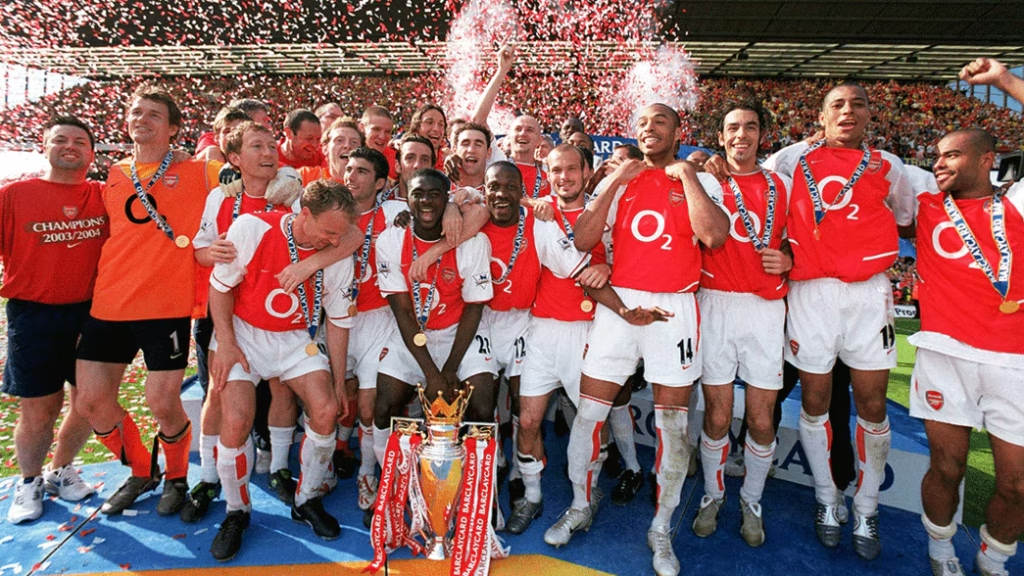
The “Invincibles” remain one of football’s most iconic sides. Under Arsène Wenger, Arsenal completed the 2003/04 season unbeaten across all 38 league matches — 26 wins and 12 draws, finishing with 90 points.

Their reward was not only the Premier League title but also a one-of-a-kind golden trophy, cementing their place in history. No team has managed to replicate the feat since.

  1. Chelsea’s 86-Game Unbeaten Home Run (2004–2008)

Between March 2004 and October 2008, Stamford Bridge became a fortress. Chelsea went 86 consecutive home league games without defeat, spanning four years and four different managers.

José Mourinho oversaw the bulk of that run, masterminding 60 of those matches. The streak finally ended in October 2008 when Liverpool’s Xabi Alonso struck the decisive goal in a 1–0 win.

  1. Chelsea’s Defensive Wall – Fewest Goals Conceded (2004/05)

The 2004/05 season under Mourinho wasn’t just about winning the title it was about defensive perfection. Chelsea conceded only 15 goals in 38 matches, a record that still stands.

With John Terry and Ricardo Carvalho at the back and Petr Čech in goal, the Blues also kept 25 clean sheets, setting a standard for defensive solidity unlikely to be equalled.

  1. Manchester United’s 14 Straight Clean Sheets (2008/09)

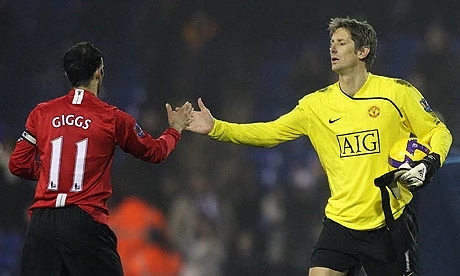
Sir Alex Ferguson’s Manchester United produced a defensive masterclass in the 2008/09 season, going 14 league matches in a row without conceding a goal.

Anchored by Nemanja Vidić, Rio Ferdinand, and goalkeeper Edwin van der Sar who set a then-world record for longest streak without conceding in league football the run remains unmatched in Premier League history.

These records showcase just how high the bar can be set in English football. While future teams may come close, these feats represent some of the league’s most enduring legacies.