Home Blog Page 53

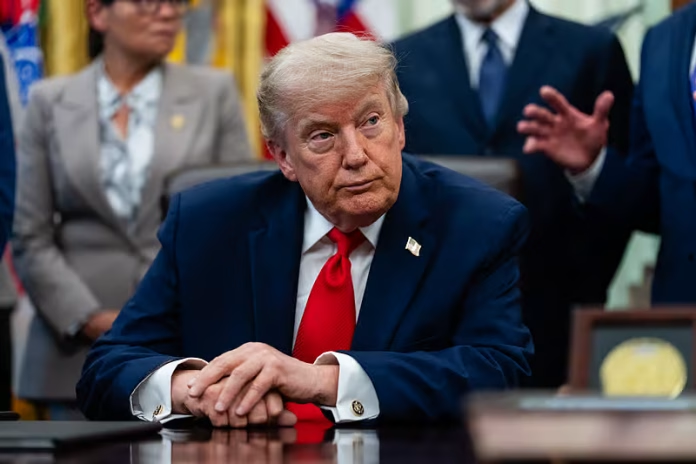
Trump Declares Iran Ceasefire ‘Over’ Following Renewed Military Escalation

Iran’s ceasefire with the United States has effectively come to an end, according to US President Donald Trump, following a fresh exchange of military strikes between American forces and the Islamic Republic.

Speaking on Wednesday at the NATO summit in Ankara, Turkey, Trump made the remarks after the United States launched overnight strikes on Iran, while Iran’s Revolutionary Guards claimed responsibility for attacks on US military bases in the Gulf.

The renewed hostilities also rattled global markets, with oil prices climbing by five percent after Trump’s comments.

Asked whether the ceasefire had collapsed, Trump gave a blunt response.

“I think it’s over. I don’t want to deal with them any more, they’re scum,” Trump said.

He continued:

“They’re scum, they’re sick people, they’re led by sick people, and they’re vicious, violent people. And if they had a nuclear weapon, they’d use it.

“As far as I’m concerned, it’s over.”

Despite his remarks, Trump said he would still consult businessman-turned-negotiator Steve Witkoff and his son-in-law, Jared Kushner, both of whom have been involved in diplomatic engagements with Iranian officials. However, he stressed that the next move rests with Tehran.

“As far as I’m concerned, it’s just a waste of time dealing with them. They’re liars.”

The US president also accused Iran of repeatedly misrepresenting the terms of the ceasefire agreement signed between Washington and Tehran on June 17.

“Everyone’s agreed, no nuclear weapon. We make a deal. They go outside, joke to the press, they say we never even talked about it. There’s something wrong with them, they’re cuckoo,” Trump added.

Egypt Cry Foul After Messi-Inspired Argentina Comeback Ends World Cup Dream

Egypt were left furious after their historic World Cup run ended in a dramatic 3-2 defeat to Argentina, with head coach Hossam Hassan accusing officials of favoring the reigning champions.

With just 12 minutes of normal time left, Egypt held a 2-0 lead in Atlanta and looked set to reach their first ever World Cup quarter-final. But Argentina staged a remarkable turnaround: Cristian Romero pulled a goal back in the 79th minute, Lionel Messi equalized four minutes later, and Enzo Fernandez struck a stoppage-time header to complete the comeback and send Argentine fans into raptures.

Egypt’s anger centered on two key decisions. The video assistant referee ruled out what would have been a second Egypt goal from Mostafa Zico, after midfielder Marwan Attia was penalized for a minor foul on Lisandro Martinez earlier in the move. Egypt also felt Mohamed Salah was fouled in Argentina’s box moments before Fernandez’s winner, though no penalty was given.

In a heated post-match interview, Hassan said his team had been treated unfairly and suggested there was pressure to keep Messi and the champions in the tournament. He pointed to a lack of consistency in decisions both on and off the pitch, questioning why sport couldn’t offer the same fairness that’s often missing from life in general. Zico echoed his coach’s frustration, saying the officiating had been unjust from the start of the match. Hassan was also booked during the game for making a gesture that FIFA uses to signal a racist incident, though he did not address it afterward.

BBC football analyst Dale Johnson examined the contentious calls, noting that this World Cup has featured fewer fouls per game than the previous two tournaments after referees were told to let more physical contact go. He argued the disallowed Zico goal was inconsistent with how the rest of the tournament had been officiated, pointing to a similar uncalled incident involving Germany’s Aleksandar Pavlovic earlier in the competition. On the Salah incident, Johnson explained that the higher threshold for awarding a penalty, rather than a standard foul, meant the non-call was defensible even if a foul outside the box might have been given.

Beyond the controversy, the match marked a bittersweet end for a team that arrived in North America looking to shed its reputation as a World Cup underachiever, having failed to win any of seven previous matches across three tournaments. Salah, who managed just one goal in the tournament and will be 38 by the 2030 World Cup, embraced former Liverpool team-mate Alexis Mac Allister after the final whistle. Egypt’s exit leaves Morocco as Africa’s last remaining team, with the Atlas Lions set to face France in the quarter-finals on Thursday.

For many Egyptians watching at home and abroad, the result brought a mix of grief and pride. Despite the heartbreaking finish, supporters said the team’s run — built around the rallying cry “Mekameleen,” meaning “we’ll keep going” — had shown Egypt could compete with football’s elite nations and had lifted spirits across the country and the wider region.

Messi In tears As Argentina Complete Stunning Comeback To Knock Out Egypt

Lionel Messi broke down in tears at Atlanta Stadium after inspiring one of the most dramatic comebacks in World Cup history, dragging Argentina back from the brink of elimination against Egypt.

With less than 20 minutes remaining and Argentina trailing 2-0, the defending champions looked destined for an early exit that would have mirrored Cristiano Ronaldo’s tearful farewell to the tournament following Portugal’s injury-time defeat to Spain. Instead, Argentina produced three goals in just 14 minutes to complete a stunning turnaround.

Egypt had built their lead through Yasser Ibrahim and Mostafa Zico, with goalkeeper Mostafa Shobeir putting in a standout performance that included saving a first-half penalty from Messi — the fourth spot-kick he has missed at a World Cup, and only the second tournament in which he’s failed to convert two penalties outside of a shootout.

But Argentina refused to fold. Cristiano Romero headed home from a Messi cross with 11 minutes left, and less than five minutes later Messi himself curled a left-footed effort past Shobeir and in off the crossbar to level the score. Enzo Fernandez then completed the comeback with a stoppage-time header, sending Argentina through to the quarter-finals and sparking wild celebrations among the team and their fans.

Former England goalkeeper Paul Robinson, commentating for BBC Radio 5 Live, described the turnaround as spectacular, noting that Argentina had looked out of the tournament before Messi took over and turned the game around.

The result carries significant weight for England too. Had Egypt held on, England’s route to a first men’s World Cup final since 1966 would have opened up considerably. Instead, Argentina and Messi remain a looming threat in the draw.

Messi, now 39, became the first player in World Cup history to score in six straight knockout-phase matches, taking his tally for the tournament to eight goals — the most through five games by any player since Gerd Muller’s ten for West Germany in 1970. Over his last nine World Cup appearances, he has now been directly involved in 16 goals, scoring 13 and assisting three.

Opta’s data had given Argentina just a 0.6% chance of winning at the moment Romero scored his equalizer, underlining the scale of the comeback — the latest a team has ever recovered from two goals down to win a World Cup match without extra time. In a tournament already filled with drama, including England’s own thrilling 3-2 win over Mexico, this may go down as the best match of the World Cup so far.

Explosions Injure 18 In Damascus During Macron’s Visit To Syria

Eighteen people were injured after explosive devices detonated in central Damascus, according to Syrian state media, reportedly close to the hotel where French President Emmanuel Macron had been staying during his visit to the country.

Syrian state news agency Sana said security forces had detected two devices, which exploded as specialized units attempted to defuse them. One device had been hidden inside a parked vehicle, while the other was concealed in a bin. Four police officers were among those injured, and Syria’s interior ministry has opened an investigation into those responsible.

Macron was meeting Syrian President Ahmed al-Sharaa at the presidential palace when the blasts occurred. His officials confirmed he was safe and did not hear the explosions. He is set to travel on to Turkey for the NATO summit following his time in Syria.

Footage shared on social media Tuesday morning showed smoke and flames rising from a vehicle near a hotel in the capital. One eyewitness told BBC Arabic they had been standing near the tourism ministry headquarters when the first blast occurred, causing damage but no injuries. As security forces searched the area for further explosives, a second blast went off roughly 20 meters away, this time injuring several members of the public security and traffic police. BBC Verify placed the explosions approximately 125 meters from the Four Seasons hotel, along one of Damascus’s major roads.

Syrian state television reported that al-Sharaa had welcomed Macron to the presidential palace around the same time news of the explosions emerged. Writing on social media afterward, Macron said nothing could extinguish Syrians’ hopes for a sovereign, safe, pluralistic, and united country, adding that his visit would continue.

Macron arrived in Syria on Monday evening, becoming the first EU leader to visit since al-Sharaa took power following the collapse of the Assad regime in December 2024 — a visit seen as symbolic of Syria’s reemergence onto the world stage after years of isolation. Al-Sharaa, a former al-Qaeda commander from Syria’s Sunni Muslim majority, has pledged to unite the country following decades of Assad family rule and a brutal 13-year civil war.

The Damascus blasts highlight the serious security challenges still facing Syria’s new leadership, including a wave of attacks on government targets claimed by the Islamic State group in recent months. Pro-government forces have also been implicated in deadly violence against religious and ethnic minority communities last year. Just days earlier, a bombing at a busy Damascus café killed at least nine people and injured 22 others.

Beyond security, Macron’s visit is also centered on Syria’s fragile economic situation, with reconstruction expected to be a key focus of talks.

Senegal’s President Faye Set To Launch His Own Political Party

Senegal’s President Bassirou Diomaye Faye is preparing to establish a new political party, according to a coalition backing him, in a move that confirms a lasting rift with his recently removed prime minister.

A statement from the pro-Faye coalition, released late Friday, said Faye has tasked senior adviser Aminata Toure with setting up a task force to build the new party. Until now, Faye has remained a member of the ruling Pastef party, led by Ousmane Sonko, who served as prime minister until Faye removed him from the role in May, following months of mounting tension between the two leaders.

Since his ouster, Sonko has taken on the role of speaker of the National Assembly, where he’s been pushing constitutional reforms that would, among other measures, prevent a sitting president from also leading a political party. Lawmakers approved these changes last week, but Faye has opted to send the matter to a public referendum instead, though a date has not yet been set.

The political tension comes as Senegal simultaneously deals with a debt crisis triggered by revelations that the previous government had misreported the country’s debt figures.

Both Faye and Sonko are now looking ahead to local elections in 2027, which will serve as an early test of each leader’s real level of public support.

ADC Leadership Crisis Deepens As Kano Chairman Rejects Caretaker Committee

0

The African Democratic Congress (ADC) is facing a fresh leadership crisis in Kano State after the party’s State Chairman, Musa Ungogo, rejected the reported dissolution of the state executive committee and the appointment of a caretaker committee.

Ungogo described the claim as false, unconstitutional and lacking any official approval from the party’s national leadership.

He made the remarks on Monday while responding to a press conference held in Kano by the ADC Deputy National Chairman (North-West), Hajiya Najaatu Mohammed.

During the briefing, Najaatu announced that the Kano State executive committee had been dissolved and that a caretaker committee led by Alhaji Umar Bala had been inaugurated to oversee the affairs of the party in the state.

However, Ungogo insisted that no formal communication regarding the dissolution had been received from the party’s national leadership.

“There is no truth in the claim that the Kano State executive has been dissolved. No such decision has been communicated to us by the party’s national leadership,” he said.

The Kano chairman also questioned why the alleged action was limited to Kano, arguing that if the national leadership intended to dissolve state executives, it would have affected other states as well.

“There is no similar action taken in any other state. So why Kano? The claim is unfounded and does not follow the party’s constitutional procedures,” Ungogo added.

He maintained that the current Kano State executive remains the legitimate leadership of the party and will continue to carry out its responsibilities until any lawful directive is issued through the appropriate constitutional organs of the ADC.

Najaatu Defends Caretaker Committee

Earlier, Najaatu Mohammed defended the decision, stating that the dissolution was carried out in accordance with the ADC constitution, the Electoral Act and the need to safeguard unity, continuity and constitutional order within the Kano chapter.

She announced that Alhaji Umar Bala had been appointed chairman of the caretaker committee, while Isma’il Musa would serve as its secretary.

Najaatu also appealed to party members in Kano to support the transitional arrangement, stressing that the move should not be interpreted as a criticism of the commitment or contributions of party members who had served the ADC in the state.

The conflicting positions have now plunged the Kano chapter of the ADC into uncertainty, with both the existing state executive and the newly constituted caretaker committee laying claim to the party’s leadership in the state.

FG Extends Final Evacuation For Nigerians In South Africa As NANS Issues Four-Day Ultimatum

0

The Federal Government has announced the final phase of its evacuation exercise for Nigerians willing to return from South Africa, warning that the security situation remains unstable as xenophobic attacks continue.

Authorities urged Nigerians who believe their lives are at risk to take advantage of the remaining evacuation flights, stressing that it can no longer guarantee the safety of those who choose to remain in the country amid the ongoing violence.

The advisory was contained in a statement shared on the official X account of the Minister of Foreign Affairs, Ambassador Bianca Odumegwu-Ojukwu.

The latest appeal comes just days after the Federal Government condemned the killing of two Nigerians in South Africa. The victims were identified as Emeka Charles Iroegbu, who was allegedly killed by officers of the Tshwane Metro Police in Pretoria, and Musa Yunana Joe, popularly known as Big Joe, who was reportedly shot dead in front of his shop in Witbank, Mpumalanga.

Following the incidents, the Nigerian government demanded a thorough investigation into the killings and the prosecution of those responsible.

In the statement, the minister said the Federal Government remains deeply concerned about the welfare of Nigerians living in South Africa as attacks targeting foreign nationals persist.

She also disclosed that President Bola Tinubu approved an extension of the evacuation exercise beyond the initial June 30 deadline due to the continued security concerns.

NANS Gives South African Businesses Four-Day Ultimatum

Meanwhile, the National Association of Nigerian Students (NANS) has issued a four-day ultimatum to South African businesses operating in Nigeria, demanding that they leave the country.

The directive was announced in a statement issued in Enugu by the National Executive Director of Corporate and Private Sectors Engagement, Bestman Okereafor.

According to Okereafor, South African business interests would face the reaction of Nigeria’s more than 43.1 million students if they failed to comply after the expiration of the ultimatum.

NANS also stated that it would begin picketing South African businesses immediately after the deadline, while considering additional actions.

The student body called on the Federal Government and the African Union to adopt stronger measures against South Africa over what it described as repeated hostile actions against fellow Africans.

“It is on record that Nigeria played a major role in support of South Africa during the apartheid struggle and should never be repaid with disloyalty, disrespect and global embarrassment,” he added.

Eight Dead, Hundreds Injured As Powerful Storms And Flooding Batter Central China

At least eight people have been killed and 275 others injured after powerful thunderstorms, tornadoes and strong winds swept through parts of central China, while heavy rainfall and flooding claimed two additional lives in the country’s south.

According to Chinese state media on Tuesday, several areas in Hubei Province were hit by what authorities described as “severe convective weather” on Monday.

State broadcaster CCTV reported that “thunderstorms and strong winds swept” through cities including Huangshi and Huanggang, leaving eight people dead.

Authorities also confirmed that tornadoes were recorded in some affected areas, while one person remains missing.

The state-run Xinhua News Agency reported that the “severe weather” left 275 people injured in Huangzhou District of Huanggang as of Tuesday morning, although details about the severity of the injuries were not disclosed.

Emergency officials also evacuated 408 residents to safer locations as rescue operations continued.

“Rescue and relief efforts are underway,” Xinhua reported.

Meanwhile, in southern China’s Guangxi region, heavy rainfall triggered by Typhoon Maysak caused severe flooding that killed at least two people and forced authorities to evacuate more than 48,000 residents by Monday evening.

In the regional capital, Nanning, officials raised the flood emergency response to its highest level after torrential rains caused water levels to rise dangerously and breached dam structures.

Footage aired by CCTV showed muddy floodwaters rushing through a collapsed reservoir wall after the dam gave way under intense pressure.

Floodwaters also submerged homes, vehicles and other infrastructure across several communities.

Rescue teams wearing life jackets and helmets were deployed to the affected areas, with some navigating flooded communities in inflatable boats while searching for stranded residents.

Climate experts have repeatedly warned that global warming is increasing both the frequency and intensity of extreme weather events worldwide as greenhouse gas emissions continue to rise.

Although China remains the world’s largest emitter of greenhouse gases, it has also become one of the world’s leading investors in renewable energy and has pledged to achieve carbon neutrality by 2060.

Why Some African Nations Are Rejecting Trump’s Aid Deals

The Trump administration is once again offering African countries hundreds of millions of dollars to strengthen their healthcare systems and combat disease, following last year’s dismantling of the main US foreign aid agency, USAID. But this new wave of funding comes with strings attached, and several governments are pushing back.

Kenya’s President William Ruto signed the first of these agreements in Washington last December, a $2.5 billion deal that Secretary of State Marco Rubio hoped would become a template for dozens more across the continent. Even that flagship deal faced delays after activists took legal action to block it over privacy concerns, though it was eventually approved by Kenyan cabinet ministers.

Trump ordered USAID’s closure shortly after taking office, citing wastefulness, a move that gutted health programs across Africa that had depended on US funding. The State Department’s new approach requires partner governments to increase their own health spending, aiming to build self-sufficient systems rather than reliance on foreign aid. In Kenya’s case, the US is contributing $1.6 billion while Kenya commits $850 million over five years.

Rubio has argued this model avoids the pitfalls of the old NGO-based aid system, which he says fostered dependency and wasted money on overhead. He’s framed the new deals as helping countries build lasting capacity rather than simply handing out money.

This marks a broader shift away from coordinated global health efforts through the World Health Organization toward individual agreements tied directly to US strategic and business interests. The US exited the WHO earlier this year, criticizing funding imbalances and the organization’s handling of Covid-19. Notably, the bilateral deals include commitments to favor American pharmaceutical companies in developing and supplying treatments — something US policy documents describe explicitly as a strategic tool for advancing bilateral interests, not simply charity.

By mid-May, 32 countries had signed on, including roughly 20 in Africa. But Ghana, Zimbabwe, and Zambia have all declined, each citing different concerns.

Zambia’s Foreign Minister Mulambo Haimbe said the US tried to bundle the health agreement with a separate deal granting America access to critical minerals, insisting the two should be negotiated independently. The State Department didn’t directly deny the linkage but reaffirmed that US aid functions as strategic investment tied to American interests, expecting partner nations to prioritize US priorities in return.

Further underscoring this approach, the US recently announced a full withdrawal from HIV/AIDS funding in South Africa, which an administration official linked to Pretoria’s failure to act on certain policy demands — including issues related to the country’s Afrikaner minority, tied to widely disputed claims of a “white genocide.”

For other nations, the sticking point has been data. The agreements require sharing patient information and biological samples, including disease-causing pathogens. Kenya’s courts initially paused its deal over patient privacy concerns. Ghana’s Data Protection Commission said it objected to the scope of data required without any reciprocal protections once that information left Ghanaian control. Zimbabwe raised similar objections, worried that any resulting vaccines or treatments developed from shared data wouldn’t necessarily be made available to its own citizens — noting the WHO already has systems in place for equitable data-sharing.

The US maintains this exchange is essential for scientific progress and says the data involved is the same de-identified information that’s long been used to fight infectious disease. But experts note the political context has shifted. One global health governance researcher observed that earlier unequal arrangements could at least be framed publicly as altruistic, whereas today’s deals are far more transactional. Africa’s experience during Covid — where pathogen data helped produce vaccines the continent then struggled to access — has made many governments more cautious this time. Civil society groups, along with South Africa’s health minister, have warned that the US terms don’t reflect African interests, with Pretoria’s health minister bluntly saying no self-respecting nation should agree to share pathogen data for research while receiving only short-term funding in return.

The debate has taken on new urgency amid a fresh Ebola outbreak in the Democratic Republic of Congo. DR Congo was among the first nations to accept a US health deal, and Washington says the arrangement is helping coordinate the country’s outbreak response. But aid workers and former US officials argue that earlier funding cuts to both DR Congo and the WHO weakened frontline readiness. Care’s country director in DR Congo said he was forced to lay off a third of his staff due to USAID cuts, eliminating community health education and outbreak-prevention teams — leaving the country without prepositioned supplies when the outbreak began and costing roughly ten critical days in response time. A former USAID Ebola response leader argued the earlier, more robust aid network likely would have caught the outbreak sooner.

The US disputes that its cuts hurt the response, saying the current approach is more efficient and pointing to $270 million already donated toward the outbreak.

Critics, however, argue the Ebola crisis illustrates the danger of abandoning coordinated global health strategy altogether, since infectious disease doesn’t respect borders and requires collective international action. Still, some analysts have urged patience with the new approach, suggesting it represents a legitimate test of whether targeted, condition-based partnerships can outperform reliance on an international body many see as slow to reform.

So far, adoption remains uneven — Tanzania recently joined the program, but with multiple nations declining, the ultimate reach of Washington’s revamped health strategy remains uncertain.

Mbappe Slams Paraguayan Senator Over Racist Remarks Following World Cup Win

Kylian Mbappe has hit back at a Paraguayan senator, calling her “despicable” and unfit for public office after she posted racist comments targeting his background and education following France’s last-16 win over Paraguay.

Celeste Amarilla, a member of Paraguay’s Liberal Radical Party, made the remarks on X in the aftermath of her country’s World Cup elimination. Mbappe didn’t hold back in his response, saying Amarilla failed to represent the passion and honor Paraguay’s players had shown throughout the tournament. He argued her comments overshadowed the historic run of Paraguay’s squad and vowed not to let people like her spread hatred unchecked.

The French Football Federation (FFF) announced it will pursue criminal charges, calling the comments abhorrent and stating that such remarks must face prosecution. The federation emphasized that the insult extended beyond the players to France itself.

Paraguay’s government distanced itself from Amarilla’s statements, saying they contradict the values of respect and peaceful coexistence the country promotes.

On-Field Heroics Amid Off-Field Controversy

Mbappe scored the winning penalty in the second half of Saturday’s match, sending France through to face Morocco in the quarter-finals in Boston. The goal also pushed his tournament tally to seven, tying him with Lionel Messi and Erling Haaland for the Golden Boot race.

French President Emmanuel Macron voiced his support, framing Mbappe’s response as a symbolic victory against racism, standing alongside the values of dignity and unity.

Second Incident Involving Paraguayan Football Figure

Amarilla’s comments came shortly after former Paraguay goalkeeper Jose Luis Chilavert made his own controversial remark ahead of the match, describing France’s team dismissively in a way that referenced their African heritage. FFF president Philippe Diallo condemned Chilavert as well, saying his statement betrayed the principles of respect and diversity in football and tarnished his legacy as a former top-level goalkeeper.